
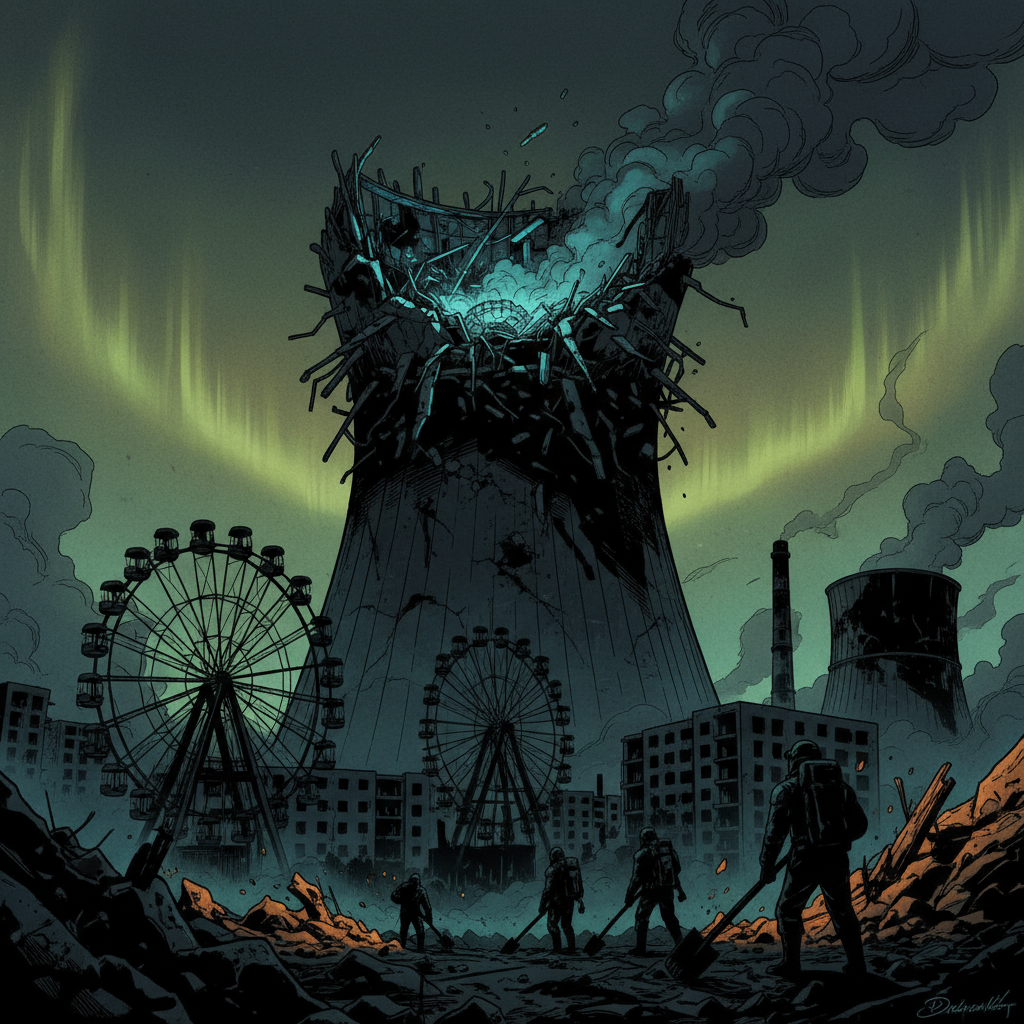
كارثة تشيرنوبيل
في 26 أبريل 1986، الساعة 01:23 صباحاً، انفجر المفاعل رقم 4 في محطة تشيرنوبيل للطاقة النووية في جمهورية أوكرانيا السوفيتية أثناء اختبار السلامة، مطلقاً مواد مشعة تفوق 400 مرة ما أطلقته قنبلة هيروشيما. أخفت السلطات السوفيتية الكارثة في البداية، مجبرةً 49,000 من سكان بريبيات على مواصلة حياتهم الطبيعية لمدة 36 ساعة قبل الإخلاء. تم نشر نحو 600,000 من 'المصفّين' لاحتواء الكارثة. تتراوح تقديرات الوفيات من 4,000 (منظمة الصحة العالمية) إلى 93,000 (غرينبيس). حطمت الكارثة أسطورة التفوق التكنولوجي السوفيتي وأجبرت غورباتشوف على الغلاسنوست.
الملخص التنفيذي
تتقارب سبع عدسات تحليلية حول نتيجة مركزية: كانت كارثة تشيرنوبيل كارثة مزدوجة — فشل تقني متجذر في تسويات تصميم المفاعل، تفاقم بفشل مؤسسي حيث أعطى كل مستوى في النظام السوفيتي الأولوية للحفاظ على الذات على حساب سلامة البشر. تتفق العدسات السبع: كان الفشل المؤسسي كارثياً بقدر الفشل التقني، وربما أكثر قابلية للمنع.
الحقائق الرئيسية
حقائق موثقة من بحث متعدد المصادر، مصنفة حسب مستوى الثقة
At 01:23 AM on April 26, 1986, Reactor No. 4 at the Chernobyl Nuclear Power Plant exploded during a turbine rundown safety test.
ثقة highThe RBMK-1000 reactor design had a known positive void coefficient of reactivity, meaning loss of coolant water increased reactivity. This was accepted as a trade-off for dual-use capability and cost savings.
ثقة highDeputy chief engineer Anatoly Dyatlov pressured operators to continue the test despite dangerously low power levels (~200 MW vs. planned 700-1000 MW). Operators disabled the ECCS and overrode automatic shutdown signals.
ثقة highPripyat (population 49,000), 3 km from the reactor, was not evacuated until 36 hours after the explosion. Children played outdoors, weddings were held, and residents observed the fire from the 'Bridge of Death.'
ثقة highSwedish radiation monitoring stations at Forsmark detected elevated levels on April 28, forcing Soviet acknowledgment. The Soviets initially blamed a 'minor accident.'
ثقة highApproximately 600,000 liquidators were deployed between 1986 and 1990. 'Bio-robots' on the roof worked in 90-second shifts, each receiving a near-lifetime dose.
ثقة highOf 134 plant workers and firefighters diagnosed with acute radiation syndrome, 28 died within months. Their deaths were documented in clinical detail.
ثقة highالفاعلون الرئيسيون
الفاعلون الرئيسيون المشاركون في هذا الحدث مع أفعالهم ومصالحهم المعلنة
Anatoly Dyatlov
individual- ›Supervised the safety test
- ›Pressured operators to continue at low power
- ›Ordered disabled safety systems
Mikhail Gorbachev
individual- ›Delayed public acknowledgment 18 days
- ›Blamed Western media
- ›Used Chernobyl to accelerate glasnost
Valery Legasov
individual- ›Led scientific investigation
- ›Presented Soviet narrative to IAEA
- ›Recorded truth-telling tapes
Liquidators
group- ›Built sarcophagus
- ›Cleared radioactive graphite from roof
- ›Decontaminated surrounding areas
البحث والمصادر
الجدول الزمني للحدث
1954-06-27 to 1991-12-26
التحليل السببي
رسم بياني تفاعلي يوضح كيف ترتبط السياسات والفاعلون والأحداث سببيًا — انقر على العقد لاستكشاف العلاقات
الشبكة السببية
18 عقدة · 19 اتصال
اختر عقدة
انقر على أي عقدة في الرسم البياني لاستكشاف اتصالاتها ومنظورات العدسات
الأسباب الجذرية
3المسار الحرج
8 خطواتتحليلات العدسات
تقدم كل عدسة إطارًا تحليليًا فريدًا — انقر للتوسيع والاطلاع على التحليل المعمّق
نظرية الألعاب
Western Moderngame-theoryChernobyl was not a failure of rationality but a masterclass in how rational individual decisions within a pathological institutional structure produce collectively catastrophic outcomes. The system's information architecture was the root cause: by classifying safety data, punishing dissent, and rewarding concealment, the system guaranteed that each actor's rational choice would aggregate into civilizational disaster. The 'peaceful atom' ideology functioned as a corrupted focal point coordinating the entire system toward catastrophe. A system that makes honesty irrational will produce dishonesty at scale, and a nuclear power program built on institutional dishonesty will eventually produce Chernobyl.
ماكيافيلي
Greco-Roman & ClassicalmachiavelliChernobyl is a perfect Machiavellian case study in institutional self-preservation becoming self-destruction. The Soviet system followed the classic playbook: conceal weakness, project strength, control information, blame subordinates. This works for political competition between elites. It fails catastrophically for governing complex technical systems where accurate information is a safety prerequisite. Nuclear reactors do not respond to political narratives — they respond to physics. When the Soviet system treated safety information as a political resource rather than a physical reality, it created conditions for an accident that physics, not politics, would determine. Gorbachev's subsequent use of Chernobyl to accelerate glasnost was genuinely Machiavellian: converting catastrophic weakness into reform leverage. But glasnost could not be confined to nuclear safety.
وكالة المخابرات المركزية
Western InstitutionalciaChernobyl's intelligence significance lies not in the reactor failure but in what it revealed about Soviet decision-making under crisis. The disaster stress-tested the Soviet information architecture and it failed comprehensively: upward reporting filtered bad news, lateral communication was impeded by classification, downward communication prioritized messaging over safety, international communication was dishonest until forced. The pattern — institutional mendacity as structural feature — became a key lens for assessing authoritarian fragility. The insight that information-controlled systems are brittle rather than resilient remains one of the most durable Cold War intelligence lessons.
بافلوف
Western ModernpavlovChernobyl demonstrates that institutional conditioning is a safety-critical infrastructure vulnerability. Decades of conditioning — obedience, news suppression, trust in official narratives, punishment of dissent — created patterns individually adaptive (kept people employed) but collectively catastrophic (prevented detection of and response to existential threats). The disaster was caused not by a few bad decisions on April 26 but by forty years of conditioning that made those decisions inevitable. When you condition operators to obey authority over instruments, managers to filter reality, officials to prioritize narrative over facts, and citizens to trust silence as safety — you create an anti-safety culture where every reflex moves toward catastrophe.
الأثر المدني
civilian-impactChernobyl's civilian impact reveals a disaster on geological timescales: centuries of contamination, generational health consequences, and psychological wounds transmitted through families. The contested death toll is ongoing harm: when official count is 31 and the range extends to 93,000, communities exist in unresolved grief. The most important lesson: the institutional failure caused as much damage as the explosion. Without the 36-hour delay, the thyroid cancer epidemic would have been significantly reduced. Without the May Day parade, Kyiv's children would not have marched through fallout. The civilian toll is a consequence not merely of the explosion but of every subsequent institutional decision that prioritized image over human life.
الطاوية
East AsiantaoismChernobyl is the Tao's answer to the 'peaceful atom.' The Taoist reading reveals a disaster driven by fundamental violation of the principle that nature cannot be conquered, only cooperated with. The Soviet system forced the atom, forced secrecy, forced obedience, forced ignorance, forced fiction. At every point, forcing produced its opposite. The Exclusion Zone — where nature flourishes in humanity's absence — is the most eloquent Taoist commentary. The wolves of Chernobyl embody the Tao Te Ching: 'the Tao nourishes all things.' The deepest lesson: systems that deny uncertainty will be destroyed by it.
نيتشه
Western ModernnietzscheChernobyl is the story of a will to power that confused institutional dominance with genuine mastery. The Soviet system had power to classify, conceal, command, and coerce — but not to control nuclear fission when the reactor exceeded institutional narrative. The liquidators embody Nietzsche's central question: what distinguishes authentic heroism from coerced sacrifice? The Soviet system, by making genuine choice impossible, destroyed the conditions that make heroism meaningful — then claimed the sacrifice as institutional virtue. Legasov's arc is the most purely Nietzschean story: beginning in slave morality, recognizing institutional values as lies, destroying himself in self-overcoming that affirmed individual truth. The Soviet response — blaming individuals, concealing flaws, claiming liquidator sacrifice as institutional virtue — was slave morality: inverting truth and power, making institutional survival the highest value. Chernobyl shattered that inversion at a cost measured in human lives.
التقاربات
حيث تصل عدسات متعددة إلى استنتاجات متشابهة — مما يشير إلى المتانة
Institutional mendacity as root cause
All four identify Soviet information architecture — classification, punishment of dissent, rewarding optimism — as the fundamental cause transforming technical failure into civilizational catastrophe.
The coverup caused more harm than the explosion
36-hour evacuation delay, Kyiv May Day, continued milk distribution all caused measurable additional harm. The thyroid cancer epidemic was largely preventable with timely response.
Hubris and limits of institutional control
All four converge on the insight that Soviet confidence in its own control was the precondition for losing control catastrophically.
التوترات المثمرة
حيث تختلف العدسات — كاشفةً عن تعقيد يستحق الفحص
مستقبلات محتملة
سيناريوهات مستمدة من تحليلات العدسات — ما قد يتكشف بناءً على أطر مختلفة
Nuclear renaissance with institutional learning
Moderate. Institutional learning genuine but incomplete. Climate pressures make expansion likely.
Another major nuclear accident exposing institutional failure
Low but non-negligible per decade.
الأسئلة الرئيسية
أسئلة تظل مفتوحة بعد التحليل — للبحث المستمر
- ?What is the true death toll? Will advances in epidemiology resolve the 4,000-93,000 range?
- ?How many liquidators developed radiation-related conditions and were denied recognition?
- ?What was the full chain of command in the first 72 hours?
تفاصيل تدقيق الحقائق
نتائج تدقيق الحقائق
verifiedملاحظات فوقية
All seven share a bias toward explanation. What all miss is the irreducibly incomprehensible dimension: ARS as documented by Alexievich, the three-day lie's cruelty, children's thyroid cancers. Some dimensions of Chernobyl resist comprehension and should resist it.
The relationship between technical and institutional failure is irreducibly complex: they are co-produced effects of the same Soviet institutional culture. Separating them is analytically useful but ultimately misrepresents a disaster in which technology and institutions were inseparable.
The contested death toll — 31 to 93,000 — is a permanent reminder of irreducible uncertainty. Any analysis claiming certainty is less honest than one acknowledging the range.
اعثر على منظورك
تتوافق أطر مختلفة مع قراء مختلفين — اعثر على نقطة دخولك
Readers drawn to structural explanations and institutional design. You see Chernobyl as fixable through better incentive structures.
The Soviet information architecture was the root cause. Information-controlled systems are brittle, not strong.
Readers drawn to questions about hubris, nature's limits, and moral weight of choices. Chernobyl as parable about humanity's relationship with uncontrollable forces.
The 'peaceful atom' embodied a fundamental misunderstanding: institutional will cannot master natural forces through political commitment.
Readers focused on how organizations function and how institutional cultures shape behavior. Chernobyl as case study in institutional pathology.
Behavioral conditioning and power dynamics made every actor behave rationally within their context while producing collective catastrophe.
Readers prioritizing human experience over analytical frameworks. Skeptical that any lens captures the horror of radiation sickness or the injustice of the contested death toll.
All frameworks risk abstracting away individual suffering. The thyroid cancer in a child's throat exceeds what any theory contains.
If in the analytical cluster, read civilian-impact to ground structural understanding in human experience. If intuitive, game-theory shows how 'hubris' operated through fixable mechanisms. If institutional, Nietzsche reminds that individual choices cannot be fully explained by conditioning. All readers: engage with the liquidator heroism/victimization tension without resolving it prematurely.
تحليلات ذات صلة
أحداث أخرى حُللت من خلال عدسات أو فئات مشابهة
كان الربيع العربي موجة ثورية من الاحتجاجات والانتفاضات والتمردات المسلحة التي اجتاحت العالم العربي ابتداءً من ديسمبر 2010. أشعلها إحراق البائع المتجول التونسي محمد البوعزيزي لنفسه في 17 ديسمبر 2010 — في فعل يأس ضد عقود من الفساد الاستبدادي والإذلال وبطالة الشباب — وانتشرت الحركة بسرعة مذهلة عبر شمال أفريقيا والشرق الأوسط. تردد الهتاف المعرِّف "الشعب يريد إسقاط النظام" من تونس إلى القاهرة إلى بنغازي إلى دمشق. فرّ بن علي في تونس بعد 23 عاماً (14 يناير 2011)؛ وسقط مبارك في مصر بعد 30 عاماً في 18 يوماً فقط (11 فبراير 2011)؛ وأُطيح بالقذافي في ليبيا وقُتل بعد تدخل حلف الناتو (أكتوبر 2011)؛ واختار الأسد في سوريا القمع الوحشي مشعلاً حرباً أهلية قتلت أكثر من 500,000 وشردت 13 مليوناً. أثبت اختيار الجيش — الانحياز للمتظاهرين أو البقاء موالياً للنظام — أنه المتغير الحاسم في كل بلد. ضخّمت بثوث الجزيرة الفضائية ووسائل التواصل الاجتماعي العدوى، لكن الأسباب الكامنة كانت بنيوية: عقود من الركود والفساد والإذلال لجيل كامل بلا آفاق اقتصادية. وصفت وسائل الإعلام الغربية هذا بأنه صحوة ديمقراطية؛ وصاغته الممالك الخليجية كزعزعة استقرار مدعومة من الخارج؛ ووصفته الأنظمة الاستبدادية بتسلل إرهابي؛ أما المشاركون فسموه ثورة الكرامة. بعد عقد، لم تحقق سوى تونس انتقالاً ديمقراطياً. عادت مصر إلى الحكم العسكري. انهارت ليبيا كدولة فاشلة. وأصبحت سوريا أسوأ كارثة إنسانية في القرن، فولّدت داعش وأطلقت أزمة اللاجئين الأوروبية. يظل الربيع العربي أكثر الأحداث الجيوسياسية تأثيراً في عقد 2010 — قصة شجاعة استثنائية ونتائج مأساوية والسؤال الدائم: هل تستطيع الثورة تحقيق الكرامة التي تَعِد بها؟
بين 6 أبريل ب18 يوليو 1994، قُتل ما يقرب من 800,000 من التوتسي والهوتو المعتدلين بشكل ممنهج في رواندا خلال 100 يوم — أكثر عمليات القتل الجماعي كفاءة في التاريخ الحديث. لم تكن الإبادة الجماعية انفجاراً لـ«عداوات قبلية قديمة» بل كانت ذروة مشروع استعماري: صنع الإداريون البلجيكيون فئات عرقية جامدة من هويات اجتماعية مرنة من خلال تعداد 1933 وبطاقات الهوية العرقية الإلزامية. اختار نظام هابياريمانا ودائرته الداخلية akazu الإبادة الجماعية كاستراتيجية للبقاء السياسي. قامت إذاعة RTLM — «راديو الماشيتي» — بتكييف السكان بشكل ممنهج من خلال سنوات من الدعاية المهينة، واصفة التوتسي بـ«inyenzi» (الصراصير). تم اغتصاب ما بين 250,000 و500,000 امرأة كسلاح متعمد للإبادة الجماعية. فشل المجتمع الدولي لم يكن سلبياً بل إيجابياً: أرسل دالير تحذيره قبل ثلاثة أشهر، وطلب 5,000 جندي، ورُفض. خفض مجلس الأمن UNAMIR من 2,500 إلى 270 جندياً أثناء الإبادة. أنهى انتصار الجبهة الوطنية الرواندية الإبادة في يوليو 1994، لكن التداعيات امتدت إلى حرب الكونغو الأولى (1996-97) و«حرب أفريقيا العالمية» التي قتلت أكثر من 5 ملايين شخص.
في الثاني والعشرين من نوفمبر عام 1963، اغتيل الرئيس John F. Kennedy في Dealey Plaza بمدينة Dallas، تكساس. وقد اعتُقل Lee Harvey Oswald إلا أنه قُتل على يد Jack Ruby قبل محاكمته. خلصت Warren Commission إلى أن Oswald تصرّف منفرداً، في حين توصّلت HSCA لاحقاً إلى وجود مؤامرة محتملة. وتكشف الوثائق التي رُفعت عنها السرية حتى عام 2025 عن عمليات تغطية مؤسسية قامت بها CIA وFBI، مما يجعل هذه الجريمة أعمق قضية عصيّة على الحل في التاريخ الأمريكي.
كيف تم تحليل هذا
شفافية كاملة حول عملية التحليل والأدوات والقيود
Crosslight Engine
v0.4.0 "Global Lens Expansion"- ⚠Non-Western philosophical lenses rely on translated primary texts — nuance may be lost in translation
- ⚠Some traditions (e.g., Maat, Ubuntu) have limited surviving primary texts; analysis draws on scholarly reconstruction
- ⚠Cross-cultural lens application is inherently interpretive — a Confucian reading of a Western event is an analytical exercise, not a claim of cultural authority
إحصائيات التحليل
المنهجية
أُنتج هذا التحليل بواسطة خط أنابيب Crosslight متعدد الوكلاء: وكيل بحث جمع وتحقق من الحقائق من مصادر متعددة، ووكلاء عدسات متخصصون طبّقوا أطرًا تحليلية متميزة، ووكيل تركيب دمج الرؤى وحدد الأنماط، ووكيل تدقيق حقائق تحقق من الادعاءات. كل منظور عدسة هو تفسير الذكاء الاصطناعي — وليس تأييدًا مؤسسيًا.اعرف المزيد →