
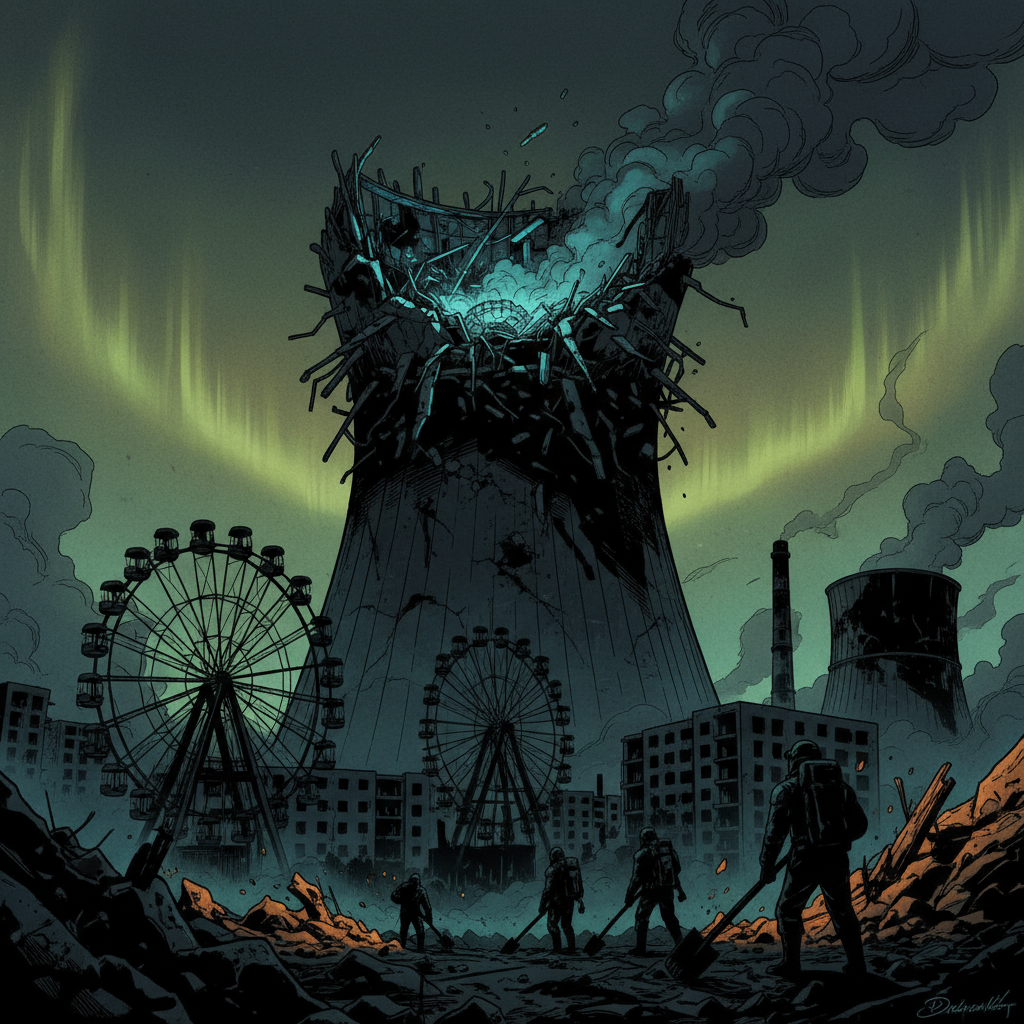
Die Katastrophe von Tschernobyl
Am 26. April 1986 um 01:23 Uhr explodierte Reaktor Nr. 4 des Kernkraftwerks Tschernobyl in der Ukrainischen SSR während eines Sicherheitstests und setzte 400-mal mehr radioaktives Material frei als die Hiroshima-Bombe. Die sowjetischen Behörden verheimlichten die Katastrophe zunächst und zwangen die 49.000 Einwohner von Prypjat, 36 Stunden lang ihr normales Leben fortzusetzen. Etwa 600.000 Liquidatoren wurden zum Einsatz gebracht. Die geschätzte Todeszahl reicht von 4.000 (WHO) bis 93.000 (Greenpeace). Die Katastrophe zerstörte den Mythos der sowjetischen technologischen Überlegenheit und trieb Gorbatschow zur Glasnost — und war nach seiner eigenen Einschätzung «vielleicht die wahre Ursache für den Zusammenbruch der Sowjetunion».
Zusammenfassung
Sieben analytische Perspektiven konvergieren in einem zentralen Befund: Die Katastrophe von Tschernobyl war eine doppelte Katastrophe — ein technisches Versagen, verwurzelt in Reaktordesign-Kompromissen, verstärkt durch institutionelles Versagen, bei dem jede Ebene des sowjetischen Systems Selbsterhaltung über Menschensicherheit stellte. Alle sieben Perspektiven stimmen überein: Das institutionelle Versagen war ebenso katastrophal wie das technische — und wohl vermeidbarer.
Wichtige Fakten
Verifizierte Fakten aus Mehrquellen-Recherche, bewertet nach Konfidenzgrad
At 01:23 AM on April 26, 1986, Reactor No. 4 at the Chernobyl Nuclear Power Plant exploded during a turbine rundown safety test.
high KonfidenzThe RBMK-1000 reactor design had a known positive void coefficient of reactivity, meaning loss of coolant water increased reactivity. This was accepted as a trade-off for dual-use capability and cost savings.
high KonfidenzDeputy chief engineer Anatoly Dyatlov pressured operators to continue the test despite dangerously low power levels (~200 MW vs. planned 700-1000 MW). Operators disabled the ECCS and overrode automatic shutdown signals.
high KonfidenzPripyat (population 49,000), 3 km from the reactor, was not evacuated until 36 hours after the explosion. Children played outdoors, weddings were held, and residents observed the fire from the 'Bridge of Death.'
high KonfidenzSwedish radiation monitoring stations at Forsmark detected elevated levels on April 28, forcing Soviet acknowledgment. The Soviets initially blamed a 'minor accident.'
high KonfidenzApproximately 600,000 liquidators were deployed between 1986 and 1990. 'Bio-robots' on the roof worked in 90-second shifts, each receiving a near-lifetime dose.
high KonfidenzOf 134 plant workers and firefighters diagnosed with acute radiation syndrome, 28 died within months. Their deaths were documented in clinical detail.
high KonfidenzWichtige Akteure
Hauptakteure dieses Ereignisses mit ihren Handlungen und erklärten Interessen
Anatoly Dyatlov
individual- ›Supervised the safety test
- ›Pressured operators to continue at low power
- ›Ordered disabled safety systems
Mikhail Gorbachev
individual- ›Delayed public acknowledgment 18 days
- ›Blamed Western media
- ›Used Chernobyl to accelerate glasnost
Valery Legasov
individual- ›Led scientific investigation
- ›Presented Soviet narrative to IAEA
- ›Recorded truth-telling tapes
Liquidators
group- ›Built sarcophagus
- ›Cleared radioactive graphite from roof
- ›Decontaminated surrounding areas
Recherche & Quellen
Ereigniszeitlinie
1954-06-27 to 1991-12-26
Kausalanalyse
Interaktiver Graph, der zeigt, wie Richtlinien, Akteure und Ereignisse kausal zusammenhängen — klicken Sie auf Knoten, um Beziehungen zu erkunden
KAUSALES NETZWERK
18 Knoten · 19 Verbindungen
Knoten auswählen
Klicken Sie auf einen beliebigen Knoten im Graphen, um seine Verbindungen und Linsenperspektiven zu erkunden
Grundursachen
3Kritischer Pfad
8 SchritteLinsenanalysen
Jede Linse bietet einen einzigartigen analytischen Rahmen — klicken Sie zum Aufklappen für eine tiefgehende Analyse
Spieltheorie
Western Moderngame-theoryChernobyl was not a failure of rationality but a masterclass in how rational individual decisions within a pathological institutional structure produce collectively catastrophic outcomes. The system's information architecture was the root cause: by classifying safety data, punishing dissent, and rewarding concealment, the system guaranteed that each actor's rational choice would aggregate into civilizational disaster. The 'peaceful atom' ideology functioned as a corrupted focal point coordinating the entire system toward catastrophe. A system that makes honesty irrational will produce dishonesty at scale, and a nuclear power program built on institutional dishonesty will eventually produce Chernobyl.
Machiavelli
Greco-Roman & ClassicalmachiavelliChernobyl is a perfect Machiavellian case study in institutional self-preservation becoming self-destruction. The Soviet system followed the classic playbook: conceal weakness, project strength, control information, blame subordinates. This works for political competition between elites. It fails catastrophically for governing complex technical systems where accurate information is a safety prerequisite. Nuclear reactors do not respond to political narratives — they respond to physics. When the Soviet system treated safety information as a political resource rather than a physical reality, it created conditions for an accident that physics, not politics, would determine. Gorbachev's subsequent use of Chernobyl to accelerate glasnost was genuinely Machiavellian: converting catastrophic weakness into reform leverage. But glasnost could not be confined to nuclear safety.
CIA
Western InstitutionalciaChernobyl's intelligence significance lies not in the reactor failure but in what it revealed about Soviet decision-making under crisis. The disaster stress-tested the Soviet information architecture and it failed comprehensively: upward reporting filtered bad news, lateral communication was impeded by classification, downward communication prioritized messaging over safety, international communication was dishonest until forced. The pattern — institutional mendacity as structural feature — became a key lens for assessing authoritarian fragility. The insight that information-controlled systems are brittle rather than resilient remains one of the most durable Cold War intelligence lessons.
Pawlow
Western ModernpavlovChernobyl demonstrates that institutional conditioning is a safety-critical infrastructure vulnerability. Decades of conditioning — obedience, news suppression, trust in official narratives, punishment of dissent — created patterns individually adaptive (kept people employed) but collectively catastrophic (prevented detection of and response to existential threats). The disaster was caused not by a few bad decisions on April 26 but by forty years of conditioning that made those decisions inevitable. When you condition operators to obey authority over instruments, managers to filter reality, officials to prioritize narrative over facts, and citizens to trust silence as safety — you create an anti-safety culture where every reflex moves toward catastrophe.
Zivile Auswirkungen
civilian-impactChernobyl's civilian impact reveals a disaster on geological timescales: centuries of contamination, generational health consequences, and psychological wounds transmitted through families. The contested death toll is ongoing harm: when official count is 31 and the range extends to 93,000, communities exist in unresolved grief. The most important lesson: the institutional failure caused as much damage as the explosion. Without the 36-hour delay, the thyroid cancer epidemic would have been significantly reduced. Without the May Day parade, Kyiv's children would not have marched through fallout. The civilian toll is a consequence not merely of the explosion but of every subsequent institutional decision that prioritized image over human life.
Taoismus
East AsiantaoismChernobyl is the Tao's answer to the 'peaceful atom.' The Taoist reading reveals a disaster driven by fundamental violation of the principle that nature cannot be conquered, only cooperated with. The Soviet system forced the atom, forced secrecy, forced obedience, forced ignorance, forced fiction. At every point, forcing produced its opposite. The Exclusion Zone — where nature flourishes in humanity's absence — is the most eloquent Taoist commentary. The wolves of Chernobyl embody the Tao Te Ching: 'the Tao nourishes all things.' The deepest lesson: systems that deny uncertainty will be destroyed by it.
Nietzsche
Western ModernnietzscheChernobyl is the story of a will to power that confused institutional dominance with genuine mastery. The Soviet system had power to classify, conceal, command, and coerce — but not to control nuclear fission when the reactor exceeded institutional narrative. The liquidators embody Nietzsche's central question: what distinguishes authentic heroism from coerced sacrifice? The Soviet system, by making genuine choice impossible, destroyed the conditions that make heroism meaningful — then claimed the sacrifice as institutional virtue. Legasov's arc is the most purely Nietzschean story: beginning in slave morality, recognizing institutional values as lies, destroying himself in self-overcoming that affirmed individual truth. The Soviet response — blaming individuals, concealing flaws, claiming liquidator sacrifice as institutional virtue — was slave morality: inverting truth and power, making institutional survival the highest value. Chernobyl shattered that inversion at a cost measured in human lives.
Konvergenzen
Wo mehrere Linsen zu ähnlichen Schlussfolgerungen gelangen — was auf Robustheit hindeutet
Institutional mendacity as root cause
All four identify Soviet information architecture — classification, punishment of dissent, rewarding optimism — as the fundamental cause transforming technical failure into civilizational catastrophe.
The coverup caused more harm than the explosion
36-hour evacuation delay, Kyiv May Day, continued milk distribution all caused measurable additional harm. The thyroid cancer epidemic was largely preventable with timely response.
Hubris and limits of institutional control
All four converge on the insight that Soviet confidence in its own control was the precondition for losing control catastrophically.
Produktive Spannungen
Wo Linsen nicht übereinstimmen — und Komplexität offenbaren, die es zu untersuchen lohnt
Mögliche Zukünfte
Szenarien, die aus Linsenanalysen abgeleitet wurden — was sich auf Basis verschiedener Rahmen entfalten könnte
Nuclear renaissance with institutional learning
Moderate. Institutional learning genuine but incomplete. Climate pressures make expansion likely.
Another major nuclear accident exposing institutional failure
Low but non-negligible per decade.
Schlüsselfragen
Fragen, die nach der Analyse offen bleiben — für weitere Untersuchungen
- ?What is the true death toll? Will advances in epidemiology resolve the 4,000-93,000 range?
- ?How many liquidators developed radiation-related conditions and were denied recognition?
- ?What was the full chain of command in the first 72 hours?
Details der Faktenprüfung
Ergebnisse der Faktenprüfung
verifiedMeta-Beobachtungen
All seven share a bias toward explanation. What all miss is the irreducibly incomprehensible dimension: ARS as documented by Alexievich, the three-day lie's cruelty, children's thyroid cancers. Some dimensions of Chernobyl resist comprehension and should resist it.
The relationship between technical and institutional failure is irreducibly complex: they are co-produced effects of the same Soviet institutional culture. Separating them is analytically useful but ultimately misrepresents a disaster in which technology and institutions were inseparable.
The contested death toll — 31 to 93,000 — is a permanent reminder of irreducible uncertainty. Any analysis claiming certainty is less honest than one acknowledging the range.
Ihre Perspektive finden
Verschiedene Rahmen sprechen unterschiedliche Leser an — finden Sie Ihren Einstiegspunkt
Readers drawn to structural explanations and institutional design. You see Chernobyl as fixable through better incentive structures.
The Soviet information architecture was the root cause. Information-controlled systems are brittle, not strong.
Readers drawn to questions about hubris, nature's limits, and moral weight of choices. Chernobyl as parable about humanity's relationship with uncontrollable forces.
The 'peaceful atom' embodied a fundamental misunderstanding: institutional will cannot master natural forces through political commitment.
Readers focused on how organizations function and how institutional cultures shape behavior. Chernobyl as case study in institutional pathology.
Behavioral conditioning and power dynamics made every actor behave rationally within their context while producing collective catastrophe.
Readers prioritizing human experience over analytical frameworks. Skeptical that any lens captures the horror of radiation sickness or the injustice of the contested death toll.
All frameworks risk abstracting away individual suffering. The thyroid cancer in a child's throat exceeds what any theory contains.
If in the analytical cluster, read civilian-impact to ground structural understanding in human experience. If intuitive, game-theory shows how 'hubris' operated through fixable mechanisms. If institutional, Nietzsche reminds that individual choices cannot be fully explained by conditioning. All readers: engage with the liquidator heroism/victimization tension without resolving it prematurely.
Verwandte Analysen
Andere Ereignisse, die durch ähnliche Linsen oder Kategorien analysiert wurden
Der Arabische Frühling war eine revolutionäre Welle von Protesten, Aufständen und bewaffneten Rebellionen, die ab Dezember 2010 über die arabische Welt hinwegfegte. Ausgelöst durch die Selbstverbrennung des tunesischen Straßenverkäufers Mohamed Bouazizi am 17. Dezember 2010 — ein Akt der Verzweiflung gegen Jahrzehnte autoritärer Korruption, Demütigung und Jugendarbeitslosigkeit — breitete sich die Bewegung mit atemberaubender Geschwindigkeit über Nordafrika und den Nahen Osten aus. Der prägende Sprechchor „الشعب يريد إسقاط النظام“ (Das Volk will den Sturz des Regimes) hallte von Tunis bis Kairo, von Bengasi bis Damaskus. Tunesiens Ben Ali floh nach 23 Jahren (14. Januar 2011); Ägyptens Mubarak fiel nach 30 Jahren in nur 18 Tagen (11. Februar 2011); Libyens Gaddafi wurde nach einer NATO-Intervention gestürzt und getötet (Oktober 2011); Syriens Assad wählte brutale Unterdrückung und entfachte einen Bürgerkrieg, der über 500.000 Menschen tötete und 13 Millionen vertrieb. Die Entscheidung des Militärs — sich auf die Seite der Demonstranten zu stellen oder dem Regime treu zu bleiben — erwies sich in jedem Land als entscheidende Variable.
Zwischen dem 6. April und dem 18. Juli 1994 wurden in Ruanda innerhalb von 100 Tagen systematisch etwa 800.000 Tutsi und gemäßigte Hutu ermordet — das effizienteste Massentöten der modernen Geschichte mit einer höheren täglichen Todesrate als der Holocaust. Der Völkermord war nicht der Ausbruch „alter Stammeskonflikte“, sondern der Höhepunkt eines Kolonialprojekts: Belgische Verwalter hatten durch die Volkszählung von 1933 und obligatorische ethnische Ausweise starre Rassenkategorien aus fließenden sozialen Identitäten geschaffen und die Hutu-Tutsi-Spaltung erzeugt, die politische Eliten später als Waffe einsetzten. Das Habyarimana-Regime und sein innerer Kreis der akazu (kleines Haus) wählten angesichts des militärischen Drucks der Ruandischen Patriotischen Front und der Machtteilungsforderungen der Arusha-Abkommen den Völkermord als politische Überlebensstrategie. RTLM-Radio — „Radio Machete“ — konditionierte die Bevölkerung systematisch durch jahrelange entmenschlichende Propaganda, nannte Tutsi „inyenzi“ (Kakerlaken) und sendete während des Völkermordes explizite Tötungsbefehle und Standorte der Opfer. Zwischen 250.000 und 500.000 Frauen wurden als vorsätzliche Waffe des Völkermordes vergewaltigt. Das Versagen der internationalen Gemeinschaft war nicht passiv, sondern aktiv: UNAMIR-Kommandeur Dallaire sandte seinen „Völkermord-Fax“ drei Monate vor Beginn der Morde, forderte 5.000 Soldaten und wurde abgewiesen. Der UN-Sicherheitsrat reduzierte UNAMIR von 2.500 auf 270 Soldaten während des Völkermordes. Der militärische Sieg der RPF beendete den Völkermord im Juli 1994, doch die Folgen kaskadieren in den Ersten Kongokrieg (1996-97) und „Afrikas Weltkrieg“ mit über 5 Millionen Toten.
Am 22. November 1963 wurde Präsident John F. Kennedy auf dem Dealey Plaza in Dallas, Texas, ermordet. Lee Harvey Oswald wurde verhaftet, aber noch vor seinem Prozess von Jack Ruby getötet. Die Warren-Kommission kam zu dem Schluss, dass Oswald allein gehandelt habe, während das HSCA später eine wahrscheinliche Verschwörung feststellte. Freigegebene Dokumente bis 2025 enthüllen institutionelle Vertuschungen durch die CIA und das FBI und machen den Fall zum folgenreichsten ungelösten Fall der amerikanischen Geschichte.
Wie dies analysiert wurde
Vollständige Transparenz über den Analyseprozess, die verwendeten Werkzeuge und die Einschränkungen
Crosslight Engine
v0.4.0 "Global Lens Expansion"- ⚠Non-Western philosophical lenses rely on translated primary texts — nuance may be lost in translation
- ⚠Some traditions (e.g., Maat, Ubuntu) have limited surviving primary texts; analysis draws on scholarly reconstruction
- ⚠Cross-cultural lens application is inherently interpretive — a Confucian reading of a Western event is an analytical exercise, not a claim of cultural authority
Analysestatistiken
Methodik
Diese Analyse wurde von der Crosslight-Multi-Agenten-Pipeline erstellt: Ein Rechercheagent sammelte und verifizierte Fakten aus mehreren Quellen, spezialisierte Linsenagenten wendeten verschiedene analytische Rahmen an, ein Syntheseagent integrierte Erkenntnisse und identifizierte Muster, und ein Faktenprüfungsagent überprüfte Behauptungen. Jede Linsenperspektive ist die KI-Interpretation — keine institutionelle Empfehlung.Mehr erfahren →