
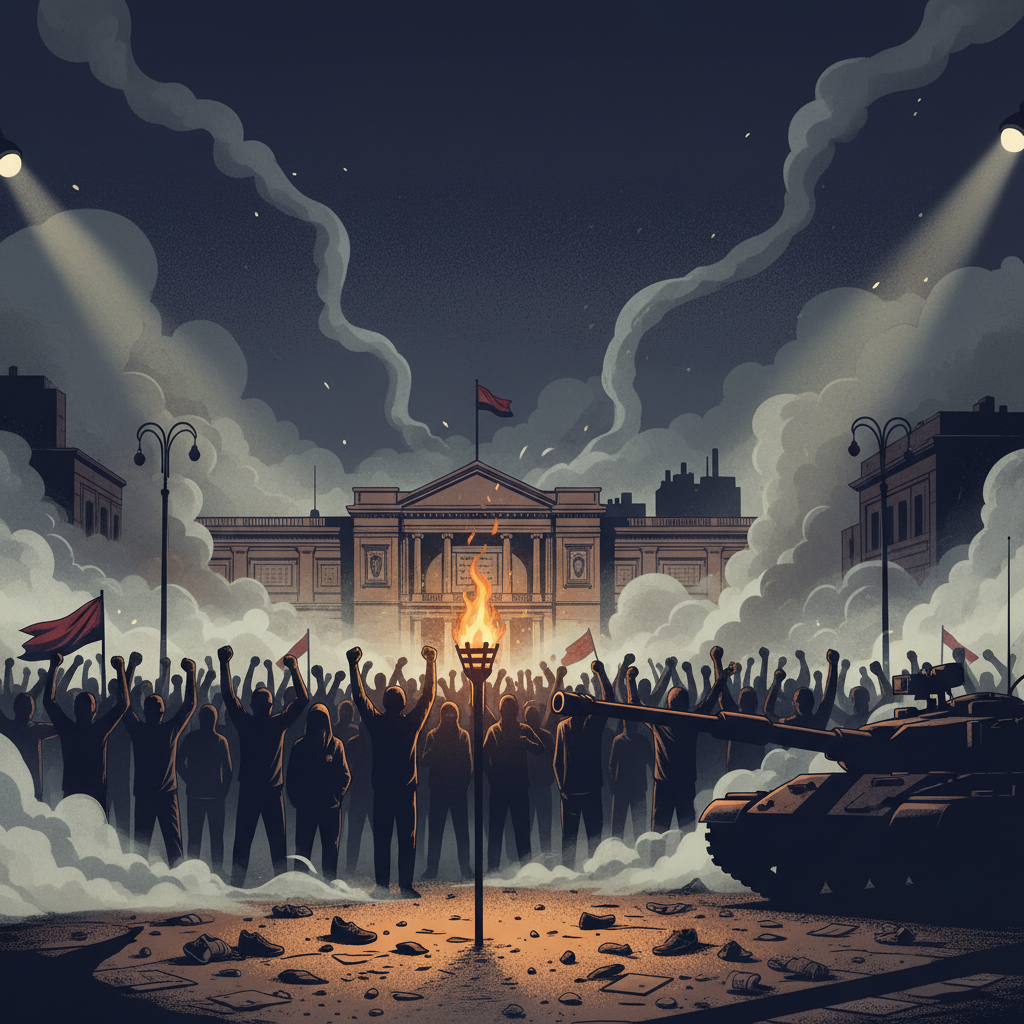
Primavera Árabe 2011
La Primavera Árabe fue una ola revolucionaria de protestas, levantamientos y rebeliones armadas que barrió el mundo árabe a partir de diciembre de 2010. Desencadenada por la autoinmolación del vendedor ambulante tunecino Mohamed Bouazizi el 17 de diciembre de 2010 — un acto de desesperación contra décadas de corrupción autoritaria, humillación y desempleo juvenil — el movimiento se extendió con velocidad vertiginosa por el norte de África y Oriente Medio. El cántico definitorio "الشعب يريد إسقاط النظام" (El pueblo quiere la caída del régimen) resonó de Túnez a El Cairo, de Bengasi a Damasco. La elección del ejército — ponerse del lado de los manifestantes o permanecer leal al régimen — resultó ser la variable decisiva en cada país.
Resumen Ejecutivo
Siete perspectivas analíticas convergen en un hallazgo central: la Primavera Árabe fue la erupción inevitable de décadas de aspiraciones humanas reprimidas, pero sus resultados fueron determinados no por las aspiraciones de millones sino por los cálculos institucionales de las élites militares y las intervenciones estratégicas de potencias externas.
Hechos Clave
Hechos verificados de investigacion multifuente, puntuados por nivel de confianza
Mohamed Bouazizi, a 26-year-old street vendor in Sidi Bouzid, Tunisia, set himself on fire on December 17, 2010, after his produce cart was confiscated and he was humiliated by a municipal official. He died of his injuries on January 4, 2011.
Confianza highTunisian President Zine El Abidine Ben Ali fled to Saudi Arabia on January 14, 2011, ending his 23-year rule. Tunisia's military refused to fire on protesters.
Confianza highMass protests began in Egypt on January 25, 2011 (the 'Day of Rage'), centering on Tahrir Square in Cairo. President Hosni Mubarak resigned on February 11, 2011, after 30 years in power.
Confianza highEgypt's Supreme Council of the Armed Forces (SCAF) sided with protesters and forced Mubarak's resignation, protecting the military's extensive economic and institutional interests.
Confianza highMohamed Morsi of the Muslim Brotherhood won Egypt's first free presidential election in June 2012. He was removed by a military coup led by General Abdel Fattah al-Sisi on July 3, 2013.
Confianza highProtests against Muammar Gaddafi began in Benghazi, Libya on February 15, 2011. UN Security Council Resolution 1973 authorized a no-fly zone. NATO intervened militarily beginning March 19, 2011. Gaddafi was captured and killed on October 20, 2011.
Confianza highAnti-government protests began in Daraa, Syria in mid-March 2011 after schoolchildren were detained for anti-regime graffiti. The Assad regime responded with military force, escalating into civil war.
Confianza highActores Clave
Actores principales involucrados en este evento con sus acciones e intereses declarados
Mohamed Bouazizi
individual- ›Set himself on fire on December 17, 2010 in Sidi Bouzid, Tunisia
Hosni Mubarak
individual- ›Imposed curfew and deployed military to streets
- ›Shut down internet and mobile communications
- ›Resigned on February 11, 2011
Muammar Gaddafi
individual- ›Ordered military to suppress protests violently
- ›Threatened to 'cleanse Libya house by house'
- ›Fought NATO intervention until captured and killed
Bashar al-Assad
individual- ›Deployed military against civilian protesters
- ›Used barrel bombs and chemical weapons against civilian areas
- ›Relied on Iranian and Russian military support
Al Jazeera
organization- ›Provided 24/7 satellite coverage of Arab Spring protests across the region
- ›Amplified protest movements through pan-Arab broadcasts reaching millions
- ›Created a shared narrative space across Arab-speaking populations
Investigacion y Fuentes
Linea de Tiempo del Evento
2010-12-17 to 2015-09-01
Analisis Causal
Grafo interactivo que muestra como politicas, actores y eventos se conectan causalmente — haz clic en los nodos para explorar relaciones
RED CAUSAL
21 nodos · 18 conexiones
Selecciona un nodo
Haz clic en cualquier nodo del grafo para explorar sus conexiones y perspectivas de lentes
Causas Raiz
3Ruta Critica
9 pasosAnalisis por Lente
Cada lente proporciona un marco analitico unico — haz clic para expandir el analisis profundo
Teoría de Juegos
Western Moderngame-theoryThe Arab Spring was a massive multi-player sequential game where each country's outcome changed the information set for all other players. Tunisia's success solved the collective action problem by demonstrating that revolution was possible — but the game-theoretic insight is that the same initial shock (popular uprising) produced radically different outcomes depending on one variable: whether the military's institutional interests were better served by defecting from or remaining loyal to the regime. This is the 'military kingmaker' dynamic — not a bug in the revolutionary wave but the fundamental strategic variable that determined winners and losers.
Maquiavelo
Greco-Roman & ClassicalmachiavelliThe Arab Spring is a masterclass in Machiavellian power dynamics: it demonstrated that power built solely on fear collapses catastrophically when the fear barrier breaks. The military — not the people, not social media, not Western intervention — was the prince-maker in every country. Where the military calculated that its institutional interests were better served by sacrificing the ruler (Tunisia, Egypt), transitions were relatively peaceful. Where the military's survival was bound to the regime (Syria's Alawite officers, Bahrain's Sunni security forces), the result was either civil war or brutal suppression. The tragedy of the Arab Spring, in Machiavellian terms, is that destroying the old order proved far easier than building a new one. As Machiavelli warned: 'There is nothing more difficult to take in hand, more perilous to conduct, or more uncertain in its success, than to take the lead in the introduction of a new order of things.'
Evaluación de Inteligencia de la CIA
Western InstitutionalciaThe Arab Spring exposed the central paradox of US intelligence engagement in the Middle East: the very authoritarian relationships that provided counter-terrorism intelligence created the conditions for the revolutionary explosions that destroyed those relationships. The CIA's partnerships with Mubarak's GIS, Ben Ali's secret police, and Gaddafi's reformed intelligence services gave the US excellent visibility into specific terrorist networks but no understanding of the structural rage building across Arab societies. The intelligence failure was not in the collection but in the analytical framework — the inability to see that 'stable authoritarian allies' was a contradiction in terms, and that the suppressed frustrations of millions of young Arabs constituted a strategic threat greater than any specific terrorist organization.
Análisis de Condicionamiento Pavloviano
Western ModernpavlovThe Arab Spring demonstrates that authoritarian control based on conditioned fear is inherently fragile: it works perfectly until it doesn't, and when it fails, it fails catastrophically. Decades of conditioning created a population that appeared compliant but was actually a pressure cooker of suppressed frustration. Bouazizi's act served as the extinction trial that demonstrated the old contingency no longer held. Al Jazeera's broadcasts generalized this extinction across the Arab world. But conditioning theory also explains the tragedy: it is far easier to extinguish a fear response (stop obeying) than to condition new constructive behaviors (build democratic institutions). The Arab Spring succeeded as mass behavioral de-conditioning — the fear was broken — but failed as re-conditioning toward democratic habits, which require years of consistent reinforcement that the post-revolutionary environment could not provide.
Análisis Nietzscheano
Western ModernnietzscheThe Arab Spring was a revolt of dignity — ثورة الكرامة — and Nietzsche's philosophy provides the deepest reading of what dignity means in this context. It was not merely a demand for political rights but an existential assertion: the refusal to accept humiliation as the human condition. Bouazizi's act was the purest expression of will against a system that had crushed all will. The tragedy is Nietzsche's own warning: destruction of the old order is the easy part. The hard part — the creation of new values, the emergence of what Nietzsche would call higher types of human organizing — requires precisely the kind of patient, creative work that revolutionary energy cannot sustain. The Arab Spring proved that the will to power can topple any regime, but it cannot, by itself, build what comes next.
Análisis Taoísta
East AsiantaoismThe Arab Spring is the Tao's most powerful modern demonstration of the principle of reversal (反, fan): whatever reaches an extreme produces its opposite. Decades of authoritarian rigidity (extreme yang) produced explosive revolutionary energy (extreme yin). Regimes that gripped tighter fell faster — Gaddafi's 42 years of iron control shattered into state collapse; Assad's brutal suppression produced the century's worst humanitarian disaster. Regimes that bent survived — Morocco's limited reforms, Jordan's modest concessions. The Tao's deepest insight about the Arab Spring is this: the revolutionary wave moved not through strategic coordination but through the natural resonance of shared grievances, flowing like water through every crack in authoritarian structures. It could not be stopped because it was not being directed — it was the Tao itself, the natural flow of suppressed human aspiration finding expression. But the Tao also teaches that water, unconstrained, floods and destroys. The Arab Spring's devastation in Libya and Syria is water without banks — natural force without the channels needed to direct it constructively.
Evaluación del Impacto Civil
civilian-impactThe Arab Spring's civilian impact reveals the terrible disproportion between revolutionary aspiration and human cost. Millions of people demanded nothing more than dignity, economic opportunity, and an end to corruption — the most basic human aspirations. In Tunisia, these aspirations were achieved at relatively low cost. In Syria, the same aspirations produced the worst humanitarian catastrophe of the 21st century. The difference was not in what civilians wanted or how they protested, but in the structural variables they could not control: military loyalty, sectarian composition, external intervention, and the willingness of rulers to destroy their own countries rather than relinquish power. The most devastating finding of this analysis is that the people who suffered most — Syrian civilians — had the least agency in determining their fate. They were caught between a regime willing to use chemical weapons, an opposition that fragmented into rival militias, external powers pursuing strategic interests, and a jihadist movement (ISIS) that exploited the chaos. The Arab Spring's human cost is not a story of failed revolution — it is a story of civilians trapped in conflicts they did not choose, determined by forces they could not influence.
Convergencias
Donde multiples lentes llegan a conclusiones similares — sugiriendo robustez
Lealtad militar como variable decisiva
Las cuatro perspectivas identifican independientemente la elección institucional del ejército como el factor que determinó si las revoluciones tuvieron éxito pacíficamente, degeneraron en guerra civil o fueron aplastadas.
La estabilidad autoritaria es inherentemente frágil
La teoría de juegos muestra que los equilibrios basados en el miedo colapsan. Pavlov muestra que el miedo condicionado se extingue. El taoísmo muestra que los sistemas rígidos producen su propia inversión.
Destruir órdenes antiguos es más fácil que construir nuevos
Maquiavelo advirtió que establecer nuevos órdenes es la empresa política más difícil. Nietzsche identifica el problema del Ubermensch. El taoísmo ve el agua sin contención como destructiva.
Tensiones Productivas
Donde los lentes discrepan — revelando complejidad que merece examinarse
Futuros Posibles
Escenarios derivados de los analisis de lentes — lo que podria desarrollarse segun diferentes marcos
Second wave of Arab uprisings driven by unresolved structural grievances
Medium — the structural conditions remain, but the memory of Syria's catastrophe acts as a powerful deterrent
Authoritarian adaptation and tech-enabled control prevent future uprisings
Medium-high — authoritarian regimes have invested heavily in learning from the Arab Spring's failures
Tunisia's democratic path consolidates and gradually influences the region
Low — Tunisia's own democracy has faced setbacks since 2021 (Kais Saied's power concentration)
Preguntas Clave
Preguntas que permanecen abiertas despues del analisis — para investigacion continua
- ?What was the precise role of Gulf intelligence services in funding and directing various factions?
- ?To what extent did Al Jazeera's editorial decisions shape the direction of the Arab Spring?
- ?What were the internal deliberations within military high commands that determined their choices?
Detalles de Verificacion
Resultados de Verificacion
verifiedMeta Observaciones
All seven lenses are fundamentally retrospective — they analyze what happened and why, but none fully captures the lived experience of revolutionary hope before it turned to despair. The Arab Spring was, for millions of people, the most exhilarating experience of their lives — a moment of collective agency and shared purpose that cannot be reduced to strategic calculation, conditioning, or power dynamics. That hope, even though it was largely betrayed by outcomes, was real and transformative for those who experienced it.
The Arab Spring involves simultaneous causation at multiple scales — individual psychology (Bouazizi), institutional dynamics (military choices), regional contagion (media amplification), and global geopolitics (external intervention) — that cannot be adequately captured by any single analytical framework. The seven lenses together approach a more complete picture, but the full complexity of a revolutionary wave affecting 300+ million people across 20 countries over five years exceeds any analytical capacity.
The Arab Spring humbled every analytical framework that tried to predict or explain it in real time. Intelligence agencies did not predict it. Academic experts did not anticipate its trajectory. No single theory — rational choice, structuralism, constructivism, or any other — captured the full dynamic. This analysis, with its seven lenses, is an attempt to triangulate toward truth, but the reader should hold all conclusions with appropriate humility.
Encuentra Tu Perspectiva
Diferentes marcos resuenan con diferentes lectores — encuentra tu punto de entrada
Readers who see the Arab Spring primarily through strategic dynamics, institutional calculations, and power politics — who ask 'what were the incentives?' and 'who benefited?'
The military kingmaker dynamic and the failure of intelligence frameworks to predict popular uprisings
Readers who see the Arab Spring as an expression of deep human aspirations — dignity, freedom, natural flow against artificial constraint — and who feel the movement's moral power
The revolt of dignity and the paradox of control — regimes that gripped tighter fell faster
Readers focused on power structures, institutional dynamics, and the concrete consequences of political action — who ask 'what happened to real people?' and 'who holds power?'
The gap between revolutionary aspiration and institutional capacity to build new orders, and the devastating human cost of that gap
Readers skeptical of grand narratives who focus on mechanisms, costs, and unintended consequences — who ask 'how did it actually spread?' and 'what was the real price?'
The conditioning dynamics that made the wave possible and the cruel arithmetic of human suffering across the spectrum
Start with the lens that resonates most, then deliberately read the lens that challenges your assumptions. If you see strategic rationality (game-theory), read the existential dimension (nietzsche). If you feel the moral power of the movement (nietzsche), confront the human cost (civilian-impact). The Arab Spring's full truth lives in the tension between these perspectives, not in any single lens.
Analisis Relacionados
Otros eventos analizados con lentes o categorias similares
El 26 de abril de 1986, a la 01:23, el reactor n.º 4 de la central nuclear de Chernóbil en la RSS de Ucrania explotó durante una prueba de seguridad, liberando 400 veces más material radiactivo que la bomba de Hiroshima. Las autoridades soviéticas ocultaron inicialmente el desastre, obligando a los 49.000 residentes de Prípiat a continuar su vida normal durante 36 horas. Unos 600.000 'liquidadores' fueron desplegados. Las estimaciones de muertes van de 4.000 (OMS) a 93.000 (Greenpeace). El desastre destruyó el mito de la supremacía tecnológica soviética y forzó la glásnost de Gorbachov.
Entre el 6 de abril y el 18 de julio de 1994, aproximadamente 800.000 tutsis y hutus moderados fueron asesinados sistemáticamente en Ruanda en el transcurso de 100 días — la matanza masiva más eficiente de la historia moderna, con una tasa de mortalidad diaria superior a la del Holocausto. El genocidio no fue la erupción de «odios tribales ancestrales» sino la culminación de un proyecto colonial: los administradores belgas habían fabricado categorías raciales rígidas a partir de identidades sociales fluidas mediante el censo de 1933 y las tarjetas de identidad étnica obligatorias. El régimen de Habyarimana y su círculo íntimo akazu (la casita) eligieron el genocidio como estrategia de supervivencia política frente a la presión militar del Frente Patriótico Ruandés y las exigencias de los Acuerdos de Arusha. La radio RTLM — «Radio Machete» — condicionó sistemáticamente a la población mediante años de propaganda deshumanizante, llamando a los tutsis «inyenzi» (cucarachas). Entre 250.000 y 500.000 mujeres fueron violadas como arma deliberada de genocidio. El fracaso de la comunidad internacional fue activo: Dallaire envió su «fax del genocidio» tres meses antes, solicitó 5.000 soldados y fue rechazado. El Consejo de Seguridad de la ONU redujo la UNAMIR de 2.500 a 270 soldados durante el genocidio. La victoria militar del FPR puso fin al genocidio en julio de 1994, pero las consecuencias se extendieron a la Primera Guerra del Congo (1996-97) y la «Guerra Mundial Africana» que mató a más de 5 millones de personas.
El 22 de noviembre de 1963, el Presidente John F. Kennedy fue asesinado en Dealey Plaza, Dallas, Texas. Lee Harvey Oswald fue arrestado, pero Jack Ruby lo mató antes de que pudiera ser juzgado. La Warren Commission concluyó que Oswald actuó solo, mientras que la HSCA determinó posteriormente que existió una probable conspiración. Los documentos desclasificados hasta 2025 revelan encubrimientos institucionales por parte de la CIA y el FBI, convirtiéndolo en el caso sin resolver más trascendental de la historia estadounidense.
Como Se Analizo Esto
Transparencia total sobre el proceso de analisis, herramientas y limitaciones
Crosslight Engine
v0.4.0 "Global Lens Expansion"- ⚠Non-Western philosophical lenses rely on translated primary texts — nuance may be lost in translation
- ⚠Some traditions (e.g., Maat, Ubuntu) have limited surviving primary texts; analysis draws on scholarly reconstruction
- ⚠Cross-cultural lens application is inherently interpretive — a Confucian reading of a Western event is an analytical exercise, not a claim of cultural authority
Estadisticas del Analisis
Metodologia
Este analisis fue producido por el pipeline multi-agente de Crosslight: un Agente de Investigacion recopilo y verifico hechos de multiples fuentes, Agentes de Lentes especializados aplicaron marcos analiticos distintos, un Agente de Sintesis integro hallazgos e identifico patrones, y un Agente de Verificacion valido las afirmaciones. Cada perspectiva de lente es la interpretacion de la IA — no un respaldo institucional.Saber mas →