
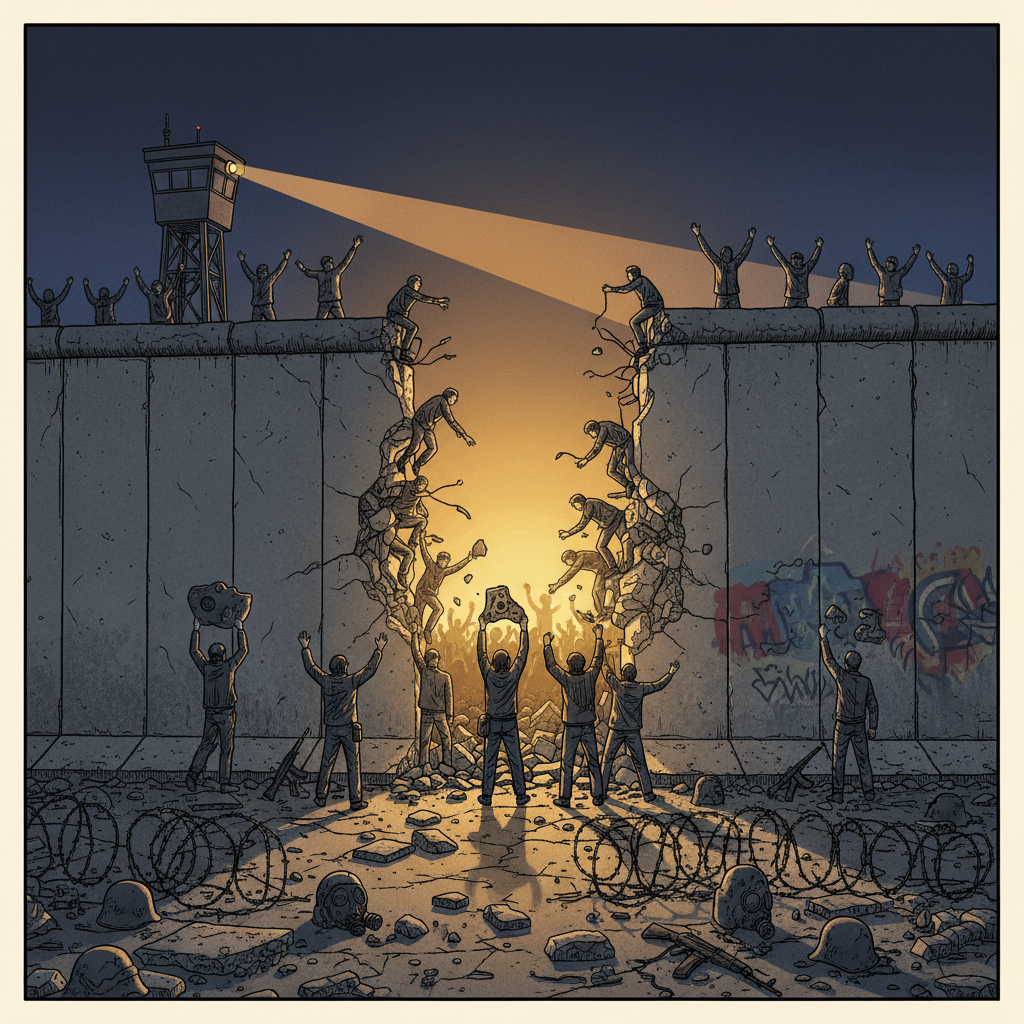
Caída del Muro de Berlín
La noche del 9 de noviembre de 1989, el Muro de Berlín — el símbolo más potente de la Guerra Fría — fue abierto inesperadamente después de que el portavoz de la RDA, Günter Schabowski, anunciara por error la libertad inmediata de viaje durante una conferencia de prensa en vivo. La apertura fue la culminación de las reformas de glásnost y perestroika de Gorbachov, el efecto dominó en el Bloque Oriental y meses de presión popular desde las Manifestaciones de los Lunes de Leipzig y el movimiento "Wir sind das Volk". Alemania fue reunificada formalmente el 3 de octubre de 1990, aunque la Mauer im Kopf (el muro en la cabeza) entre alemanes del este y del oeste persiste hasta hoy.
Resumen Ejecutivo
Five lenses converge on the fundamental insight that the Berlin Wall's fall was overdetermined — the division was unsustainable and some form of collapse was inevitable — but diverge sharply on why and how. Game theory highlights the rational calculus of cooperation replacing confrontation; Machiavelli focuses on elite agency and political opportunism; Jung reveals the psychological dimensions of division and incomplete integration; the CIA lens claims Western strategic pressure as a significant cause; and Taoism sees the Wall's fall as natural correction of artificial forcing. The most productive tension is between the CIA's triumphalism (the West won) and Taoism's inevitabilism (the Wall dissolved under its own contradictions), with the other lenses occupying the spectrum between these poles. All lenses agree on three things: Gorbachev's non-intervention was the single most critical enabling factor; the grassroots movements (Leipzig, Mauerspechte) were as important as elite decisions; and the Schabowski gaffe was the accidental catalyst that collapsed a fragile equilibrium.
Hechos Clave
Hechos verificados de investigacion multifuente, puntuados por nivel de confianza
Mikhail Gorbachev became General Secretary of the Communist Party of the Soviet Union on March 11, 1985, and initiated glasnost (openness) and perestroika (restructuring) reforms.
Confianza highThe Sinatra Doctrine, articulated by Soviet Foreign Ministry spokesman Gennadi Gerasimov in October 1989, replaced the Brezhnev Doctrine, signaling that the USSR would no longer intervene militarily to prevent political change in Eastern Bloc states.
Confianza highThe Leipzig Monday Demonstrations began on September 4, 1989, at the Nikolaikirche (St. Nicholas Church) and grew from hundreds to over 300,000 participants by late October 1989.
Confianza highThe chant "Wir sind das Volk" (We are the people) became the rallying cry of the Leipzig Monday demonstrators, explicitly claiming popular sovereignty against the SED regime.
Confianza highErich Honecker was forced to resign as General Secretary of the SED on October 18, 1989, replaced by Egon Krenz.
Confianza highOn the evening of November 9, 1989, SED Politburo member Günter Schabowski held a press conference announcing new travel regulations. When asked when the regulations took effect, he replied "sofort, unverzüglich" (immediately, without delay), though the regulations were supposed to take effect the next morning.
Confianza highThe press conference was broadcast live on West German television, widely watched in East Berlin. Thousands gathered at border crossings, particularly Bornholmer Straße.
Confianza highActores Clave
Actores principales involucrados en este evento con sus acciones e intereses declarados
Mikhail Gorbachev
individual- ›Initiated glasnost and perestroika reforms
- ›Articulated Sinatra Doctrine
- ›Refused to authorize military intervention in GDR
Helmut Kohl
individual- ›Seized reunification window within days
- ›Negotiated monetary union
- ›Secured Allied and Soviet consent via Two Plus Four Agreement
Günter Schabowski
individual- ›Delivered the press conference that inadvertently opened the Wall
Leipzig Monday Demonstrators
group- ›Organized weekly Monday demonstrations from September 1989
- ›Grew from hundreds to over 300,000 participants
- ›Maintained nonviolent discipline
George H.W. Bush
individual- ›Exercised deliberate restraint
- ›Supported Kohl's reunification agenda
- ›Worked to reassure Gorbachev
Investigacion y Fuentes
Linea de Tiempo del Evento
1985-03-11 to 1990-10-03
Analisis Causal
Grafo interactivo que muestra como politicas, actores y eventos se conectan causalmente — haz clic en los nodos para explorar relaciones
RED CAUSAL
15 nodos · 15 conexiones
Selecciona un nodo
Haz clic en cualquier nodo del grafo para explorar sus conexiones y perspectivas de lentes
Causas Raiz
2Ruta Critica
11 pasosAnalisis por Lente
Cada lente proporciona un marco analitico unico — haz clic para expandir el analisis profundo
Teoría de Juegos
Western Moderngame-theoryThe Fall of the Berlin Wall was a multi-player game that resolved through a remarkable convergence of cooperative strategies — but the timing was determined by an exogenous shock (Schabowski's gaffe) that no rational actor model could have predicted. The most significant game-theoretic insight is that the Cold War's most dangerous confrontation point was defused not through deterrence or brinksmanship, but through one leader's decision not to play the game at all (Gorbachev's non-intervention) and millions of citizens solving their collective action problem on Monday evenings in Leipzig.
Análisis Maquiavélico
Greco-Roman & ClassicalmachiavelliThe Fall of the Berlin Wall reveals Machiavelli's deepest insight: that fortuna governs at least half of human affairs, and the virtuous prince is one who can adapt to fortune's changes. Gorbachev had virtù in choosing reform over repression, but lacked the capacity to control its consequences. Kohl had virtù in seizing the moment with extraordinary speed. The SED regime had neither virtù nor fortuna — its power was borrowed from Moscow, and when Moscow withdrew, the regime had nothing of its own. The most Machiavellian lesson: Schabowski's gaffe demonstrates that even the most consequential historical events can turn on a moment of incompetence, and the prince who cannot recover from accidents is no prince at all.
Psicología Profunda Junguiana
Western ModernjungThe Berlin Wall was not just a political structure but a psychic one — the externalization of Germany's collective shadow after the catastrophe of the Nazi period. Its fall on November 9, 1989, was a moment of numinous collective experience, but true individuation requires integrating what the Wall divided, not merely removing the barrier. The Mauer im Kopf persists because political reunification was not accompanied by psychological reunification. Schabowski's gaffe was the collective unconscious speaking through a bureaucrat's error what the political system could not yet say: that the division was unsustainable, and history would find its own way through the Wall.
CIA / Evaluación de Inteligencia Occidental
Western InstitutionalciaThe Fall of the Berlin Wall was the Western alliance's greatest strategic achievement and one of the intelligence community's most instructive analytical failures. Western pressure — military, economic, and ideological — was a significant contributing factor to the Soviet system's crisis, but the specific mechanism and timing of the Wall's fall were driven by forces no intelligence agency predicted: Gorbachev's personal commitment to non-violence, the nonlinear dynamics of collective citizen action, and the bureaucratic accident of Schabowski's press conference. The greatest intelligence success of the entire episode was not an assessment but a policy recommendation: Bush's restraint, which preserved the cooperative dynamic that made peaceful reunification possible.
Taoísmo
East AsiantaoismThe Fall of the Berlin Wall is the Tao made visible in history. The Wall was the ultimate act of forcing — the attempt to divide by concrete what nature had joined. For 28 years the pressure built like water behind a dam, and on November 9, 1989, a crack appeared through a bureaucrat's fumbled words, and 28 years of accumulated force flowed through it in a single night. The most consequential actions were non-actions: Gorbachev not intervening, Bush not gloating, border guards not shooting. The Mauerspechte, chipping away with hammers, were water wearing away stone. The Tao Te Ching teaches: 'Nothing in the world is as soft and yielding as water. Yet for dissolving the hard and inflexible, nothing can surpass it.' The Berlin Wall dissolved not under military assault but under the soft, persistent, irresistible pressure of human freedom.
Convergencias
Donde multiples lentes llegan a conclusiones similares — sugiriendo robustez
Gorbachev's non-intervention was the single most critical factor enabling peaceful change
All five lenses identify Gorbachev's decision not to use military force as the necessary precondition for everything else. Without it, the Monday Demonstrations could have been crushed (Budapest 1956, Prague 1968), Schabowski's gaffe would have been irrelevant, and the Wall would have stood.
Grassroots citizen action was as consequential as elite political decisions
Game theory identifies the Leipzig demonstrations as solving the collective action problem; Jung sees 'Wir sind das Volk' as collective individuation; Taoism sees citizens as water finding cracks. The Machiavelli and CIA lenses, while acknowledging citizen agency, give more weight to elite actors.
The Schabowski gaffe was an accidental catalyst that collapsed a fragile equilibrium
Game theory calls it an exogenous shock; Machiavelli sees it as fortuna overriding virtues; Jung interprets it as the collective unconscious speaking through a bureaucratic error; Taoism sees it as the Tao finding its own path through a crack. The CIA lens is less focused on the gaffe itself, treating it as acceleration of an inevitable process.
The Mauer im Kopf (wall in the head) represents incomplete integration after political reunification
Jung sees it as unintegrated shadow material; Taoism sees it as the natural yin-yang cycle after forced reunification; Machiavelli notes the political consequences of Kohl's speed (unification on Western terms without genuine negotiation). Game theory and CIA are less focused on post-reunification psychology.
Tensiones Productivas
Donde los lentes discrepan — revelando complejidad que merece examinarse
Futuros Posibles
Escenarios derivados de los analisis de lentes — lo que podria desarrollarse segun diferentes marcos
Gradual dissolution of the Mauer im Kopf through generational change
Likely over a 50-100 year horizon. Jung and Taoism both suggest that integration follows its own timeline and cannot be forced.
Korean reunification following the Berlin Wall model
Low in the near term. The Berlin Wall model required a reformist Soviet leader willing to accept Eastern Bloc self-determination. No equivalent Chinese policy shift is visible.
Russian revanchism produces new East-West confrontation
Already materializing. The Russia-Ukraine War is a direct consequence of the unresolved tensions from 1989.
Preguntas Clave
Preguntas que permanecen abiertas despues del analisis — para investigacion continua
- ?What were the full contents of the classified Soviet Politburo deliberations on non-intervention in November 1989?
- ?To what extent did CIA covert operations materially support Eastern Bloc dissident movements, as opposed to merely monitoring them?
- ?What was Gorbachev's internal calculus: did he genuinely believe he could reform communism, or had he accepted the system's end?
Detalles de Verificacion
Resultados de Verificacion
verifiedMeta Observaciones
All five lenses struggle with the ordinary human dimension of the Wall's fall: the families reunited after decades, the woman who walked from East Berlin to West Berlin for the first time in 28 years to visit her sister, the border guard who decided to open the gate because he could not look into the faces of the crowd and say no. No analytical framework fully captures the emotional reality of that night. The lenses provide understanding; the human experience provides meaning.
The Fall of the Berlin Wall resists single-cause explanation. It was simultaneously a strategic outcome (game-theory), a political opportunity seized (Machiavelli), a collective psychological breakthrough (Jung), a Western strategic achievement (CIA), and a natural correction (Taoism). Any interpretation that privileges one cause over all others is necessarily incomplete. The irreducible complexity is the point: historical events of this magnitude are overdetermined, and their meaning depends on where you stand.
No intelligence agency predicted November 9, 1989. No political leader planned it. No analytical framework can fully explain it. The most honest response to the Fall of the Berlin Wall is epistemic humility: we can analyze it from multiple angles, identify contributing factors, and trace consequences, but we cannot reduce it to a single cause or narrative without distorting it. The five lenses in this analysis are five windows onto a reality too large for any single frame.
Encuentra Tu Perspectiva
Diferentes marcos resuenan con diferentes lectores — encuentra tu punto de entrada
Readers who think in terms of strategic calculation, rational actors, and geopolitical competition. You see the Cold War as a contest that was won through superior strategy and resources.
The Wall fell because the strategic balance shifted: Soviet economic decline, Western pressure, and Gorbachev's rational calculation that intervention was costlier than acceptance. The game-theoretic and CIA lenses provide the most actionable framework for understanding geopolitical change.
Readers who sense deeper currents beneath political events. You see the Wall's fall as expressing something about human nature, collective psychology, or the natural order of things — not just strategic calculation.
The Wall was a psychic structure as much as a physical one, and its fall represented a moment of collective liberation that transcended political calculation. The Mauer im Kopf reveals that true integration requires psychological work, not just political treaties.
Readers who focus on power, institutions, and political skill. You see history as shaped by individuals and organizations making calculated decisions in pursuit of their interests.
Kohl's Machiavellian speed in seizing the reunification window was the defining political performance of the crisis. Leaders shaped the outcome, even if citizens provided the pressure.
Readers who distrust official narratives and look for hidden motives and strategic calculations behind public rhetoric.
Every major actor had stated goals that differed from their real goals. Gorbachev's 'reform' masked a survival strategy. Kohl's 'historical destiny' masked electoral calculation. Bush's 'restraint' masked strategic positioning. The CIA lens reveals that intelligence agencies got the direction right but the timeline wrong, a humbling reminder of analytical limitations.
If you gravitate toward the strategic/analytical cluster (game-theory, CIA), challenge yourself with the Jungian and Taoist perspectives on collective psychology and natural flow. If you gravitate toward the intuitive cluster (Jung, Taoism), engage seriously with the game-theoretic analysis of rational incentives and the CIA's evidence of Western strategic pressure. The most complete understanding requires holding the tension between these frameworks without resolving it prematurely.
Analisis Relacionados
Otros eventos analizados con lentes o categorias similares
La noche del 28 de febrero de 1986, a las 23:21, el primer ministro sueco Olof Palme fue asesinado de un disparo en la calle Sveavägen del centro de Estocolmo mientras caminaba de regreso del cine con su esposa Lisbeth. Había prescindido de su escolta de seguridad ese día.
El 22 de noviembre de 1963, el Presidente John F. Kennedy fue asesinado en Dealey Plaza, Dallas, Texas. Lee Harvey Oswald fue arrestado, pero Jack Ruby lo mató antes de que pudiera ser juzgado. La Warren Commission concluyó que Oswald actuó solo, mientras que la HSCA determinó posteriormente que existió una probable conspiración. Los documentos desclasificados hasta 2025 revelan encubrimientos institucionales por parte de la CIA y el FBI, convirtiéndolo en el caso sin resolver más trascendental de la historia estadounidense.
El 26 de abril de 1986, a la 01:23, el reactor n.º 4 de la central nuclear de Chernóbil en la RSS de Ucrania explotó durante una prueba de seguridad, liberando 400 veces más material radiactivo que la bomba de Hiroshima. Las autoridades soviéticas ocultaron inicialmente el desastre, obligando a los 49.000 residentes de Prípiat a continuar su vida normal durante 36 horas. Unos 600.000 'liquidadores' fueron desplegados. Las estimaciones de muertes van de 4.000 (OMS) a 93.000 (Greenpeace). El desastre destruyó el mito de la supremacía tecnológica soviética y forzó la glásnost de Gorbachov.
Como Se Analizo Esto
Transparencia total sobre el proceso de analisis, herramientas y limitaciones
Crosslight Engine
v0.4.0 "Global Lens Expansion"- ⚠Non-Western philosophical lenses rely on translated primary texts — nuance may be lost in translation
- ⚠Some traditions (e.g., Maat, Ubuntu) have limited surviving primary texts; analysis draws on scholarly reconstruction
- ⚠Cross-cultural lens application is inherently interpretive — a Confucian reading of a Western event is an analytical exercise, not a claim of cultural authority
Estadisticas del Analisis
Metodologia
Este analisis fue producido por el pipeline multi-agente de Crosslight: un Agente de Investigacion recopilo y verifico hechos de multiples fuentes, Agentes de Lentes especializados aplicaron marcos analiticos distintos, un Agente de Sintesis integro hallazgos e identifico patrones, y un Agente de Verificacion valido las afirmaciones. Cada perspectiva de lente es la interpretacion de la IA — no un respaldo institucional.Saber mas →