
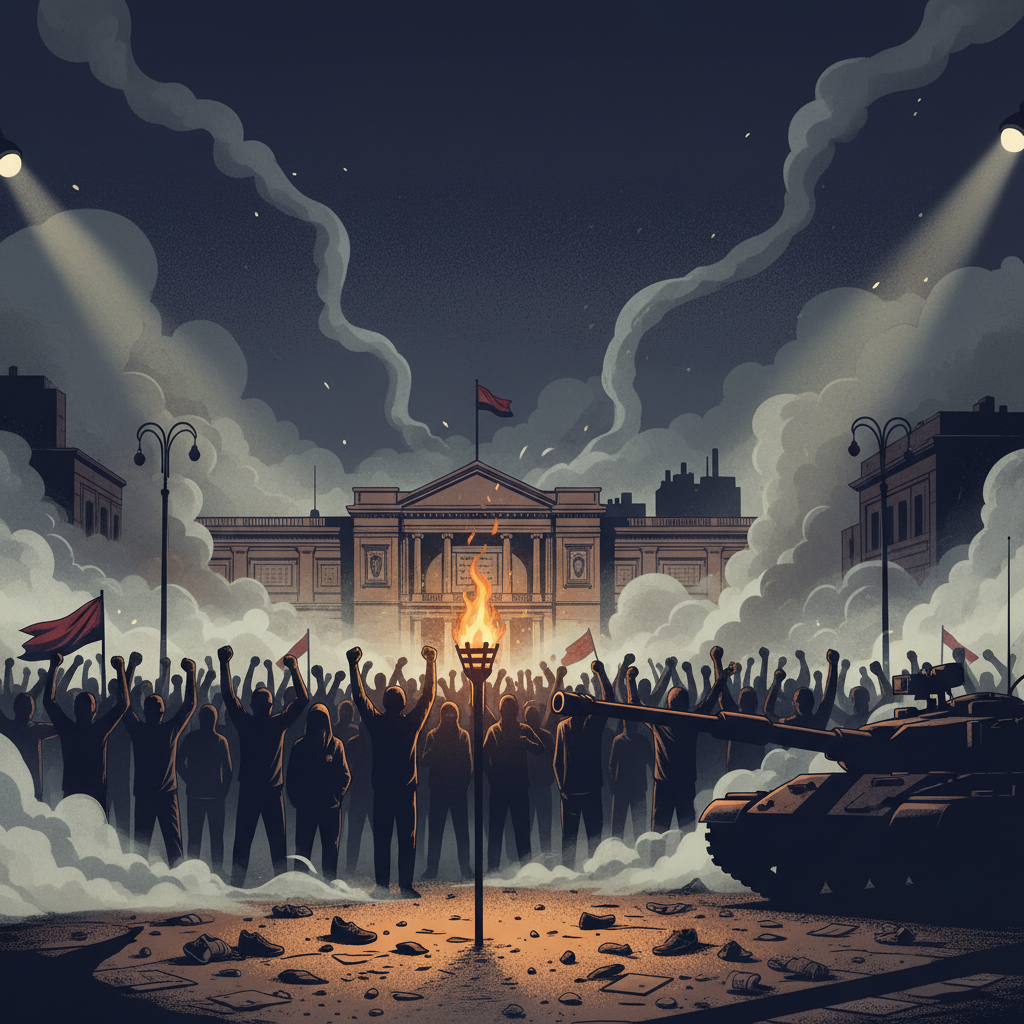
Printemps arabe 2011
Le Printemps arabe fut une vague révolutionnaire de manifestations, de soulèvements et de rébellions armées qui déferla sur le monde arabe à partir de décembre 2010. Déclenché par l'auto-immolation du vendeur ambulant tunisien Mohamed Bouazizi le 17 décembre 2010 — un acte de désespoir contre des décennies de corruption autoritaire, d'humiliation et de chômage des jeunes — le mouvement se propagea avec une rapidité fulgurante à travers l'Afrique du Nord et le Moyen-Orient. Le slogan définitoire «الشعب يريد إسقاط النظام» (Le peuple veut la chute du régime) résonna de Tunis au Caire, de Benghazi à Damas. Le choix de l'armée — se ranger du côté des manifestants ou rester fidèle au régime — s'avéra la variable décisive dans chaque pays.
Resume Executif
Sept perspectives analytiques convergent vers une conclusion centrale : le Printemps arabe fut l'éruption inévitable de décennies d'aspirations humaines réprimées, mais ses résultats furent déterminés non par les aspirations de millions de personnes mais par les calculs institutionnels des élites militaires et les interventions stratégiques de puissances extérieures.
Faits Cles
Faits verifies issus de recherches multi-sources, notes par niveau de confiance
Mohamed Bouazizi, a 26-year-old street vendor in Sidi Bouzid, Tunisia, set himself on fire on December 17, 2010, after his produce cart was confiscated and he was humiliated by a municipal official. He died of his injuries on January 4, 2011.
Confiance highTunisian President Zine El Abidine Ben Ali fled to Saudi Arabia on January 14, 2011, ending his 23-year rule. Tunisia's military refused to fire on protesters.
Confiance highMass protests began in Egypt on January 25, 2011 (the 'Day of Rage'), centering on Tahrir Square in Cairo. President Hosni Mubarak resigned on February 11, 2011, after 30 years in power.
Confiance highEgypt's Supreme Council of the Armed Forces (SCAF) sided with protesters and forced Mubarak's resignation, protecting the military's extensive economic and institutional interests.
Confiance highMohamed Morsi of the Muslim Brotherhood won Egypt's first free presidential election in June 2012. He was removed by a military coup led by General Abdel Fattah al-Sisi on July 3, 2013.
Confiance highProtests against Muammar Gaddafi began in Benghazi, Libya on February 15, 2011. UN Security Council Resolution 1973 authorized a no-fly zone. NATO intervened militarily beginning March 19, 2011. Gaddafi was captured and killed on October 20, 2011.
Confiance highAnti-government protests began in Daraa, Syria in mid-March 2011 after schoolchildren were detained for anti-regime graffiti. The Assad regime responded with military force, escalating into civil war.
Confiance highActeurs Cles
Acteurs majeurs impliques dans cet evenement avec leurs actions et interets declares
Mohamed Bouazizi
individual- ›Set himself on fire on December 17, 2010 in Sidi Bouzid, Tunisia
Hosni Mubarak
individual- ›Imposed curfew and deployed military to streets
- ›Shut down internet and mobile communications
- ›Resigned on February 11, 2011
Muammar Gaddafi
individual- ›Ordered military to suppress protests violently
- ›Threatened to 'cleanse Libya house by house'
- ›Fought NATO intervention until captured and killed
Bashar al-Assad
individual- ›Deployed military against civilian protesters
- ›Used barrel bombs and chemical weapons against civilian areas
- ›Relied on Iranian and Russian military support
Al Jazeera
organization- ›Provided 24/7 satellite coverage of Arab Spring protests across the region
- ›Amplified protest movements through pan-Arab broadcasts reaching millions
- ›Created a shared narrative space across Arab-speaking populations
Recherche et Sources
Chronologie de l'Evenement
2010-12-17 to 2015-09-01
Analyse Causale
Graphe interactif montrant comment les politiques, acteurs et evenements sont relies causalement — cliquez sur les noeuds pour explorer les relations
RESEAU CAUSAL
21 noeuds · 18 connexions
Selectionnez un noeud
Cliquez sur n'importe quel noeud du graphe pour explorer ses connexions et les perspectives des prismes
Causes Profondes
3Chemin Critique
9 etapesAnalyses par Prisme
Chaque prisme fournit un cadre analytique unique — cliquez pour developper l'analyse approfondie
Théorie des jeux
Western Moderngame-theoryThe Arab Spring was a massive multi-player sequential game where each country's outcome changed the information set for all other players. Tunisia's success solved the collective action problem by demonstrating that revolution was possible — but the game-theoretic insight is that the same initial shock (popular uprising) produced radically different outcomes depending on one variable: whether the military's institutional interests were better served by defecting from or remaining loyal to the regime. This is the 'military kingmaker' dynamic — not a bug in the revolutionary wave but the fundamental strategic variable that determined winners and losers.
Machiavel
Greco-Roman & ClassicalmachiavelliThe Arab Spring is a masterclass in Machiavellian power dynamics: it demonstrated that power built solely on fear collapses catastrophically when the fear barrier breaks. The military — not the people, not social media, not Western intervention — was the prince-maker in every country. Where the military calculated that its institutional interests were better served by sacrificing the ruler (Tunisia, Egypt), transitions were relatively peaceful. Where the military's survival was bound to the regime (Syria's Alawite officers, Bahrain's Sunni security forces), the result was either civil war or brutal suppression. The tragedy of the Arab Spring, in Machiavellian terms, is that destroying the old order proved far easier than building a new one. As Machiavelli warned: 'There is nothing more difficult to take in hand, more perilous to conduct, or more uncertain in its success, than to take the lead in the introduction of a new order of things.'
Évaluation du renseignement de la CIA
Western InstitutionalciaThe Arab Spring exposed the central paradox of US intelligence engagement in the Middle East: the very authoritarian relationships that provided counter-terrorism intelligence created the conditions for the revolutionary explosions that destroyed those relationships. The CIA's partnerships with Mubarak's GIS, Ben Ali's secret police, and Gaddafi's reformed intelligence services gave the US excellent visibility into specific terrorist networks but no understanding of the structural rage building across Arab societies. The intelligence failure was not in the collection but in the analytical framework — the inability to see that 'stable authoritarian allies' was a contradiction in terms, and that the suppressed frustrations of millions of young Arabs constituted a strategic threat greater than any specific terrorist organization.
Analyse du conditionnement pavlovien
Western ModernpavlovThe Arab Spring demonstrates that authoritarian control based on conditioned fear is inherently fragile: it works perfectly until it doesn't, and when it fails, it fails catastrophically. Decades of conditioning created a population that appeared compliant but was actually a pressure cooker of suppressed frustration. Bouazizi's act served as the extinction trial that demonstrated the old contingency no longer held. Al Jazeera's broadcasts generalized this extinction across the Arab world. But conditioning theory also explains the tragedy: it is far easier to extinguish a fear response (stop obeying) than to condition new constructive behaviors (build democratic institutions). The Arab Spring succeeded as mass behavioral de-conditioning — the fear was broken — but failed as re-conditioning toward democratic habits, which require years of consistent reinforcement that the post-revolutionary environment could not provide.
Analyse nietzschéenne
Western ModernnietzscheThe Arab Spring was a revolt of dignity — ثورة الكرامة — and Nietzsche's philosophy provides the deepest reading of what dignity means in this context. It was not merely a demand for political rights but an existential assertion: the refusal to accept humiliation as the human condition. Bouazizi's act was the purest expression of will against a system that had crushed all will. The tragedy is Nietzsche's own warning: destruction of the old order is the easy part. The hard part — the creation of new values, the emergence of what Nietzsche would call higher types of human organizing — requires precisely the kind of patient, creative work that revolutionary energy cannot sustain. The Arab Spring proved that the will to power can topple any regime, but it cannot, by itself, build what comes next.
Analyse taoïste
East AsiantaoismThe Arab Spring is the Tao's most powerful modern demonstration of the principle of reversal (反, fan): whatever reaches an extreme produces its opposite. Decades of authoritarian rigidity (extreme yang) produced explosive revolutionary energy (extreme yin). Regimes that gripped tighter fell faster — Gaddafi's 42 years of iron control shattered into state collapse; Assad's brutal suppression produced the century's worst humanitarian disaster. Regimes that bent survived — Morocco's limited reforms, Jordan's modest concessions. The Tao's deepest insight about the Arab Spring is this: the revolutionary wave moved not through strategic coordination but through the natural resonance of shared grievances, flowing like water through every crack in authoritarian structures. It could not be stopped because it was not being directed — it was the Tao itself, the natural flow of suppressed human aspiration finding expression. But the Tao also teaches that water, unconstrained, floods and destroys. The Arab Spring's devastation in Libya and Syria is water without banks — natural force without the channels needed to direct it constructively.
Évaluation de l'impact sur les civils
civilian-impactThe Arab Spring's civilian impact reveals the terrible disproportion between revolutionary aspiration and human cost. Millions of people demanded nothing more than dignity, economic opportunity, and an end to corruption — the most basic human aspirations. In Tunisia, these aspirations were achieved at relatively low cost. In Syria, the same aspirations produced the worst humanitarian catastrophe of the 21st century. The difference was not in what civilians wanted or how they protested, but in the structural variables they could not control: military loyalty, sectarian composition, external intervention, and the willingness of rulers to destroy their own countries rather than relinquish power. The most devastating finding of this analysis is that the people who suffered most — Syrian civilians — had the least agency in determining their fate. They were caught between a regime willing to use chemical weapons, an opposition that fragmented into rival militias, external powers pursuing strategic interests, and a jihadist movement (ISIS) that exploited the chaos. The Arab Spring's human cost is not a story of failed revolution — it is a story of civilians trapped in conflicts they did not choose, determined by forces they could not influence.
Convergences
La ou plusieurs prismes arrivent a des conclusions similaires — suggerant une robustesse
La loyauté militaire comme variable décisive
Les quatre perspectives identifient indépendamment le choix institutionnel de l'armée comme le facteur qui détermina si les révolutions réussirent pacifiquement, dégénérèrent en guerre civile ou furent écrasées.
La stabilité autoritaire est inhéremment fragile
La théorie des jeux montre que les équilibres fondés sur la peur s'effondrent. Pavlov montre que la peur conditionnée s'éteint. Le taoïsme montre que les systèmes rigides produisent leur propre renversement.
Détruire les anciens ordres est plus facile que d'en construire de nouveaux
Machiavel avertit que l'établissement de nouveaux ordres est l'entreprise politique la plus difficile. Nietzsche identifie le problème du Ubermensch. Le taoïsme voit l'eau sans berges comme destructrice.
Tensions Productives
La ou les prismes divergent — revelant une complexite qui merite examen
Futurs Possibles
Scenarios derives des analyses par prisme — ce qui pourrait se derouler selon differents cadres
Second wave of Arab uprisings driven by unresolved structural grievances
Medium — the structural conditions remain, but the memory of Syria's catastrophe acts as a powerful deterrent
Authoritarian adaptation and tech-enabled control prevent future uprisings
Medium-high — authoritarian regimes have invested heavily in learning from the Arab Spring's failures
Tunisia's democratic path consolidates and gradually influences the region
Low — Tunisia's own democracy has faced setbacks since 2021 (Kais Saied's power concentration)
Questions Cles
Questions qui restent ouvertes apres l'analyse — pour une investigation continue
- ?What was the precise role of Gulf intelligence services in funding and directing various factions?
- ?To what extent did Al Jazeera's editorial decisions shape the direction of the Arab Spring?
- ?What were the internal deliberations within military high commands that determined their choices?
Details de la Verification
Resultats de la Verification
verifiedMeta Observations
All seven lenses are fundamentally retrospective — they analyze what happened and why, but none fully captures the lived experience of revolutionary hope before it turned to despair. The Arab Spring was, for millions of people, the most exhilarating experience of their lives — a moment of collective agency and shared purpose that cannot be reduced to strategic calculation, conditioning, or power dynamics. That hope, even though it was largely betrayed by outcomes, was real and transformative for those who experienced it.
The Arab Spring involves simultaneous causation at multiple scales — individual psychology (Bouazizi), institutional dynamics (military choices), regional contagion (media amplification), and global geopolitics (external intervention) — that cannot be adequately captured by any single analytical framework. The seven lenses together approach a more complete picture, but the full complexity of a revolutionary wave affecting 300+ million people across 20 countries over five years exceeds any analytical capacity.
The Arab Spring humbled every analytical framework that tried to predict or explain it in real time. Intelligence agencies did not predict it. Academic experts did not anticipate its trajectory. No single theory — rational choice, structuralism, constructivism, or any other — captured the full dynamic. This analysis, with its seven lenses, is an attempt to triangulate toward truth, but the reader should hold all conclusions with appropriate humility.
Trouvez Votre Perspective
Differents cadres resonnent avec differents lecteurs — trouvez votre point d'entree
Readers who see the Arab Spring primarily through strategic dynamics, institutional calculations, and power politics — who ask 'what were the incentives?' and 'who benefited?'
The military kingmaker dynamic and the failure of intelligence frameworks to predict popular uprisings
Readers who see the Arab Spring as an expression of deep human aspirations — dignity, freedom, natural flow against artificial constraint — and who feel the movement's moral power
The revolt of dignity and the paradox of control — regimes that gripped tighter fell faster
Readers focused on power structures, institutional dynamics, and the concrete consequences of political action — who ask 'what happened to real people?' and 'who holds power?'
The gap between revolutionary aspiration and institutional capacity to build new orders, and the devastating human cost of that gap
Readers skeptical of grand narratives who focus on mechanisms, costs, and unintended consequences — who ask 'how did it actually spread?' and 'what was the real price?'
The conditioning dynamics that made the wave possible and the cruel arithmetic of human suffering across the spectrum
Start with the lens that resonates most, then deliberately read the lens that challenges your assumptions. If you see strategic rationality (game-theory), read the existential dimension (nietzsche). If you feel the moral power of the movement (nietzsche), confront the human cost (civilian-impact). The Arab Spring's full truth lives in the tension between these perspectives, not in any single lens.
Analyses Connexes
Autres evenements analyses a travers des prismes ou categories similaires
Le 26 avril 1986 à 01h23, le réacteur n°4 de la centrale nucléaire de Tchernobyl en RSS d'Ukraine a explosé lors d'un test de sécurité, libérant 400 fois plus de matières radioactives que la bombe d'Hiroshima. Les autorités soviétiques ont d'abord dissimulé la catastrophe, forçant les 49 000 habitants de Pripiat à poursuivre leur vie normale pendant 36 heures. Environ 600 000 « liquidateurs » ont été déployés. Les estimations de décès vont de 4 000 (OMS) à 93 000 (Greenpeace). La catastrophe a brisé le mythe de la suprématie technologique soviétique et a forcé Gorbatchev vers la glasnost.
Entre le 6 avril et le 18 juillet 1994, environ 800 000 Tutsis et Hutus moderes ont ete systematiquement assassines au Rwanda en l'espace de 100 jours — le massacre le plus efficace de l'histoire moderne, avec un taux de mortalite quotidien superieur a celui de l'Holocauste. Le genocide n'etait pas l'eruption de « haines tribales ancestrales » mais l'aboutissement d'un projet colonial : les administrateurs belges avaient fabrique des categories raciales rigides a partir d'identites sociales fluides par le biais du recensement de 1933 et des cartes d'identite ethniques obligatoires, creant la division Hutu-Tutsi que les elites politiques ont ensuite instrumentalisee. Le regime de Habyarimana et son cercle restreint de l'akazu (la maisonnee), confrontes a la pression militaire du Front patriotique rwandais et aux exigences de partage du pouvoir des Accords d'Arusha, ont choisi le genocide comme strategie de survie politique. La radio RTLM — « Radio Machette » — a systematiquement conditionne la population par des annees de propagande deshumanisante, qualifiant les Tutsis d'« inyenzi » (cafards) avant de diffuser des instructions explicites de mise a mort et les localisations des victimes pendant le genocide lui-meme. Entre 250 000 et 500 000 femmes ont ete violees comme arme deliberee de genocide, le jugement historique du TPIR dans l'affaire Akayesu reconnaissant le viol comme acte de genocide pour la premiere fois en droit international. L'echec de la communaute internationale n'etait pas passif mais actif : le commandant de la MINUAR Romeo Dallaire a envoye son « fax sur le genocide » trois mois avant le debut des massacres, a demande 5 000 soldats, et a ete refuse. Le Conseil de securite des Nations Unies a reduit la MINUAR de 2 500 a 270 soldats pendant le genocide. Les Etats-Unis ont deliberement evite d'utiliser le mot « genocide » pour contourner les obligations legales d'intervenir. La Commission Duclert (2021) a conclu que la France portait des « responsabilites lourdes et accablantes » incluant « une faillite politique, institutionnelle, intellectuelle, morale et cognitive ». L'Operation Turquoise, officiellement humanitaire, a permis aux genocidaires de fuir au Zaire. La victoire militaire du FPR a mis fin au genocide en juillet 1994, mais les consequences se sont propagees jusqu'a la Premiere Guerre du Congo (1996-97) et la « Guerre mondiale africaine » qui a tue plus de 5 millions de personnes.
Le 22 novembre 1963, le président John F. Kennedy fut assassiné à Dealey Plaza, Dallas, Texas. Lee Harvey Oswald fut arrêté mais tué par Jack Ruby avant son procès. La Warren Commission conclut qu'Oswald avait agi seul, tandis que la HSCA constata ultérieurement une probable conspiration. Les documents déclassifiés jusqu'en 2025 révèlent des dissimulations institutionnelles de la CIA et du FBI, faisant de cet événement l'affaire criminelle non résolue la plus lourde de conséquences de l'histoire américaine.
Comment Cela a Ete Analyse
Transparence totale sur le processus d'analyse, les outils et les limitations
Crosslight Engine
v0.4.0 "Global Lens Expansion"- ⚠Non-Western philosophical lenses rely on translated primary texts — nuance may be lost in translation
- ⚠Some traditions (e.g., Maat, Ubuntu) have limited surviving primary texts; analysis draws on scholarly reconstruction
- ⚠Cross-cultural lens application is inherently interpretive — a Confucian reading of a Western event is an analytical exercise, not a claim of cultural authority
Statistiques d'Analyse
Methodologie
Cette analyse a ete produite par le pipeline multi-agents de Crosslight : un Agent de Recherche a rassemble et verifie les faits de sources multiples, des Agents de Prismes specialises ont applique des cadres analytiques distincts, un Agent de Synthese a integre les perspectives et identifie les tendances, et un Agent de Verification a valide les affirmations. Chaque perspective de prisme est l'interpretation de l'IA — pas une approbation institutionnelle.En savoir plus →