
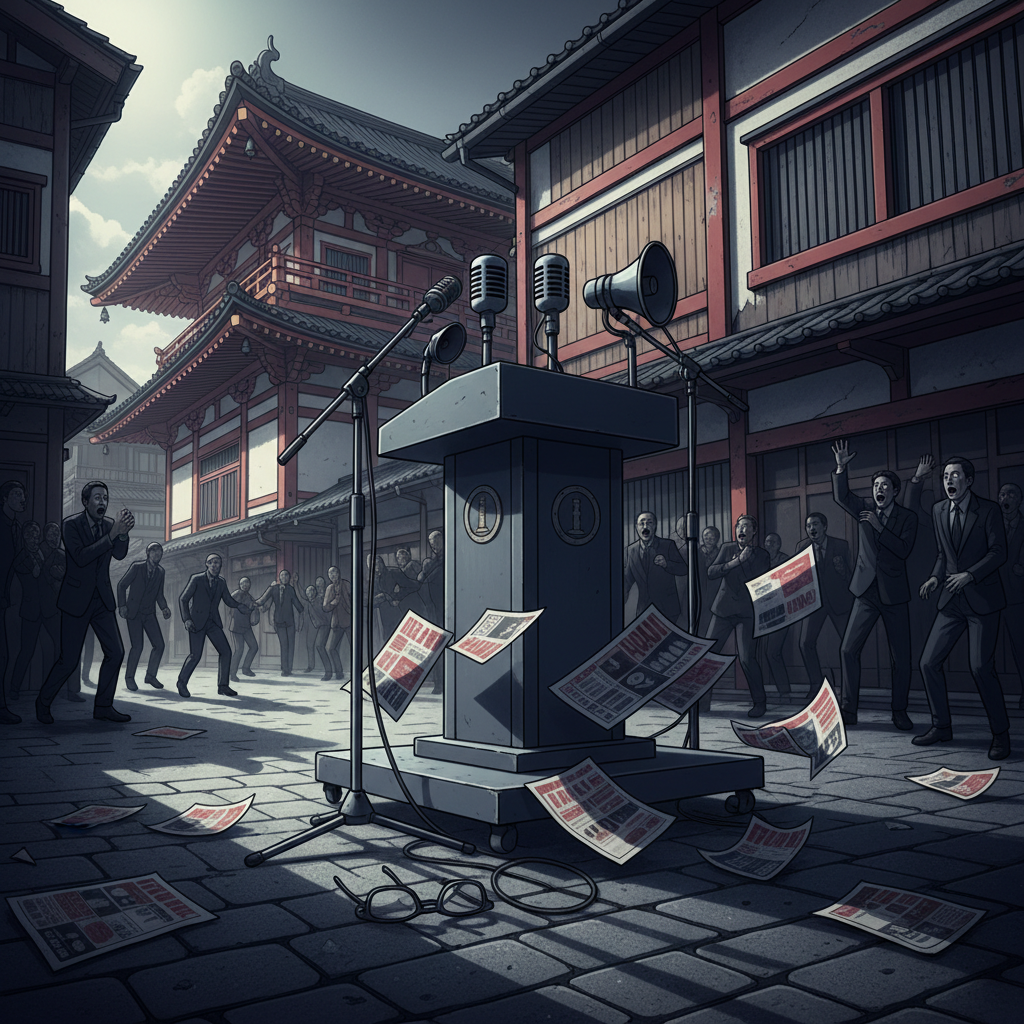
शिंजो आबे की हत्या
8 जुलाई 2022 को, जापान के पूर्व प्रधानमंत्री शिंजो आबे की नारा में चुनाव प्रचार भाषण के दौरान हत्या कर दी गई। हमलावर तेत्सुया यामागामी ने घर में बनाई गई बंदूक का इस्तेमाल किया, जो यूनिफिकेशन चर्च के खिलाफ व्यक्तिगत द्वेष से प्रेरित था। उसने चर्च को अपने परिवार को लगभग 10 करोड़ येन के जबरन दान के माध्यम से दिवालिया करने का दोषी ठहराया। यामागामी ने आबे को चर्च के सबसे प्रमुख राजनीतिक सहयोगी के रूप में निशाना बनाया, जिसके सत्तारूढ़ लिबरल डेमोक्रेटिक पार्टी से संबंध 1960 के दशक से थे जब आबे के नाना प्रधानमंत्री किशी नोबुसुके ने यह गठबंधन बनाया था।
कार्यकारी सारांश
छह विश्लेषणात्मक लेंस एक केंद्रीय खोज पर अभिसरित होते हैं: शिंजो आबे की हत्या साठ वर्षों से अधिक समय से छिपी एक संस्थागत व्यवस्था का हिंसक उद्घाटन थी। LDP-चर्च गठबंधन पारस्परिक लाभ (खेल सिद्धांत), शक्ति समेकन (मैकियावेली), सामूहिक इनकार (युंग), व्यवहार कंडीशनिंग (पावलोव), विरासत में मिली शक्ति की इच्छा (नीत्शे), और प्रकटीकरण की खोज करने वाले छिपाव (ताओवाद) द्वारा बनाए रखा गया था।
प्रमुख तथ्य
बहु-स्रोत शोध से सत्यापित तथ्य, विश्वास स्तर के अनुसार वर्गीकृत
Abe was shot and killed July 8, 2022, at approximately 11:30 AM during a campaign speech outside Yamato-Saidaiji Station in Nara. He was 67.
high विश्वासYamagami (41) used a homemade firearm. First shot missed; second struck Abe in neck and left upper arm, fatally damaging an artery near the heart.
high विश्वासYamagami's mother joined the Church in August 1991 and donated approximately 100 million yen (~$720,000) over seven years, including 50 million yen from husband's life insurance within months of joining. Family declared bankruptcy.
high विश्वासYamagami's father died by suicide. His brother lost sight in one eye. In 2005, Yamagami himself attempted suicide while in the Maritime Self-Defense Force.
high विश्वासAbe sent a video message to a September 12, 2021 UPF rally praising the organization's focus on family values. This was a key trigger for Yamagami's targeting decision.
high विश्वासAbe's grandfather Kishi Nobusuke (PM 1957-1960) established close ties with Moon Sun-myung in the 1960s. The Church HQ was at one point housed adjacent to Kishi's Tokyo residence.
high विश्वासThe Church co-founded the IFVC with Sasakawa Ryoichi. This anti-communist network spread Church influence throughout the LDP.
high विश्वासप्रमुख कर्ता
इस घटना में शामिल प्रमुख कर्ता उनके कार्यों और घोषित हितों के साथ
Shinzo Abe
individual- ›Longest-serving PM
- ›Maintained Church-LDP relationship
- ›Sent 2021 UPF video
Tetsuya Yamagami
individual- ›Built homemade firearm
- ›Researched Abe schedule
- ›Assassinated Abe July 8 2022
Unification Church
organization- ›Cultivated LDP since 1960s
- ›Provided electoral support
- ›Extracted donations
Kishida Fumio
individual- ›Ordered LDP Church investigation
- ›Held state funeral
- ›Sought Church dissolution
शोध और स्रोत
घटना समयरेखा
1960s-2023
कारण विश्लेषण
इंटरैक्टिव ग्राफ़ जो दिखाता है कि नीतियाँ, कर्ता और घटनाएँ कारणात्मक रूप से कैसे जुड़ती हैं — संबंधों का अन्वेषण करने के लिए नोड्स पर क्लिक करें
कारण नेटवर्क
14 नोड्स · 14 कनेक्शन
एक नोड चुनें
इसके कनेक्शन और दृष्टिकोण परिप्रेक्ष्यों का अन्वेषण करने के लिए ग्राफ़ में किसी भी नोड पर क्लिक करें
मूल कारण
3महत्वपूर्ण पथ
6 चरणदृष्टिकोण विश्लेषण
प्रत्येक दृष्टिकोण एक अद्वितीय विश्लेषणात्मक ढाँचा प्रदान करता है — गहन विश्लेषण के लिए क्लिक करके विस्तारित करें
खेल सिद्धांत विश्लेषण
Western Moderngame-theoryThe assassination of Shinzo Abe represents the violent collapse of a six-decade Nash equilibrium between the LDP and the Unification Church. Yamagami's targeting calculus was strategically rational: by attacking the highest-profile Church ally rather than the Church itself, he ensured the investigation would expose the political nexus rather than being dismissed as anti-religious violence. The pre-assassination equilibrium was Pareto efficient for the LDP and Church but exploitative of Church members and the uninformed public. The new post-assassination equilibrium, enforced by the dissolution order, is more socially efficient but came at the cost of a political assassination and life imprisonment for the agent of change.
मैकियावेली शक्ति विश्लेषण
Greco-Roman & ClassicalmachiavelliThe Abe assassination reveals a classic Machiavellian tragedy: a political dynasty that maintained power through a morally compromised alliance ultimately had that alliance destroy its most prominent member. Abe mastered the Machiavellian arts of power consolidation, faction management, and institutional alliance-building. But he and the LDP committed the fundamental Machiavellian error of confusing concealment with resolution. The Church relationship was a known vulnerability that was managed through secrecy rather than addressed through severance. When the concealment failed, the accumulated weight of 60 years of hidden alliance crashed down at once. Kishida's post-assassination response was textbook Machiavellian crisis management: sacrifice the expendable (Church ties) to preserve the essential (LDP power), use the crisis to weaken internal rivals (Abe faction), and signal reform without surrendering structural advantage.
युंग गहन मनोविज्ञान
Western ModernjungThe assassination represents the violent eruption of three generations of inherited shadow. Yamagami, personally wounded by the Church's shadow practices, became the agent through whom Japan's collective shadow -- the known-but-unacknowledged Church-LDP nexus -- was forced into consciousness. The public's shift from condemnation to partial sympathy marks the beginning of collective individuation: the painful but necessary process of integrating shadow material that the persona had long concealed. The deepest Jungian insight is that the assassination was not an anomaly but an inevitability: shadow material that is repressed for 60 years does not dissolve but accumulates pressure until it erupts through whatever fault line the psyche presents.
व्यवहार कंडीशनिंग विश्लेषण
Western ModernpavlovThe Abe assassination illuminates behavioral conditioning operating at three levels simultaneously: the Church's operant conditioning of individual members (exploiting grief to establish donation behavior), the LDP's institutional conditioning through decades of mutual reinforcement with the Church, and Japanese society's conditioned deference to institutional authority that allowed the nexus to persist unchallenged. Yamagami's radicalization follows a classic extinction burst pattern: when all conditioned avoidance responses were extinguished, the behavioral repertoire collapsed to a single extreme response. The public's rapid counter-conditioning from condemnation to sympathy reveals that the old conditioned trust in institutional integrity was already weakened, awaiting only a sufficiently powerful unconditioned stimulus to complete the shift.
नीत्शे शक्ति दर्शन
Western ModernnietzscheThe Abe assassination presents the collision between two forms of will to power: Abe's institutional will to power (the patient, generational accumulation of political dominance through the LDP-Church alliance) and Yamagami's individual will to power (the explosive assertion of agency by a person whose entire life had been shaped by institutional domination). Nietzsche would recognize the tragic inevitability: inherited power that refuses to examine its own foundations creates the conditions for its own destruction. The double transvaluation of values -- Yamagami from terrorist to sympathetic figure, Abe from great statesman to Church collaborator -- represents a genuine Nietzschean transformation of the moral framework through which Japanese society evaluates political power and institutional corruption.
ताओवादी विश्लेषण
East AsiantaoismThe assassination of Shinzo Abe is a profound illustration of the Taoist principle that extreme yin generates extreme yang: six decades of concealment (yin) produced an explosive revelation (yang) through the most unlikely catalyst -- a single act of violence by a traumatized individual. The deepest Taoist insight is the paradox of Yamagami's action: his intention was to destroy Abe, but the consequence was to expose the institutional corruption that Abe had concealed. The assassin became the unwitting agent of truth, and the assassination became the mechanism through which a hidden relationship was brought into the light. This is wu wei in its most paradoxical form: the truth emerged not through intentional truth-seeking (which had failed for decades) but through an act of violence whose consequences flowed naturally beyond the actor's control. The Tao moved through the event, using the assassin's personal grievance as the channel through which collective truth could emerge.
अभिसरण
जहाँ कई दृष्टिकोण समान निष्कर्षों पर पहुँचते हैं — मज़बूती का संकेत
Hidden institutional corruption generates pressure toward exposure
All four lenses identify the concealment of the Church-LDP nexus as inherently unstable. Game-theory identifies information asymmetry as the equilibrium's vulnerability. Jung identifies collective shadow accumulation. Taoism identifies extreme yin generating yang reversal. Pavlov identifies weakening conditioned trust.
The assassination was more consequential than the assassin intended
Yamagami intended to punish Abe for Church ties. The actual consequence was the exposure and dissolution of the entire Church-LDP institutional arrangement. Game-theory notes the equilibrium collapse. Machiavelli notes the cascade of alliance shifts. Taoism identifies wu wei (truth emerging beyond the actor's control). Nietzsche identifies the transvaluation of values.
Institutional conditioning enabled exploitation at every level
The Church conditioned individual members (pavlov), the LDP was institutionally conditioned to accept Church support (pavlov/game-theory), the public was conditioned to trust institutional arrangements (pavlov/jung), and the entire system operated through habitual power arrangements resistant to change (machiavelli).
The public sympathy shift represents genuine institutional learning
Jung sees collective individuation, Pavlov sees counter-conditioning, Nietzsche sees transvaluation of values, Taoism sees yin-yang reversal. All interpret the shift from condemnation to sympathy as substantive rather than superficial.
उत्पादक तनाव
जहाँ दृष्टिकोण असहमत हैं — जाँच योग्य जटिलता प्रकट करते हुए
संभावित भविष्य
दृष्टिकोण विश्लेषणों से प्राप्त परिदृश्य — विभिन्न ढाँचों के आधार पर क्या हो सकता है
Complete institutional reform: Church dissolved, LDP reforms transparency, Japan establishes robust political-religious separation framework
Moderate -- most likely outcome in the medium term, but depth of reform is uncertain.
Partial reform: Church dissolved but LDP finds new non-transparent organizational partners; surface reforms without structural change
Moderate-high -- Machiavellian power-seeking and conditioned patterns suggest adaptation rather than transformation.
Minimal lasting change: Church dissolution proceeds but broader political-religious relationships remain unexamined; the case treated as isolated exception
Lower -- the scale of the revelations makes this less likely, but institutional memory is short.
प्रमुख प्रश्न
विश्लेषण के बाद भी खुले रहने वाले प्रश्न — निरंतर जाँच के लिए
- ?What was the full extent of Church influence on specific LDP policy decisions?
- ?How many Japanese families were financially destroyed by Church donation extraction?
- ?What did Abe personally know about Church coercive practices when recording the 2021 UPF video?
तथ्य-जाँच विवरण
तथ्य-जाँच परिणाम
verifiedमेटा अवलोकन
All six lenses analyze the assassination through the Church-LDP nexus, which is where the analytical weight belongs. But they collectively underweight Abe's diplomatic legacy -- his role in strengthening the Japan-US alliance, the Quad framework, and Japan's international standing. A complete assessment of Abe requires holding both the domestic corruption nexus and the international diplomatic achievement in view simultaneously. The assassination's aftermath also has implications for Japan-South Korea relations (the Church's Korean origins) that none of the selected lenses fully address.
The Abe assassination resists single-lens explanation precisely because it operates simultaneously at personal (Yamagami's family destruction), institutional (Church-LDP alliance), cultural (Japanese norms of deference), and philosophical (questions of justice and violence) levels. Each lens illuminates one dimension clearly but necessarily distorts the others. The event is irreducibly complex because the personal and institutional, the rational and psychological, the inevitable and contingent are all simultaneously true.
This analysis was produced two years after the assassination, while the trial has concluded but the Church dissolution is still proceeding through courts. Future revelations may significantly alter our understanding of the Church-LDP relationship, Yamagami's psychology, or the institutional consequences. The reader should hold these interpretations provisionally, recognizing that events this complex continue to reveal new dimensions over time.
अपना दृष्टिकोण खोजें
विभिन्न ढाँचे विभिन्न पाठकों के साथ प्रतिध्वनित होते हैं — अपना प्रवेश बिंदु खोजें
Readers who think in terms of incentives, power structures, and strategic calculation. You likely focus on what actors wanted, what they got, and how the institutional rules shaped their behavior.
The Church-LDP alliance was a rational arrangement sustained by mutual benefit. It collapsed when information asymmetry was destroyed. Post-assassination reforms represent a new equilibrium, not a moral awakening.
Readers who sense deeper patterns beneath surface events. You may feel that the assassination revealed something that was always true but collectively denied, and that the truth emerged with a strange inevitability.
The assassination was the eruption of collective shadow material accumulated over three generations. The truth was already seeking emergence; Yamagami was the catalyst, not the cause.
Readers who focus on how institutions shape individual behavior. You likely see the Church-LDP nexus as a product of systematic conditioning and power arrangements rather than individual moral failure.
Every actor in this event -- from Church members to LDP politicians to the Japanese public -- was shaped by conditioning processes that made the arrangement self-perpetuating until external shock disrupted it.
Readers who question dominant narratives and accepted moral frameworks. You may find yourself sympathizing with Yamagami not despite but because of the moral complexity, and questioning whether the institutional system deserved the disruption it received.
The transvaluation of values -- from condemning Yamagami to partially sympathizing with him -- reveals that the pre-assassination moral consensus was itself a product of institutional concealment rather than genuine moral reasoning.
Start with game-theory for the clearest structural analysis of what happened and why. Move to jung for the psychological depth that strategic analysis misses. Then read nietzsche for the philosophical stakes of the legacy question. Finish with taoism for the paradoxical insight that unifies the other perspectives: the assassination destroyed one man but revealed a truth that sixty years of peaceful advocacy could not.
संबंधित विश्लेषण
समान दृष्टिकोणों या श्रेणियों से विश्लेषित अन्य घटनाएँ
22 नवंबर 1963 को, राष्ट्रपति John F. Kennedy की Dealey Plaza, Dallas, Texas में हत्या कर दी गई। Lee Harvey Oswald को गिरफ्तार किया गया, लेकिन मुकदमे से पहले Jack Ruby ने उसे मार डाला। Warren Commission ने निष्कर्ष निकाला कि Oswald ने अकेले काम किया था, जबकि HSCA ने बाद में संभावित षड्यंत्र पाया। 2025 तक गोपनीयता मुक्त दस्तावेज़ CIA और FBI द्वारा संस्थागत छुपाव को उजागर करते हैं, जो इसे अमेरिकी इतिहास का सबसे महत्वपूर्ण अनसुलझा मामला बनाता है।
रैप सुपरस्टार Nicki Minaj और Cardi B के बीच कई वर्षों तक चली दुश्मनी, जो 2017 में चार्ट दबदबे को लेकर शुरू हुई तनाव से लेकर 2018 में NYFW में Harper's Bazaar के बदनाम जूता-फेंक हादसे तक, ghost-writing के आरोपों, Atlantic Records की लेबल राजनीति और 2025 में Cardi के 'Am I the Drama?' एल्बम रिलीज़ के बाद फिर से भड़की आग तक फैली रही। यह दुश्मनी महिला रैप में दबंगई को लेकर गहरे तनाव, 'एक ही रहेगी' की कहानी, और म्यूज़िक इंडस्ट्री के महिला कलाकारों के साथ व्यवहार को उजागर करती है।
28 फरवरी 1986 की रात 23:21 बजे, स्वीडन के प्रधानमंत्री ओलोफ़ पाल्मे को स्टॉकहोल्म के केंद्र में स्वेआवैगेन पर गोली मारकर हत्या कर दी गई।
यह कैसे विश्लेषित किया गया
विश्लेषण प्रक्रिया, उपकरणों और सीमाओं के बारे में पूर्ण पारदर्शिता
Crosslight Engine
v0.4.0 "Global Lens Expansion"- ⚠Non-Western philosophical lenses rely on translated primary texts — nuance may be lost in translation
- ⚠Some traditions (e.g., Maat, Ubuntu) have limited surviving primary texts; analysis draws on scholarly reconstruction
- ⚠Cross-cultural lens application is inherently interpretive — a Confucian reading of a Western event is an analytical exercise, not a claim of cultural authority
विश्लेषण आँकड़े
कार्यप्रणाली
यह विश्लेषण Crosslight बहु-एजेंट पाइपलाइन द्वारा निर्मित किया गया: एक शोध एजेंट ने कई स्रोतों से तथ्य एकत्र और सत्यापित किए, विशेष दृष्टिकोण एजेंटों ने विशिष्ट विश्लेषणात्मक ढाँचे लागू किए, एक संश्लेषण एजेंट ने अंतर्दृष्टियों को एकीकृत किया और पैटर्न पहचाने, और एक तथ्य-जाँच एजेंट ने दावों की पुष्टि की। प्रत्येक दृष्टिकोण AI की व्याख्या है — संस्थागत समर्थन नहीं।और जानें →