
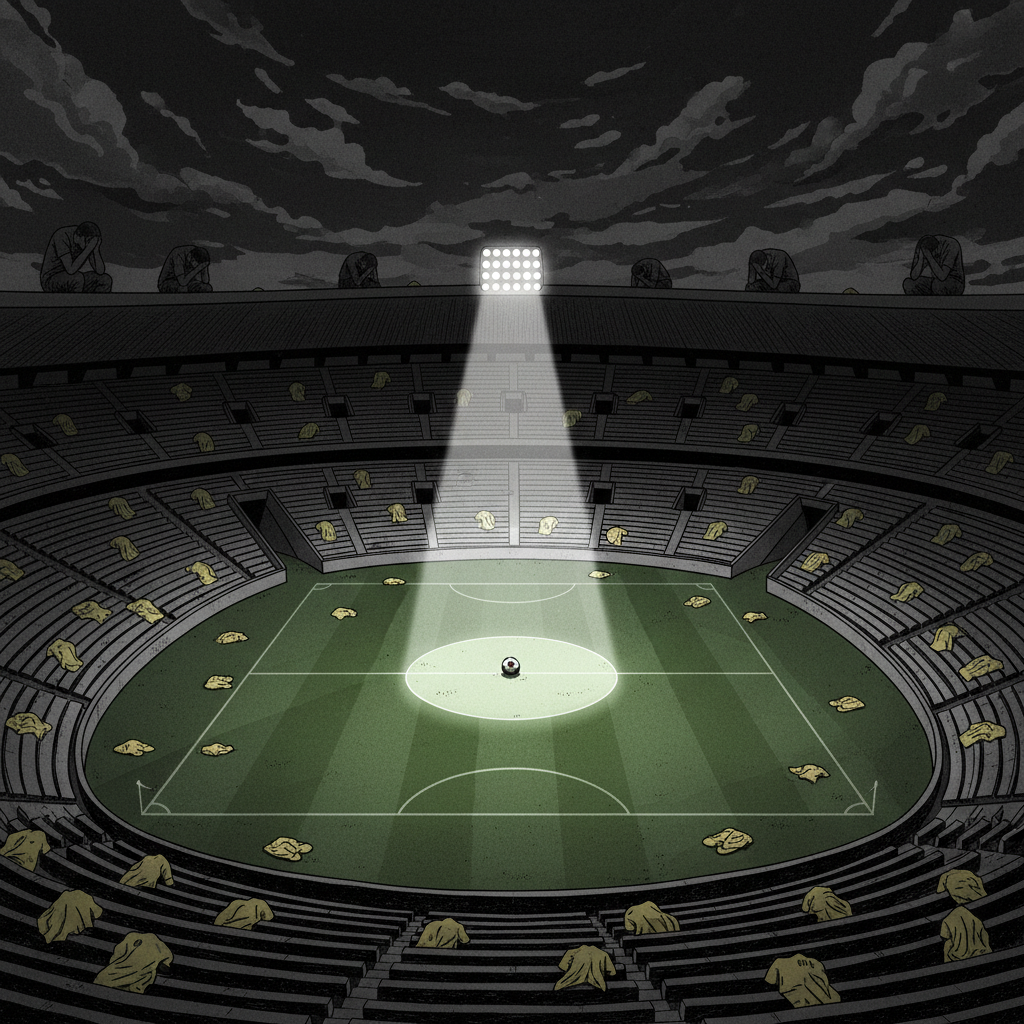
2014年ワールドカップ ブラジル7-1敗北
2014年7月8日、ブラジルはベロオリゾンテのエスタジオ・ミネイラオンで行われた2014 FIFAワールドカップ準決勝でドイツに歴史的な1-7の敗北を喫した。ブラジルでは「ミネイラッソ」として知られるこの試合で、ドイツは前半18分間で5得点を記録した。ホストチームは主要選手のネイマール(準々決勝での椎骨骨折)とキャプテンのチアゴ・シウバ(出場停止)を欠いていた。
エグゼクティブサマリー
2014年ワールドカップ準決勝のブラジル対ドイツ戦は、国家的危機に転じたサッカーの試合ではなく、サッカーの試合として表出した国家的危機であった。すべての分析的視点が同じ根本的な発見に収束する:7-1は過剰決定されていた。戦術的欠陥、心理的脆弱性、実存的重圧、文化的意義、メディアの増幅、政治的文脈——すべてが破局を指し示していた。
重要な事実
複数のソースからの検証済み事実、確信度レベルで評価
Germany defeated Brazil 7-1 in the 2014 FIFA World Cup semifinal on July 8, 2014, at Estádio Mineirão in Belo Horizonte.
highの確信度Germany's goals were scored by Thomas Müller (11'), Miroslav Klose (23'), Toni Kroos (24', 26'), Sami Khedira (29'), André Schürrle (69', 79'). Oscar scored Brazil's consolation goal in the 90th minute.
highの確信度Five goals were scored between the 11th and 29th minutes, with four goals in a six-minute span from the 23rd to 29th minute.
highの確信度Neymar suffered a fractured third lumbar vertebra from a knee-to-the-back challenge by Colombia's Juan Camilo Zúñiga in the 88th minute of the quarterfinal on July 4, 2014, ruling him out of the rest of the tournament.
highの確信度Captain Thiago Silva was suspended for the semifinal due to accumulation of two yellow cards. His appeal to FIFA was denied as having 'no legal basis.'
highの確信度Miroslav Klose's goal in the 23rd minute made him the all-time leading scorer in World Cup history with 16 goals, surpassing Brazil's Ronaldo who held the record with 15.
highの確信度Brazil's official World Cup spending was approximately $11.6 billion, making it the most expensive World Cup in history at that time.
highの確信度主要アクター
このイベントに関与する主要アクターとその行動および表明された利益
Luiz Felipe Scolari
individual- ›Selected 4-2-3-1 formation for semifinal despite missing key players
- ›Chose not to fundamentally alter tactical approach for Neymar/Thiago Silva absences
- ›Started Dante and Bernard as replacements
Joachim Löw
individual- ›Developed Germany's tactical system over 8 years since 2006
- ›Prepared specific pressing strategy to exploit Brazil's high defensive line
- ›Instructed team to ease off after 5-0 at halftime
Neymar
individual- ›Carried Brazil's attacking burden through the tournament as the team's talisman
- ›Suffered fractured third lumbar vertebra in quarterfinal vs. Colombia
- ›Watched the 7-1 from a hospital/recovery setting
Dilma Rousseff
individual- ›Defended World Cup spending as beneficial for Brazil's infrastructure and economy
- ›Oversaw security operations during 2013-2014 protests
- ›Won narrow re-election in October 2014
Não vai ter Copa protest movement
group- ›Organized mass protests during 2013 Confederations Cup and 2014 World Cup
- ›Coined and popularized the slogan 'Não vai ter Copa'
- ›Highlighted forced evictions and public spending priorities
リサーチとソース
イベントタイムライン
2007-10-30 to 2016-08-31
因果分析
政策、アクター、イベントが因果的にどのように結びついているかを示すインタラクティブグラフ。ノードをクリックして関係を探索できます。
因果ネットワーク
18ノード · 17接続
ノードを選択
グラフ内の任意のノードをクリックして、接続とレンズの視点を探索してください
根本原因
1クリティカルパス
7ステップレンズ分析
各レンズは独自の分析フレームワークを提供します。クリックして深い分析を展開してください。
ゲーム理論
Western Moderngame-theoryThe 7-1 was not merely a tactical defeat but a cascading equilibrium collapse. Brazil entered with a fragile strategy that required specific conditions (Neymar's creativity, Thiago Silva's organization, crowd momentum) to function. Germany systematically removed each support pillar, and once the strategic structure collapsed after the second goal, no rational recovery was possible. The game-theoretic lesson is that high-risk, high-reward strategies with single points of failure are catastrophically vulnerable to systematic opponents who identify and exploit those failure points.
行動条件付け分析
Western ModernpavlovThe 7-1 was a mass extinction event for Brazil's conditioned national football identity. Decades of reinforcement — five World Cup titles, generations of legendary players, cultural production around football supremacy — were shattered in 18 minutes. The psychological mechanism was identical to laboratory demonstrations of learned helplessness: after the third rapid goal, Brazilian players and fans alike ceased active coping and entered a state of passive acceptance. The subsequent reconditioning through dark humor was not merely a cultural quirk but a psychologically adaptive response — counter-conditioning the aversive stimulus with a new, less painful response. The 7-1 permanently altered Brazil's conditioned relationship with its own football identity.
ニーチェ的権力分析
Western ModernnietzscheThe 7-1 was the death of Brazilian football's god — the end of the foundational myth of inherent supremacy that had organized Brazilian national identity for generations. The Übermensch model (dependence on individual genius) was exposed as fatally fragile when tested against Germany's systematic will to power. The ensuing ressentiment was both existentially genuine and politically consequential, contributing to the broader crisis that culminated in Rousseff's impeachment. Brazil's dark humor response represents a remarkable form of amor fati — embracing the catastrophe as part of national identity rather than being destroyed by it.
マネーボール統計分析
Entertainment & SportsmoneyballThe statistical story of the 7-1 is a tale of two components. The first is a predictable tactical mismatch: removing Neymar (40% of attacking output) and Thiago Silva (the defensive organizer) from a team facing the most systematically prepared opponent in the tournament made a defeat statistically likely, with an expected margin of 2-3 goals. The second component is the 'trauma premium': the additional 3-4 goals that represent pure psychological collapse, visible in the data as defensive positioning errors, pass completion rate collapse, and pressing intensity dropping to near-zero between the 23rd and 40th minutes. The 7-1 was a 3-0 or 4-1 tactical defeat amplified into a 7-1 catastrophe by the psychological disintegration of a team and a stadium.
スポーツ社会学
Entertainment & Sportssports-sociologyThe 7-1 was not a football match but a sociological earthquake. Football in Brazil functions as a civil religion — the primary institution of national identity and cross-class solidarity. The Mineiraço shattered this institution's claim to sacredness, exposed the class dynamics of mega-event hosting that had been masked by football's unifying narrative, and produced a collective trauma that is sociologically unprecedented in its combination of magnitude (7-1), context (home soil), and stakes (national identity + $11B investment). The humor response was not trivial but a deeply rooted cultural survival mechanism: Brazil's centuries-old tradition of using laughter to process pain found its ultimate expression in the memes that followed the worst day in the nation's sporting history.
メディアナラティブ分析
Entertainment & Sportstalking-headThe 7-1 was narrated through four competing but interlocking media frames: Brazilian devastation, German restraint, international disbelief, and protest movement vindication. The Brazilian media's compressed narrative arc — from shock to humor in hours rather than months — reflected a culturally specific processing speed enabled by social media. The event's transformation into a permanent cultural meme ('7 a 1' as shorthand for catastrophic failure) demonstrates how media narrative construction can embed a sporting result into the permanent lexicon of a language and culture. Perhaps most remarkably, Germany's narrative restraint showed that even the victors recognized this was not a normal sporting triumph but a cultural event that required careful narrative handling.
市民影響評価
civilian-impactThe civilian impact of the 7-1 extended far beyond the emotional trauma of a football match. The event crystallized the contradictions of Brazil's mega-event model: $11.6 billion in public spending that produced luxury stadiums while displacing hundreds of thousands from favela communities, white elephant venues with no viable post-tournament use, and a political promise of national glory that was replaced by the worst humiliation in the country's sporting history. The 7-1 became the defining symbol of institutional failure that contributed to Dilma Rousseff's impeachment and discredited the model of mega-event-driven development for a generation. For the communities displaced to build stadiums they could never afford to enter, the 7-1 was not a sporting disaster but the final proof that they had been sacrificed for a spectacle that served everyone but them.
収束点
複数のレンズが類似した結論に達する箇所。堅牢性を示唆しています。
The 7-1 was overdetermined — multiple independent factors all pointed toward disaster
Every analytical lens identifies independent factors that made Brazil vulnerable to a catastrophic result. The tactical weakness without key players (game-theory, moneyball), the psychological fragility of conditioned expectations (pavlov), the existential weight of the 'country of football' identity (nietzsche, sports-sociology), and the political pressure of $11B in spending (civilian-impact) all created overlapping vulnerabilities. The convergence of all these factors simultaneously is what made the 7-1 historically unique rather than merely a bad result.
Germany's systematic approach defeated Brazil's talent-dependent model
Game-theory identifies Germany's dominant strategy of exploiting structural weaknesses. Moneyball quantifies the tactical asymmetry. Nietzsche frames it as Apollo defeating Dionysus. Sports-sociology contextualizes it as the end of the individual-genius model's supremacy. All four lenses agree that the 7-1 represented the triumph of a collective system over individual talent dependence.
The 18-minute spell was a psychological cascade, not merely a tactical collapse
Game-theory identifies the cascading equilibrium collapse. Pavlov identifies the learned helplessness response. Moneyball quantifies the 'trauma premium' — the gap between expected goals from tactical positioning and actual goals, representing the pure psychological disintegration component. All three agree that the 7-1 was approximately a 3-0 or 4-1 tactical defeat amplified into a 7-1 catastrophe by psychological collapse.
The 7-1 transcended sport to become a political and cultural event
All four lenses independently identify the 7-1 as an event that exceeded its sporting context. Nietzsche identifies the existential dimension. Sports-sociology identifies the civil religion dimension. Talking-head identifies the media narrative construction that elevated the event to national crisis status. Civilian-impact identifies the political consequences. The convergence confirms that the 7-1 cannot be understood as a football match alone.
生産的な緊張
レンズが意見を異にする箇所。検討に値する複雑さを明らかにしています。
起こりうる未来
レンズ分析から導出されたシナリオ。異なるフレームワークに基づいて何が展開するかもしれないか。
Brazilian football renaissance through systematic reform
Medium. Brazil's talent pipeline remains strong, but institutional resistance to systematic approaches is significant. The tension between jogo bonito tradition and tactical modernization has not been resolved.
The 7-1 becomes a fading cultural memory without institutional change
Medium-high. The humor response already began the process of normalizing the trauma. Future successes could complete the reconditioning process without addressing structural issues.
Permanent discrediting of the mega-event development model in Brazil
Medium. The Brazilian public's appetite for mega-events has been significantly reduced, but economic pressures and political opportunism could override this skepticism in the future.
主要な問い
分析後も残る未解決の問い。継続的な探求のために。
- ?What specific tactical adjustments, if any, did Scolari make at halftime when the score was already 5-0?
- ?What were the exact economic downstream effects of World Cup spending — did any infrastructure investments produce measurable long-term benefits?
- ?How many of the 12 World Cup stadiums are currently in regular use versus functioning as white elephants?
ファクトチェック詳細
ファクトチェック結果
verifiedメタ観察
All seven lenses analyze the 7-1 from the perspective of Brazil's failure, with Germany's achievement treated as a backdrop rather than a story in its own right. Germany's 2014 World Cup victory — the culmination of 14 years of systematic development — deserves its own multi-lens analysis as one of the greatest achievements in football history. By centering the 7-1 on Brazilian trauma, we risk reducing Germany's triumph to a supporting role in someone else's tragedy.
The 7-1 resists reduction to any single explanatory framework because it operates simultaneously across tactical, psychological, cultural, political, and sociological dimensions. Any lens that claims to fully explain the event is necessarily incomplete. The genuine understanding of the 7-1 requires holding all seven perspectives simultaneously — not synthesizing them into a single narrative but allowing them to remain in productive tension.
We should be honest about what we cannot know. We cannot know what would have happened with Neymar and Thiago Silva present. We cannot precisely separate the tactical from the psychological component of the scoreline. We cannot definitively determine whether the 7-1 'caused' political change or merely symbolized existing trends. We cannot know whether future generations will remember the 7-1 as a defining national trauma or a fading sporting anecdote. The 7-1 teaches epistemic humility: some events are too complex, too overdetermined, and too deeply embedded in their cultural context to be fully explained by any analytical framework.
あなたの視点を見つける
異なるフレームワークは異なる読者に響きます。あなたの入口を見つけてください。
Readers who approach the 7-1 as a tactical and statistical puzzle — wanting to understand the mechanics of how five goals happened in 18 minutes and what the data reveals about the underlying quality difference between the teams.
The 7-1 was approximately a 3-0 tactical defeat amplified into a 7-1 by psychological collapse. Germany's dominant strategy exploited specific, identifiable weaknesses created by Brazil's missing players. The match was a statistical outlier (4-5 sigma) driven by the interaction between tactical inferiority and psychological cascade.
Readers who feel the 7-1 as a cultural and emotional event — who understand that football in Brazil is not just a sport but a structure of meaning, and that the 7-1 shattered something fundamental about Brazilian self-understanding.
The 7-1 was the death of a foundational national myth. Decades of conditioned belief in Brazilian football supremacy were extinguished in 18 minutes. Football functions as a civil religion in Brazil, and the 7-1 was a desecration of the sacred. The dark humor response was a culturally specific form of amor fati — embracing catastrophe rather than being destroyed by it.
Readers who see the 7-1 as a political and institutional event — the culmination of misplaced spending priorities, government overreach, and institutional failure that was expressed through but not limited to a football match.
The $11.6B World Cup spending displaced hundreds of thousands, created white elephant stadiums, and was justified by a promise of national glory that the 7-1 destroyed. The political downstream contributed to Rousseff's impeachment. The media narrative was constructed differently across four perspectives (devastation, restraint, disbelief, vindication), each serving different institutional interests.
Readers skeptical of the grander narratives who want to strip the 7-1 back to its sporting fundamentals: a team missing two key players lost badly to a better-prepared opponent. The cultural and political overlay, while real, risks obscuring the straightforward sporting explanation.
Much of what happened can be explained by standard tactical analysis: Brazil's defensive disorganization without Thiago Silva, the creative void without Neymar, and Germany's clinical exploitation of predictable weaknesses. The 7-1 was extraordinary in degree but not in kind — football produces heavy defeats when one team is significantly weakened and the other is at peak preparation.
Start with the analytical cluster (game-theory, moneyball) to understand what happened mechanically, then layer the intuitive cluster (pavlov, nietzsche, sports-sociology) to understand why it mattered so deeply, and finally add the institutional cluster (civilian-impact, talking-head) to understand the broader consequences. The 7-1 requires all three perspectives to be fully comprehended — it was a tactical failure, an existential crisis, and a political turning point, all simultaneously.
関連分析
類似のレンズやカテゴリーを通して分析された他のイベント
アラブの春は2010年12月からアラブ世界を席巻いた抵抗運動、蜂起、武装反乱の革命的な波であった。2010年12月17日にチュニジアの路上販売人モハメド・ブアジジの焼身自殺が引き金となった。「الشعب يريد إسقاط النظام」(人民は体制の崩壊を望む)というスローガンがチュニスからカイロ、ベンガジからダマスカスまで響き渡った。軍の選択——デモ参加者の側につくか体制に忠誠であり続けるか——が各国で決定的な変数となった。
1994年4月6日から7月18日の間に、ルワンダで約80万人のツチ族と穏健派フツ族が100日間で組織的に殺害されました——近代史上最も効率的な大量殺戴であり、ホロコーストを上回る1日あたりの死亡率でした。このジェノサイドは「古代の部族間憾恶」の爆発ではなく、植民地計画の破滅的結末でした:ベルギーの管理者たちは1933年の国勢調査と義務的な民族身分証明書を通じて、流動的な社会的アイデンティティから硬直的な人種カテゴリーを製造しました。RTLMラジオ——「ラジオ・マシェテ」——は何年もの非人間化プロパガンダを通じて体系的に住民を条件付けしました。25万人から50万人の女性がジェノサイドの意図的な武器として強姦されました。国際社会の失敗は受動的ではなく能動的でした:ダレールは3か月前に警告を送り、5,000人の兵士を要請し、拒否されました。RPFの軍事的勝利は1994年7月にジェノサイドを終結させましたが、余波は第一次コンゴ戦争(1996-97)と500万人以上が死亡した「アフリカの世界大戦」に波及しました。
1986年4月26日午前1時23分、ウクライナ・ソビエト社会主義共和国のチェルノブイリ原子力発電所4号炉が安全試験中に爆発し、広島原爆の400倍の放射性物質を放出した。ソ連当局は当初この大惨事を隠蔽し、プリピャチの住民49,000人に36時間にわたり通常の生活を続けさせた。約60万人の「リクビダートル(除染作業員)」が動員された。死亡者数の推定はWHOの4,000人からグリーンピースの93,000人まで幅がある。この惨事はソ連の技術的優位という神話を打ち砕き、ゴルバチョフにグラスノスチを余儀なくさせた。
この分析の方法
分析プロセス、ツール、および限界についての完全な透明性
Crosslightエンジン
v0.4.0 "Global Lens Expansion"- ⚠Non-Western philosophical lenses rely on translated primary texts — nuance may be lost in translation
- ⚠Some traditions (e.g., Maat, Ubuntu) have limited surviving primary texts; analysis draws on scholarly reconstruction
- ⚠Cross-cultural lens application is inherently interpretive — a Confucian reading of a Western event is an analytical exercise, not a claim of cultural authority
分析統計
方法論
この分析はCrosslightマルチエージェントパイプラインによって生成されました。リサーチエージェントが複数のソースから事実を収集・検証し、専門化されたレンズエージェントが個別の分析フレームワークを適用し、統合エージェントが洞察を統合してパターンを特定し、ファクトチェックエージェントが主張を検証しました。各レンズの視点はAIによる解釈であり、機関としての推薦ではありません。詳しく見る →