
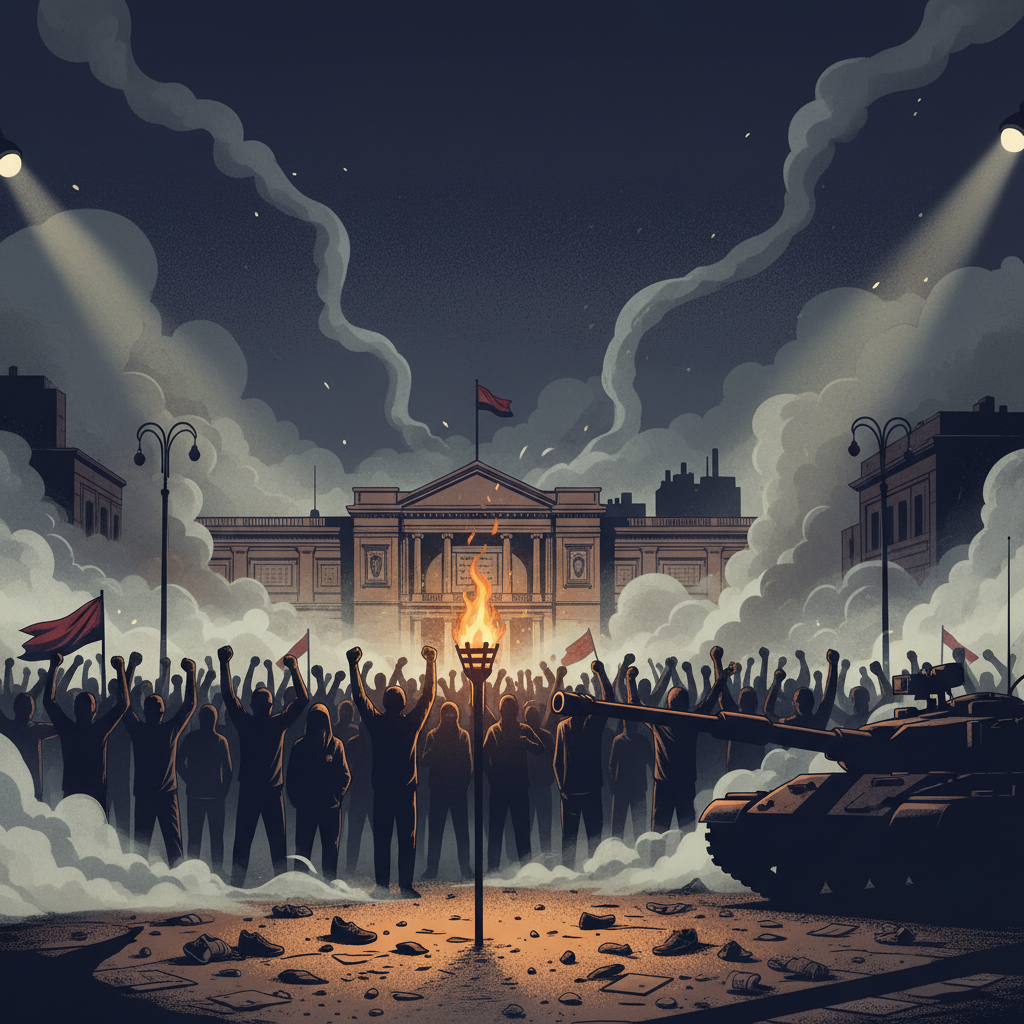
아랍의 봄 2011
아랍의 봄은 2010년 12월부터 아랍 세계를 휘쓸은 시위, 봉기, 무장 반란의 혁명적 물결이었다. 2010년 12월 17일 튜니지 노점상 모하메드 부아지지의 분신자살로 촉발되었다. "الشعب يريد إسقاط النظام" (국민은 체제의 붕괴를 원한다)라는 구호가 튜니스에서 카이로, 벤가지에서 다마스쿠스까지 울려 퍼졌다. 군의 선택—시위대 편에 설 것인가 체제에 충성할 것인가—이 모든 나라에서 결정적 변수임이 입증되었다.
요약
7가지 분석적 시각이 핵심 발견에 수렴한다: 아랍의 봄은 수십 년간 억압된 인간의 염원이 불가피하게 폭발한 것이었지만, 그 결과는 수백만 명의 염원이 아니라 군사 엘리트의 제도적 계산과 외부 세력의 전략적 개입에 의해 결정되었다.
핵심 사실
다중 소스 리서치에서 검증된 사실, 신뢰도 수준별 평가
Mohamed Bouazizi, a 26-year-old street vendor in Sidi Bouzid, Tunisia, set himself on fire on December 17, 2010, after his produce cart was confiscated and he was humiliated by a municipal official. He died of his injuries on January 4, 2011.
high 신뢰도Tunisian President Zine El Abidine Ben Ali fled to Saudi Arabia on January 14, 2011, ending his 23-year rule. Tunisia's military refused to fire on protesters.
high 신뢰도Mass protests began in Egypt on January 25, 2011 (the 'Day of Rage'), centering on Tahrir Square in Cairo. President Hosni Mubarak resigned on February 11, 2011, after 30 years in power.
high 신뢰도Egypt's Supreme Council of the Armed Forces (SCAF) sided with protesters and forced Mubarak's resignation, protecting the military's extensive economic and institutional interests.
high 신뢰도Mohamed Morsi of the Muslim Brotherhood won Egypt's first free presidential election in June 2012. He was removed by a military coup led by General Abdel Fattah al-Sisi on July 3, 2013.
high 신뢰도Protests against Muammar Gaddafi began in Benghazi, Libya on February 15, 2011. UN Security Council Resolution 1973 authorized a no-fly zone. NATO intervened militarily beginning March 19, 2011. Gaddafi was captured and killed on October 20, 2011.
high 신뢰도Anti-government protests began in Daraa, Syria in mid-March 2011 after schoolchildren were detained for anti-regime graffiti. The Assad regime responded with military force, escalating into civil war.
high 신뢰도주요 행위자
이 사건에 관련된 주요 행위자와 그들의 행동 및 공식적 이해관계
Mohamed Bouazizi
individual- ›Set himself on fire on December 17, 2010 in Sidi Bouzid, Tunisia
Hosni Mubarak
individual- ›Imposed curfew and deployed military to streets
- ›Shut down internet and mobile communications
- ›Resigned on February 11, 2011
Muammar Gaddafi
individual- ›Ordered military to suppress protests violently
- ›Threatened to 'cleanse Libya house by house'
- ›Fought NATO intervention until captured and killed
Bashar al-Assad
individual- ›Deployed military against civilian protesters
- ›Used barrel bombs and chemical weapons against civilian areas
- ›Relied on Iranian and Russian military support
Al Jazeera
organization- ›Provided 24/7 satellite coverage of Arab Spring protests across the region
- ›Amplified protest movements through pan-Arab broadcasts reaching millions
- ›Created a shared narrative space across Arab-speaking populations
리서치 및 출처
사건 타임라인
2010-12-17 to 2015-09-01
인과 분석
정책, 행위자, 사건이 인과적으로 어떻게 연결되는지 보여주는 인터랙티브 그래프 — 노드를 클릭하여 관계를 탐색하세요
인과 네트워크
21개 노드 · 18개 연결
노드 선택
그래프에서 노드를 클릭하여 연결과 렌즈 관점을 탐색하세요
근본 원인
3핵심 경로
9단계렌즈 분석
각 렌즈는 독자적인 분석 프레임워크를 제공합니다 — 클릭하여 심층 분석을 펼쳐보세요
게임 이론
Western Moderngame-theoryThe Arab Spring was a massive multi-player sequential game where each country's outcome changed the information set for all other players. Tunisia's success solved the collective action problem by demonstrating that revolution was possible — but the game-theoretic insight is that the same initial shock (popular uprising) produced radically different outcomes depending on one variable: whether the military's institutional interests were better served by defecting from or remaining loyal to the regime. This is the 'military kingmaker' dynamic — not a bug in the revolutionary wave but the fundamental strategic variable that determined winners and losers.
마키아벨리
Greco-Roman & ClassicalmachiavelliThe Arab Spring is a masterclass in Machiavellian power dynamics: it demonstrated that power built solely on fear collapses catastrophically when the fear barrier breaks. The military — not the people, not social media, not Western intervention — was the prince-maker in every country. Where the military calculated that its institutional interests were better served by sacrificing the ruler (Tunisia, Egypt), transitions were relatively peaceful. Where the military's survival was bound to the regime (Syria's Alawite officers, Bahrain's Sunni security forces), the result was either civil war or brutal suppression. The tragedy of the Arab Spring, in Machiavellian terms, is that destroying the old order proved far easier than building a new one. As Machiavelli warned: 'There is nothing more difficult to take in hand, more perilous to conduct, or more uncertain in its success, than to take the lead in the introduction of a new order of things.'
CIA 정보 평가
Western InstitutionalciaThe Arab Spring exposed the central paradox of US intelligence engagement in the Middle East: the very authoritarian relationships that provided counter-terrorism intelligence created the conditions for the revolutionary explosions that destroyed those relationships. The CIA's partnerships with Mubarak's GIS, Ben Ali's secret police, and Gaddafi's reformed intelligence services gave the US excellent visibility into specific terrorist networks but no understanding of the structural rage building across Arab societies. The intelligence failure was not in the collection but in the analytical framework — the inability to see that 'stable authoritarian allies' was a contradiction in terms, and that the suppressed frustrations of millions of young Arabs constituted a strategic threat greater than any specific terrorist organization.
파블로프 조건화 분석
Western ModernpavlovThe Arab Spring demonstrates that authoritarian control based on conditioned fear is inherently fragile: it works perfectly until it doesn't, and when it fails, it fails catastrophically. Decades of conditioning created a population that appeared compliant but was actually a pressure cooker of suppressed frustration. Bouazizi's act served as the extinction trial that demonstrated the old contingency no longer held. Al Jazeera's broadcasts generalized this extinction across the Arab world. But conditioning theory also explains the tragedy: it is far easier to extinguish a fear response (stop obeying) than to condition new constructive behaviors (build democratic institutions). The Arab Spring succeeded as mass behavioral de-conditioning — the fear was broken — but failed as re-conditioning toward democratic habits, which require years of consistent reinforcement that the post-revolutionary environment could not provide.
니체 분석
Western ModernnietzscheThe Arab Spring was a revolt of dignity — ثورة الكرامة — and Nietzsche's philosophy provides the deepest reading of what dignity means in this context. It was not merely a demand for political rights but an existential assertion: the refusal to accept humiliation as the human condition. Bouazizi's act was the purest expression of will against a system that had crushed all will. The tragedy is Nietzsche's own warning: destruction of the old order is the easy part. The hard part — the creation of new values, the emergence of what Nietzsche would call higher types of human organizing — requires precisely the kind of patient, creative work that revolutionary energy cannot sustain. The Arab Spring proved that the will to power can topple any regime, but it cannot, by itself, build what comes next.
도가 분석
East AsiantaoismThe Arab Spring is the Tao's most powerful modern demonstration of the principle of reversal (反, fan): whatever reaches an extreme produces its opposite. Decades of authoritarian rigidity (extreme yang) produced explosive revolutionary energy (extreme yin). Regimes that gripped tighter fell faster — Gaddafi's 42 years of iron control shattered into state collapse; Assad's brutal suppression produced the century's worst humanitarian disaster. Regimes that bent survived — Morocco's limited reforms, Jordan's modest concessions. The Tao's deepest insight about the Arab Spring is this: the revolutionary wave moved not through strategic coordination but through the natural resonance of shared grievances, flowing like water through every crack in authoritarian structures. It could not be stopped because it was not being directed — it was the Tao itself, the natural flow of suppressed human aspiration finding expression. But the Tao also teaches that water, unconstrained, floods and destroys. The Arab Spring's devastation in Libya and Syria is water without banks — natural force without the channels needed to direct it constructively.
민간인 영향 평가
civilian-impactThe Arab Spring's civilian impact reveals the terrible disproportion between revolutionary aspiration and human cost. Millions of people demanded nothing more than dignity, economic opportunity, and an end to corruption — the most basic human aspirations. In Tunisia, these aspirations were achieved at relatively low cost. In Syria, the same aspirations produced the worst humanitarian catastrophe of the 21st century. The difference was not in what civilians wanted or how they protested, but in the structural variables they could not control: military loyalty, sectarian composition, external intervention, and the willingness of rulers to destroy their own countries rather than relinquish power. The most devastating finding of this analysis is that the people who suffered most — Syrian civilians — had the least agency in determining their fate. They were caught between a regime willing to use chemical weapons, an opposition that fragmented into rival militias, external powers pursuing strategic interests, and a jihadist movement (ISIS) that exploited the chaos. The Arab Spring's human cost is not a story of failed revolution — it is a story of civilians trapped in conflicts they did not choose, determined by forces they could not influence.
수렴점
여러 렌즈가 유사한 결론에 도달하는 지점 — 분석의 견고성을 시사합니다
Military loyalty as the decisive variable
All four lenses independently identify the military's institutional choice as the factor that determined whether revolutions succeeded peacefully, devolved into civil war, or were crushed. This is the single strongest convergence across all analyses.
Authoritarian stability is inherently fragile
Game theory shows that fear-based equilibria collapse when the punishment mechanism fails. Pavlov shows that conditioned fear extinguishes when the contingency breaks. Taoism shows that rigid systems produce their own reversal. CIA learned that 'stable authoritarian allies' was a strategic delusion. All agree: apparent authoritarian stability masks fragility.
Destruction of old orders is easier than construction of new ones
Machiavelli warned that establishing new orders is the most difficult political undertaking. Nietzsche identifies the Ubermensch problem — revolutions lack creative vision for what comes after. Taoism sees unconstrained water (revolution without institutional channels) as destructive. Civilian impact documents the human cost of this gap between destruction and construction.
생산적 긴장
렌즈들이 의견을 달리하는 지점 — 검토할 가치가 있는 복잡성을 드러냅니다
가능한 미래
렌즈 분석으로부터 도출된 시나리오 — 다양한 프레임워크에 기반하여 전개될 수 있는 상황
Second wave of Arab uprisings driven by unresolved structural grievances
Medium — the structural conditions remain, but the memory of Syria's catastrophe acts as a powerful deterrent
Authoritarian adaptation and tech-enabled control prevent future uprisings
Medium-high — authoritarian regimes have invested heavily in learning from the Arab Spring's failures
Tunisia's democratic path consolidates and gradually influences the region
Low — Tunisia's own democracy has faced setbacks since 2021 (Kais Saied's power concentration)
핵심 질문
분석 후에도 미해결로 남은 질문들 — 지속적인 탐구를 위해
- ?What was the precise role of Gulf intelligence services in funding and directing various factions?
- ?To what extent did Al Jazeera's editorial decisions shape the direction of the Arab Spring?
- ?What were the internal deliberations within military high commands that determined their choices?
팩트체크 상세
팩트체크 결과
verified메타 관찰
All seven lenses are fundamentally retrospective — they analyze what happened and why, but none fully captures the lived experience of revolutionary hope before it turned to despair. The Arab Spring was, for millions of people, the most exhilarating experience of their lives — a moment of collective agency and shared purpose that cannot be reduced to strategic calculation, conditioning, or power dynamics. That hope, even though it was largely betrayed by outcomes, was real and transformative for those who experienced it.
The Arab Spring involves simultaneous causation at multiple scales — individual psychology (Bouazizi), institutional dynamics (military choices), regional contagion (media amplification), and global geopolitics (external intervention) — that cannot be adequately captured by any single analytical framework. The seven lenses together approach a more complete picture, but the full complexity of a revolutionary wave affecting 300+ million people across 20 countries over five years exceeds any analytical capacity.
The Arab Spring humbled every analytical framework that tried to predict or explain it in real time. Intelligence agencies did not predict it. Academic experts did not anticipate its trajectory. No single theory — rational choice, structuralism, constructivism, or any other — captured the full dynamic. This analysis, with its seven lenses, is an attempt to triangulate toward truth, but the reader should hold all conclusions with appropriate humility.
자신의 관점 찾기
다양한 프레임워크는 독자에 따라 다르게 공명합니다 — 자신에게 맞는 진입점을 찾아보세요
Readers who see the Arab Spring primarily through strategic dynamics, institutional calculations, and power politics — who ask 'what were the incentives?' and 'who benefited?'
The military kingmaker dynamic and the failure of intelligence frameworks to predict popular uprisings
Readers who see the Arab Spring as an expression of deep human aspirations — dignity, freedom, natural flow against artificial constraint — and who feel the movement's moral power
The revolt of dignity and the paradox of control — regimes that gripped tighter fell faster
Readers focused on power structures, institutional dynamics, and the concrete consequences of political action — who ask 'what happened to real people?' and 'who holds power?'
The gap between revolutionary aspiration and institutional capacity to build new orders, and the devastating human cost of that gap
Readers skeptical of grand narratives who focus on mechanisms, costs, and unintended consequences — who ask 'how did it actually spread?' and 'what was the real price?'
The conditioning dynamics that made the wave possible and the cruel arithmetic of human suffering across the spectrum
Start with the lens that resonates most, then deliberately read the lens that challenges your assumptions. If you see strategic rationality (game-theory), read the existential dimension (nietzsche). If you feel the moral power of the movement (nietzsche), confront the human cost (civilian-impact). The Arab Spring's full truth lives in the tension between these perspectives, not in any single lens.
관련 분석
유사한 렌즈나 카테고리를 통해 분석된 다른 사건들
1986년 4월 26일 오전 1시 23분, 우크라이나 소비에트 사회주의 공화국의 체르노빌 원자력 발전소 4호기가 안전 시험 중 폭발하여 히로시마 원폭의 400배에 달하는 방사성 물질을 방출했다. 소련 당국은 처음에 재앙을 은폐하여 프리피야트 주민 49,000명이 36시간 동안 정상 생활을 계속하도록 강요했다. 약 60만 명의 '리크비다토르(청소부대)'가 투입되었다. 사망자 추정치는 WHO의 4,000명에서 그린피스의 93,000명까지 다양하다.
1994년 4월 6일부터 7월 18일까지 100일 동안 르완다에서 약 80만 명의 투치족과 온건파 후투족이 체계적으로 학살되었습니다 — 근대 역사상 가장 효율적인 대량 학살이며 홀로코스트보다 높은 일일 사망률을 기록했습니다. 이 제노사이드는 '고대 부족 적대감'의 폭발이 아니라 식민 프로젝트의 파멸적 결말이었습니다: 벨기에 관리자들이 1933년 인구조사와 의무적 민족 신분증을 통해 유동적인 사회적 정체성에서 경직된 인종 범주를 제조했습니다. RTLM 라디오 — '라디오 마쉐테' — 는 수년간의 비인간화 선전을 통해 체계적으로 인구를 조건화했습니다. 25만~50만 명의 여성이 제노사이드의 의도적 무기로 강간당했습니다. 국제사회의 실패는 능동적이었습니다: 달레르는 3개월 전 경고를 보냈고, 5,000명의 병력을 요청했으며, 거부당했습니다. RPF의 군사적 승리는 1994년 7월 제노사이드를 종식시켰지만, 여파는 제1차 콩고 전쟁(1996-97)과 500만 명 이상이 사망한 '아프리카의 세계대전'으로 확산되었습니다.
1963년 11월 22일, 존 F. 케네디 대통령이 텍사스주 달라스 딜리 광장에서 암살되었다. 리 하비 오즈월드가 체포되었으나 재판 전 잭 루비에게 살해되었다. 워런 위원회는 오즈월드가 단독으로 행동했다고 결론지었으나, 하원특별위원회(HSCA)는 이후 공모 가능성이 있다는 결론을 내렸다. 2025년까지 기밀 해제된 문서들은 CIA와 FBI의 제도적 은폐를 드러내며, 이 사건은 미국 역사상 가장 중대한 미해결 사건으로 남아 있다.
분석 방법
분석 프로세스, 도구, 한계에 대한 완전한 투명성
Crosslight 엔진
v0.4.0 "Global Lens Expansion"- ⚠Non-Western philosophical lenses rely on translated primary texts — nuance may be lost in translation
- ⚠Some traditions (e.g., Maat, Ubuntu) have limited surviving primary texts; analysis draws on scholarly reconstruction
- ⚠Cross-cultural lens application is inherently interpretive — a Confucian reading of a Western event is an analytical exercise, not a claim of cultural authority
분석 통계
방법론
이 분석은 Crosslight 다중 에이전트 파이프라인에 의해 생성되었습니다. 리서치 에이전트가 여러 출처로부터 사실을 수집하고 검증하였으며, 전문화된 렌즈 에이전트가 각각의 분석 프레임워크를 적용하였고, 종합 에이전트가 인사이트를 통합하여 패턴을 파악하였으며, 팩트체크 에이전트가 주장을 검증하였습니다. 각 렌즈의 관점은 AI의 해석이며 — 기관의 공식 입장을 대변하지 않습니다.더 알아보기 →