
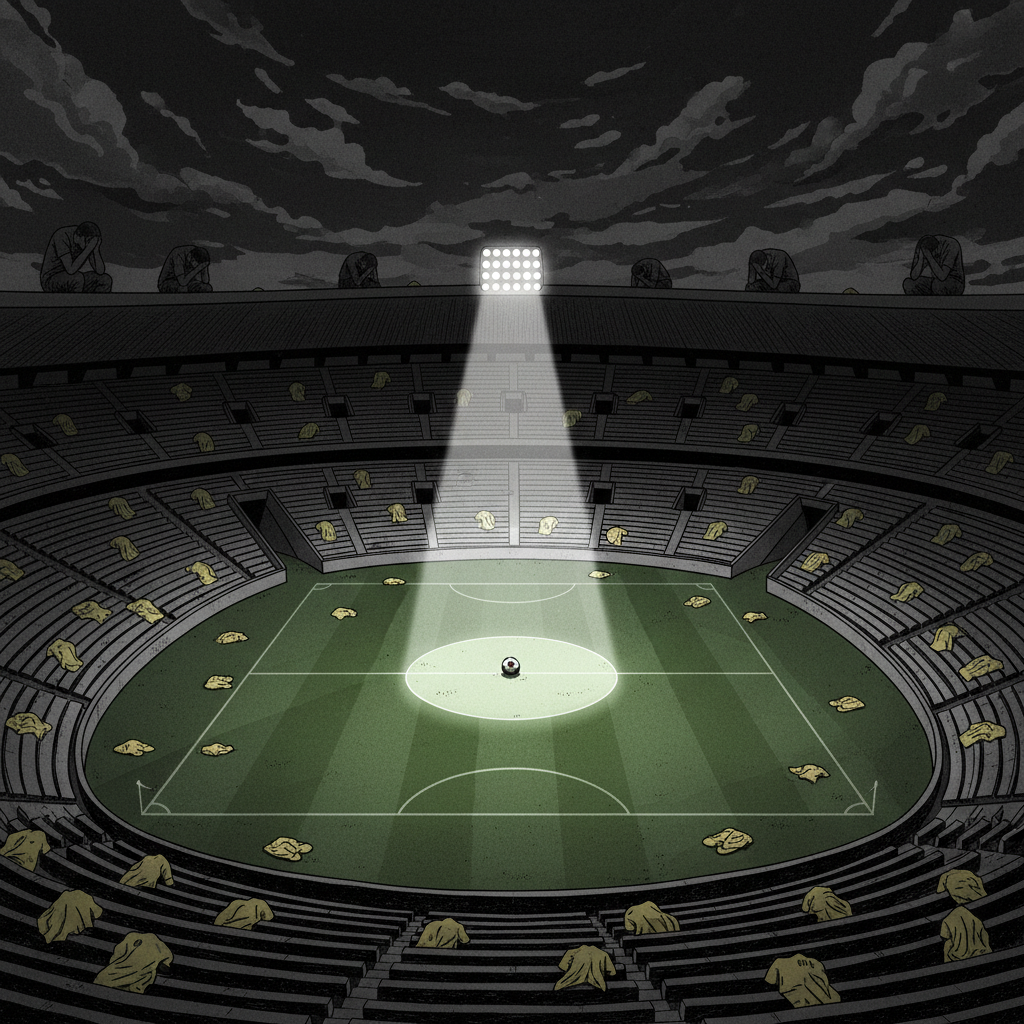
Derrota do Brasil por 7 a 1 na Copa do Mundo de 2014
Em 8 de julho de 2014, o Brasil sofreu uma histórica derrota de 7 a 1 para a Alemanha na semifinal da Copa do Mundo FIFA 2014, no Estádio Mineirão, em Belo Horizonte. A partida, conhecida no Brasil como o 'Mineiraço', viu a Alemanha marcar cinco gols em 18 minutos no primeiro tempo, com os anfitriões sem os jogadores-chave Neymar (vértebra fraturada nas quartas de final) e o capitão Thiago Silva (suspenso). O resultado foi a pior derrota da história do Brasil em Copas do Mundo e se tornou um momento de trauma nacional, expondo as tensões entre os R$ 26 bilhões gastos pelo Brasil na Copa e seus serviços públicos deficientes, em meio ao movimento de protesto 'Não vai ter Copa'. A repercussão política contribuiu para a narrativa de incompetência governamental que culminou no impeachment da presidente Dilma Rousseff em 2016.
Resumo Executivo
A semifinal da Copa do Mundo de 2014 entre Brasil e Alemanha não foi uma partida de futebol que se tornou uma crise nacional — foi uma crise nacional que se expressou como uma partida de futebol. Todas as perspectivas analíticas convergem para a mesma conclusão fundamental: o 7 a 1 era sobredeterminado. O déficit tático (teoria dos jogos, moneyball), a fragilidade psicológica (pavlov), o peso existencial (nietzsche), o significado cultural (sociologia do esporte), a amplificação midiática (talking-head) e o contexto político (impacto civil) apontavam para a catástrofe. O que tornou o 7 a 1 historicamente único não foi que qualquer fator isolado estivesse presente — todas as derrotas esportivas envolvem dinâmicas táticas e psicológicas — mas que TODOS os fatores se alinharam simultaneamente, criando uma tempestade perfeita de vulnerabilidade que a preparação sistemática da Alemanha explorou com eficiência implacável. Os 18 minutos que produziram cinco gols foram o momento em que forças táticas, psicológicas, culturais, políticas e sociológicas convergiram em um único resultado catastrófico. O rescaldo revelou que o 7 a 1 era um teste de Rorschach: cada observador via o que sua estrutura analítica previa. Para teóricos dos jogos, foi um colapso em cascata de equilíbrio. Para behavioristas, foi desamparo aprendido sob estimulação aversiva avassaladora. Para nietzschianos, foi a morte de um mito fundacional. Para estatísticos, foi um outlier de 4-5 sigma impulsionado por fatores psicológicos em vez de táticos. Para sociólogos, foi a profanação de uma religião civil. Para analistas de mídia, foi uma experiência global compartilhada que demonstrou o poder das redes sociais de criar narrativas coletivas em tempo real. Para analistas de impacto civil, foi o símbolo máximo de fracasso institucional e prioridades nacionais equivocadas. Todos estão certos. O 7 a 1 foi tudo isso simultaneamente.
Fatos-Chave
Fatos verificados de pesquisa multifonte, classificados por nivel de confianca
Germany defeated Brazil 7-1 in the 2014 FIFA World Cup semifinal on July 8, 2014, at Estádio Mineirão in Belo Horizonte.
Confianca highGermany's goals were scored by Thomas Müller (11'), Miroslav Klose (23'), Toni Kroos (24', 26'), Sami Khedira (29'), André Schürrle (69', 79'). Oscar scored Brazil's consolation goal in the 90th minute.
Confianca highFive goals were scored between the 11th and 29th minutes, with four goals in a six-minute span from the 23rd to 29th minute.
Confianca highNeymar suffered a fractured third lumbar vertebra from a knee-to-the-back challenge by Colombia's Juan Camilo Zúñiga in the 88th minute of the quarterfinal on July 4, 2014, ruling him out of the rest of the tournament.
Confianca highCaptain Thiago Silva was suspended for the semifinal due to accumulation of two yellow cards. His appeal to FIFA was denied as having 'no legal basis.'
Confianca highMiroslav Klose's goal in the 23rd minute made him the all-time leading scorer in World Cup history with 16 goals, surpassing Brazil's Ronaldo who held the record with 15.
Confianca highBrazil's official World Cup spending was approximately $11.6 billion, making it the most expensive World Cup in history at that time.
Confianca highAtores-Chave
Principais atores envolvidos neste evento com suas acoes e interesses declarados
Luiz Felipe Scolari
individual- ›Selected 4-2-3-1 formation for semifinal despite missing key players
- ›Chose not to fundamentally alter tactical approach for Neymar/Thiago Silva absences
- ›Started Dante and Bernard as replacements
Joachim Löw
individual- ›Developed Germany's tactical system over 8 years since 2006
- ›Prepared specific pressing strategy to exploit Brazil's high defensive line
- ›Instructed team to ease off after 5-0 at halftime
Neymar
individual- ›Carried Brazil's attacking burden through the tournament as the team's talisman
- ›Suffered fractured third lumbar vertebra in quarterfinal vs. Colombia
- ›Watched the 7-1 from a hospital/recovery setting
Dilma Rousseff
individual- ›Defended World Cup spending as beneficial for Brazil's infrastructure and economy
- ›Oversaw security operations during 2013-2014 protests
- ›Won narrow re-election in October 2014
Não vai ter Copa protest movement
group- ›Organized mass protests during 2013 Confederations Cup and 2014 World Cup
- ›Coined and popularized the slogan 'Não vai ter Copa'
- ›Highlighted forced evictions and public spending priorities
Pesquisa e Fontes
Linha do Tempo do Evento
2007-10-30 to 2016-08-31
Analise Causal
Grafo interativo mostrando como politicas, atores e eventos se conectam causalmente — clique nos nos para explorar relacoes
REDE CAUSAL
18 nos · 17 conexoes
Selecione um no
Clique em qualquer no do grafo para explorar suas conexoes e perspectivas de lentes
Causas Raiz
1Caminho Critico
7 etapasAnalises por Lente
Cada lente fornece uma estrutura analitica unica — clique para expandir a analise profunda
Teoria dos Jogos
Western Moderngame-theoryThe 7-1 was not merely a tactical defeat but a cascading equilibrium collapse. Brazil entered with a fragile strategy that required specific conditions (Neymar's creativity, Thiago Silva's organization, crowd momentum) to function. Germany systematically removed each support pillar, and once the strategic structure collapsed after the second goal, no rational recovery was possible. The game-theoretic lesson is that high-risk, high-reward strategies with single points of failure are catastrophically vulnerable to systematic opponents who identify and exploit those failure points.
Análise de Condicionamento Comportamental
Western ModernpavlovThe 7-1 was a mass extinction event for Brazil's conditioned national football identity. Decades of reinforcement — five World Cup titles, generations of legendary players, cultural production around football supremacy — were shattered in 18 minutes. The psychological mechanism was identical to laboratory demonstrations of learned helplessness: after the third rapid goal, Brazilian players and fans alike ceased active coping and entered a state of passive acceptance. The subsequent reconditioning through dark humor was not merely a cultural quirk but a psychologically adaptive response — counter-conditioning the aversive stimulus with a new, less painful response. The 7-1 permanently altered Brazil's conditioned relationship with its own football identity.
Análise de Poder Nietzschiana
Western ModernnietzscheThe 7-1 was the death of Brazilian football's god — the end of the foundational myth of inherent supremacy that had organized Brazilian national identity for generations. The Übermensch model (dependence on individual genius) was exposed as fatally fragile when tested against Germany's systematic will to power. The ensuing ressentiment was both existentially genuine and politically consequential, contributing to the broader crisis that culminated in Rousseff's impeachment. Brazil's dark humor response represents a remarkable form of amor fati — embracing the catastrophe as part of national identity rather than being destroyed by it.
Análise Estatística Moneyball
Entertainment & SportsmoneyballThe statistical story of the 7-1 is a tale of two components. The first is a predictable tactical mismatch: removing Neymar (40% of attacking output) and Thiago Silva (the defensive organizer) from a team facing the most systematically prepared opponent in the tournament made a defeat statistically likely, with an expected margin of 2-3 goals. The second component is the 'trauma premium': the additional 3-4 goals that represent pure psychological collapse, visible in the data as defensive positioning errors, pass completion rate collapse, and pressing intensity dropping to near-zero between the 23rd and 40th minutes. The 7-1 was a 3-0 or 4-1 tactical defeat amplified into a 7-1 catastrophe by the psychological disintegration of a team and a stadium.
Sociologia do Esporte
Entertainment & Sportssports-sociologyThe 7-1 was not a football match but a sociological earthquake. Football in Brazil functions as a civil religion — the primary institution of national identity and cross-class solidarity. The Mineiraço shattered this institution's claim to sacredness, exposed the class dynamics of mega-event hosting that had been masked by football's unifying narrative, and produced a collective trauma that is sociologically unprecedented in its combination of magnitude (7-1), context (home soil), and stakes (national identity + $11B investment). The humor response was not trivial but a deeply rooted cultural survival mechanism: Brazil's centuries-old tradition of using laughter to process pain found its ultimate expression in the memes that followed the worst day in the nation's sporting history.
Análise de Narrativa Midiática
Entertainment & Sportstalking-headThe 7-1 was narrated through four competing but interlocking media frames: Brazilian devastation, German restraint, international disbelief, and protest movement vindication. The Brazilian media's compressed narrative arc — from shock to humor in hours rather than months — reflected a culturally specific processing speed enabled by social media. The event's transformation into a permanent cultural meme ('7 a 1' as shorthand for catastrophic failure) demonstrates how media narrative construction can embed a sporting result into the permanent lexicon of a language and culture. Perhaps most remarkably, Germany's narrative restraint showed that even the victors recognized this was not a normal sporting triumph but a cultural event that required careful narrative handling.
Avaliação do Impacto Civil
civilian-impactThe civilian impact of the 7-1 extended far beyond the emotional trauma of a football match. The event crystallized the contradictions of Brazil's mega-event model: $11.6 billion in public spending that produced luxury stadiums while displacing hundreds of thousands from favela communities, white elephant venues with no viable post-tournament use, and a political promise of national glory that was replaced by the worst humiliation in the country's sporting history. The 7-1 became the defining symbol of institutional failure that contributed to Dilma Rousseff's impeachment and discredited the model of mega-event-driven development for a generation. For the communities displaced to build stadiums they could never afford to enter, the 7-1 was not a sporting disaster but the final proof that they had been sacrificed for a spectacle that served everyone but them.
Convergencias
Onde multiplas lentes chegam a conclusoes semelhantes — sugerindo robustez
The 7-1 was overdetermined — multiple independent factors all pointed toward disaster
Every analytical lens identifies independent factors that made Brazil vulnerable to a catastrophic result. The tactical weakness without key players (game-theory, moneyball), the psychological fragility of conditioned expectations (pavlov), the existential weight of the 'country of football' identity (nietzsche, sports-sociology), and the political pressure of $11B in spending (civilian-impact) all created overlapping vulnerabilities. The convergence of all these factors simultaneously is what made the 7-1 historically unique rather than merely a bad result.
Germany's systematic approach defeated Brazil's talent-dependent model
Game-theory identifies Germany's dominant strategy of exploiting structural weaknesses. Moneyball quantifies the tactical asymmetry. Nietzsche frames it as Apollo defeating Dionysus. Sports-sociology contextualizes it as the end of the individual-genius model's supremacy. All four lenses agree that the 7-1 represented the triumph of a collective system over individual talent dependence.
The 18-minute spell was a psychological cascade, not merely a tactical collapse
Game-theory identifies the cascading equilibrium collapse. Pavlov identifies the learned helplessness response. Moneyball quantifies the 'trauma premium' — the gap between expected goals from tactical positioning and actual goals, representing the pure psychological disintegration component. All three agree that the 7-1 was approximately a 3-0 or 4-1 tactical defeat amplified into a 7-1 catastrophe by psychological collapse.
The 7-1 transcended sport to become a political and cultural event
All four lenses independently identify the 7-1 as an event that exceeded its sporting context. Nietzsche identifies the existential dimension. Sports-sociology identifies the civil religion dimension. Talking-head identifies the media narrative construction that elevated the event to national crisis status. Civilian-impact identifies the political consequences. The convergence confirms that the 7-1 cannot be understood as a football match alone.
Tensoes Produtivas
Onde as lentes discordam — revelando complexidade que merece exame
Futuros Possiveis
Cenarios derivados das analises por lente — o que pode se desenrolar com base em diferentes estruturas
Brazilian football renaissance through systematic reform
Medium. Brazil's talent pipeline remains strong, but institutional resistance to systematic approaches is significant. The tension between jogo bonito tradition and tactical modernization has not been resolved.
The 7-1 becomes a fading cultural memory without institutional change
Medium-high. The humor response already began the process of normalizing the trauma. Future successes could complete the reconditioning process without addressing structural issues.
Permanent discrediting of the mega-event development model in Brazil
Medium. The Brazilian public's appetite for mega-events has been significantly reduced, but economic pressures and political opportunism could override this skepticism in the future.
Questoes-Chave
Questoes que permanecem abertas apos a analise — para investigacao continua
- ?What specific tactical adjustments, if any, did Scolari make at halftime when the score was already 5-0?
- ?What were the exact economic downstream effects of World Cup spending — did any infrastructure investments produce measurable long-term benefits?
- ?How many of the 12 World Cup stadiums are currently in regular use versus functioning as white elephants?
Detalhes da Verificacao
Resultados da Verificacao
verifiedMeta Observacoes
All seven lenses analyze the 7-1 from the perspective of Brazil's failure, with Germany's achievement treated as a backdrop rather than a story in its own right. Germany's 2014 World Cup victory — the culmination of 14 years of systematic development — deserves its own multi-lens analysis as one of the greatest achievements in football history. By centering the 7-1 on Brazilian trauma, we risk reducing Germany's triumph to a supporting role in someone else's tragedy.
The 7-1 resists reduction to any single explanatory framework because it operates simultaneously across tactical, psychological, cultural, political, and sociological dimensions. Any lens that claims to fully explain the event is necessarily incomplete. The genuine understanding of the 7-1 requires holding all seven perspectives simultaneously — not synthesizing them into a single narrative but allowing them to remain in productive tension.
We should be honest about what we cannot know. We cannot know what would have happened with Neymar and Thiago Silva present. We cannot precisely separate the tactical from the psychological component of the scoreline. We cannot definitively determine whether the 7-1 'caused' political change or merely symbolized existing trends. We cannot know whether future generations will remember the 7-1 as a defining national trauma or a fading sporting anecdote. The 7-1 teaches epistemic humility: some events are too complex, too overdetermined, and too deeply embedded in their cultural context to be fully explained by any analytical framework.
Encontre Sua Perspectiva
Diferentes estruturas ressoam com diferentes leitores — encontre seu ponto de entrada
Readers who approach the 7-1 as a tactical and statistical puzzle — wanting to understand the mechanics of how five goals happened in 18 minutes and what the data reveals about the underlying quality difference between the teams.
The 7-1 was approximately a 3-0 tactical defeat amplified into a 7-1 by psychological collapse. Germany's dominant strategy exploited specific, identifiable weaknesses created by Brazil's missing players. The match was a statistical outlier (4-5 sigma) driven by the interaction between tactical inferiority and psychological cascade.
Readers who feel the 7-1 as a cultural and emotional event — who understand that football in Brazil is not just a sport but a structure of meaning, and that the 7-1 shattered something fundamental about Brazilian self-understanding.
The 7-1 was the death of a foundational national myth. Decades of conditioned belief in Brazilian football supremacy were extinguished in 18 minutes. Football functions as a civil religion in Brazil, and the 7-1 was a desecration of the sacred. The dark humor response was a culturally specific form of amor fati — embracing catastrophe rather than being destroyed by it.
Readers who see the 7-1 as a political and institutional event — the culmination of misplaced spending priorities, government overreach, and institutional failure that was expressed through but not limited to a football match.
The $11.6B World Cup spending displaced hundreds of thousands, created white elephant stadiums, and was justified by a promise of national glory that the 7-1 destroyed. The political downstream contributed to Rousseff's impeachment. The media narrative was constructed differently across four perspectives (devastation, restraint, disbelief, vindication), each serving different institutional interests.
Readers skeptical of the grander narratives who want to strip the 7-1 back to its sporting fundamentals: a team missing two key players lost badly to a better-prepared opponent. The cultural and political overlay, while real, risks obscuring the straightforward sporting explanation.
Much of what happened can be explained by standard tactical analysis: Brazil's defensive disorganization without Thiago Silva, the creative void without Neymar, and Germany's clinical exploitation of predictable weaknesses. The 7-1 was extraordinary in degree but not in kind — football produces heavy defeats when one team is significantly weakened and the other is at peak preparation.
Start with the analytical cluster (game-theory, moneyball) to understand what happened mechanically, then layer the intuitive cluster (pavlov, nietzsche, sports-sociology) to understand why it mattered so deeply, and finally add the institutional cluster (civilian-impact, talking-head) to understand the broader consequences. The 7-1 requires all three perspectives to be fully comprehended — it was a tactical failure, an existential crisis, and a political turning point, all simultaneously.
Analises Relacionadas
Outros eventos analisados com lentes ou categorias semelhantes
A Primavera Árabe foi uma onda revolucionária de protestos, levantes e rebeliões armadas que varreu o mundo árabe a partir de dezembro de 2010. Desencadeada pela autoimolação do vendedor ambulante tunisiano Mohamed Bouazizi em 17 de dezembro de 2010, o movimento espalhou-se com velocidade impressionante pelo Norte da África e Oriente Médio. O cântico definidor "الشعب يريد إسقاط النظام" (O povo quer a queda do regime) ecoou de Tunís ao Cairo, de Benghazi a Damasco. A escolha dos militares — apoiar os manifestantes ou permanecer leal ao regime — provou ser a variável decisiva em cada país.
Entre 6 de abril e 18 de julho de 1994, aproximadamente 800.000 tutsis e hutus moderados foram sistematicamente assassinados em Ruanda ao longo de 100 dias — o massacre em massa mais eficiente da história moderna, com uma taxa diária de mortes superior à do Holocausto. O genocídio não foi a erupção de «antigos ódios tribais», mas a culminação de um projeto colonial: os administradores belgas fabricaram categorias raciais rígidas a partir de identidades sociais fluidas através do censo de 1933 e dos cartões de identidade étnica obrigatórios. O regime de Habyarimana e o seu círculo íntimo akazu (casa pequena) escolheram o genocídio como estratégia de sobrevivência política. A rádio RTLM — «Rádio Machete» — condicionou sistematicamente a população através de anos de propaganda desumanizante, chamando os tutsis de «inyenzi» (baratas). Entre 250.000 e 500.000 mulheres foram violadas como arma deliberada de genocídio. O fracasso da comunidade internacional foi ativo: Dallaire enviou o seu «fax do genocídio» três meses antes, solicitou 5.000 soldados e foi recusado. O Conselho de Segurança da ONU reduziu a UNAMIR de 2.500 para 270 soldados durante o genocídio. A vitória militar do FPR pôs fim ao genocídio em julho de 1994, mas as consequências propagaram-se até à Primeira Guerra do Congo (1996-97) e à «Guerra Mundial Africana» que matou mais de 5 milhões de pessoas.
Em 26 de abril de 1986, às 01h23, o reator n.º 4 da central nuclear de Chernobyl na RSS da Ucrânia explodiu durante um teste de segurança, libertando 400 vezes mais material radioativo que a bomba de Hiroshima. As autoridades soviéticas ocultaram inicialmente o desastre, obrigando os 49.000 residentes de Pripyat a manter a vida normal durante 36 horas. Cerca de 600.000 'liquidadores' foram mobilizados. As estimativas de mortes variam de 4.000 (OMS) a 93.000 (Greenpeace). O desastre destruiu o mito da supremacia tecnológica soviética e forçou Gorbachev à glasnost.
Como Isto Foi Analisado
Transparencia total sobre o processo de analise, ferramentas e limitacoes
Crosslight Engine
v0.4.0 "Global Lens Expansion"- ⚠Non-Western philosophical lenses rely on translated primary texts — nuance may be lost in translation
- ⚠Some traditions (e.g., Maat, Ubuntu) have limited surviving primary texts; analysis draws on scholarly reconstruction
- ⚠Cross-cultural lens application is inherently interpretive — a Confucian reading of a Western event is an analytical exercise, not a claim of cultural authority
Estatisticas da Analise
Metodologia
Esta analise foi produzida pelo pipeline multi-agente da Crosslight: um Agente de Pesquisa coletou e verificou fatos de multiplas fontes, Agentes de Lentes especializados aplicaram estruturas analiticas distintas, um Agente de Sintese integrou insights e identificou padroes, e um Agente de Verificacao validou as alegacoes. Cada perspectiva de lente e a interpretacao da IA — nao um endosso institucional.Saiba mais →