
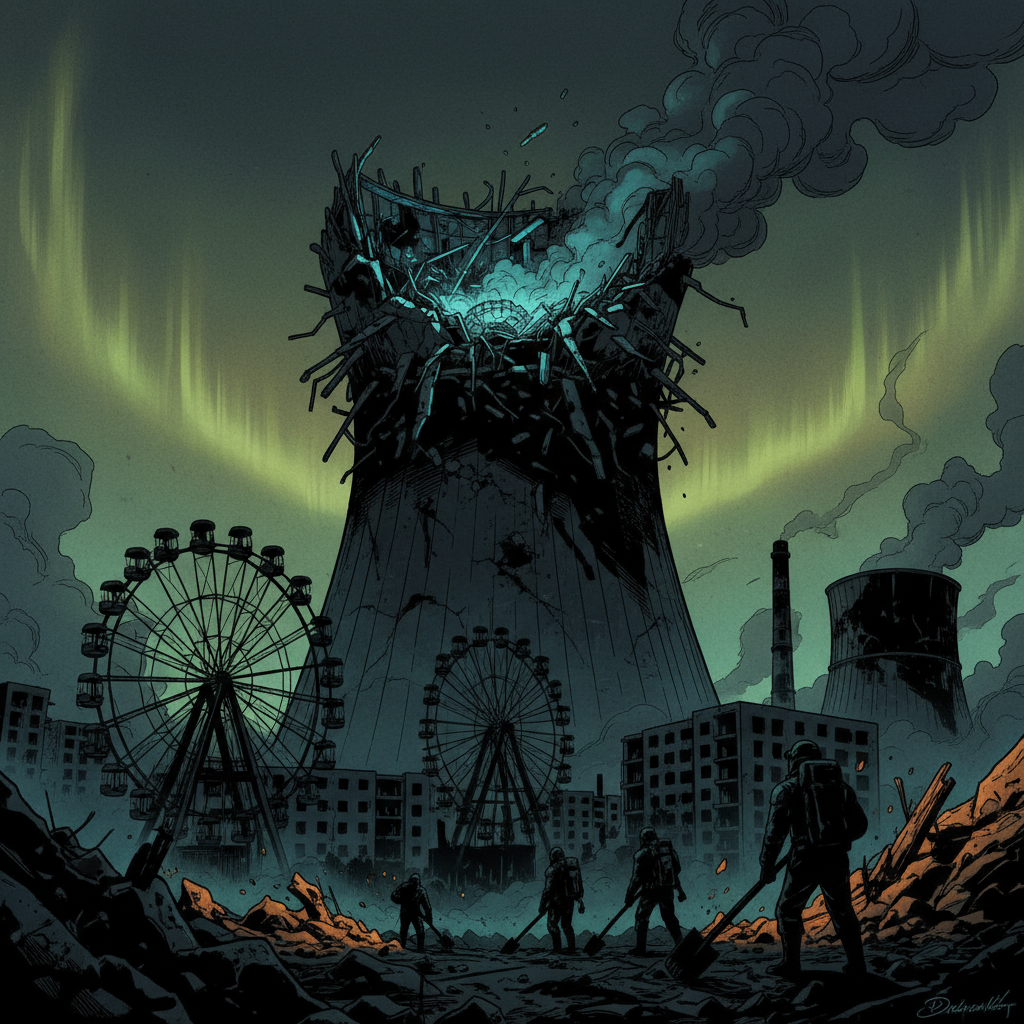
Чернобыльская катастрофа
26 апреля 1986 года в 01:23 реактор №4 Чернобыльской атомной электростанции в Украинской ССР взорвался во время испытания на безопасность, выбросив в атмосферу в 400 раз больше радиоактивных материалов, чем бомба, сброшенная на Хиросиму. Взрыв и последовавший за ним пожар отправили облако радиоактивных осадков над западной частью СССР и Европой. Советские власти первоначально скрывали катастрофу, вынуждая 49 000 жителей Припяти продолжать обычную жизнь в течение 36 часов до эвакуации. Около 600 000 ликвидаторов были мобилизованы для ликвидации последствий катастрофы — в том числе «биороботы», добровольцы, заменившие вышедшую из строя технику, чтобы сгребать радиоактивный графит с крыши реактора 90-секундными сменами, получая пожизненную дозу облучения за каждый выход. Официальное советское число погибших — 31 человек — остаётся оспариваемым; оценки варьируются от 4 000 (ВОЗ) до 93 000 (Greenpeace) избыточных смертей от рака. Катастрофа разрушила миф о советском технологическом превосходстве, вынудила Горбачёва перейти к гласности и — по собственной более поздней оценке Горбачёва — стала «возможно, истинной причиной распада Советского Союза», более значимой, чем любая политика или реформа. Зона отчуждения площадью 2 600 квадратных километров остаётся непригодной для проживания — постоянный шрам на украинской земле, где решения Москвы обернулись последствиями для Украины.
Краткое резюме
Семь аналитических перспектив сходятся в центральном выводе: Чернобыльская катастрофа была двойной катастрофой — технической аварией, коренящейся в конструктивных компромиссах реактора, усиленной и усугублённой институциональным провалом, при котором каждый уровень советской системы ставил самосохранение выше безопасности людей. Теория игр показывает, как рациональные индивидуальные решения в рамках патологической системы стимулов привели к коллективно катастрофическим последствиям. Макиавелли обнажает, как институциональная динамика власти превратила аварию на реакторе в цивилизационный кризис. Перспектива ЦРУ подтверждает, что западная разведка верно оценивала советскую непрозрачность, но недооценила, как единственная техногенная авария может катализировать системный коллапс. Павлов демонстрирует, как десятилетия условного рефлексирования создали рефлексивные паттерны, ухудшившие каждую критическую точку принятия решений. Анализ гражданских последствий документирует человеческие потери: 350 000 эвакуированных, 600 000 ликвидаторов, эпидемию рака щитовидной железы у детей и постоянную зону отчуждения на украинской территории. Даосизм читает катастрофу как ответ природы на гордыню — столкновение идеологии «мирного атома» с физической реальностью. Ницше исследует жертву ликвидаторов и путь Легасова от институциональной лояльности к индивидуальной правде. Все семь перспектив согласны: институциональный провал был столь же катастрофичен, как и техническая авария, и, пожалуй, более предотвратим.
Ключевые факты
Проверенные факты из многоисточникового исследования, оценённые по уровню достоверности
At 01:23 AM on April 26, 1986, Reactor No. 4 at the Chernobyl Nuclear Power Plant exploded during a turbine rundown safety test.
Достоверность: highThe RBMK-1000 reactor design had a known positive void coefficient of reactivity, meaning loss of coolant water increased reactivity. This was accepted as a trade-off for dual-use capability and cost savings.
Достоверность: highDeputy chief engineer Anatoly Dyatlov pressured operators to continue the test despite dangerously low power levels (~200 MW vs. planned 700-1000 MW). Operators disabled the ECCS and overrode automatic shutdown signals.
Достоверность: highPripyat (population 49,000), 3 km from the reactor, was not evacuated until 36 hours after the explosion. Children played outdoors, weddings were held, and residents observed the fire from the 'Bridge of Death.'
Достоверность: highSwedish radiation monitoring stations at Forsmark detected elevated levels on April 28, forcing Soviet acknowledgment. The Soviets initially blamed a 'minor accident.'
Достоверность: highApproximately 600,000 liquidators were deployed between 1986 and 1990. 'Bio-robots' on the roof worked in 90-second shifts, each receiving a near-lifetime dose.
Достоверность: highOf 134 plant workers and firefighters diagnosed with acute radiation syndrome, 28 died within months. Their deaths were documented in clinical detail.
Достоверность: highКлючевые участники
Основные участники этого события с их действиями и заявленными интересами
Anatoly Dyatlov
individual- ›Supervised the safety test
- ›Pressured operators to continue at low power
- ›Ordered disabled safety systems
Mikhail Gorbachev
individual- ›Delayed public acknowledgment 18 days
- ›Blamed Western media
- ›Used Chernobyl to accelerate glasnost
Valery Legasov
individual- ›Led scientific investigation
- ›Presented Soviet narrative to IAEA
- ›Recorded truth-telling tapes
Liquidators
group- ›Built sarcophagus
- ›Cleared radioactive graphite from roof
- ›Decontaminated surrounding areas
Исследования и источники
Хронология событий
1954-06-27 to 1991-12-26
Причинно-следственный анализ
Интерактивный граф, показывающий причинно-следственные связи между политиками, актёрами и событиями — нажмите на узлы для изучения связей
ПРИЧИННО-СЛЕДСТВЕННАЯ СЕТЬ
18 узлов · 19 связей
Выберите узел
Нажмите на любой узел графа для изучения его связей и перспектив призм
Первопричины
3Критический путь
8 шаговАнализы по призмам
Каждая призма предоставляет уникальную аналитическую рамку — нажмите для развёртывания глубокого анализа
Теория игр
Western Moderngame-theoryChernobyl was not a failure of rationality but a masterclass in how rational individual decisions within a pathological institutional structure produce collectively catastrophic outcomes. The system's information architecture was the root cause: by classifying safety data, punishing dissent, and rewarding concealment, the system guaranteed that each actor's rational choice would aggregate into civilizational disaster. The 'peaceful atom' ideology functioned as a corrupted focal point coordinating the entire system toward catastrophe. A system that makes honesty irrational will produce dishonesty at scale, and a nuclear power program built on institutional dishonesty will eventually produce Chernobyl.
Макиавелли
Greco-Roman & ClassicalmachiavelliChernobyl is a perfect Machiavellian case study in institutional self-preservation becoming self-destruction. The Soviet system followed the classic playbook: conceal weakness, project strength, control information, blame subordinates. This works for political competition between elites. It fails catastrophically for governing complex technical systems where accurate information is a safety prerequisite. Nuclear reactors do not respond to political narratives — they respond to physics. When the Soviet system treated safety information as a political resource rather than a physical reality, it created conditions for an accident that physics, not politics, would determine. Gorbachev's subsequent use of Chernobyl to accelerate glasnost was genuinely Machiavellian: converting catastrophic weakness into reform leverage. But glasnost could not be confined to nuclear safety.
ЦРУ
Western InstitutionalciaChernobyl's intelligence significance lies not in the reactor failure but in what it revealed about Soviet decision-making under crisis. The disaster stress-tested the Soviet information architecture and it failed comprehensively: upward reporting filtered bad news, lateral communication was impeded by classification, downward communication prioritized messaging over safety, international communication was dishonest until forced. The pattern — institutional mendacity as structural feature — became a key lens for assessing authoritarian fragility. The insight that information-controlled systems are brittle rather than resilient remains one of the most durable Cold War intelligence lessons.
Павлов
Western ModernpavlovChernobyl demonstrates that institutional conditioning is a safety-critical infrastructure vulnerability. Decades of conditioning — obedience, news suppression, trust in official narratives, punishment of dissent — created patterns individually adaptive (kept people employed) but collectively catastrophic (prevented detection of and response to existential threats). The disaster was caused not by a few bad decisions on April 26 but by forty years of conditioning that made those decisions inevitable. When you condition operators to obey authority over instruments, managers to filter reality, officials to prioritize narrative over facts, and citizens to trust silence as safety — you create an anti-safety culture where every reflex moves toward catastrophe.
Гражданские последствия
civilian-impactChernobyl's civilian impact reveals a disaster on geological timescales: centuries of contamination, generational health consequences, and psychological wounds transmitted through families. The contested death toll is ongoing harm: when official count is 31 and the range extends to 93,000, communities exist in unresolved grief. The most important lesson: the institutional failure caused as much damage as the explosion. Without the 36-hour delay, the thyroid cancer epidemic would have been significantly reduced. Without the May Day parade, Kyiv's children would not have marched through fallout. The civilian toll is a consequence not merely of the explosion but of every subsequent institutional decision that prioritized image over human life.
Даосизм
East AsiantaoismChernobyl is the Tao's answer to the 'peaceful atom.' The Taoist reading reveals a disaster driven by fundamental violation of the principle that nature cannot be conquered, only cooperated with. The Soviet system forced the atom, forced secrecy, forced obedience, forced ignorance, forced fiction. At every point, forcing produced its opposite. The Exclusion Zone — where nature flourishes in humanity's absence — is the most eloquent Taoist commentary. The wolves of Chernobyl embody the Tao Te Ching: 'the Tao nourishes all things.' The deepest lesson: systems that deny uncertainty will be destroyed by it.
Ницше
Western ModernnietzscheChernobyl is the story of a will to power that confused institutional dominance with genuine mastery. The Soviet system had power to classify, conceal, command, and coerce — but not to control nuclear fission when the reactor exceeded institutional narrative. The liquidators embody Nietzsche's central question: what distinguishes authentic heroism from coerced sacrifice? The Soviet system, by making genuine choice impossible, destroyed the conditions that make heroism meaningful — then claimed the sacrifice as institutional virtue. Legasov's arc is the most purely Nietzschean story: beginning in slave morality, recognizing institutional values as lies, destroying himself in self-overcoming that affirmed individual truth. The Soviet response — blaming individuals, concealing flaws, claiming liquidator sacrifice as institutional virtue — was slave morality: inverting truth and power, making institutional survival the highest value. Chernobyl shattered that inversion at a cost measured in human lives.
Конвергенции
Где несколько призм приходят к схожим выводам — что указывает на их устойчивость
Institutional mendacity as root cause
All four identify Soviet information architecture — classification, punishment of dissent, rewarding optimism — as the fundamental cause transforming technical failure into civilizational catastrophe.
The coverup caused more harm than the explosion
36-hour evacuation delay, Kyiv May Day, continued milk distribution all caused measurable additional harm. The thyroid cancer epidemic was largely preventable with timely response.
Hubris and limits of institutional control
All four converge on the insight that Soviet confidence in its own control was the precondition for losing control catastrophically.
Продуктивные противоречия
Где призмы расходятся — выявляя сложность, заслуживающую изучения
Возможные варианты будущего
Сценарии, выведенные из призменных анализов — что может произойти в зависимости от различных рамок
Nuclear renaissance with institutional learning
Moderate. Institutional learning genuine but incomplete. Climate pressures make expansion likely.
Another major nuclear accident exposing institutional failure
Low but non-negligible per decade.
Ключевые вопросы
Вопросы, остающиеся открытыми после анализа — для дальнейшего исследования
- ?What is the true death toll? Will advances in epidemiology resolve the 4,000-93,000 range?
- ?How many liquidators developed radiation-related conditions and were denied recognition?
- ?What was the full chain of command in the first 72 hours?
Детали проверки фактов
Результаты проверки фактов
verifiedМета-наблюдения
All seven share a bias toward explanation. What all miss is the irreducibly incomprehensible dimension: ARS as documented by Alexievich, the three-day lie's cruelty, children's thyroid cancers. Some dimensions of Chernobyl resist comprehension and should resist it.
The relationship between technical and institutional failure is irreducibly complex: they are co-produced effects of the same Soviet institutional culture. Separating them is analytically useful but ultimately misrepresents a disaster in which technology and institutions were inseparable.
The contested death toll — 31 to 93,000 — is a permanent reminder of irreducible uncertainty. Any analysis claiming certainty is less honest than one acknowledging the range.
Найдите свою перспективу
Разные рамки резонируют с разными читателями — найдите свою точку входа
Readers drawn to structural explanations and institutional design. You see Chernobyl as fixable through better incentive structures.
The Soviet information architecture was the root cause. Information-controlled systems are brittle, not strong.
Readers drawn to questions about hubris, nature's limits, and moral weight of choices. Chernobyl as parable about humanity's relationship with uncontrollable forces.
The 'peaceful atom' embodied a fundamental misunderstanding: institutional will cannot master natural forces through political commitment.
Readers focused on how organizations function and how institutional cultures shape behavior. Chernobyl as case study in institutional pathology.
Behavioral conditioning and power dynamics made every actor behave rationally within their context while producing collective catastrophe.
Readers prioritizing human experience over analytical frameworks. Skeptical that any lens captures the horror of radiation sickness or the injustice of the contested death toll.
All frameworks risk abstracting away individual suffering. The thyroid cancer in a child's throat exceeds what any theory contains.
If in the analytical cluster, read civilian-impact to ground structural understanding in human experience. If intuitive, game-theory shows how 'hubris' operated through fixable mechanisms. If institutional, Nietzsche reminds that individual choices cannot be fully explained by conditioning. All readers: engage with the liquidator heroism/victimization tension without resolving it prematurely.
Связанные анализы
Другие события, проанализированные через схожие призмы или категории
Арабская весна была революционной волной протестов, восстаний и вооружённых мятежей, охватившей арабский мир с декабря 2010 года. Спровоцированная самосожжением тунисского уличного торговца Мухаммеда Буазизи 17 декабря 2010 года, движение распространилось с поразительной скоростью по Северной Африке и Ближнему Востоку. Лозунг «الشعب يريد إسقاط النظام» (Народ хочет падения режима) звучал от Туниса до Каира, от Бенгази до Дамаска. Выбор армии — встать на сторону протестующих или остаться верной режиму — оказался решающей переменной в каждой стране.
С 6 апреля по 18 июля 1994 года в Руанде за 100 дней было систематически убито около 800 000 тутси и умеренных хуту — самое эффективное массовое убийство в современной истории с ежедневным уровнем смертности, превышающим Холокост. Геноцид не был вспышкой «древней племенной вражды», а кульминацией колониального проекта: бельгийские администраторы создали жёсткие расовые категории из подвижных социальных идентичностей посредством переписи 1933 года и обязательных этнических удостоверений личности. Радио RTLM — «Радио Мачете» — систематически обуславливало население годами дегуманизирующей пропаганды, называя тутси «inyenzi» (тараканы). От 250 000 до 500 000 женщин были изнасилованы как орудие геноцида. Провал международного сообщества был активным: Даллэр отправил предупреждение за три месяца, запросил 5000 солдат и получил отказ. Совет Безопасности ООН сократил МООНПР с 2500 до 270 солдат во время геноцида. Военная победа РПФ прекратила геноцид в июле 1994 года, но последствия распространились на Первую конголезскую войну (1996-97) и «Мировую войну Африки», унёсшую более 5 миллионов жизней.
22 ноября 1963 года президент Джон Ф. Кеннеди был убит на площади Дили в Далласе, штат Техас. Ли Харви Освальд был арестован, однако до суда его застрелил Джек Руби. Комиссия Уоррена пришла к выводу, что Освальд действовал в одиночку, тогда как HSCA впоследствии установил вероятность заговора. Рассекреченные к 2025 году документы раскрывают институциональные сокрытия со стороны ЦРУ и ФБР, что делает это дело наиболее значимым нераскрытым делом в американской истории.
Как проводился этот анализ
Полная прозрачность процесса анализа, инструментов и ограничений
Движок Crosslight
v0.4.0 "Global Lens Expansion"- ⚠Non-Western philosophical lenses rely on translated primary texts — nuance may be lost in translation
- ⚠Some traditions (e.g., Maat, Ubuntu) have limited surviving primary texts; analysis draws on scholarly reconstruction
- ⚠Cross-cultural lens application is inherently interpretive — a Confucian reading of a Western event is an analytical exercise, not a claim of cultural authority
Статистика анализа
Методология
Этот анализ был произведён многоагентным конвейером Crosslight: Агент исследования собирал и проверял факты из множества источников, специализированные агенты призм применяли отдельные аналитические рамки, Агент синтеза интегрировал выводы и выявлял паттерны, а Агент проверки фактов верифицировал утверждения. Каждая призменная перспектива является интерпретацией ИИ — а не институциональным одобрением.Узнать больше →