
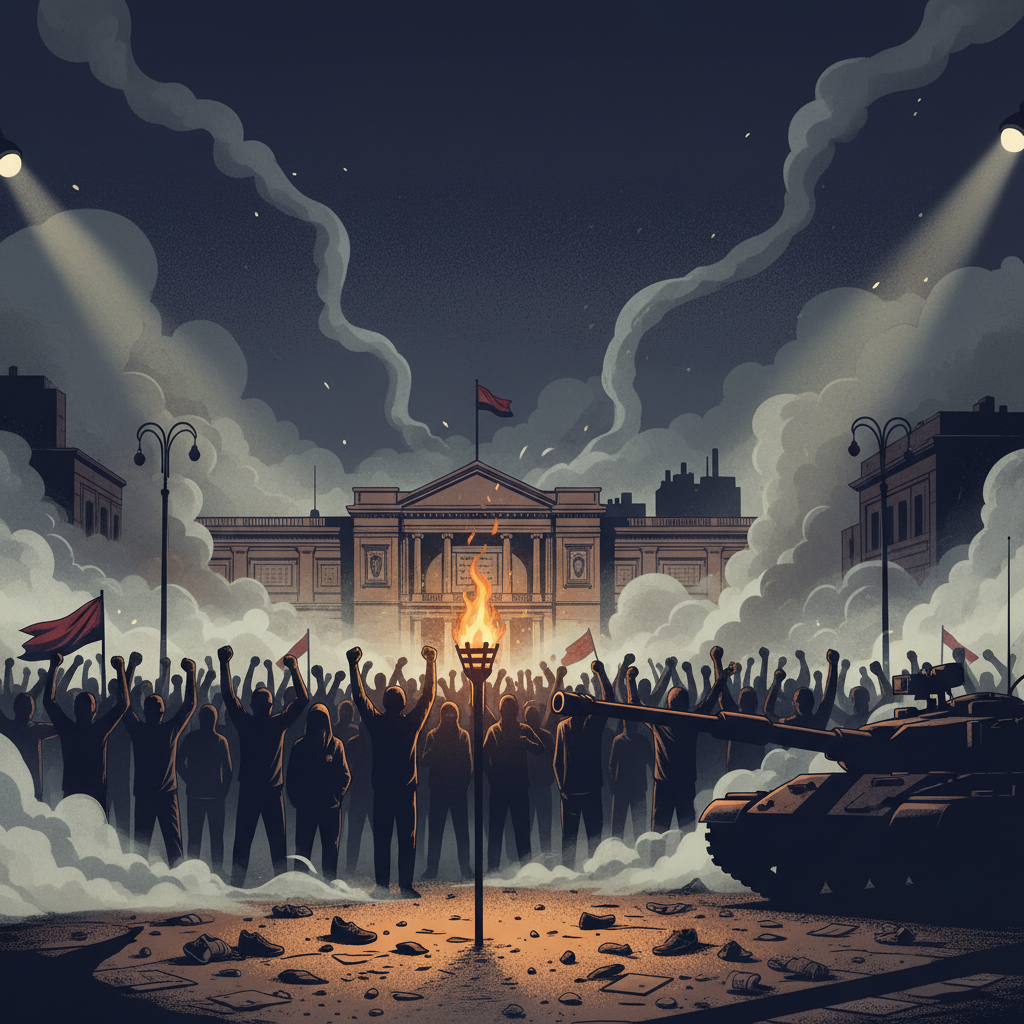
Mapinduzi ya Kiarabu 2011
Mapinduzi ya Kiarabu yalikuwa wimbi la mapinduzi ya maandamano, maasi na uasi wenye silaha uliosambaa katika ulimwengu wa Kiarabu kuanzia Desemba 2010. Yalitokana na kujichoma moto kwa muuzaji wa mitaani wa Tunisia Mohamed Bouazizi mnamo Desemba 17, 2010. Kauli mbiu ya "الشعب يريد إسقاط النظام" (Watu wanataka kuanguka kwa utawala) ilisikika kutoka Tunis hadi Cairo, Benghazi hadi Damascus. Uchaguzi wa jeshi — kusimama upande wa waandamanaji au kubaki waaminifu kwa utawala — ulidhihirika kuwa kigezo muhimu katika kila nchi.
Muhtasari Mkuu
Mitazamo saba ya uchambuzi inakutana katika ugunduzi mkuu: Mapinduzi ya Kiarabu yalikuwa mlipuko usiozuilika wa miongo kadhaa ya matarajio ya binadamu yaliyokandamizwa, lakini matokeo yake yaliamuliwa na mahesabu ya kitaasisi ya wasomi wa kijeshi.
Ukweli Muhimu
Ukweli uliothibitishwa kutoka utafiti wa vyanzo vingi, uliokadiriwa kwa kiwango cha imani
Mohamed Bouazizi, a 26-year-old street vendor in Sidi Bouzid, Tunisia, set himself on fire on December 17, 2010, after his produce cart was confiscated and he was humiliated by a municipal official. He died of his injuries on January 4, 2011.
Imani ya highTunisian President Zine El Abidine Ben Ali fled to Saudi Arabia on January 14, 2011, ending his 23-year rule. Tunisia's military refused to fire on protesters.
Imani ya highMass protests began in Egypt on January 25, 2011 (the 'Day of Rage'), centering on Tahrir Square in Cairo. President Hosni Mubarak resigned on February 11, 2011, after 30 years in power.
Imani ya highEgypt's Supreme Council of the Armed Forces (SCAF) sided with protesters and forced Mubarak's resignation, protecting the military's extensive economic and institutional interests.
Imani ya highMohamed Morsi of the Muslim Brotherhood won Egypt's first free presidential election in June 2012. He was removed by a military coup led by General Abdel Fattah al-Sisi on July 3, 2013.
Imani ya highProtests against Muammar Gaddafi began in Benghazi, Libya on February 15, 2011. UN Security Council Resolution 1973 authorized a no-fly zone. NATO intervened militarily beginning March 19, 2011. Gaddafi was captured and killed on October 20, 2011.
Imani ya highAnti-government protests began in Daraa, Syria in mid-March 2011 after schoolchildren were detained for anti-regime graffiti. The Assad regime responded with military force, escalating into civil war.
Imani ya highWaigizaji Wakuu
Waigizaji wakuu wanaohusika katika tukio hili pamoja na vitendo vyao na maslahi yaliyoelezwa
Mohamed Bouazizi
individual- ›Set himself on fire on December 17, 2010 in Sidi Bouzid, Tunisia
Hosni Mubarak
individual- ›Imposed curfew and deployed military to streets
- ›Shut down internet and mobile communications
- ›Resigned on February 11, 2011
Muammar Gaddafi
individual- ›Ordered military to suppress protests violently
- ›Threatened to 'cleanse Libya house by house'
- ›Fought NATO intervention until captured and killed
Bashar al-Assad
individual- ›Deployed military against civilian protesters
- ›Used barrel bombs and chemical weapons against civilian areas
- ›Relied on Iranian and Russian military support
Al Jazeera
organization- ›Provided 24/7 satellite coverage of Arab Spring protests across the region
- ›Amplified protest movements through pan-Arab broadcasts reaching millions
- ›Created a shared narrative space across Arab-speaking populations
Utafiti na Vyanzo
Ratiba ya Tukio
2010-12-17 to 2015-09-01
Uchambuzi wa Kisababu
Grafu inayoweza kuingiliana inayoonyesha jinsi sera, waigizaji, na matukio yanavyounganika kisababu — bonyeza nodi ili kuchunguza mahusiano
MTANDAO WA KISABABU
nodi 21 · muunganiko 18
Chagua nodi
Bonyeza nodi yoyote kwenye grafu ili kuchunguza muunganiko wake na mitazamo ya lenses
Sababu Kuu
3Njia Muhimu
hatua 9Uchambuzi wa Lenses
Kila lens hutoa mfumo wa kipekee wa uchambuzi — bonyeza ili kupanua kwa uchambuzi wa kina
Nadharia ya Michezo
Western Moderngame-theoryThe Arab Spring was a massive multi-player sequential game where each country's outcome changed the information set for all other players. Tunisia's success solved the collective action problem by demonstrating that revolution was possible — but the game-theoretic insight is that the same initial shock (popular uprising) produced radically different outcomes depending on one variable: whether the military's institutional interests were better served by defecting from or remaining loyal to the regime. This is the 'military kingmaker' dynamic — not a bug in the revolutionary wave but the fundamental strategic variable that determined winners and losers.
Machiavelli
Greco-Roman & ClassicalmachiavelliThe Arab Spring is a masterclass in Machiavellian power dynamics: it demonstrated that power built solely on fear collapses catastrophically when the fear barrier breaks. The military — not the people, not social media, not Western intervention — was the prince-maker in every country. Where the military calculated that its institutional interests were better served by sacrificing the ruler (Tunisia, Egypt), transitions were relatively peaceful. Where the military's survival was bound to the regime (Syria's Alawite officers, Bahrain's Sunni security forces), the result was either civil war or brutal suppression. The tragedy of the Arab Spring, in Machiavellian terms, is that destroying the old order proved far easier than building a new one. As Machiavelli warned: 'There is nothing more difficult to take in hand, more perilous to conduct, or more uncertain in its success, than to take the lead in the introduction of a new order of things.'
Tathmini ya Ujasusi ya CIA
Western InstitutionalciaThe Arab Spring exposed the central paradox of US intelligence engagement in the Middle East: the very authoritarian relationships that provided counter-terrorism intelligence created the conditions for the revolutionary explosions that destroyed those relationships. The CIA's partnerships with Mubarak's GIS, Ben Ali's secret police, and Gaddafi's reformed intelligence services gave the US excellent visibility into specific terrorist networks but no understanding of the structural rage building across Arab societies. The intelligence failure was not in the collection but in the analytical framework — the inability to see that 'stable authoritarian allies' was a contradiction in terms, and that the suppressed frustrations of millions of young Arabs constituted a strategic threat greater than any specific terrorist organization.
Uchambuzi wa Masharti ya Pavlov
Western ModernpavlovThe Arab Spring demonstrates that authoritarian control based on conditioned fear is inherently fragile: it works perfectly until it doesn't, and when it fails, it fails catastrophically. Decades of conditioning created a population that appeared compliant but was actually a pressure cooker of suppressed frustration. Bouazizi's act served as the extinction trial that demonstrated the old contingency no longer held. Al Jazeera's broadcasts generalized this extinction across the Arab world. But conditioning theory also explains the tragedy: it is far easier to extinguish a fear response (stop obeying) than to condition new constructive behaviors (build democratic institutions). The Arab Spring succeeded as mass behavioral de-conditioning — the fear was broken — but failed as re-conditioning toward democratic habits, which require years of consistent reinforcement that the post-revolutionary environment could not provide.
Uchambuzi wa Nietzsche
Western ModernnietzscheThe Arab Spring was a revolt of dignity — ثورة الكرامة — and Nietzsche's philosophy provides the deepest reading of what dignity means in this context. It was not merely a demand for political rights but an existential assertion: the refusal to accept humiliation as the human condition. Bouazizi's act was the purest expression of will against a system that had crushed all will. The tragedy is Nietzsche's own warning: destruction of the old order is the easy part. The hard part — the creation of new values, the emergence of what Nietzsche would call higher types of human organizing — requires precisely the kind of patient, creative work that revolutionary energy cannot sustain. The Arab Spring proved that the will to power can topple any regime, but it cannot, by itself, build what comes next.
Uchambuzi wa Kitao
East AsiantaoismThe Arab Spring is the Tao's most powerful modern demonstration of the principle of reversal (反, fan): whatever reaches an extreme produces its opposite. Decades of authoritarian rigidity (extreme yang) produced explosive revolutionary energy (extreme yin). Regimes that gripped tighter fell faster — Gaddafi's 42 years of iron control shattered into state collapse; Assad's brutal suppression produced the century's worst humanitarian disaster. Regimes that bent survived — Morocco's limited reforms, Jordan's modest concessions. The Tao's deepest insight about the Arab Spring is this: the revolutionary wave moved not through strategic coordination but through the natural resonance of shared grievances, flowing like water through every crack in authoritarian structures. It could not be stopped because it was not being directed — it was the Tao itself, the natural flow of suppressed human aspiration finding expression. But the Tao also teaches that water, unconstrained, floods and destroys. The Arab Spring's devastation in Libya and Syria is water without banks — natural force without the channels needed to direct it constructively.
Tathmini ya Athari kwa Raia
civilian-impactThe Arab Spring's civilian impact reveals the terrible disproportion between revolutionary aspiration and human cost. Millions of people demanded nothing more than dignity, economic opportunity, and an end to corruption — the most basic human aspirations. In Tunisia, these aspirations were achieved at relatively low cost. In Syria, the same aspirations produced the worst humanitarian catastrophe of the 21st century. The difference was not in what civilians wanted or how they protested, but in the structural variables they could not control: military loyalty, sectarian composition, external intervention, and the willingness of rulers to destroy their own countries rather than relinquish power. The most devastating finding of this analysis is that the people who suffered most — Syrian civilians — had the least agency in determining their fate. They were caught between a regime willing to use chemical weapons, an opposition that fragmented into rival militias, external powers pursuing strategic interests, and a jihadist movement (ISIS) that exploited the chaos. The Arab Spring's human cost is not a story of failed revolution — it is a story of civilians trapped in conflicts they did not choose, determined by forces they could not influence.
Mwelekeo wa Pamoja
Pale lenses nyingi zinapofika hitimisho sawa — kuonyesha nguvu
Military loyalty as the decisive variable
All four lenses independently identify the military's institutional choice as the factor that determined whether revolutions succeeded peacefully, devolved into civil war, or were crushed. This is the single strongest convergence across all analyses.
Authoritarian stability is inherently fragile
Game theory shows that fear-based equilibria collapse when the punishment mechanism fails. Pavlov shows that conditioned fear extinguishes when the contingency breaks. Taoism shows that rigid systems produce their own reversal. CIA learned that 'stable authoritarian allies' was a strategic delusion. All agree: apparent authoritarian stability masks fragility.
Destruction of old orders is easier than construction of new ones
Machiavelli warned that establishing new orders is the most difficult political undertaking. Nietzsche identifies the Ubermensch problem — revolutions lack creative vision for what comes after. Taoism sees unconstrained water (revolution without institutional channels) as destructive. Civilian impact documents the human cost of this gap between destruction and construction.
Mvutano Wenye Tija
Pale lenses zinapotofautiana — kufunua ugumu unaostahili kuchunguzwa
Mustakabali Unaowezekana
Hali zilizopatikana kutoka uchambuzi wa lenses — kinachoweza kutokea kulingana na mifumo tofauti
Second wave of Arab uprisings driven by unresolved structural grievances
Medium — the structural conditions remain, but the memory of Syria's catastrophe acts as a powerful deterrent
Authoritarian adaptation and tech-enabled control prevent future uprisings
Medium-high — authoritarian regimes have invested heavily in learning from the Arab Spring's failures
Tunisia's democratic path consolidates and gradually influences the region
Low — Tunisia's own democracy has faced setbacks since 2021 (Kais Saied's power concentration)
Maswali Muhimu
Maswali yanayobaki wazi baada ya uchambuzi — kwa uchunguzi unaoendelea
- ?What was the precise role of Gulf intelligence services in funding and directing various factions?
- ?To what extent did Al Jazeera's editorial decisions shape the direction of the Arab Spring?
- ?What were the internal deliberations within military high commands that determined their choices?
Maelezo ya Ukaguzi wa Ukweli
Matokeo ya Ukaguzi wa Ukweli
verifiedUchunguzi wa Meta
All seven lenses are fundamentally retrospective — they analyze what happened and why, but none fully captures the lived experience of revolutionary hope before it turned to despair. The Arab Spring was, for millions of people, the most exhilarating experience of their lives — a moment of collective agency and shared purpose that cannot be reduced to strategic calculation, conditioning, or power dynamics. That hope, even though it was largely betrayed by outcomes, was real and transformative for those who experienced it.
The Arab Spring involves simultaneous causation at multiple scales — individual psychology (Bouazizi), institutional dynamics (military choices), regional contagion (media amplification), and global geopolitics (external intervention) — that cannot be adequately captured by any single analytical framework. The seven lenses together approach a more complete picture, but the full complexity of a revolutionary wave affecting 300+ million people across 20 countries over five years exceeds any analytical capacity.
The Arab Spring humbled every analytical framework that tried to predict or explain it in real time. Intelligence agencies did not predict it. Academic experts did not anticipate its trajectory. No single theory — rational choice, structuralism, constructivism, or any other — captured the full dynamic. This analysis, with its seven lenses, is an attempt to triangulate toward truth, but the reader should hold all conclusions with appropriate humility.
Pata Mtazamo Wako
Mifumo tofauti inawavutia wasomaji tofauti — pata mahali pako pa kuingia
Readers who see the Arab Spring primarily through strategic dynamics, institutional calculations, and power politics — who ask 'what were the incentives?' and 'who benefited?'
The military kingmaker dynamic and the failure of intelligence frameworks to predict popular uprisings
Readers who see the Arab Spring as an expression of deep human aspirations — dignity, freedom, natural flow against artificial constraint — and who feel the movement's moral power
The revolt of dignity and the paradox of control — regimes that gripped tighter fell faster
Readers focused on power structures, institutional dynamics, and the concrete consequences of political action — who ask 'what happened to real people?' and 'who holds power?'
The gap between revolutionary aspiration and institutional capacity to build new orders, and the devastating human cost of that gap
Readers skeptical of grand narratives who focus on mechanisms, costs, and unintended consequences — who ask 'how did it actually spread?' and 'what was the real price?'
The conditioning dynamics that made the wave possible and the cruel arithmetic of human suffering across the spectrum
Start with the lens that resonates most, then deliberately read the lens that challenges your assumptions. If you see strategic rationality (game-theory), read the existential dimension (nietzsche). If you feel the moral power of the movement (nietzsche), confront the human cost (civilian-impact). The Arab Spring's full truth lives in the tension between these perspectives, not in any single lens.
Uchambuzi Unaohusiana
Matukio mengine yaliyochambuliwa kupitia lenses au kategoria zinazofanana
Tarehe 26 Aprili 1986, saa 01:23 asubuhi, kinu cha nne cha kiwanda cha nguvu za nyuklia cha Chernobyl katika Jamhuri ya Kisovieti ya Ukraine kilipasuka wakati wa jaribio la usalama, kikitoa nyenzo za mionzi mara 400 zaidi ya bomu la Hiroshima. Mamlaka za Kisovieti ziliweka siri janga hilo, na kuwalazimisha wakazi 49,000 wa Pripyat kuendelea na maisha ya kawaida kwa masaa 36. Takriban 'waondoaji' 600,000 walipelekwa. Makadirio ya vifo yanakadiriwa kuwa kati ya 4,000 (WHO) na 93,000 (Greenpeace). Janga hilo liliharibu hadithi ya ubora wa kiteknolojia wa Usovieti na kumlazimisha Gorbachev kuelekea glasnost.
Kati ya tarehe 6 Aprili na 18 Julai 1994, takriban Watutsi 800,000 na Wahutu wa wastani waliuawa kwa utaratibu nchini Rwanda kwa muda wa siku 100 — mauaji ya watu wengi kwa ufanisi zaidi katika historia ya kisasa, yenye kiwango cha vifo kwa siku kinachozidi kile cha Holocaust. Mauaji ya kimbari hayakuwa mlipuko wa 'chuki za kikabila za kale' bali kilele cha mradi wa kikoloni: watawala wa Kibelgiji walikuwa wametengeneza makundi magumu ya kikabila kutoka kwa utambulisho wa kijamii unaobadilika kupitia sensa ya 1933 na kadi za kitambulisho cha lazima cha kikabila, wakiunda mgawanyiko wa Hutu-Tutsi ambao wasomi wa kisiasa baadaye waliutumia kama silaha. Serikali ya Habyarimana na mzunguko wake wa ndani wa akazu (nyumba ndogo), wakikabiliwa na shinikizo la kijeshi kutoka kwa Rwandan Patriotic Front na madai ya kugawana madaraka ya Makubaliano ya Arusha, walichagua mauaji ya kimbari kama mkakati wa kuishi kisiasa. Radio ya RTLM — 'Radio Machete' — iliandaa watu kwa utaratibu kupitia miaka ya propaganda ya kudhalilisha, wakiwaita Watutsi 'inyenzi' (mende) kabla ya kutangaza maagizo ya wazi ya kuua na maeneo ya waathiriwa wakati wa mauaji ya kimbari yenyewe. Kati ya wanawake 250,000 na 500,000 walibakwa kama silaha ya makusudi ya mauaji ya kimbari, hukumu ya kihistoria ya ICTR ya Akayesu ikitambua ubakaji kama kitendo cha mauaji ya kimbari kwa mara ya kwanza katika sheria ya kimataifa. Kushindwa kwa jumuiya ya kimataifa hakukuwa kupita bali kwa makusudi: kamanda wa UNAMIR Romeo Dallaire alituma 'faksi ya mauaji ya kimbari' akionya miezi mitatu kabla ya mauaji kuanza, akaomba askari 5,000, na alikataliwa. Baraza la Usalama la Umoja wa Mataifa lilipunguza UNAMIR kutoka askari 2,500 hadi 270 wakati wa mauaji ya kimbari. Marekani ilikwepa kwa makusudi kutumia neno 'mauaji ya kimbari' ili kuepuka wajibu wa kisheria wa kuingilia kati. Ushindi wa kijeshi wa RPF ulikomeshia mauaji ya kimbari Julai 1994, lakini matokeo yake yalienea hadi Vita ya Kwanza ya Kongo (1996-97) na 'Vita ya Dunia ya Afrika' iliyoua watu zaidi ya milioni 5.
Tarehe 22 Novemba 1963, Rais John F. Kennedy aliuawa katika Dealey Plaza, Dallas, Texas. Lee Harvey Oswald alikamatwa lakini aliuawa na Jack Ruby kabla ya kusikilizwa kwa kesi yake. Tume ya Warren ilihitimisha kwamba Oswald alitenda peke yake, wakati HSCA baadaye ilipata uwezekano wa njama. Nyaraka zilizofunguliwa hadi 2025 zinaonyesha ufichaji wa kimataasisi na CIA na FBI, na kuifanya kuwa kesi kubwa zaidi isiyosuluhiwa katika historia ya Amerika.
Jinsi Hii Ilivyochambuliwa
Uwazi kamili kuhusu mchakato wa uchambuzi, zana, na mipaka
Injini ya Crosslight
v0.4.0 "Global Lens Expansion"- ⚠Non-Western philosophical lenses rely on translated primary texts — nuance may be lost in translation
- ⚠Some traditions (e.g., Maat, Ubuntu) have limited surviving primary texts; analysis draws on scholarly reconstruction
- ⚠Cross-cultural lens application is inherently interpretive — a Confucian reading of a Western event is an analytical exercise, not a claim of cultural authority
Takwimu za Uchambuzi
Mbinu
Uchambuzi huu ulitengenezwa na mfumo wa mawakala wengi wa Crosslight: Wakala wa Utafiti alikusanya na kuthibitisha ukweli kutoka vyanzo vingi, Mawakala Maalum wa Lenses walitumia mifumo tofauti ya uchambuzi, Wakala wa Muhtasari alichanganya maarifa na kutambua mifumo, na Wakala wa Ukaguzi wa Ukweli alithibitisha madai. Kila mtazamo wa lens ni tafsiri ya AI — si idhini ya kitaasisi.Jifunze zaidi →