
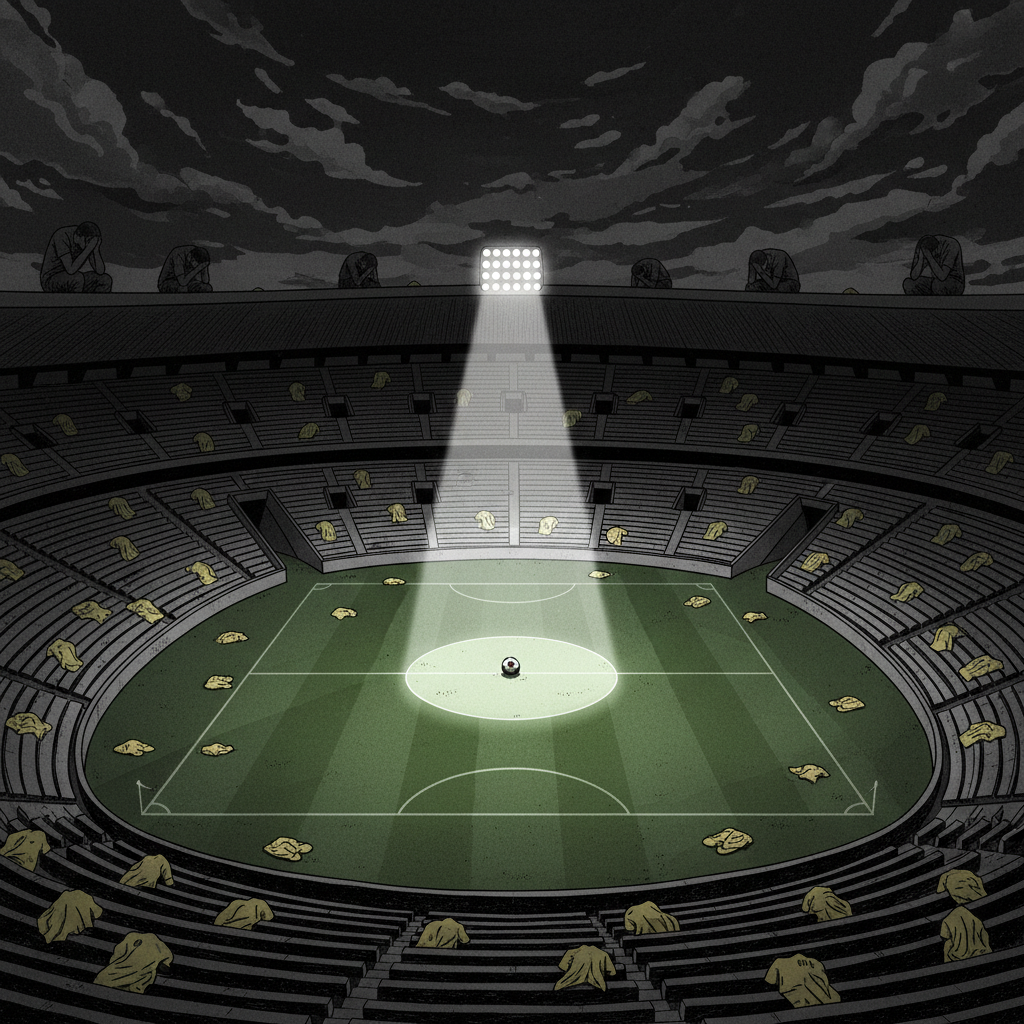
هزيمة البرازيل 7-1 في كأس العالم 2014
في 8 يوليو 2014، تعرضت البرازيل لهزيمة تاريخية 7-1 أمام ألمانيا في نصف نهائي كأس العالم FIFA 2014 في ملعب مينيراو في بيلو هوريزونتي. شهدت المباراة، المعروفة في البرازيل باسم "مينيراسو"، تسجيل ألمانيا خمسة أهداف في 18 دقيقة خلال الشوط الأول، مع غياب اللاعبين الأساسيين نيمار (كسر في الفقرة بسبب إصابة في ربع النهائي) والقائد تياغو سيلفا (إيقاف). كانت النتيجة أسوأ هزيمة في تاريخ البرازيل في كأس العالم وأصبحت لحظة صدمة وطنية، كاشفة التوترات بين إنفاق البرازيل 11 مليار دولار على كأس العالم وخدماتها العامة المتدهورة، وسط حركة الاحتجاج "لن تكون هناك كأس عالم". ساهمت التداعيات السياسية في سردية عدم الكفاءة الحكومية التي بلغت ذروتها بعزل الرئيسة ديلما روسيف في 2016.
الملخص التنفيذي
لم تكن نصف نهائي كأس العالم 2014 بين البرازيل وألمانيا مباراة كرة قدم تحولت إلى أزمة وطنية — بل كانت أزمة وطنية عبّرت عن نفسها كمباراة كرة قدم. تتقارب جميع المنظورات التحليلية حول نفس الاستنتاج الأساسي: كان 7-1 محتومًا. العجز التكتيكي (نظرية الألعاب، مونيبول)، والهشاشة النفسية (بافلوف)، والثقل الوجودي (نيتشه)، والدلالة الثقافية (علم اجتماع الرياضة)، والتضخيم الإعلامي (التحليل الإعلامي)، والسياق السياسي (التأثير المدني) — كلها أشارت نحو الكارثة. ما جعل 7-1 فريدًا تاريخيًا ليس أن عاملًا واحدًا كان موجودًا بل أن جميع العوامل اصطفت في وقت واحد، مما خلق عاصفة مثالية من الضعف استغلها الإعداد المنهجي الألماني بكفاءة لا هوادة فيها.
الحقائق الرئيسية
حقائق موثقة من بحث متعدد المصادر، مصنفة حسب مستوى الثقة
Germany defeated Brazil 7-1 in the 2014 FIFA World Cup semifinal on July 8, 2014, at Estádio Mineirão in Belo Horizonte.
ثقة highGermany's goals were scored by Thomas Müller (11'), Miroslav Klose (23'), Toni Kroos (24', 26'), Sami Khedira (29'), André Schürrle (69', 79'). Oscar scored Brazil's consolation goal in the 90th minute.
ثقة highFive goals were scored between the 11th and 29th minutes, with four goals in a six-minute span from the 23rd to 29th minute.
ثقة highNeymar suffered a fractured third lumbar vertebra from a knee-to-the-back challenge by Colombia's Juan Camilo Zúñiga in the 88th minute of the quarterfinal on July 4, 2014, ruling him out of the rest of the tournament.
ثقة highCaptain Thiago Silva was suspended for the semifinal due to accumulation of two yellow cards. His appeal to FIFA was denied as having 'no legal basis.'
ثقة highMiroslav Klose's goal in the 23rd minute made him the all-time leading scorer in World Cup history with 16 goals, surpassing Brazil's Ronaldo who held the record with 15.
ثقة highBrazil's official World Cup spending was approximately $11.6 billion, making it the most expensive World Cup in history at that time.
ثقة highالفاعلون الرئيسيون
الفاعلون الرئيسيون المشاركون في هذا الحدث مع أفعالهم ومصالحهم المعلنة
Luiz Felipe Scolari
individual- ›Selected 4-2-3-1 formation for semifinal despite missing key players
- ›Chose not to fundamentally alter tactical approach for Neymar/Thiago Silva absences
- ›Started Dante and Bernard as replacements
Joachim Löw
individual- ›Developed Germany's tactical system over 8 years since 2006
- ›Prepared specific pressing strategy to exploit Brazil's high defensive line
- ›Instructed team to ease off after 5-0 at halftime
Neymar
individual- ›Carried Brazil's attacking burden through the tournament as the team's talisman
- ›Suffered fractured third lumbar vertebra in quarterfinal vs. Colombia
- ›Watched the 7-1 from a hospital/recovery setting
Dilma Rousseff
individual- ›Defended World Cup spending as beneficial for Brazil's infrastructure and economy
- ›Oversaw security operations during 2013-2014 protests
- ›Won narrow re-election in October 2014
Não vai ter Copa protest movement
group- ›Organized mass protests during 2013 Confederations Cup and 2014 World Cup
- ›Coined and popularized the slogan 'Não vai ter Copa'
- ›Highlighted forced evictions and public spending priorities
البحث والمصادر
الجدول الزمني للحدث
2007-10-30 to 2016-08-31
التحليل السببي
رسم بياني تفاعلي يوضح كيف ترتبط السياسات والفاعلون والأحداث سببيًا — انقر على العقد لاستكشاف العلاقات
الشبكة السببية
18 عقدة · 17 اتصال
اختر عقدة
انقر على أي عقدة في الرسم البياني لاستكشاف اتصالاتها ومنظورات العدسات
الأسباب الجذرية
1المسار الحرج
7 خطواتتحليلات العدسات
تقدم كل عدسة إطارًا تحليليًا فريدًا — انقر للتوسيع والاطلاع على التحليل المعمّق
نظرية الألعاب
Western Moderngame-theoryThe 7-1 was not merely a tactical defeat but a cascading equilibrium collapse. Brazil entered with a fragile strategy that required specific conditions (Neymar's creativity, Thiago Silva's organization, crowd momentum) to function. Germany systematically removed each support pillar, and once the strategic structure collapsed after the second goal, no rational recovery was possible. The game-theoretic lesson is that high-risk, high-reward strategies with single points of failure are catastrophically vulnerable to systematic opponents who identify and exploit those failure points.
تحليل التكييف السلوكي
Western ModernpavlovThe 7-1 was a mass extinction event for Brazil's conditioned national football identity. Decades of reinforcement — five World Cup titles, generations of legendary players, cultural production around football supremacy — were shattered in 18 minutes. The psychological mechanism was identical to laboratory demonstrations of learned helplessness: after the third rapid goal, Brazilian players and fans alike ceased active coping and entered a state of passive acceptance. The subsequent reconditioning through dark humor was not merely a cultural quirk but a psychologically adaptive response — counter-conditioning the aversive stimulus with a new, less painful response. The 7-1 permanently altered Brazil's conditioned relationship with its own football identity.
تحليل القوة النيتشوي
Western ModernnietzscheThe 7-1 was the death of Brazilian football's god — the end of the foundational myth of inherent supremacy that had organized Brazilian national identity for generations. The Übermensch model (dependence on individual genius) was exposed as fatally fragile when tested against Germany's systematic will to power. The ensuing ressentiment was both existentially genuine and politically consequential, contributing to the broader crisis that culminated in Rousseff's impeachment. Brazil's dark humor response represents a remarkable form of amor fati — embracing the catastrophe as part of national identity rather than being destroyed by it.
التحليل الإحصائي مونيبول
Entertainment & SportsmoneyballThe statistical story of the 7-1 is a tale of two components. The first is a predictable tactical mismatch: removing Neymar (40% of attacking output) and Thiago Silva (the defensive organizer) from a team facing the most systematically prepared opponent in the tournament made a defeat statistically likely, with an expected margin of 2-3 goals. The second component is the 'trauma premium': the additional 3-4 goals that represent pure psychological collapse, visible in the data as defensive positioning errors, pass completion rate collapse, and pressing intensity dropping to near-zero between the 23rd and 40th minutes. The 7-1 was a 3-0 or 4-1 tactical defeat amplified into a 7-1 catastrophe by the psychological disintegration of a team and a stadium.
علم اجتماع الرياضة
Entertainment & Sportssports-sociologyThe 7-1 was not a football match but a sociological earthquake. Football in Brazil functions as a civil religion — the primary institution of national identity and cross-class solidarity. The Mineiraço shattered this institution's claim to sacredness, exposed the class dynamics of mega-event hosting that had been masked by football's unifying narrative, and produced a collective trauma that is sociologically unprecedented in its combination of magnitude (7-1), context (home soil), and stakes (national identity + $11B investment). The humor response was not trivial but a deeply rooted cultural survival mechanism: Brazil's centuries-old tradition of using laughter to process pain found its ultimate expression in the memes that followed the worst day in the nation's sporting history.
تحليل السردية الإعلامية
Entertainment & Sportstalking-headThe 7-1 was narrated through four competing but interlocking media frames: Brazilian devastation, German restraint, international disbelief, and protest movement vindication. The Brazilian media's compressed narrative arc — from shock to humor in hours rather than months — reflected a culturally specific processing speed enabled by social media. The event's transformation into a permanent cultural meme ('7 a 1' as shorthand for catastrophic failure) demonstrates how media narrative construction can embed a sporting result into the permanent lexicon of a language and culture. Perhaps most remarkably, Germany's narrative restraint showed that even the victors recognized this was not a normal sporting triumph but a cultural event that required careful narrative handling.
تقييم التأثير المدني
civilian-impactThe civilian impact of the 7-1 extended far beyond the emotional trauma of a football match. The event crystallized the contradictions of Brazil's mega-event model: $11.6 billion in public spending that produced luxury stadiums while displacing hundreds of thousands from favela communities, white elephant venues with no viable post-tournament use, and a political promise of national glory that was replaced by the worst humiliation in the country's sporting history. The 7-1 became the defining symbol of institutional failure that contributed to Dilma Rousseff's impeachment and discredited the model of mega-event-driven development for a generation. For the communities displaced to build stadiums they could never afford to enter, the 7-1 was not a sporting disaster but the final proof that they had been sacrificed for a spectacle that served everyone but them.
التقاربات
حيث تصل عدسات متعددة إلى استنتاجات متشابهة — مما يشير إلى المتانة
The 7-1 was overdetermined — multiple independent factors all pointed toward disaster
Every analytical lens identifies independent factors that made Brazil vulnerable to a catastrophic result. The tactical weakness without key players (game-theory, moneyball), the psychological fragility of conditioned expectations (pavlov), the existential weight of the 'country of football' identity (nietzsche, sports-sociology), and the political pressure of $11B in spending (civilian-impact) all created overlapping vulnerabilities. The convergence of all these factors simultaneously is what made the 7-1 historically unique rather than merely a bad result.
Germany's systematic approach defeated Brazil's talent-dependent model
Game-theory identifies Germany's dominant strategy of exploiting structural weaknesses. Moneyball quantifies the tactical asymmetry. Nietzsche frames it as Apollo defeating Dionysus. Sports-sociology contextualizes it as the end of the individual-genius model's supremacy. All four lenses agree that the 7-1 represented the triumph of a collective system over individual talent dependence.
The 18-minute spell was a psychological cascade, not merely a tactical collapse
Game-theory identifies the cascading equilibrium collapse. Pavlov identifies the learned helplessness response. Moneyball quantifies the 'trauma premium' — the gap between expected goals from tactical positioning and actual goals, representing the pure psychological disintegration component. All three agree that the 7-1 was approximately a 3-0 or 4-1 tactical defeat amplified into a 7-1 catastrophe by psychological collapse.
The 7-1 transcended sport to become a political and cultural event
All four lenses independently identify the 7-1 as an event that exceeded its sporting context. Nietzsche identifies the existential dimension. Sports-sociology identifies the civil religion dimension. Talking-head identifies the media narrative construction that elevated the event to national crisis status. Civilian-impact identifies the political consequences. The convergence confirms that the 7-1 cannot be understood as a football match alone.
التوترات المثمرة
حيث تختلف العدسات — كاشفةً عن تعقيد يستحق الفحص
مستقبلات محتملة
سيناريوهات مستمدة من تحليلات العدسات — ما قد يتكشف بناءً على أطر مختلفة
Brazilian football renaissance through systematic reform
Medium. Brazil's talent pipeline remains strong, but institutional resistance to systematic approaches is significant. The tension between jogo bonito tradition and tactical modernization has not been resolved.
The 7-1 becomes a fading cultural memory without institutional change
Medium-high. The humor response already began the process of normalizing the trauma. Future successes could complete the reconditioning process without addressing structural issues.
Permanent discrediting of the mega-event development model in Brazil
Medium. The Brazilian public's appetite for mega-events has been significantly reduced, but economic pressures and political opportunism could override this skepticism in the future.
الأسئلة الرئيسية
أسئلة تظل مفتوحة بعد التحليل — للبحث المستمر
- ?What specific tactical adjustments, if any, did Scolari make at halftime when the score was already 5-0?
- ?What were the exact economic downstream effects of World Cup spending — did any infrastructure investments produce measurable long-term benefits?
- ?How many of the 12 World Cup stadiums are currently in regular use versus functioning as white elephants?
تفاصيل تدقيق الحقائق
نتائج تدقيق الحقائق
verifiedملاحظات فوقية
All seven lenses analyze the 7-1 from the perspective of Brazil's failure, with Germany's achievement treated as a backdrop rather than a story in its own right. Germany's 2014 World Cup victory — the culmination of 14 years of systematic development — deserves its own multi-lens analysis as one of the greatest achievements in football history. By centering the 7-1 on Brazilian trauma, we risk reducing Germany's triumph to a supporting role in someone else's tragedy.
The 7-1 resists reduction to any single explanatory framework because it operates simultaneously across tactical, psychological, cultural, political, and sociological dimensions. Any lens that claims to fully explain the event is necessarily incomplete. The genuine understanding of the 7-1 requires holding all seven perspectives simultaneously — not synthesizing them into a single narrative but allowing them to remain in productive tension.
We should be honest about what we cannot know. We cannot know what would have happened with Neymar and Thiago Silva present. We cannot precisely separate the tactical from the psychological component of the scoreline. We cannot definitively determine whether the 7-1 'caused' political change or merely symbolized existing trends. We cannot know whether future generations will remember the 7-1 as a defining national trauma or a fading sporting anecdote. The 7-1 teaches epistemic humility: some events are too complex, too overdetermined, and too deeply embedded in their cultural context to be fully explained by any analytical framework.
اعثر على منظورك
تتوافق أطر مختلفة مع قراء مختلفين — اعثر على نقطة دخولك
Readers who approach the 7-1 as a tactical and statistical puzzle — wanting to understand the mechanics of how five goals happened in 18 minutes and what the data reveals about the underlying quality difference between the teams.
The 7-1 was approximately a 3-0 tactical defeat amplified into a 7-1 by psychological collapse. Germany's dominant strategy exploited specific, identifiable weaknesses created by Brazil's missing players. The match was a statistical outlier (4-5 sigma) driven by the interaction between tactical inferiority and psychological cascade.
Readers who feel the 7-1 as a cultural and emotional event — who understand that football in Brazil is not just a sport but a structure of meaning, and that the 7-1 shattered something fundamental about Brazilian self-understanding.
The 7-1 was the death of a foundational national myth. Decades of conditioned belief in Brazilian football supremacy were extinguished in 18 minutes. Football functions as a civil religion in Brazil, and the 7-1 was a desecration of the sacred. The dark humor response was a culturally specific form of amor fati — embracing catastrophe rather than being destroyed by it.
Readers who see the 7-1 as a political and institutional event — the culmination of misplaced spending priorities, government overreach, and institutional failure that was expressed through but not limited to a football match.
The $11.6B World Cup spending displaced hundreds of thousands, created white elephant stadiums, and was justified by a promise of national glory that the 7-1 destroyed. The political downstream contributed to Rousseff's impeachment. The media narrative was constructed differently across four perspectives (devastation, restraint, disbelief, vindication), each serving different institutional interests.
Readers skeptical of the grander narratives who want to strip the 7-1 back to its sporting fundamentals: a team missing two key players lost badly to a better-prepared opponent. The cultural and political overlay, while real, risks obscuring the straightforward sporting explanation.
Much of what happened can be explained by standard tactical analysis: Brazil's defensive disorganization without Thiago Silva, the creative void without Neymar, and Germany's clinical exploitation of predictable weaknesses. The 7-1 was extraordinary in degree but not in kind — football produces heavy defeats when one team is significantly weakened and the other is at peak preparation.
Start with the analytical cluster (game-theory, moneyball) to understand what happened mechanically, then layer the intuitive cluster (pavlov, nietzsche, sports-sociology) to understand why it mattered so deeply, and finally add the institutional cluster (civilian-impact, talking-head) to understand the broader consequences. The 7-1 requires all three perspectives to be fully comprehended — it was a tactical failure, an existential crisis, and a political turning point, all simultaneously.
تحليلات ذات صلة
أحداث أخرى حُللت من خلال عدسات أو فئات مشابهة
كان الربيع العربي موجة ثورية من الاحتجاجات والانتفاضات والتمردات المسلحة التي اجتاحت العالم العربي ابتداءً من ديسمبر 2010. أشعلها إحراق البائع المتجول التونسي محمد البوعزيزي لنفسه في 17 ديسمبر 2010 — في فعل يأس ضد عقود من الفساد الاستبدادي والإذلال وبطالة الشباب — وانتشرت الحركة بسرعة مذهلة عبر شمال أفريقيا والشرق الأوسط. تردد الهتاف المعرِّف "الشعب يريد إسقاط النظام" من تونس إلى القاهرة إلى بنغازي إلى دمشق. فرّ بن علي في تونس بعد 23 عاماً (14 يناير 2011)؛ وسقط مبارك في مصر بعد 30 عاماً في 18 يوماً فقط (11 فبراير 2011)؛ وأُطيح بالقذافي في ليبيا وقُتل بعد تدخل حلف الناتو (أكتوبر 2011)؛ واختار الأسد في سوريا القمع الوحشي مشعلاً حرباً أهلية قتلت أكثر من 500,000 وشردت 13 مليوناً. أثبت اختيار الجيش — الانحياز للمتظاهرين أو البقاء موالياً للنظام — أنه المتغير الحاسم في كل بلد. ضخّمت بثوث الجزيرة الفضائية ووسائل التواصل الاجتماعي العدوى، لكن الأسباب الكامنة كانت بنيوية: عقود من الركود والفساد والإذلال لجيل كامل بلا آفاق اقتصادية. وصفت وسائل الإعلام الغربية هذا بأنه صحوة ديمقراطية؛ وصاغته الممالك الخليجية كزعزعة استقرار مدعومة من الخارج؛ ووصفته الأنظمة الاستبدادية بتسلل إرهابي؛ أما المشاركون فسموه ثورة الكرامة. بعد عقد، لم تحقق سوى تونس انتقالاً ديمقراطياً. عادت مصر إلى الحكم العسكري. انهارت ليبيا كدولة فاشلة. وأصبحت سوريا أسوأ كارثة إنسانية في القرن، فولّدت داعش وأطلقت أزمة اللاجئين الأوروبية. يظل الربيع العربي أكثر الأحداث الجيوسياسية تأثيراً في عقد 2010 — قصة شجاعة استثنائية ونتائج مأساوية والسؤال الدائم: هل تستطيع الثورة تحقيق الكرامة التي تَعِد بها؟
بين 6 أبريل ب18 يوليو 1994، قُتل ما يقرب من 800,000 من التوتسي والهوتو المعتدلين بشكل ممنهج في رواندا خلال 100 يوم — أكثر عمليات القتل الجماعي كفاءة في التاريخ الحديث. لم تكن الإبادة الجماعية انفجاراً لـ«عداوات قبلية قديمة» بل كانت ذروة مشروع استعماري: صنع الإداريون البلجيكيون فئات عرقية جامدة من هويات اجتماعية مرنة من خلال تعداد 1933 وبطاقات الهوية العرقية الإلزامية. اختار نظام هابياريمانا ودائرته الداخلية akazu الإبادة الجماعية كاستراتيجية للبقاء السياسي. قامت إذاعة RTLM — «راديو الماشيتي» — بتكييف السكان بشكل ممنهج من خلال سنوات من الدعاية المهينة، واصفة التوتسي بـ«inyenzi» (الصراصير). تم اغتصاب ما بين 250,000 و500,000 امرأة كسلاح متعمد للإبادة الجماعية. فشل المجتمع الدولي لم يكن سلبياً بل إيجابياً: أرسل دالير تحذيره قبل ثلاثة أشهر، وطلب 5,000 جندي، ورُفض. خفض مجلس الأمن UNAMIR من 2,500 إلى 270 جندياً أثناء الإبادة. أنهى انتصار الجبهة الوطنية الرواندية الإبادة في يوليو 1994، لكن التداعيات امتدت إلى حرب الكونغو الأولى (1996-97) و«حرب أفريقيا العالمية» التي قتلت أكثر من 5 ملايين شخص.
في 26 أبريل 1986، الساعة 01:23 صباحاً، انفجر المفاعل رقم 4 في محطة تشيرنوبيل للطاقة النووية في جمهورية أوكرانيا السوفيتية أثناء اختبار السلامة، مطلقاً مواد مشعة تفوق 400 مرة ما أطلقته قنبلة هيروشيما. أخفت السلطات السوفيتية الكارثة في البداية، مجبرةً 49,000 من سكان بريبيات على مواصلة حياتهم الطبيعية لمدة 36 ساعة قبل الإخلاء. تم نشر نحو 600,000 من 'المصفّين' لاحتواء الكارثة. تتراوح تقديرات الوفيات من 4,000 (منظمة الصحة العالمية) إلى 93,000 (غرينبيس). حطمت الكارثة أسطورة التفوق التكنولوجي السوفيتي وأجبرت غورباتشوف على الغلاسنوست.
كيف تم تحليل هذا
شفافية كاملة حول عملية التحليل والأدوات والقيود
Crosslight Engine
v0.4.0 "Global Lens Expansion"- ⚠Non-Western philosophical lenses rely on translated primary texts — nuance may be lost in translation
- ⚠Some traditions (e.g., Maat, Ubuntu) have limited surviving primary texts; analysis draws on scholarly reconstruction
- ⚠Cross-cultural lens application is inherently interpretive — a Confucian reading of a Western event is an analytical exercise, not a claim of cultural authority
إحصائيات التحليل
المنهجية
أُنتج هذا التحليل بواسطة خط أنابيب Crosslight متعدد الوكلاء: وكيل بحث جمع وتحقق من الحقائق من مصادر متعددة، ووكلاء عدسات متخصصون طبّقوا أطرًا تحليلية متميزة، ووكيل تركيب دمج الرؤى وحدد الأنماط، ووكيل تدقيق حقائق تحقق من الادعاءات. كل منظور عدسة هو تفسير الذكاء الاصطناعي — وليس تأييدًا مؤسسيًا.اعرف المزيد →