
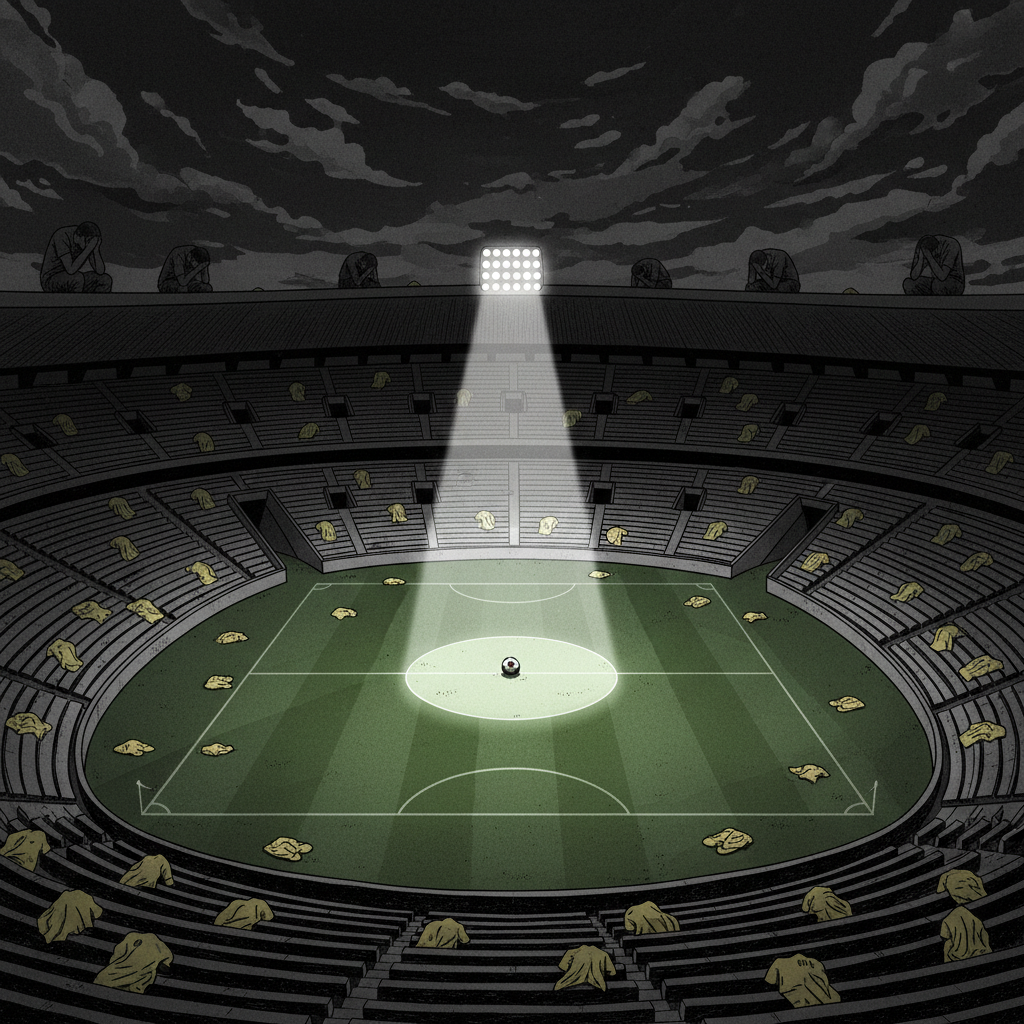
Brazil 7-1 World Cup Loss 2014
On July 8, 2014, Brazil suffered a historic 7-1 defeat to Germany in the semifinal of the 2014 FIFA World Cup at Estádio Mineirão in Belo Horizonte. The match, known in Brazil as the 'Mineiraço,' saw Germany score five goals in 18 minutes during the first half, with the hosts missing key players Neymar (fractured vertebra from the quarterfinal) and captain Thiago Silva (suspended). The result was the worst defeat in Brazil's World Cup history and became a moment of national trauma, exposing the tensions between Brazil's $11 billion World Cup spending and its failing public services, amid the 'Não vai ter Copa' protest movement. The political fallout contributed to the narrative of government incompetence that culminated in President Dilma Rousseff's impeachment in 2016.
Executive Summary
The 2014 Brazil-Germany World Cup semifinal was not a football match that became a national crisis — it was a national crisis that was expressed as a football match. Every lens converges on the same fundamental finding: the 7-1 was overdetermined. The tactical deficit (game-theory, moneyball), psychological fragility (pavlov), existential weight (nietzsche), cultural significance (sports-sociology), media amplification (talking-head), and political context (civilian-impact) all pointed toward catastrophe. What made the 7-1 historically unique was not that any one factor was present — all sporting upsets involve tactical and psychological dynamics — but that ALL factors aligned simultaneously, creating a perfect storm of vulnerability that Germany's systematic preparation exploited with ruthless efficiency. The 18 minutes that produced five goals were the moment when tactical, psychological, cultural, political, and sociological forces converged into a single catastrophic outcome. The aftermath revealed that the 7-1 was a Rorschach test: each observer saw what their framework predicted. For game theorists, it was a cascading equilibrium collapse. For behaviorists, it was learned helplessness under overwhelming aversive stimulation. For Nietzscheans, it was the death of a foundational myth. For statisticians, it was a 4-5 sigma outlier driven by psychological rather than tactical factors. For sociologists, it was the desecration of a civil religion. For media analysts, it was a global shared experience that demonstrated social media's power to create real-time collective narrative. For civilian impact analysts, it was the ultimate symbol of institutional failure and misplaced national priorities. All of them are right. The 7-1 was all of these things simultaneously.
Key Facts
Verified facts from multi-source research, scored by confidence level
Germany defeated Brazil 7-1 in the 2014 FIFA World Cup semifinal on July 8, 2014, at Estádio Mineirão in Belo Horizonte.
high confidenceGermany's goals were scored by Thomas Müller (11'), Miroslav Klose (23'), Toni Kroos (24', 26'), Sami Khedira (29'), André Schürrle (69', 79'). Oscar scored Brazil's consolation goal in the 90th minute.
high confidenceFive goals were scored between the 11th and 29th minutes, with four goals in a six-minute span from the 23rd to 29th minute.
high confidenceNeymar suffered a fractured third lumbar vertebra from a knee-to-the-back challenge by Colombia's Juan Camilo Zúñiga in the 88th minute of the quarterfinal on July 4, 2014, ruling him out of the rest of the tournament.
high confidenceCaptain Thiago Silva was suspended for the semifinal due to accumulation of two yellow cards. His appeal to FIFA was denied as having 'no legal basis.'
high confidenceMiroslav Klose's goal in the 23rd minute made him the all-time leading scorer in World Cup history with 16 goals, surpassing Brazil's Ronaldo who held the record with 15.
high confidenceBrazil's official World Cup spending was approximately $11.6 billion, making it the most expensive World Cup in history at that time.
high confidenceKey Actors
Major actors involved in this event with their actions and stated interests
Luiz Felipe Scolari
individual- ›Selected 4-2-3-1 formation for semifinal despite missing key players
- ›Chose not to fundamentally alter tactical approach for Neymar/Thiago Silva absences
- ›Started Dante and Bernard as replacements
Joachim Löw
individual- ›Developed Germany's tactical system over 8 years since 2006
- ›Prepared specific pressing strategy to exploit Brazil's high defensive line
- ›Instructed team to ease off after 5-0 at halftime
Neymar
individual- ›Carried Brazil's attacking burden through the tournament as the team's talisman
- ›Suffered fractured third lumbar vertebra in quarterfinal vs. Colombia
- ›Watched the 7-1 from a hospital/recovery setting
Dilma Rousseff
individual- ›Defended World Cup spending as beneficial for Brazil's infrastructure and economy
- ›Oversaw security operations during 2013-2014 protests
- ›Won narrow re-election in October 2014
Não vai ter Copa protest movement
group- ›Organized mass protests during 2013 Confederations Cup and 2014 World Cup
- ›Coined and popularized the slogan 'Não vai ter Copa'
- ›Highlighted forced evictions and public spending priorities
Research & Sources
Event Timeline
2007-10-30 to 2016-08-31
Causal Analysis
Interactive graph showing how policies, actors, and events connect causally — click nodes to explore relationships
CAUSAL NETWORK
18 nodes · 17 connections
Select a node
Click any node in the graph to explore its connections and lens perspectives
Root Causes
1Critical Path
7 stepsLens Analyses
Each lens provides a unique analytical framework — click to expand for deep analysis
Game Theory
Western Moderngame-theoryThe 7-1 was not merely a tactical defeat but a cascading equilibrium collapse. Brazil entered with a fragile strategy that required specific conditions (Neymar's creativity, Thiago Silva's organization, crowd momentum) to function. Germany systematically removed each support pillar, and once the strategic structure collapsed after the second goal, no rational recovery was possible. The game-theoretic lesson is that high-risk, high-reward strategies with single points of failure are catastrophically vulnerable to systematic opponents who identify and exploit those failure points.
Behavioral Conditioning Analysis
Western ModernpavlovThe 7-1 was a mass extinction event for Brazil's conditioned national football identity. Decades of reinforcement — five World Cup titles, generations of legendary players, cultural production around football supremacy — were shattered in 18 minutes. The psychological mechanism was identical to laboratory demonstrations of learned helplessness: after the third rapid goal, Brazilian players and fans alike ceased active coping and entered a state of passive acceptance. The subsequent reconditioning through dark humor was not merely a cultural quirk but a psychologically adaptive response — counter-conditioning the aversive stimulus with a new, less painful response. The 7-1 permanently altered Brazil's conditioned relationship with its own football identity.
Nietzschean Power Analysis
Western ModernnietzscheThe 7-1 was the death of Brazilian football's god — the end of the foundational myth of inherent supremacy that had organized Brazilian national identity for generations. The Übermensch model (dependence on individual genius) was exposed as fatally fragile when tested against Germany's systematic will to power. The ensuing ressentiment was both existentially genuine and politically consequential, contributing to the broader crisis that culminated in Rousseff's impeachment. Brazil's dark humor response represents a remarkable form of amor fati — embracing the catastrophe as part of national identity rather than being destroyed by it.
Moneyball Statistical Analysis
Entertainment & SportsmoneyballThe statistical story of the 7-1 is a tale of two components. The first is a predictable tactical mismatch: removing Neymar (40% of attacking output) and Thiago Silva (the defensive organizer) from a team facing the most systematically prepared opponent in the tournament made a defeat statistically likely, with an expected margin of 2-3 goals. The second component is the 'trauma premium': the additional 3-4 goals that represent pure psychological collapse, visible in the data as defensive positioning errors, pass completion rate collapse, and pressing intensity dropping to near-zero between the 23rd and 40th minutes. The 7-1 was a 3-0 or 4-1 tactical defeat amplified into a 7-1 catastrophe by the psychological disintegration of a team and a stadium.
Sports Sociology
Entertainment & Sportssports-sociologyThe 7-1 was not a football match but a sociological earthquake. Football in Brazil functions as a civil religion — the primary institution of national identity and cross-class solidarity. The Mineiraço shattered this institution's claim to sacredness, exposed the class dynamics of mega-event hosting that had been masked by football's unifying narrative, and produced a collective trauma that is sociologically unprecedented in its combination of magnitude (7-1), context (home soil), and stakes (national identity + $11B investment). The humor response was not trivial but a deeply rooted cultural survival mechanism: Brazil's centuries-old tradition of using laughter to process pain found its ultimate expression in the memes that followed the worst day in the nation's sporting history.
Media Narrative Analysis
Entertainment & Sportstalking-headThe 7-1 was narrated through four competing but interlocking media frames: Brazilian devastation, German restraint, international disbelief, and protest movement vindication. The Brazilian media's compressed narrative arc — from shock to humor in hours rather than months — reflected a culturally specific processing speed enabled by social media. The event's transformation into a permanent cultural meme ('7 a 1' as shorthand for catastrophic failure) demonstrates how media narrative construction can embed a sporting result into the permanent lexicon of a language and culture. Perhaps most remarkably, Germany's narrative restraint showed that even the victors recognized this was not a normal sporting triumph but a cultural event that required careful narrative handling.
Civilian Impact Assessment
civilian-impactThe civilian impact of the 7-1 extended far beyond the emotional trauma of a football match. The event crystallized the contradictions of Brazil's mega-event model: $11.6 billion in public spending that produced luxury stadiums while displacing hundreds of thousands from favela communities, white elephant venues with no viable post-tournament use, and a political promise of national glory that was replaced by the worst humiliation in the country's sporting history. The 7-1 became the defining symbol of institutional failure that contributed to Dilma Rousseff's impeachment and discredited the model of mega-event-driven development for a generation. For the communities displaced to build stadiums they could never afford to enter, the 7-1 was not a sporting disaster but the final proof that they had been sacrificed for a spectacle that served everyone but them.
Convergences
Where multiple lenses reach similar conclusions — suggesting robustness
The 7-1 was overdetermined — multiple independent factors all pointed toward disaster
Every analytical lens identifies independent factors that made Brazil vulnerable to a catastrophic result. The tactical weakness without key players (game-theory, moneyball), the psychological fragility of conditioned expectations (pavlov), the existential weight of the 'country of football' identity (nietzsche, sports-sociology), and the political pressure of $11B in spending (civilian-impact) all created overlapping vulnerabilities. The convergence of all these factors simultaneously is what made the 7-1 historically unique rather than merely a bad result.
Germany's systematic approach defeated Brazil's talent-dependent model
Game-theory identifies Germany's dominant strategy of exploiting structural weaknesses. Moneyball quantifies the tactical asymmetry. Nietzsche frames it as Apollo defeating Dionysus. Sports-sociology contextualizes it as the end of the individual-genius model's supremacy. All four lenses agree that the 7-1 represented the triumph of a collective system over individual talent dependence.
The 18-minute spell was a psychological cascade, not merely a tactical collapse
Game-theory identifies the cascading equilibrium collapse. Pavlov identifies the learned helplessness response. Moneyball quantifies the 'trauma premium' — the gap between expected goals from tactical positioning and actual goals, representing the pure psychological disintegration component. All three agree that the 7-1 was approximately a 3-0 or 4-1 tactical defeat amplified into a 7-1 catastrophe by psychological collapse.
The 7-1 transcended sport to become a political and cultural event
All four lenses independently identify the 7-1 as an event that exceeded its sporting context. Nietzsche identifies the existential dimension. Sports-sociology identifies the civil religion dimension. Talking-head identifies the media narrative construction that elevated the event to national crisis status. Civilian-impact identifies the political consequences. The convergence confirms that the 7-1 cannot be understood as a football match alone.
Productive Tensions
Where lenses disagree — revealing complexity worth examining
Possible Futures
Scenarios derived from lens analyses — what might unfold based on different frameworks
Brazilian football renaissance through systematic reform
Medium. Brazil's talent pipeline remains strong, but institutional resistance to systematic approaches is significant. The tension between jogo bonito tradition and tactical modernization has not been resolved.
The 7-1 becomes a fading cultural memory without institutional change
Medium-high. The humor response already began the process of normalizing the trauma. Future successes could complete the reconditioning process without addressing structural issues.
Permanent discrediting of the mega-event development model in Brazil
Medium. The Brazilian public's appetite for mega-events has been significantly reduced, but economic pressures and political opportunism could override this skepticism in the future.
Key Questions
Questions that remain open after analysis — for continued inquiry
- ?What specific tactical adjustments, if any, did Scolari make at halftime when the score was already 5-0?
- ?What were the exact economic downstream effects of World Cup spending — did any infrastructure investments produce measurable long-term benefits?
- ?How many of the 12 World Cup stadiums are currently in regular use versus functioning as white elephants?
Fact Check Details
Fact Check Results
verifiedMeta Observations
All seven lenses analyze the 7-1 from the perspective of Brazil's failure, with Germany's achievement treated as a backdrop rather than a story in its own right. Germany's 2014 World Cup victory — the culmination of 14 years of systematic development — deserves its own multi-lens analysis as one of the greatest achievements in football history. By centering the 7-1 on Brazilian trauma, we risk reducing Germany's triumph to a supporting role in someone else's tragedy.
The 7-1 resists reduction to any single explanatory framework because it operates simultaneously across tactical, psychological, cultural, political, and sociological dimensions. Any lens that claims to fully explain the event is necessarily incomplete. The genuine understanding of the 7-1 requires holding all seven perspectives simultaneously — not synthesizing them into a single narrative but allowing them to remain in productive tension.
We should be honest about what we cannot know. We cannot know what would have happened with Neymar and Thiago Silva present. We cannot precisely separate the tactical from the psychological component of the scoreline. We cannot definitively determine whether the 7-1 'caused' political change or merely symbolized existing trends. We cannot know whether future generations will remember the 7-1 as a defining national trauma or a fading sporting anecdote. The 7-1 teaches epistemic humility: some events are too complex, too overdetermined, and too deeply embedded in their cultural context to be fully explained by any analytical framework.
Find Your Perspective
Different frameworks resonate with different readers — find your entry point
Readers who approach the 7-1 as a tactical and statistical puzzle — wanting to understand the mechanics of how five goals happened in 18 minutes and what the data reveals about the underlying quality difference between the teams.
The 7-1 was approximately a 3-0 tactical defeat amplified into a 7-1 by psychological collapse. Germany's dominant strategy exploited specific, identifiable weaknesses created by Brazil's missing players. The match was a statistical outlier (4-5 sigma) driven by the interaction between tactical inferiority and psychological cascade.
Readers who feel the 7-1 as a cultural and emotional event — who understand that football in Brazil is not just a sport but a structure of meaning, and that the 7-1 shattered something fundamental about Brazilian self-understanding.
The 7-1 was the death of a foundational national myth. Decades of conditioned belief in Brazilian football supremacy were extinguished in 18 minutes. Football functions as a civil religion in Brazil, and the 7-1 was a desecration of the sacred. The dark humor response was a culturally specific form of amor fati — embracing catastrophe rather than being destroyed by it.
Readers who see the 7-1 as a political and institutional event — the culmination of misplaced spending priorities, government overreach, and institutional failure that was expressed through but not limited to a football match.
The $11.6B World Cup spending displaced hundreds of thousands, created white elephant stadiums, and was justified by a promise of national glory that the 7-1 destroyed. The political downstream contributed to Rousseff's impeachment. The media narrative was constructed differently across four perspectives (devastation, restraint, disbelief, vindication), each serving different institutional interests.
Readers skeptical of the grander narratives who want to strip the 7-1 back to its sporting fundamentals: a team missing two key players lost badly to a better-prepared opponent. The cultural and political overlay, while real, risks obscuring the straightforward sporting explanation.
Much of what happened can be explained by standard tactical analysis: Brazil's defensive disorganization without Thiago Silva, the creative void without Neymar, and Germany's clinical exploitation of predictable weaknesses. The 7-1 was extraordinary in degree but not in kind — football produces heavy defeats when one team is significantly weakened and the other is at peak preparation.
Start with the analytical cluster (game-theory, moneyball) to understand what happened mechanically, then layer the intuitive cluster (pavlov, nietzsche, sports-sociology) to understand why it mattered so deeply, and finally add the institutional cluster (civilian-impact, talking-head) to understand the broader consequences. The 7-1 requires all three perspectives to be fully comprehended — it was a tactical failure, an existential crisis, and a political turning point, all simultaneously.
Related Analyses
Other events analyzed through similar lenses or categories
The Arab Spring was a revolutionary wave of protests, uprisings, and armed rebellions that swept across the Arab world beginning in December 2010. Triggered by the self-immolation of Tunisian street vendor Mohamed Bouazizi on December 17, 2010 — an act of desperation against decades of authoritarian corruption, humiliation, and youth unemployment — the movement spread with breathtaking speed across North Africa and the Middle East. The defining chant "الشعب يريد إسقاط النظام" (The people want the fall of the regime) echoed from Tunis to Cairo to Benghazi to Damascus. Tunisia's Ben Ali fled after 23 years (January 14, 2011); Egypt's Mubarak fell after 30 years in just 18 days (February 11, 2011); Libya's Gaddafi was overthrown and killed after NATO intervention (October 2011); Syria's Assad chose brutal suppression, igniting a civil war that killed over 500,000 and displaced 13 million. The military's choice — to side with protesters or stay loyal to the regime — proved the decisive variable in every country. Al Jazeera's satellite broadcasts and social media amplified the contagion, but the underlying causes were structural: decades of stagnation, corruption, and humiliation across a generation with no economic prospects. Western media characterized this as a democratic awakening; Gulf monarchies framed it as foreign-backed destabilization; authoritarian regimes described it as terrorist infiltration; participants called it ثورة الكرامة — the Dignity Revolution. A decade later, only Tunisia achieved democratic transition. Egypt reverted to military rule. Libya collapsed into a failed state. Syria became the century's worst humanitarian catastrophe, birthing ISIS and triggering the European refugee crisis. The Arab Spring remains the most consequential geopolitical event of the 2010s — a story of extraordinary courage, tragic outcomes, and the enduring question of whether revolution can deliver the dignity it promises.
Between April 6 and July 18, 1994, approximately 800,000 Tutsi and moderate Hutu were systematically murdered in Rwanda over the course of 100 days — the most efficient mass killing in modern history, with a faster per-day death rate than the Holocaust. The genocide was not the eruption of 'ancient tribal hatreds' but the culmination of a colonial project: Belgian administrators had manufactured rigid racial categories from fluid social identities through the 1933 census and mandatory ethnic identity cards, creating the very Hutu-Tutsi divide that political elites later weaponized. The Habyarimana regime's akazu inner circle, facing military pressure from the Rwandan Patriotic Front and the power-sharing demands of the Arusha Accords, chose genocide as a political survival strategy. RTLM radio — 'Radio Machete' — systematically conditioned the population through years of dehumanizing propaganda, calling Tutsis 'inyenzi' (cockroaches) before broadcasting explicit kill instructions and victim locations during the genocide itself. Between 250,000 and 500,000 women were raped as a deliberate weapon of genocide, with the ICTR's landmark Akayesu judgment recognizing rape as an act of genocide for the first time in international law. The international community's failure was not passive but active: UN force commander Roméo Dallaire sent his 'genocide fax' warning three months before the killing began, requested 5,000 troops, and was denied. The UN Security Council reduced UNAMIR from 2,500 to 270 soldiers during the genocide. The United States deliberately avoided using the word 'genocide' to circumvent legal obligations to intervene. The RPF's military victory ended the genocide in July 1994, but the aftermath cascaded into the First Congo War (1996-97) and 'Africa's World War' that killed over 5 million people.
On April 26, 1986, at 01:23 AM, Reactor No. 4 at the Chernobyl Nuclear Power Plant in the Ukrainian SSR exploded during a safety test, releasing 400 times more radioactive material than the Hiroshima bomb. The explosion and subsequent fire sent a plume of radioactive fallout across much of the western USSR and Europe. Soviet authorities initially concealed the disaster, forcing Pripyat’s 49,000 residents to continue normal life for 36 hours before evacuation. Some 600,000 ‘liquidators’ were eventually deployed to contain the catastrophe — including the ‘bio-robots,’ human volunteers who replaced failed machines to shovel radioactive graphite from the roof in 90-second shifts, each receiving a lifetime’s radiation dose. The official Soviet death toll of 31 remains contested; estimates range from the WHO’s 4,000 to Greenpeace’s 93,000 excess cancer deaths. The disaster shattered the myth of Soviet technological supremacy, forced Gorbachev’s hand on glasnost, and — in Gorbachev’s own later assessment — was ‘perhaps the real cause of the collapse of the Soviet Union’ more than any policy or reform. The 2,600-square-kilometer Exclusion Zone remains uninhabitable, a permanent scar on Ukrainian territory where Moscow’s decisions played out at Ukraine’s expense.
How This Was Analyzed
Full transparency about the analysis process, tools, and limitations
Crosslight Engine
v0.4.0 "Global Lens Expansion"- ⚠Non-Western philosophical lenses rely on translated primary texts — nuance may be lost in translation
- ⚠Some traditions (e.g., Maat, Ubuntu) have limited surviving primary texts; analysis draws on scholarly reconstruction
- ⚠Cross-cultural lens application is inherently interpretive — a Confucian reading of a Western event is an analytical exercise, not a claim of cultural authority
Analysis Statistics
Methodology
This analysis was produced by the Crosslight multi-agent pipeline: a Research Agent gathered and verified facts from multiple sources, specialized Lens Agents applied distinct analytical frameworks, a Synthesis Agent integrated insights and identified patterns, and a Fact-Check Agent verified claims. Each lens perspective is the AI's interpretation — not institutional endorsement.Learn more →