
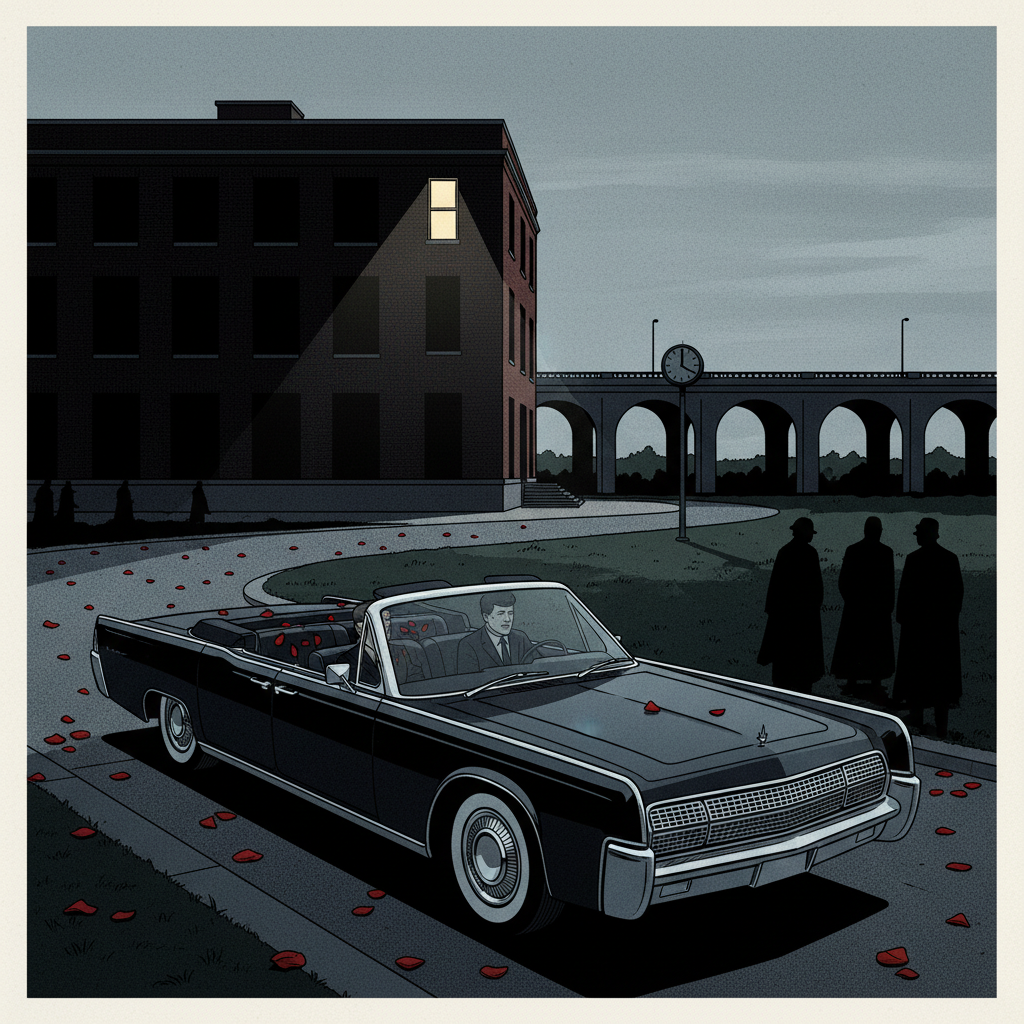
The Assassination of President John F. Kennedy
On November 22, 1963, President John F. Kennedy was assassinated in Dealey Plaza, Dallas, Texas. Lee Harvey Oswald was arrested but killed by Jack Ruby before trial. The Warren Commission concluded Oswald acted alone, while the HSCA later found probable conspiracy. Declassified documents through 2025 reveal institutional cover-ups by the CIA and FBI, making it the most consequential unsolved case in American history.
Executive Summary
Across 11 analytical lenses, the JFK assassination reveals a consistent meta-pattern: regardless of who pulled the trigger, the institutional response prioritized self-preservation over truth. Game theory shows cover-up was the rational strategy for every institution. Machiavelli reveals every power center hostile to Kennedy benefited. Intelligence lenses confirm documented concealment. Jung and Nietzsche illuminate deep psychological and philosophical wounds. Pavlov explains narrative conditioning. The counter-narrative lens notes the extraordinary fact that 65% of Americans reject the official conclusion.
Key Facts
Verified facts from multi-source research, scored by confidence level
JFK was assassinated on November 22, 1963 in Dealey Plaza, Dallas, Texas at approximately 12:30 PM CST
high confidenceThree shots were fired from the Texas School Book Depository sixth floor window
high confidenceLee Harvey Oswald was arrested at the Texas Theatre approximately 80 minutes after the assassination
high confidenceA 6.5mm Mannlicher-Carcano rifle found on the sixth floor was traced to Oswald via mail order
high confidenceJFK was pronounced dead at Parkland Memorial Hospital at 1:00 PM CST
high confidenceOswald defected to the Soviet Union in October 1959 and returned to the US in June 1962 with his Russian wife Marina
high confidenceJack Ruby shot and killed Oswald on live television on November 24, 1963
high confidenceKey Actors
Major actors involved in this event with their actions and stated interests
Lee Harvey Oswald
individual- ›Defected to USSR 1959
- ›Returned to US 1962
- ›Distributed FPCC leaflets in New Orleans
Jack Ruby
individual- ›Operated nightclubs in Dallas
- ›Maintained police connections
- ›Made extensive calls to mob figures Oct-Nov 1963
CIA
organization- ›Monitored Oswald in Mexico City
- ›Ran anti-Castro operations with Mafia
- ›Assigned Joannides to HSCA without disclosure
FBI / J. Edgar Hoover
organization- ›Maintained file on Oswald
- ›Agent Hosty monitored Oswald
- ›Destroyed Hosty note after assassination
Research & Sources
Event Timeline
1963-11-22 to present (investigations ongoing)
Causal Analysis
Interactive graph showing how policies, actors, and events connect causally — click nodes to explore relationships
CAUSAL NETWORK
19 nodes · 20 connections
Select a node
Click any node in the graph to explore its connections and lens perspectives
Root Causes
2Critical Path
10 stepsLens Analyses
Each lens provides a unique analytical framework — click to expand for deep analysis
Game Theory & Strategic Interaction
Western Moderngame-theoryThe JFK assassination reveals a perfect storm of game-theoretic incentives for institutional cover-up. Regardless of whether a conspiracy existed, every major institution had dominant strategies favoring concealment. The lone gunman narrative functioned as a Schelling focal point requiring no coordination. The elimination of Oswald removed the only credible threat to this equilibrium. Sixty-two years later, the equilibrium holds not because truth is impossible, but because the game was structured to make it irrational.
Machiavellian Realpolitik
Greco-Roman & ClassicalmachiavelliKennedy had systematically antagonized every major covert power center in Washington. The assassination created a power vacuum immediately filled by those same centers. Whether by conspiracy or coincidence, the aftermath perfectly served the interests of those Kennedy had opposed. Machiavelli would note that when a prince makes enemies of all the powerful simultaneously, his survival depends entirely on the loyalty of his guards - and in Dallas, the Secret Service inexplicably relaxed its protection protocols.
Taoist Wisdom
East AsiantaoismThe Taoist lens reveals the JFK assassination as a cosmic inflection point where Americas yang transformed into yin. Every attempt to force resolution has deepened the mystery. The Tao te Ching teaches that the more prohibitions you have, the less virtuous people will be. The more the institutions concealed, the more the public distrusted. The way forward is not more forcing but the wisdom to hold uncertainty without needing to resolve it.
Intelligence Analysis (CIA Perspective)
Western InstitutionalciaThe intelligence lens reveals that CIAs post-assassination behavior follows the pattern of an agency managing an operational catastrophe. The Joannides cover-up demonstrates that source protection and institutional survival trump Congressional oversight and public trust. After 80,000 pages of declassification, no document proves CIA operational involvement - but the pattern of concealment means we cannot know what was destroyed.
FBI / Domestic Security Perspective
Western InstitutionalfbiThe FBI lens reveals an institution that possessed critical pre-assassination intelligence, failed to act on it, and then systematically destroyed evidence and concealed its failures. The Hosty note destruction proves beyond doubt that the FBI prioritized self-protection over truth within hours of the Presidents murder.
Conspiracy & Hidden Connections
Western ModernconspiracyThe conspiracy lens reveals an event where proven institutional cover-ups, documented operational nexuses, the elimination of the suspect before trial, and universal benefit to hostile power centers ALL converge. Whether these add up to orchestrated conspiracy or a perfect storm of institutional failure and convenient coincidence is what 62 years of investigation have failed to answer.
Counter-Narrative & Marginalized Perspectives
Western Moderncounter-narrativeThe counter-narrative lens exposes that the official narrative has never commanded majority public belief yet maintains authority through the social power of labeling dissent. When 65% of Americans are conspiracy theorists the term has lost all meaning. What remains is documented institutional concealment being defended by the same institutions that engaged in it.
Carl Jung / Depth Psychology
Western ModernjungThe Jungian lens reveals the assassination as Americas foundational collective trauma. Kennedy carried the Sacred King projection and his murder shattered the psychic container of postwar confidence. The persistent belief in conspiracy is the collective unconscious insisting the wound is deeper than one mans pathology. What wants to become conscious is what Kennedys death revealed about violence and institutional betrayal at the heart of American power.
Nietzsche / Will to Power
Western ModernnietzscheThrough the Nietzschean lens, Kennedy's attempt to bend the security state toward peace collided with institutions whose will to power demanded expansion and secrecy. The Warren Commission functions as a noble lie. The publics persistent rejection represents a revaluation of values: democratic will asserting itself against institutional authoritys claim to define reality.
Pavlov / Behavioral Conditioning
Western ModernpavlovThe Pavlovian lens reveals that Americas response to the JFK assassination has been shaped by six decades of behavioral conditioning. The lone gunman narrative was reinforced through authority, repetition, and social punishment. The 2025 documents are deconditioning stimuli. The fact that 65% now reject the conditioned response suggests the conditioning is failing - the bell still rings, but the dog no longer salivates.
Council on Foreign Relations / Foreign Policy Establishment
Western InstitutionalcfrThe CFR lens reveals the assassination as a pivotal moment in grand strategy. Kennedy was pursuing detente and questioning Vietnam escalation. His assassination produced the most consequential reversal of the Cold War: from withdrawal to massive escalation. The Vietnam War shaped a generation, altered regional power, and weakened American hegemony - outcomes Kennedys policies might have avoided.
Convergences
Where multiple lenses reach similar conclusions — suggesting robustness
Institutional cover-up is proven fact, not theory
Seven of eleven lenses identify documented institutional concealment as the central finding
Cover-up was rational regardless of guilt
Both CIA and FBI had catastrophic intelligence failures that would have been devastating if exposed
The assassination marked a psychic/cultural inflection point
Five lenses converge on the assassination as transformative in American consciousness
Every hostile power center benefited from Kennedys death
CIA regained freedom, Hoover secured position, Vietnam escalated, RFKs mob campaign lost its champion
Productive Tensions
Where lenses disagree — revealing complexity worth examining
Possible Futures
Scenarios derived from lens analyses — what might unfold based on different frameworks
Incremental truth through continued declassification
Most likely
Truth remains permanently ambiguous
Highly likely
Definitive revelation emerges
Unlikely but not impossible
Key Questions
Questions that remain open after analysis — for continued inquiry
- ?What was the full extent of CIA monitoring of Oswald?
- ?What were the exact contents of the destroyed Hosty note?
- ?Did Ruby receive instructions from organized crime?
Fact Check Details
Fact Check Results
verifiedMeta Observations
All eleven lenses miss the simple human tragedy: a 46-year-old man was murdered in front of his wife, leaving two young children fatherless.
The intersection of Cold War geopolitics, institutional dysfunction, individual psychology, organized crime, and pure contingency may resist untangling by any framework.
After 62 years, two official investigations reaching opposite conclusions, and millions of pages, the fundamental question remains unresolved. This should inspire humility.
Find Your Perspective
Different frameworks resonate with different readers — find your entry point
Those who prefer logical analysis of institutional behavior and incentive structures
Cover-up was rational for every institution. Power dynamics explain why truth was sacrificed for stability.
Those who sense the assassination transcends forensics - something deeper was revealed or broken
The assassination represents a psychic wound. Institutional will to power overwhelmed individual idealism.
Those who study how institutions operate
Intelligence community behavior follows recognizable patterns. Institutional failure is more common than conspiracy.
Those who question official narratives
The documented cover-ups are fact. The conspiracy theorist label was a conditioning tool. The question is not whether institutions lied but about what.
Start with your natural cluster then deliberately explore the most foreign one. The assassinations enduring power comes from its capacity to be truthfully analyzed from radically different perspectives.
Related Analyses
Other events analyzed through similar lenses or categories
The emergence of SARS-CoV-2 in late 2019, its global spread, varying governmental responses, vaccine development and distribution, economic impacts, and resulting societal changes.
On the night of February 28, 1986, at 23:21, Swedish Prime Minister Olof Palme was shot and killed on the central Stockholm street Sveavägen while walking home from a cinema with his wife Lisbeth. He had dismissed his security detail earlier that day — a prime minister walking unguarded through his capital on a Friday night, the very embodiment of Swedish democratic openness. A second shot grazed Lisbeth Palme. The killer fled up the steps of Tunnelgatan and vanished into the night. What followed was not merely a murder investigation but a national trauma that consumed Sweden for nearly four decades: a catastrophically botched crime scene, an investigation fixated on the wrong suspects, 134 people who confessed to the murder, over 10,000 tips that created information paralysis, the wrongful conviction and acquittal of Christer Pettersson, and dozens of competing conspiracy theories implicating South African intelligence, the CIA, NATO's Stay Behind/Gladio networks, the Kurdish PKK, and elements within the Swedish police themselves. In 2020, Chief Prosecutor Krister Petersson named graphic designer Stig Engström — the 'Skandia Man' — as the probable killer and closed the case. Engström had died by suicide in 2000, so could never be tried. The announcement was met with widespread criticism as circumstantial and unprovable. In December 2025, Sweden's director of public prosecutions formally reversed the conclusion, stating there was insufficient evidence to consider Engström the main suspect — but the investigation would not be reopened. The case remains, in effect, unsolved: Sweden's defining political wound, still open after nearly forty years.
The Arab Spring was a revolutionary wave of protests, uprisings, and armed rebellions that swept across the Arab world beginning in December 2010. Triggered by the self-immolation of Tunisian street vendor Mohamed Bouazizi on December 17, 2010 — an act of desperation against decades of authoritarian corruption, humiliation, and youth unemployment — the movement spread with breathtaking speed across North Africa and the Middle East. The defining chant "الشعب يريد إسقاط النظام" (The people want the fall of the regime) echoed from Tunis to Cairo to Benghazi to Damascus. Tunisia's Ben Ali fled after 23 years (January 14, 2011); Egypt's Mubarak fell after 30 years in just 18 days (February 11, 2011); Libya's Gaddafi was overthrown and killed after NATO intervention (October 2011); Syria's Assad chose brutal suppression, igniting a civil war that killed over 500,000 and displaced 13 million. The military's choice — to side with protesters or stay loyal to the regime — proved the decisive variable in every country. Al Jazeera's satellite broadcasts and social media amplified the contagion, but the underlying causes were structural: decades of stagnation, corruption, and humiliation across a generation with no economic prospects. Western media characterized this as a democratic awakening; Gulf monarchies framed it as foreign-backed destabilization; authoritarian regimes described it as terrorist infiltration; participants called it ثورة الكرامة — the Dignity Revolution. A decade later, only Tunisia achieved democratic transition. Egypt reverted to military rule. Libya collapsed into a failed state. Syria became the century's worst humanitarian catastrophe, birthing ISIS and triggering the European refugee crisis. The Arab Spring remains the most consequential geopolitical event of the 2010s — a story of extraordinary courage, tragic outcomes, and the enduring question of whether revolution can deliver the dignity it promises.
How This Was Analyzed
Full transparency about the analysis process, tools, and limitations
Crosslight Engine
v0.3.1 "Arena & Stage"- ⚠Entertainment/sports lenses reflect domain stereotypes for analytical color, not endorsement
- ⚠Celebrity and sports events have limited 'ground truth' - analysis is inherently interpretive
- ⚠Hot take and tabloid personas are satirical framing devices for accessible analysis
Analysis Statistics
Methodology
This analysis was produced by the Crosslight multi-agent pipeline: a Research Agent gathered and verified facts from multiple sources, specialized Lens Agents applied distinct analytical frameworks, a Synthesis Agent integrated insights and identified patterns, and a Fact-Check Agent verified claims. Each lens perspective is the AI's interpretation — not institutional endorsement.Learn more →