Sewol Ferry Disaster
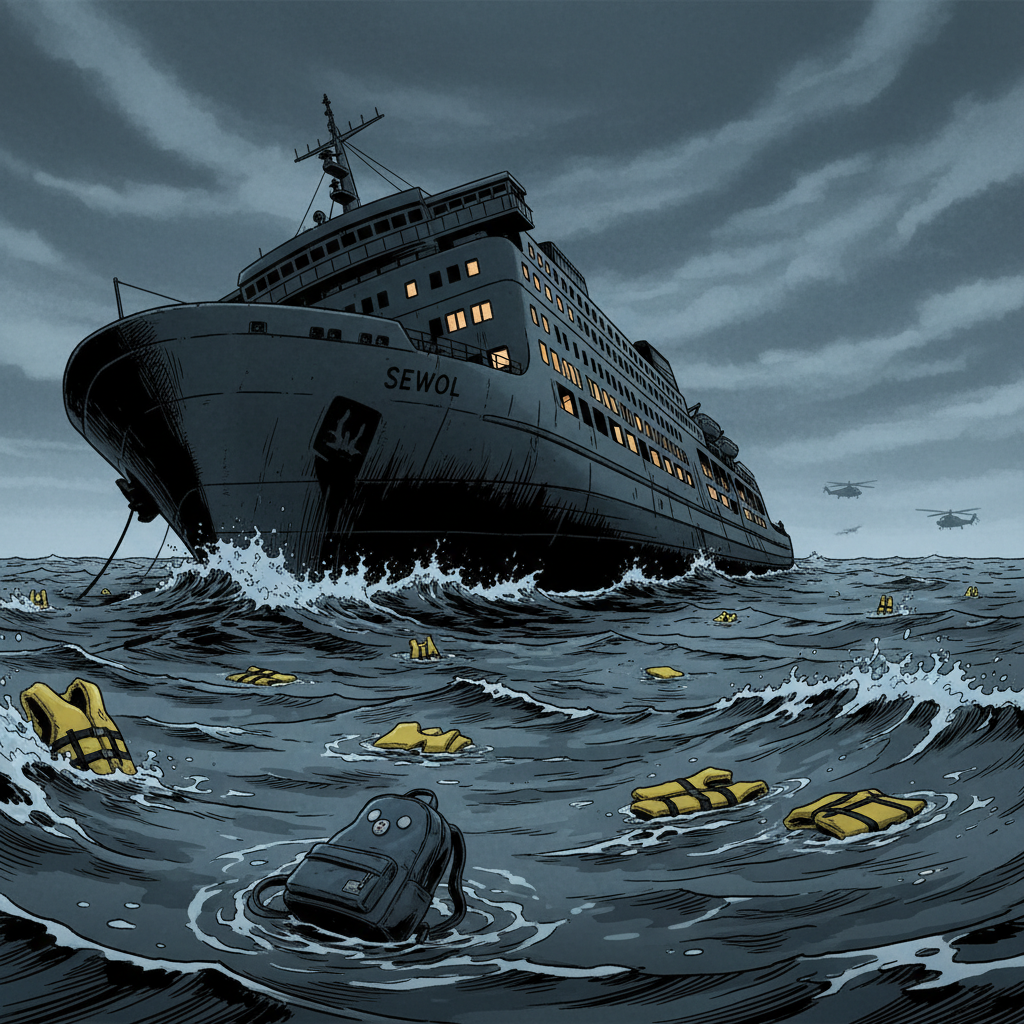
On April 16, 2014, the South Korean ferry MV Sewol capsized and sank while en route from Incheon to Jeju Island, killing 304 of the 476 people on board. Among the dead were 250 students from Danwon High School in Ansan, aged 16-17, on a school field trip. The disaster exposed systemic failures in South Korea's maritime safety regime: the vessel had been illegally modified to carry more passengers and cargo, was loaded to more than twice its legal cargo limit, and its crew abandoned ship while repeatedly instructing passengers to stay in their cabins. President Park Geun-hye's unexplained seven-hour absence during the critical early hours became a major political scandal contributing to her impeachment in 2017. The Sewol disaster became a symbol of institutional failure in South Korea.
Executive Summary
Seven analytical lenses converge on a single devastating conclusion: the Sewol disaster was not an accident but the inevitable product of a social system that systematically prioritized speed, profit, and hierarchical obedience over human safety. Every lens identifies systemic rather than individual failure as the root cause, though they differ on which systemic dimension is most significant — Confucian hierarchy, neoliberal deregulation, regulatory capture, or behavioral conditioning. The most profound insight emerges from the intersection of the Confucian and Pavlovian analyses: the very virtue Korean society most cultivates in its children — obedience to authority — became the mechanism of their deaths when authority proved unworthy of trust. The disaster catalyzed a counter-hegemonic movement that toppled a president, but whether it produced lasting structural change or merely a temporary disruption of the hegemonic order remains the central open question.
Key Facts
Verified facts from multi-source research, scored by confidence level
MV Sewol departed Incheon at approximately 9:00 PM on April 15, 2014, with 476 people: 443 passengers (325 Danwon High School students, 14 teachers) and 33 crew.
high confidenceDistress signal sent at 08:58 KST on April 16, 2014. The ship took approximately two and a half hours to sink.
high confidenceMV Sewol was originally the Japanese ferry Naminoue (built 1994). Chonghaejin Marine purchased it in 2012 and illegally modified it to add passenger cabins on upper decks, raising center of gravity.
high confidenceSewol carried 2,142.7 tons of cargo against a legal maximum of 987 tons, with only 761.2 tons of ballast water. Included 180 vehicles (recorded as 150) and 1,157+ tons of freight.
high confidenceCaptain Lee Joon-seok (age 69) and 14 crew evacuated while PA system told passengers to remain in cabins.
high confidenceOf 172 survivors, more than half were rescued by civilian fishing boats that arrived ~40 minutes before the Korea Coast Guard.
high confidence304 people died, including ~250 Danwon High School students aged 16-17. About 82% of casualties were children.
high confidenceKey Actors
Major actors involved in this event with their actions and stated interests
Captain Lee Joon-seok
individual- ›Failed to issue evacuation order
- ›Abandoned ship while passengers remained below
- ›Was among first crew rescued
Chonghaejin Marine Company
corporation- ›Purchased and illegally modified MV Sewol
- ›Routinely overloaded beyond legal limits
- ›Falsified cargo manifests
President Park Geun-hye
individual- ›Absent from crisis management for seven hours
- ›Blamed captain and crew publicly
- ›Ordered Coast Guard dissolution
Korea Coast Guard
organization- ›Arrived 40 min after civilian boats
- ›Failed to enter sinking vessel
- ›Rescued captain/crew first
Danwon High School families
group- ›Established Paengmok Harbor vigil
- ›Launched yellow ribbon movement
- ›Demanded independent investigation
Research & Sources
Event Timeline
2009-2017
Causal Analysis
Interactive graph showing how policies, actors, and events connect causally — click nodes to explore relationships
CAUSAL NETWORK
14 nodes · 16 connections
Select a node
Click any node in the graph to explore its connections and lens perspectives
Root Causes
1Critical Path
8 stepsLens Analyses
Each lens provides a unique analytical framework — click to expand for deep analysis
Civilian Population Impact Analysis
civilian-impactThe Sewol disaster inverts the expected moral calculus of obedience: children who followed instructions died while those who defied authority survived. This produced not merely grief but a fundamental crisis of institutional trust in South Korean society, transforming a maritime accident into a civilization-level reckoning with the relationship between authority, obedience, and the duty of care.
Confucian Ethics
East AsianconfucianThe Sewol disaster reveals the lethal paradox at the heart of Confucian obedience culture: the very virtue of respectful compliance that Korean society cultivates in its children became the mechanism of their deaths when the authority figures they trusted violated every Confucian duty of care. The disaster demands a reckoning not with Confucianism itself but with its distortion — obedience without the reciprocal obligation of benevolent authority that makes Confucian hierarchy ethically coherent.
Game Theory
Western Moderngame-theoryThe Sewol disaster is a textbook case of catastrophic equilibrium: every actor behaved rationally given the incentive structure they faced, and 304 people died. The regulatory capture equilibrium was individually rational for both regulators and industry, the captain's abandonment was individually rational given the payoff structure, and the students' obedience was rational given their information state. The tragedy is that the system produced collectively catastrophic outcomes from individually rational choices at every level.
Behavioral Conditioning Analysis
Western ModernpavlovThe Sewol disaster demonstrates that behavioral conditioning is not merely a laboratory phenomenon but a lethal social force. The Korean education system's systematic conditioning of obedience produced students who followed fatal instructions as automatically as Pavlov's dogs responded to bells. The tragedy is not that the conditioning 'failed' — it worked perfectly. The students did exactly what they had been trained to do. The failure was in the system that conditioned obedience without ensuring the authorities being obeyed were worthy of that conditioned trust.
Machiavellian Realpolitik
Greco-Roman & ClassicalmachiavelliThe Sewol disaster is a Machiavellian masterclass in how appearance devours substance. Park Geun-hye may or may not have been monitoring the crisis during the seven missing hours — but it does not matter. Machiavelli teaches that for a prince, appearing to act is as important as acting. By disappearing during the crisis, Park violated the cardinal Machiavellian principle: never let your people see you as either incompetent or indifferent, for they will forgive cruelty before they forgive contempt.
Corporate Interests Analysis
Western ModerncorporateThe Sewol disaster demonstrates that regulatory capture is not a market 'imperfection' but a predictable equilibrium outcome when the regulated industry has concentrated interests and the public has diffuse ones. Chonghaejin Marine did not 'break' the system — it operated exactly as the system was designed to allow. The 304 deaths are the externalized cost of a regulatory regime that systematically valued corporate profitability over public safety.
Gramscian Analysis (Cultural Hegemony)
Western ModerngramsciThe Sewol disaster reveals that ppalli-ppalli is not a neutral cultural trait but a hegemonic formation — a way of organizing society that serves particular class interests while appearing as universal common sense. When 250 children died because speed and profit were prioritized over safety and care, the hegemonic spell was broken. The yellow ribbon movement and the candlelight protests represent one of the most successful counter-hegemonic mobilizations in recent East Asian history: a war of position that toppled a president and, for a time, made a new common sense — that the state's first duty is to protect life, not to facilitate profit.
Convergences
Where multiple lenses reach similar conclusions — suggesting robustness
Systemic institutional failure, not individual incompetence
All four lenses independently identify the disaster as the product of systemic failures — regulatory capture, corporate impunity, deregulation ideology — rather than merely individual bad actors. Captain Lee's abandonment and Park's absence are symptoms, not causes.
Obedience to authority as lethal mechanism
The Confucian, Pavlovian, and civilian impact lenses all identify the students' conditioned obedience as the proximate cause of the extreme casualty concentration. The cultural conditioning that produced compliance (Confucian/Pavlov) directly produced the casualties (civilian impact).
Appearance vs. reality in governance
Machiavelli identifies the failure of political appearance management; Gramsci identifies the hegemonic construction of 'common sense' that masked danger; corporate analysis identifies the regulatory capture that created the appearance of oversight without substance.
Post-1997 deregulation as causal root
Corporate, Gramscian, and game theory analyses all trace the causal chain back to the post-Asian Financial Crisis deregulation regime that created the institutional conditions for the disaster.
Productive Tensions
Where lenses disagree — revealing complexity worth examining
Possible Futures
Scenarios derived from lens analyses — what might unfold based on different frameworks
Durable reform: Sewol becomes Korea's 'never again' moment
Medium — possible if reforms are institutionalized before political attention fades
Gradual erosion: Reforms decay as memories fade
Medium-high — historical pattern suggests regulatory reforms erode within 15-20 years without sustained political pressure
Cultural transformation: Korean society fundamentally rebalances obedience norms
Low — deep cultural conditioning is resistant to event-driven change
Key Questions
Questions that remain open after analysis — for continued inquiry
- ?What was Park Geun-hye doing during the seven missing hours?
- ?How many previous overloading incidents occurred on Sewol routes before the disaster?
- ?What was the exact relationship between maritime regulators and Chonghaejin Marine personnel?
Fact Check Details
Fact Check Results
verifiedMeta Observations
All seven lenses focus on what went wrong and why, but none adequately accounts for the acts of extraordinary courage that also occurred: the crew member Park Ji-young (age 22) who helped students put on life vests and pushed them toward exits before she herself drowned, or the students who defied instructions to help classmates. The disaster produced both the worst and the best of human behavior, and an exclusive focus on failure risks dishonoring those who chose courage.
The Sewol disaster sits at the intersection of culture (Confucian hierarchy), economics (neoliberal deregulation), politics (regulatory capture and presidential accountability), psychology (conditioned obedience), and technology (maritime engineering). No single lens can capture this intersection; the seven together approach but do not exhaust the event's meaning.
This analysis was conducted from outside Korean culture, primarily using English-language sources. Korean-language scholarship, survivor testimony, and the Sewol families' own articulation of what the disaster means should be weighted more heavily than any external analytical framework. The most important voices in this analysis are those of the 304 who cannot speak and the families who speak for them.
Find Your Perspective
Different frameworks resonate with different readers — find your entry point
Readers who think in terms of incentives, systems, and institutional design. You see the disaster as a predictable outcome of misaligned incentives and regulatory failure.
The disaster was rational at every level — the system produced catastrophic outcomes from individually rational choices. Reform requires changing incentive structures, not just punishing individuals.
Readers who focus on cultural context, human behavior, and the relationship between individuals and the social systems that shape them. You see the disaster as a failure of the social contract between authority and trust.
The obedience that killed the students was a product of the very social system that Korean society values most. Reform requires rethinking the relationship between authority and compliance, not just fixing regulations.
Readers who focus on leadership, governance, and the responsibilities of those in power. You see the disaster as a failure of leadership at every level.
Leaders' failure to fulfill their duty of care — captain, company, president — produced both the disaster and the political consequences. The appearance of caring is inseparable from the substance of governance.
Readers who question dominant narratives and look for whose interests are served by 'common sense.' You see the disaster as the product of a hegemonic system that normalized danger.
Ppalli-ppalli culture and deregulation ideology were not neutral — they served particular class interests while appearing as universal Korean values. The reforms may be transformismo: surface changes that preserve underlying power structures.
Start with the convergences — all seven lenses agree on systemic failure. Then explore the tensions: the debate between individual agency (Machiavelli) and structural determinism (Gramsci) reveals the most productive analytical ground. The Confucian-Pavlovian intersection on obedience is the most distinctive insight this analysis produces.
Related Analyses
Other events analyzed through similar lenses or categories
On April 26, 1986, at 01:23 AM, Reactor No. 4 at the Chernobyl Nuclear Power Plant in the Ukrainian SSR exploded during a safety test, releasing 400 times more radioactive material than the Hiroshima bomb. The explosion and subsequent fire sent a plume of radioactive fallout across much of the western USSR and Europe. Soviet authorities initially concealed the disaster, forcing Pripyat’s 49,000 residents to continue normal life for 36 hours before evacuation. Some 600,000 ‘liquidators’ were eventually deployed to contain the catastrophe — including the ‘bio-robots,’ human volunteers who replaced failed machines to shovel radioactive graphite from the roof in 90-second shifts, each receiving a lifetime’s radiation dose. The official Soviet death toll of 31 remains contested; estimates range from the WHO’s 4,000 to Greenpeace’s 93,000 excess cancer deaths. The disaster shattered the myth of Soviet technological supremacy, forced Gorbachev’s hand on glasnost, and — in Gorbachev’s own later assessment — was ‘perhaps the real cause of the collapse of the Soviet Union’ more than any policy or reform. The 2,600-square-kilometer Exclusion Zone remains uninhabitable, a permanent scar on Ukrainian territory where Moscow’s decisions played out at Ukraine’s expense.
The Arab Spring was a revolutionary wave of protests, uprisings, and armed rebellions that swept across the Arab world beginning in December 2010. Triggered by the self-immolation of Tunisian street vendor Mohamed Bouazizi on December 17, 2010 — an act of desperation against decades of authoritarian corruption, humiliation, and youth unemployment — the movement spread with breathtaking speed across North Africa and the Middle East. The defining chant "الشعب يريد إسقاط النظام" (The people want the fall of the regime) echoed from Tunis to Cairo to Benghazi to Damascus. Tunisia's Ben Ali fled after 23 years (January 14, 2011); Egypt's Mubarak fell after 30 years in just 18 days (February 11, 2011); Libya's Gaddafi was overthrown and killed after NATO intervention (October 2011); Syria's Assad chose brutal suppression, igniting a civil war that killed over 500,000 and displaced 13 million. The military's choice — to side with protesters or stay loyal to the regime — proved the decisive variable in every country. Al Jazeera's satellite broadcasts and social media amplified the contagion, but the underlying causes were structural: decades of stagnation, corruption, and humiliation across a generation with no economic prospects. Western media characterized this as a democratic awakening; Gulf monarchies framed it as foreign-backed destabilization; authoritarian regimes described it as terrorist infiltration; participants called it ثورة الكرامة — the Dignity Revolution. A decade later, only Tunisia achieved democratic transition. Egypt reverted to military rule. Libya collapsed into a failed state. Syria became the century's worst humanitarian catastrophe, birthing ISIS and triggering the European refugee crisis. The Arab Spring remains the most consequential geopolitical event of the 2010s — a story of extraordinary courage, tragic outcomes, and the enduring question of whether revolution can deliver the dignity it promises.
Between April 6 and July 18, 1994, approximately 800,000 Tutsi and moderate Hutu were systematically murdered in Rwanda over the course of 100 days — the most efficient mass killing in modern history, with a faster per-day death rate than the Holocaust. The genocide was not the eruption of 'ancient tribal hatreds' but the culmination of a colonial project: Belgian administrators had manufactured rigid racial categories from fluid social identities through the 1933 census and mandatory ethnic identity cards, creating the very Hutu-Tutsi divide that political elites later weaponized. The Habyarimana regime's akazu inner circle, facing military pressure from the Rwandan Patriotic Front and the power-sharing demands of the Arusha Accords, chose genocide as a political survival strategy. RTLM radio — 'Radio Machete' — systematically conditioned the population through years of dehumanizing propaganda, calling Tutsis 'inyenzi' (cockroaches) before broadcasting explicit kill instructions and victim locations during the genocide itself. Between 250,000 and 500,000 women were raped as a deliberate weapon of genocide, with the ICTR's landmark Akayesu judgment recognizing rape as an act of genocide for the first time in international law. The international community's failure was not passive but active: UN force commander Roméo Dallaire sent his 'genocide fax' warning three months before the killing began, requested 5,000 troops, and was denied. The UN Security Council reduced UNAMIR from 2,500 to 270 soldiers during the genocide. The United States deliberately avoided using the word 'genocide' to circumvent legal obligations to intervene. The RPF's military victory ended the genocide in July 1994, but the aftermath cascaded into the First Congo War (1996-97) and 'Africa's World War' that killed over 5 million people.
How This Was Analyzed
Full transparency about the analysis process, tools, and limitations
Crosslight Engine
v0.4.0 "Global Lens Expansion"- ⚠Non-Western philosophical lenses rely on translated primary texts — nuance may be lost in translation
- ⚠Some traditions (e.g., Maat, Ubuntu) have limited surviving primary texts; analysis draws on scholarly reconstruction
- ⚠Cross-cultural lens application is inherently interpretive — a Confucian reading of a Western event is an analytical exercise, not a claim of cultural authority
Analysis Statistics
Methodology
This analysis was produced by the Crosslight multi-agent pipeline: a Research Agent gathered and verified facts from multiple sources, specialized Lens Agents applied distinct analytical frameworks, a Synthesis Agent integrated insights and identified patterns, and a Fact-Check Agent verified claims. Each lens perspective is the AI's interpretation — not institutional endorsement.Learn more →