
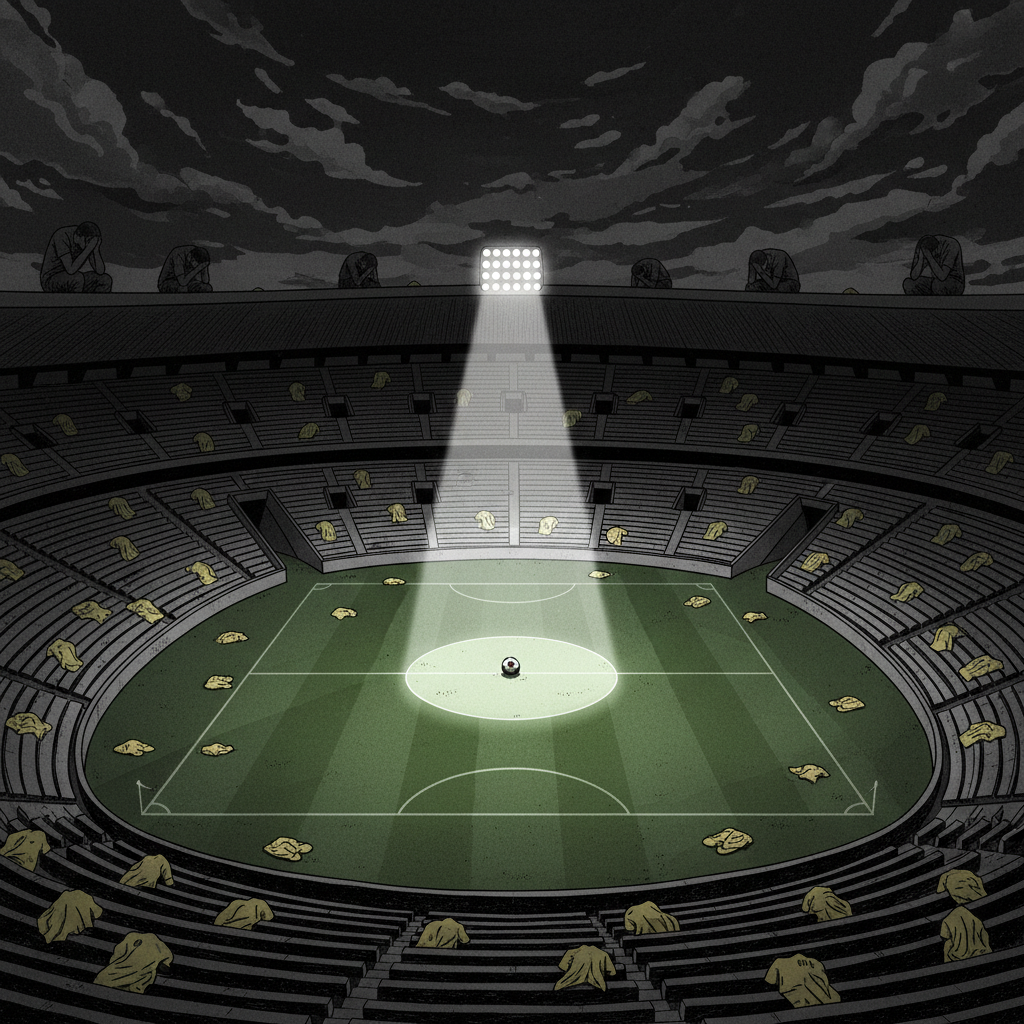
Défaite du Brésil 7-1 à la Coupe du Monde 2014
Le 8 juillet 2014, le Brésil a subi une défaite historique 7-1 face à l'Allemagne en demi-finale de la Coupe du Monde FIFA 2014 à l'Estádio Mineirão de Belo Horizonte. Le match, connu au Brésil sous le nom de "Mineiraço", a vu l'Allemagne marquer cinq buts en 18 minutes lors de la première mi-temps, les hôtes étant privés des joueurs clés Neymar (vertèbre fracturée en quart de finale) et du capitaine Thiago Silva (suspendu). Le résultat fut la pire défaite de l'histoire du Brésil en Coupe du Monde et devint un moment de traumatisme national, exposant les tensions entre les 11 milliards de dollars dépensés par le Brésil pour la Coupe du Monde et ses services publics défaillants. Les retombées politiques ont contribué au récit d'incompétence gouvernementale qui a culminé avec la destitution de la présidente Dilma Rousseff en 2016.
Resume Executif
La demi-finale de la Coupe du Monde 2014 entre le Brésil et l'Allemagne n'était pas un match de football devenu crise nationale — c'était une crise nationale qui s'est exprimée comme un match de football. Toutes les perspectives analytiques convergent vers la même conclusion fondamentale : le 7-1 était surdéterminé. Le déficit tactique (théorie des jeux, moneyball), la fragilité psychologique (Pavlov), le poids existentiel (Nietzsche), la signification culturelle (sociologie du sport), l'amplification médiatique (analyse médiatique) et le contexte politique (impact civil) pointaient tous vers la catastrophe.
Faits Cles
Faits verifies issus de recherches multi-sources, notes par niveau de confiance
Germany defeated Brazil 7-1 in the 2014 FIFA World Cup semifinal on July 8, 2014, at Estádio Mineirão in Belo Horizonte.
Confiance highGermany's goals were scored by Thomas Müller (11'), Miroslav Klose (23'), Toni Kroos (24', 26'), Sami Khedira (29'), André Schürrle (69', 79'). Oscar scored Brazil's consolation goal in the 90th minute.
Confiance highFive goals were scored between the 11th and 29th minutes, with four goals in a six-minute span from the 23rd to 29th minute.
Confiance highNeymar suffered a fractured third lumbar vertebra from a knee-to-the-back challenge by Colombia's Juan Camilo Zúñiga in the 88th minute of the quarterfinal on July 4, 2014, ruling him out of the rest of the tournament.
Confiance highCaptain Thiago Silva was suspended for the semifinal due to accumulation of two yellow cards. His appeal to FIFA was denied as having 'no legal basis.'
Confiance highMiroslav Klose's goal in the 23rd minute made him the all-time leading scorer in World Cup history with 16 goals, surpassing Brazil's Ronaldo who held the record with 15.
Confiance highBrazil's official World Cup spending was approximately $11.6 billion, making it the most expensive World Cup in history at that time.
Confiance highActeurs Cles
Acteurs majeurs impliques dans cet evenement avec leurs actions et interets declares
Luiz Felipe Scolari
individual- ›Selected 4-2-3-1 formation for semifinal despite missing key players
- ›Chose not to fundamentally alter tactical approach for Neymar/Thiago Silva absences
- ›Started Dante and Bernard as replacements
Joachim Löw
individual- ›Developed Germany's tactical system over 8 years since 2006
- ›Prepared specific pressing strategy to exploit Brazil's high defensive line
- ›Instructed team to ease off after 5-0 at halftime
Neymar
individual- ›Carried Brazil's attacking burden through the tournament as the team's talisman
- ›Suffered fractured third lumbar vertebra in quarterfinal vs. Colombia
- ›Watched the 7-1 from a hospital/recovery setting
Dilma Rousseff
individual- ›Defended World Cup spending as beneficial for Brazil's infrastructure and economy
- ›Oversaw security operations during 2013-2014 protests
- ›Won narrow re-election in October 2014
Não vai ter Copa protest movement
group- ›Organized mass protests during 2013 Confederations Cup and 2014 World Cup
- ›Coined and popularized the slogan 'Não vai ter Copa'
- ›Highlighted forced evictions and public spending priorities
Recherche et Sources
Chronologie de l'Evenement
2007-10-30 to 2016-08-31
Analyse Causale
Graphe interactif montrant comment les politiques, acteurs et evenements sont relies causalement — cliquez sur les noeuds pour explorer les relations
RESEAU CAUSAL
18 noeuds · 17 connexions
Selectionnez un noeud
Cliquez sur n'importe quel noeud du graphe pour explorer ses connexions et les perspectives des prismes
Causes Profondes
1Chemin Critique
7 etapesAnalyses par Prisme
Chaque prisme fournit un cadre analytique unique — cliquez pour developper l'analyse approfondie
Théorie des Jeux
Western Moderngame-theoryThe 7-1 was not merely a tactical defeat but a cascading equilibrium collapse. Brazil entered with a fragile strategy that required specific conditions (Neymar's creativity, Thiago Silva's organization, crowd momentum) to function. Germany systematically removed each support pillar, and once the strategic structure collapsed after the second goal, no rational recovery was possible. The game-theoretic lesson is that high-risk, high-reward strategies with single points of failure are catastrophically vulnerable to systematic opponents who identify and exploit those failure points.
Analyse du Conditionnement Comportemental
Western ModernpavlovThe 7-1 was a mass extinction event for Brazil's conditioned national football identity. Decades of reinforcement — five World Cup titles, generations of legendary players, cultural production around football supremacy — were shattered in 18 minutes. The psychological mechanism was identical to laboratory demonstrations of learned helplessness: after the third rapid goal, Brazilian players and fans alike ceased active coping and entered a state of passive acceptance. The subsequent reconditioning through dark humor was not merely a cultural quirk but a psychologically adaptive response — counter-conditioning the aversive stimulus with a new, less painful response. The 7-1 permanently altered Brazil's conditioned relationship with its own football identity.
Analyse Nietzschéenne du Pouvoir
Western ModernnietzscheThe 7-1 was the death of Brazilian football's god — the end of the foundational myth of inherent supremacy that had organized Brazilian national identity for generations. The Übermensch model (dependence on individual genius) was exposed as fatally fragile when tested against Germany's systematic will to power. The ensuing ressentiment was both existentially genuine and politically consequential, contributing to the broader crisis that culminated in Rousseff's impeachment. Brazil's dark humor response represents a remarkable form of amor fati — embracing the catastrophe as part of national identity rather than being destroyed by it.
Analyse Statistique Moneyball
Entertainment & SportsmoneyballThe statistical story of the 7-1 is a tale of two components. The first is a predictable tactical mismatch: removing Neymar (40% of attacking output) and Thiago Silva (the defensive organizer) from a team facing the most systematically prepared opponent in the tournament made a defeat statistically likely, with an expected margin of 2-3 goals. The second component is the 'trauma premium': the additional 3-4 goals that represent pure psychological collapse, visible in the data as defensive positioning errors, pass completion rate collapse, and pressing intensity dropping to near-zero between the 23rd and 40th minutes. The 7-1 was a 3-0 or 4-1 tactical defeat amplified into a 7-1 catastrophe by the psychological disintegration of a team and a stadium.
Sociologie du Sport
Entertainment & Sportssports-sociologyThe 7-1 was not a football match but a sociological earthquake. Football in Brazil functions as a civil religion — the primary institution of national identity and cross-class solidarity. The Mineiraço shattered this institution's claim to sacredness, exposed the class dynamics of mega-event hosting that had been masked by football's unifying narrative, and produced a collective trauma that is sociologically unprecedented in its combination of magnitude (7-1), context (home soil), and stakes (national identity + $11B investment). The humor response was not trivial but a deeply rooted cultural survival mechanism: Brazil's centuries-old tradition of using laughter to process pain found its ultimate expression in the memes that followed the worst day in the nation's sporting history.
Analyse du Récit Médiatique
Entertainment & Sportstalking-headThe 7-1 was narrated through four competing but interlocking media frames: Brazilian devastation, German restraint, international disbelief, and protest movement vindication. The Brazilian media's compressed narrative arc — from shock to humor in hours rather than months — reflected a culturally specific processing speed enabled by social media. The event's transformation into a permanent cultural meme ('7 a 1' as shorthand for catastrophic failure) demonstrates how media narrative construction can embed a sporting result into the permanent lexicon of a language and culture. Perhaps most remarkably, Germany's narrative restraint showed that even the victors recognized this was not a normal sporting triumph but a cultural event that required careful narrative handling.
Évaluation de l'Impact Civil
civilian-impactThe civilian impact of the 7-1 extended far beyond the emotional trauma of a football match. The event crystallized the contradictions of Brazil's mega-event model: $11.6 billion in public spending that produced luxury stadiums while displacing hundreds of thousands from favela communities, white elephant venues with no viable post-tournament use, and a political promise of national glory that was replaced by the worst humiliation in the country's sporting history. The 7-1 became the defining symbol of institutional failure that contributed to Dilma Rousseff's impeachment and discredited the model of mega-event-driven development for a generation. For the communities displaced to build stadiums they could never afford to enter, the 7-1 was not a sporting disaster but the final proof that they had been sacrificed for a spectacle that served everyone but them.
Convergences
La ou plusieurs prismes arrivent a des conclusions similaires — suggerant une robustesse
The 7-1 was overdetermined — multiple independent factors all pointed toward disaster
Every analytical lens identifies independent factors that made Brazil vulnerable to a catastrophic result. The tactical weakness without key players (game-theory, moneyball), the psychological fragility of conditioned expectations (pavlov), the existential weight of the 'country of football' identity (nietzsche, sports-sociology), and the political pressure of $11B in spending (civilian-impact) all created overlapping vulnerabilities. The convergence of all these factors simultaneously is what made the 7-1 historically unique rather than merely a bad result.
Germany's systematic approach defeated Brazil's talent-dependent model
Game-theory identifies Germany's dominant strategy of exploiting structural weaknesses. Moneyball quantifies the tactical asymmetry. Nietzsche frames it as Apollo defeating Dionysus. Sports-sociology contextualizes it as the end of the individual-genius model's supremacy. All four lenses agree that the 7-1 represented the triumph of a collective system over individual talent dependence.
The 18-minute spell was a psychological cascade, not merely a tactical collapse
Game-theory identifies the cascading equilibrium collapse. Pavlov identifies the learned helplessness response. Moneyball quantifies the 'trauma premium' — the gap between expected goals from tactical positioning and actual goals, representing the pure psychological disintegration component. All three agree that the 7-1 was approximately a 3-0 or 4-1 tactical defeat amplified into a 7-1 catastrophe by psychological collapse.
The 7-1 transcended sport to become a political and cultural event
All four lenses independently identify the 7-1 as an event that exceeded its sporting context. Nietzsche identifies the existential dimension. Sports-sociology identifies the civil religion dimension. Talking-head identifies the media narrative construction that elevated the event to national crisis status. Civilian-impact identifies the political consequences. The convergence confirms that the 7-1 cannot be understood as a football match alone.
Tensions Productives
La ou les prismes divergent — revelant une complexite qui merite examen
Futurs Possibles
Scenarios derives des analyses par prisme — ce qui pourrait se derouler selon differents cadres
Brazilian football renaissance through systematic reform
Medium. Brazil's talent pipeline remains strong, but institutional resistance to systematic approaches is significant. The tension between jogo bonito tradition and tactical modernization has not been resolved.
The 7-1 becomes a fading cultural memory without institutional change
Medium-high. The humor response already began the process of normalizing the trauma. Future successes could complete the reconditioning process without addressing structural issues.
Permanent discrediting of the mega-event development model in Brazil
Medium. The Brazilian public's appetite for mega-events has been significantly reduced, but economic pressures and political opportunism could override this skepticism in the future.
Questions Cles
Questions qui restent ouvertes apres l'analyse — pour une investigation continue
- ?What specific tactical adjustments, if any, did Scolari make at halftime when the score was already 5-0?
- ?What were the exact economic downstream effects of World Cup spending — did any infrastructure investments produce measurable long-term benefits?
- ?How many of the 12 World Cup stadiums are currently in regular use versus functioning as white elephants?
Details de la Verification
Resultats de la Verification
verifiedMeta Observations
All seven lenses analyze the 7-1 from the perspective of Brazil's failure, with Germany's achievement treated as a backdrop rather than a story in its own right. Germany's 2014 World Cup victory — the culmination of 14 years of systematic development — deserves its own multi-lens analysis as one of the greatest achievements in football history. By centering the 7-1 on Brazilian trauma, we risk reducing Germany's triumph to a supporting role in someone else's tragedy.
The 7-1 resists reduction to any single explanatory framework because it operates simultaneously across tactical, psychological, cultural, political, and sociological dimensions. Any lens that claims to fully explain the event is necessarily incomplete. The genuine understanding of the 7-1 requires holding all seven perspectives simultaneously — not synthesizing them into a single narrative but allowing them to remain in productive tension.
We should be honest about what we cannot know. We cannot know what would have happened with Neymar and Thiago Silva present. We cannot precisely separate the tactical from the psychological component of the scoreline. We cannot definitively determine whether the 7-1 'caused' political change or merely symbolized existing trends. We cannot know whether future generations will remember the 7-1 as a defining national trauma or a fading sporting anecdote. The 7-1 teaches epistemic humility: some events are too complex, too overdetermined, and too deeply embedded in their cultural context to be fully explained by any analytical framework.
Trouvez Votre Perspective
Differents cadres resonnent avec differents lecteurs — trouvez votre point d'entree
Readers who approach the 7-1 as a tactical and statistical puzzle — wanting to understand the mechanics of how five goals happened in 18 minutes and what the data reveals about the underlying quality difference between the teams.
The 7-1 was approximately a 3-0 tactical defeat amplified into a 7-1 by psychological collapse. Germany's dominant strategy exploited specific, identifiable weaknesses created by Brazil's missing players. The match was a statistical outlier (4-5 sigma) driven by the interaction between tactical inferiority and psychological cascade.
Readers who feel the 7-1 as a cultural and emotional event — who understand that football in Brazil is not just a sport but a structure of meaning, and that the 7-1 shattered something fundamental about Brazilian self-understanding.
The 7-1 was the death of a foundational national myth. Decades of conditioned belief in Brazilian football supremacy were extinguished in 18 minutes. Football functions as a civil religion in Brazil, and the 7-1 was a desecration of the sacred. The dark humor response was a culturally specific form of amor fati — embracing catastrophe rather than being destroyed by it.
Readers who see the 7-1 as a political and institutional event — the culmination of misplaced spending priorities, government overreach, and institutional failure that was expressed through but not limited to a football match.
The $11.6B World Cup spending displaced hundreds of thousands, created white elephant stadiums, and was justified by a promise of national glory that the 7-1 destroyed. The political downstream contributed to Rousseff's impeachment. The media narrative was constructed differently across four perspectives (devastation, restraint, disbelief, vindication), each serving different institutional interests.
Readers skeptical of the grander narratives who want to strip the 7-1 back to its sporting fundamentals: a team missing two key players lost badly to a better-prepared opponent. The cultural and political overlay, while real, risks obscuring the straightforward sporting explanation.
Much of what happened can be explained by standard tactical analysis: Brazil's defensive disorganization without Thiago Silva, the creative void without Neymar, and Germany's clinical exploitation of predictable weaknesses. The 7-1 was extraordinary in degree but not in kind — football produces heavy defeats when one team is significantly weakened and the other is at peak preparation.
Start with the analytical cluster (game-theory, moneyball) to understand what happened mechanically, then layer the intuitive cluster (pavlov, nietzsche, sports-sociology) to understand why it mattered so deeply, and finally add the institutional cluster (civilian-impact, talking-head) to understand the broader consequences. The 7-1 requires all three perspectives to be fully comprehended — it was a tactical failure, an existential crisis, and a political turning point, all simultaneously.
Analyses Connexes
Autres evenements analyses a travers des prismes ou categories similaires
Le Printemps arabe fut une vague révolutionnaire de manifestations, de soulèvements et de rébellions armées qui déferla sur le monde arabe à partir de décembre 2010. Déclenché par l'auto-immolation du vendeur ambulant tunisien Mohamed Bouazizi le 17 décembre 2010 — un acte de désespoir contre des décennies de corruption autoritaire, d'humiliation et de chômage des jeunes — le mouvement se propagea avec une rapidité fulgurante à travers l'Afrique du Nord et le Moyen-Orient. Le slogan définitoire «الشعب يريد إسقاط النظام» (Le peuple veut la chute du régime) résonna de Tunis au Caire, de Benghazi à Damas. Le choix de l'armée — se ranger du côté des manifestants ou rester fidèle au régime — s'avéra la variable décisive dans chaque pays.
Entre le 6 avril et le 18 juillet 1994, environ 800 000 Tutsis et Hutus moderes ont ete systematiquement assassines au Rwanda en l'espace de 100 jours — le massacre le plus efficace de l'histoire moderne, avec un taux de mortalite quotidien superieur a celui de l'Holocauste. Le genocide n'etait pas l'eruption de « haines tribales ancestrales » mais l'aboutissement d'un projet colonial : les administrateurs belges avaient fabrique des categories raciales rigides a partir d'identites sociales fluides par le biais du recensement de 1933 et des cartes d'identite ethniques obligatoires, creant la division Hutu-Tutsi que les elites politiques ont ensuite instrumentalisee. Le regime de Habyarimana et son cercle restreint de l'akazu (la maisonnee), confrontes a la pression militaire du Front patriotique rwandais et aux exigences de partage du pouvoir des Accords d'Arusha, ont choisi le genocide comme strategie de survie politique. La radio RTLM — « Radio Machette » — a systematiquement conditionne la population par des annees de propagande deshumanisante, qualifiant les Tutsis d'« inyenzi » (cafards) avant de diffuser des instructions explicites de mise a mort et les localisations des victimes pendant le genocide lui-meme. Entre 250 000 et 500 000 femmes ont ete violees comme arme deliberee de genocide, le jugement historique du TPIR dans l'affaire Akayesu reconnaissant le viol comme acte de genocide pour la premiere fois en droit international. L'echec de la communaute internationale n'etait pas passif mais actif : le commandant de la MINUAR Romeo Dallaire a envoye son « fax sur le genocide » trois mois avant le debut des massacres, a demande 5 000 soldats, et a ete refuse. Le Conseil de securite des Nations Unies a reduit la MINUAR de 2 500 a 270 soldats pendant le genocide. Les Etats-Unis ont deliberement evite d'utiliser le mot « genocide » pour contourner les obligations legales d'intervenir. La Commission Duclert (2021) a conclu que la France portait des « responsabilites lourdes et accablantes » incluant « une faillite politique, institutionnelle, intellectuelle, morale et cognitive ». L'Operation Turquoise, officiellement humanitaire, a permis aux genocidaires de fuir au Zaire. La victoire militaire du FPR a mis fin au genocide en juillet 1994, mais les consequences se sont propagees jusqu'a la Premiere Guerre du Congo (1996-97) et la « Guerre mondiale africaine » qui a tue plus de 5 millions de personnes.
Le 26 avril 1986 à 01h23, le réacteur n°4 de la centrale nucléaire de Tchernobyl en RSS d'Ukraine a explosé lors d'un test de sécurité, libérant 400 fois plus de matières radioactives que la bombe d'Hiroshima. Les autorités soviétiques ont d'abord dissimulé la catastrophe, forçant les 49 000 habitants de Pripiat à poursuivre leur vie normale pendant 36 heures. Environ 600 000 « liquidateurs » ont été déployés. Les estimations de décès vont de 4 000 (OMS) à 93 000 (Greenpeace). La catastrophe a brisé le mythe de la suprématie technologique soviétique et a forcé Gorbatchev vers la glasnost.
Comment Cela a Ete Analyse
Transparence totale sur le processus d'analyse, les outils et les limitations
Crosslight Engine
v0.4.0 "Global Lens Expansion"- ⚠Non-Western philosophical lenses rely on translated primary texts — nuance may be lost in translation
- ⚠Some traditions (e.g., Maat, Ubuntu) have limited surviving primary texts; analysis draws on scholarly reconstruction
- ⚠Cross-cultural lens application is inherently interpretive — a Confucian reading of a Western event is an analytical exercise, not a claim of cultural authority
Statistiques d'Analyse
Methodologie
Cette analyse a ete produite par le pipeline multi-agents de Crosslight : un Agent de Recherche a rassemble et verifie les faits de sources multiples, des Agents de Prismes specialises ont applique des cadres analytiques distincts, un Agent de Synthese a integre les perspectives et identifie les tendances, et un Agent de Verification a valide les affirmations. Chaque perspective de prisme est l'interpretation de l'IA — pas une approbation institutionnelle.En savoir plus →