
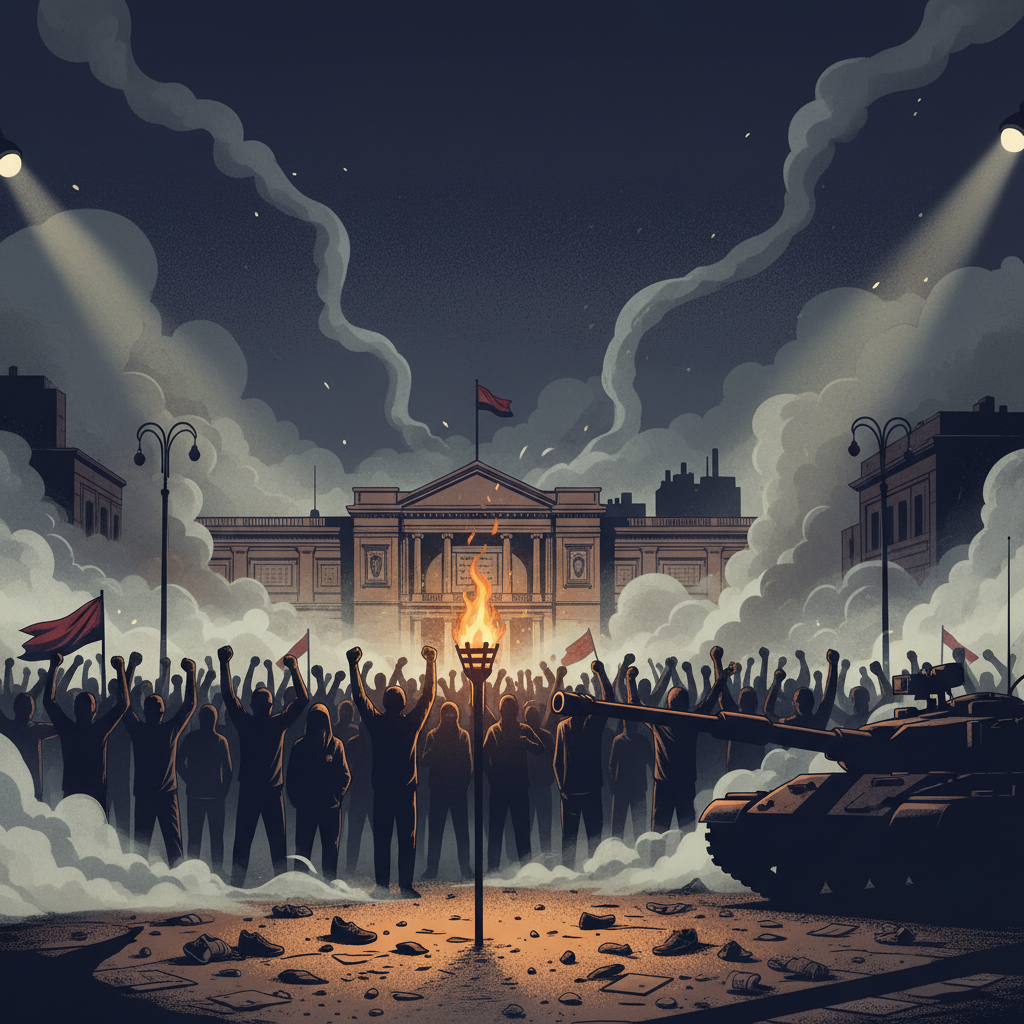
האביב הערבי 2011
האביב הערבי היה גל מחאה מהפכני של מחאות, התקוממויות ומרדים מזוינים שפקדו את העולם הערבי החל מדצמבר 2010. הוצת על ידי הצתת האש של הרוכל הטוניסאי מוחמד בועזיזי ב-17 בדצמבר 2010 — מעשה ייאוש נגד עשרות שנים של שחיתות סמכותנית, השפלה ואבטלה בקרב צעירים. קריאת הלחימה המזהה "الشعب يريد إسقاط النظام" (העם רוצה בנפילת המשטר) הדהדה מתוניס עד קהיר, מבנגזי עד דמשק. בחירת הצבא — לעמוד לצד המפגינים או להישאר נאמן למשטר — התבררה כמשתנה המכריע בכל מדינה.
סיכום מנהלים
שבע עדשות אנליטיות מתכנסות לממצא מרכזי: האביב הערבי היה ההתפרצות הבלתי נמנעת של עשרות שנים של שאיפות אנושיות מדוכאות, אך תוצאותיו נקבעו על ידי חישובים מוסדיים של אליטות צבאיות.
עובדות מרכזיות
עובדות מאומתות ממחקר רב-מקורי, מדורגות לפי רמת ביטחון
Mohamed Bouazizi, a 26-year-old street vendor in Sidi Bouzid, Tunisia, set himself on fire on December 17, 2010, after his produce cart was confiscated and he was humiliated by a municipal official. He died of his injuries on January 4, 2011.
ביטחון highTunisian President Zine El Abidine Ben Ali fled to Saudi Arabia on January 14, 2011, ending his 23-year rule. Tunisia's military refused to fire on protesters.
ביטחון highMass protests began in Egypt on January 25, 2011 (the 'Day of Rage'), centering on Tahrir Square in Cairo. President Hosni Mubarak resigned on February 11, 2011, after 30 years in power.
ביטחון highEgypt's Supreme Council of the Armed Forces (SCAF) sided with protesters and forced Mubarak's resignation, protecting the military's extensive economic and institutional interests.
ביטחון highMohamed Morsi of the Muslim Brotherhood won Egypt's first free presidential election in June 2012. He was removed by a military coup led by General Abdel Fattah al-Sisi on July 3, 2013.
ביטחון highProtests against Muammar Gaddafi began in Benghazi, Libya on February 15, 2011. UN Security Council Resolution 1973 authorized a no-fly zone. NATO intervened militarily beginning March 19, 2011. Gaddafi was captured and killed on October 20, 2011.
ביטחון highAnti-government protests began in Daraa, Syria in mid-March 2011 after schoolchildren were detained for anti-regime graffiti. The Assad regime responded with military force, escalating into civil war.
ביטחון highגורמים מרכזיים
גורמים מרכזיים המעורבים באירוע זה עם פעולותיהם ואינטרסים מוצהרים
Mohamed Bouazizi
individual- ›Set himself on fire on December 17, 2010 in Sidi Bouzid, Tunisia
Hosni Mubarak
individual- ›Imposed curfew and deployed military to streets
- ›Shut down internet and mobile communications
- ›Resigned on February 11, 2011
Muammar Gaddafi
individual- ›Ordered military to suppress protests violently
- ›Threatened to 'cleanse Libya house by house'
- ›Fought NATO intervention until captured and killed
Bashar al-Assad
individual- ›Deployed military against civilian protesters
- ›Used barrel bombs and chemical weapons against civilian areas
- ›Relied on Iranian and Russian military support
Al Jazeera
organization- ›Provided 24/7 satellite coverage of Arab Spring protests across the region
- ›Amplified protest movements through pan-Arab broadcasts reaching millions
- ›Created a shared narrative space across Arab-speaking populations
מחקר ומקורות
ציר זמן של האירוע
2010-12-17 to 2015-09-01
ניתוח סיבתי
גרף אינטראקטיבי המציג כיצד מדיניות, גורמים ואירועים מתחברים סיבתית — לחץ על צמתים לחקור קשרים
רשת סיבתית
21 צמתים · 18 חיבורים
בחר צומת
לחץ על כל צומת בגרף לחקור את חיבוריו ופרספקטיבות העדשות
סיבות שורש
3נתיב קריטי
9 שלביםניתוחי עדשות
כל עדשה מספקת מסגרת אנליטית ייחודית — לחץ להרחבה לניתוח מעמיק
תורת המשחקים
Western Moderngame-theoryThe Arab Spring was a massive multi-player sequential game where each country's outcome changed the information set for all other players. Tunisia's success solved the collective action problem by demonstrating that revolution was possible — but the game-theoretic insight is that the same initial shock (popular uprising) produced radically different outcomes depending on one variable: whether the military's institutional interests were better served by defecting from or remaining loyal to the regime. This is the 'military kingmaker' dynamic — not a bug in the revolutionary wave but the fundamental strategic variable that determined winners and losers.
מקיאוולי
Greco-Roman & ClassicalmachiavelliThe Arab Spring is a masterclass in Machiavellian power dynamics: it demonstrated that power built solely on fear collapses catastrophically when the fear barrier breaks. The military — not the people, not social media, not Western intervention — was the prince-maker in every country. Where the military calculated that its institutional interests were better served by sacrificing the ruler (Tunisia, Egypt), transitions were relatively peaceful. Where the military's survival was bound to the regime (Syria's Alawite officers, Bahrain's Sunni security forces), the result was either civil war or brutal suppression. The tragedy of the Arab Spring, in Machiavellian terms, is that destroying the old order proved far easier than building a new one. As Machiavelli warned: 'There is nothing more difficult to take in hand, more perilous to conduct, or more uncertain in its success, than to take the lead in the introduction of a new order of things.'
הערכת מודיעין CIA
Western InstitutionalciaThe Arab Spring exposed the central paradox of US intelligence engagement in the Middle East: the very authoritarian relationships that provided counter-terrorism intelligence created the conditions for the revolutionary explosions that destroyed those relationships. The CIA's partnerships with Mubarak's GIS, Ben Ali's secret police, and Gaddafi's reformed intelligence services gave the US excellent visibility into specific terrorist networks but no understanding of the structural rage building across Arab societies. The intelligence failure was not in the collection but in the analytical framework — the inability to see that 'stable authoritarian allies' was a contradiction in terms, and that the suppressed frustrations of millions of young Arabs constituted a strategic threat greater than any specific terrorist organization.
ניתוח התניה פבלובית
Western ModernpavlovThe Arab Spring demonstrates that authoritarian control based on conditioned fear is inherently fragile: it works perfectly until it doesn't, and when it fails, it fails catastrophically. Decades of conditioning created a population that appeared compliant but was actually a pressure cooker of suppressed frustration. Bouazizi's act served as the extinction trial that demonstrated the old contingency no longer held. Al Jazeera's broadcasts generalized this extinction across the Arab world. But conditioning theory also explains the tragedy: it is far easier to extinguish a fear response (stop obeying) than to condition new constructive behaviors (build democratic institutions). The Arab Spring succeeded as mass behavioral de-conditioning — the fear was broken — but failed as re-conditioning toward democratic habits, which require years of consistent reinforcement that the post-revolutionary environment could not provide.
ניתוח ניטשיאני
Western ModernnietzscheThe Arab Spring was a revolt of dignity — ثورة الكرامة — and Nietzsche's philosophy provides the deepest reading of what dignity means in this context. It was not merely a demand for political rights but an existential assertion: the refusal to accept humiliation as the human condition. Bouazizi's act was the purest expression of will against a system that had crushed all will. The tragedy is Nietzsche's own warning: destruction of the old order is the easy part. The hard part — the creation of new values, the emergence of what Nietzsche would call higher types of human organizing — requires precisely the kind of patient, creative work that revolutionary energy cannot sustain. The Arab Spring proved that the will to power can topple any regime, but it cannot, by itself, build what comes next.
ניתוח טאואיסטי
East AsiantaoismThe Arab Spring is the Tao's most powerful modern demonstration of the principle of reversal (反, fan): whatever reaches an extreme produces its opposite. Decades of authoritarian rigidity (extreme yang) produced explosive revolutionary energy (extreme yin). Regimes that gripped tighter fell faster — Gaddafi's 42 years of iron control shattered into state collapse; Assad's brutal suppression produced the century's worst humanitarian disaster. Regimes that bent survived — Morocco's limited reforms, Jordan's modest concessions. The Tao's deepest insight about the Arab Spring is this: the revolutionary wave moved not through strategic coordination but through the natural resonance of shared grievances, flowing like water through every crack in authoritarian structures. It could not be stopped because it was not being directed — it was the Tao itself, the natural flow of suppressed human aspiration finding expression. But the Tao also teaches that water, unconstrained, floods and destroys. The Arab Spring's devastation in Libya and Syria is water without banks — natural force without the channels needed to direct it constructively.
הערכת ההשפעה על אזרחים
civilian-impactThe Arab Spring's civilian impact reveals the terrible disproportion between revolutionary aspiration and human cost. Millions of people demanded nothing more than dignity, economic opportunity, and an end to corruption — the most basic human aspirations. In Tunisia, these aspirations were achieved at relatively low cost. In Syria, the same aspirations produced the worst humanitarian catastrophe of the 21st century. The difference was not in what civilians wanted or how they protested, but in the structural variables they could not control: military loyalty, sectarian composition, external intervention, and the willingness of rulers to destroy their own countries rather than relinquish power. The most devastating finding of this analysis is that the people who suffered most — Syrian civilians — had the least agency in determining their fate. They were caught between a regime willing to use chemical weapons, an opposition that fragmented into rival militias, external powers pursuing strategic interests, and a jihadist movement (ISIS) that exploited the chaos. The Arab Spring's human cost is not a story of failed revolution — it is a story of civilians trapped in conflicts they did not choose, determined by forces they could not influence.
התכנסויות
היכן שעדשות מרובות מגיעות למסקנות דומות — מה שמצביע על עמידות
Military loyalty as the decisive variable
All four lenses independently identify the military's institutional choice as the factor that determined whether revolutions succeeded peacefully, devolved into civil war, or were crushed. This is the single strongest convergence across all analyses.
Authoritarian stability is inherently fragile
Game theory shows that fear-based equilibria collapse when the punishment mechanism fails. Pavlov shows that conditioned fear extinguishes when the contingency breaks. Taoism shows that rigid systems produce their own reversal. CIA learned that 'stable authoritarian allies' was a strategic delusion. All agree: apparent authoritarian stability masks fragility.
Destruction of old orders is easier than construction of new ones
Machiavelli warned that establishing new orders is the most difficult political undertaking. Nietzsche identifies the Ubermensch problem — revolutions lack creative vision for what comes after. Taoism sees unconstrained water (revolution without institutional channels) as destructive. Civilian impact documents the human cost of this gap between destruction and construction.
מתחים פוריים
היכן שעדשות חולקות — מגלה מורכבות הראויה לבחינה
עתידות אפשריים
תרחישים הנגזרים מניתוחי עדשות — מה עשוי להתפתח על פי מסגרות שונות
Second wave of Arab uprisings driven by unresolved structural grievances
Medium — the structural conditions remain, but the memory of Syria's catastrophe acts as a powerful deterrent
Authoritarian adaptation and tech-enabled control prevent future uprisings
Medium-high — authoritarian regimes have invested heavily in learning from the Arab Spring's failures
Tunisia's democratic path consolidates and gradually influences the region
Low — Tunisia's own democracy has faced setbacks since 2021 (Kais Saied's power concentration)
שאלות מרכזיות
שאלות שנותרות פתוחות לאחר הניתוח — לחקירה מתמשכת
- ?What was the precise role of Gulf intelligence services in funding and directing various factions?
- ?To what extent did Al Jazeera's editorial decisions shape the direction of the Arab Spring?
- ?What were the internal deliberations within military high commands that determined their choices?
פרטי בדיקת עובדות
תוצאות בדיקת עובדות
verifiedתצפיות מטא
All seven lenses are fundamentally retrospective — they analyze what happened and why, but none fully captures the lived experience of revolutionary hope before it turned to despair. The Arab Spring was, for millions of people, the most exhilarating experience of their lives — a moment of collective agency and shared purpose that cannot be reduced to strategic calculation, conditioning, or power dynamics. That hope, even though it was largely betrayed by outcomes, was real and transformative for those who experienced it.
The Arab Spring involves simultaneous causation at multiple scales — individual psychology (Bouazizi), institutional dynamics (military choices), regional contagion (media amplification), and global geopolitics (external intervention) — that cannot be adequately captured by any single analytical framework. The seven lenses together approach a more complete picture, but the full complexity of a revolutionary wave affecting 300+ million people across 20 countries over five years exceeds any analytical capacity.
The Arab Spring humbled every analytical framework that tried to predict or explain it in real time. Intelligence agencies did not predict it. Academic experts did not anticipate its trajectory. No single theory — rational choice, structuralism, constructivism, or any other — captured the full dynamic. This analysis, with its seven lenses, is an attempt to triangulate toward truth, but the reader should hold all conclusions with appropriate humility.
מצא את הפרספקטיבה שלך
מסגרות שונות מהדהדות עם קוראים שונים — מצא את נקודת הכניסה שלך
Readers who see the Arab Spring primarily through strategic dynamics, institutional calculations, and power politics — who ask 'what were the incentives?' and 'who benefited?'
The military kingmaker dynamic and the failure of intelligence frameworks to predict popular uprisings
Readers who see the Arab Spring as an expression of deep human aspirations — dignity, freedom, natural flow against artificial constraint — and who feel the movement's moral power
The revolt of dignity and the paradox of control — regimes that gripped tighter fell faster
Readers focused on power structures, institutional dynamics, and the concrete consequences of political action — who ask 'what happened to real people?' and 'who holds power?'
The gap between revolutionary aspiration and institutional capacity to build new orders, and the devastating human cost of that gap
Readers skeptical of grand narratives who focus on mechanisms, costs, and unintended consequences — who ask 'how did it actually spread?' and 'what was the real price?'
The conditioning dynamics that made the wave possible and the cruel arithmetic of human suffering across the spectrum
Start with the lens that resonates most, then deliberately read the lens that challenges your assumptions. If you see strategic rationality (game-theory), read the existential dimension (nietzsche). If you feel the moral power of the movement (nietzsche), confront the human cost (civilian-impact). The Arab Spring's full truth lives in the tension between these perspectives, not in any single lens.
ניתוחים קשורים
אירועים אחרים שנותחו דרך עדשות או קטגוריות דומות
ב-26 באפריל 1986, בשעה 01:23 בלילה, התפוצץ כור מספר 4 בתחנת הכוח הגרעינית של צ'רנוביל בסוכנות האוקראינית הסובייטית במהלך ניסוי בטיחות, ושחרר חומר רדיואקטיבי פי 400 מפצצת הירושימה. הרשויות הסובייטיות הסתירו תחילה את האסון, והכריחו את 49,000 תושבי פריפיאט להמשיך בחיים רגילים במשך 36 שעות. כ-600,000 'מחסלים' גויסו. הערכות מספר ההרוגים נעות בין 4,000 (WHO) ל-93,000 (גרינפיס). האסון שבר את המיתוס של העליונות הטכנולוגית הסובייטית.
בין 6 באפריל ל-18 ביולי 1994, כ-800,000 טוטסים והוטו מתונים נרצחו בשיטתית ברואנדה במהלך 100 ימים — רצח ההמונים היעיל ביותר בהיסטוריה המודרנית. רצח העם לא היה פריצת של «שנאות שבטיות עתיקות» אלא שיאו של מפעל קולוניאלי: המנהלים הבלגיים יצרו קטגוריות גזעיות נוקשות מזהויות חברתיות גמישות במפקד 1933 ותעודות זהות אתנית חובה. משטר האביארימנה והמעגל הפנימי akazu בחרו ברצח עם כאסטרטגיה להישרדות פוליטית. רדיו RTLM — «רדיו מאצ'טה» — התנה את האוכלוסיה בשיטתית בשנים של תעמולה משפילה. כישלון הקהילה הבינלאומי היה פעיל: דלייר שלח את האזהרה שלו שלושה חודשים לפני תחילת הרצח, ביקש 5,000 חיילים וסורב. מועצת הביטחון של האו"ם צמצמה את UNAMIR מ-2,500 ל-270 חיילים במהלך רצח העם. ניצחון RPF הצבאי סיים את רצח העם ביולי 1994, אך התוצאות התפשטו למלחמת קונגו הראשונה (1996-97) ו«מלחמת העולם של אפריקה» שהרגה למעלה מ-5 מיליון אנשים.
ב-22 בנובמבר 1963, נרצח הנשיא ג'ון פ. קנדי בכיכר דילי, דאלאס, טקסס. לי הארווי אוסוולד נעצר אך נהרג על ידי ג'ק רובי לפני המשפט. ועדת וורן הגיעה למסקנה שאוסוולד פעל לבדו, בעוד ה-HSCA מצא מאוחר יותר קנוניה סבירה. מסמכים שסווגו עד 2025 חושפים הסתרות מוסדיות מצד ה-CIA וה-FBI, מה שהופך אותו לתיק הבלתי-פתור המשמעותי ביותר בהיסטוריה האמריקנית.
כיצד נותח זה
שקיפות מלאה לגבי תהליך הניתוח, הכלים והמגבלות
מנוע Crosslight
v0.4.0 "Global Lens Expansion"- ⚠Non-Western philosophical lenses rely on translated primary texts — nuance may be lost in translation
- ⚠Some traditions (e.g., Maat, Ubuntu) have limited surviving primary texts; analysis draws on scholarly reconstruction
- ⚠Cross-cultural lens application is inherently interpretive — a Confucian reading of a Western event is an analytical exercise, not a claim of cultural authority
סטטיסטיקות ניתוח
מתודולוגיה
ניתוח זה הופק על ידי צינור הסוכנים המרובים של Crosslight: סוכן מחקר אסף ואימת עובדות ממקורות מרובים, סוכני עדשות מתמחים החילו מסגרות אנליטיות ייחודיות, סוכן סינתזה שילב תובנות וזיהה דפוסים, וסוכן בדיקת עובדות אימת טענות. כל פרספקטיבת עדשה היא פרשנות הבינה המלאכותית — לא אישור מוסדי.למד עוד →