
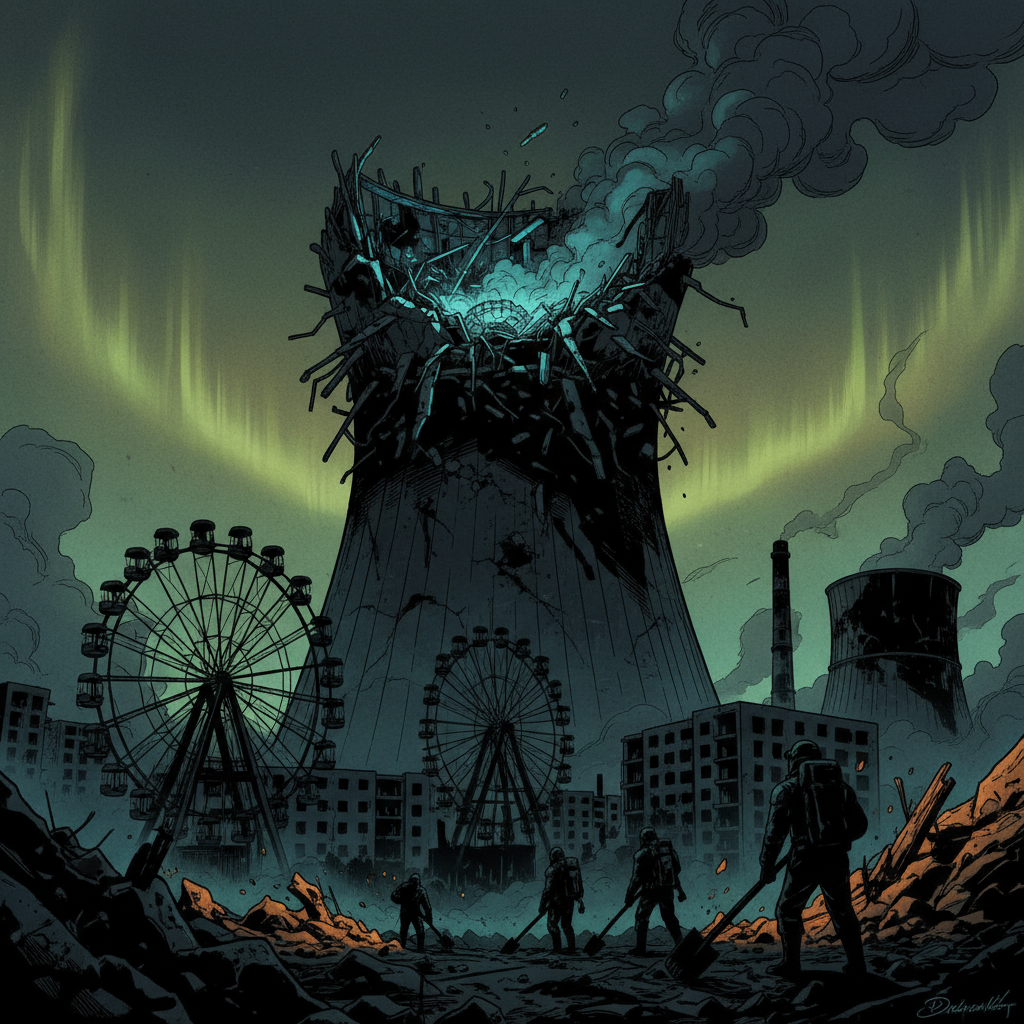
אסון צ'רנוביל
ב-26 באפריל 1986, בשעה 01:23 בלילה, התפוצץ כור מספר 4 בתחנת הכוח הגרעינית של צ'רנוביל בסוכנות האוקראינית הסובייטית במהלך ניסוי בטיחות, ושחרר חומר רדיואקטיבי פי 400 מפצצת הירושימה. הרשויות הסובייטיות הסתירו תחילה את האסון, והכריחו את 49,000 תושבי פריפיאט להמשיך בחיים רגילים במשך 36 שעות. כ-600,000 'מחסלים' גויסו. הערכות מספר ההרוגים נעות בין 4,000 (WHO) ל-93,000 (גרינפיס). האסון שבר את המיתוס של העליונות הטכנולוגית הסובייטית.
סיכום מנהלים
שבע עדשות אנליטיות מתכנסות למסקנה מרכזית: אסון צ'רנוביל היה אסון כפול — כשל טכני השורשי בפשרות בתכנון הכור, שהוגבר על ידי כשל מוסדי שבו כל רמה במערכת הסובייטית העדיפה שימור עצמי על בטיחות אנושית. כל שבע העדשות מסכימות: הכשל המוסדי היה קטסטרופלי כמו הטכני.
עובדות מרכזיות
עובדות מאומתות ממחקר רב-מקורי, מדורגות לפי רמת ביטחון
At 01:23 AM on April 26, 1986, Reactor No. 4 at the Chernobyl Nuclear Power Plant exploded during a turbine rundown safety test.
ביטחון highThe RBMK-1000 reactor design had a known positive void coefficient of reactivity, meaning loss of coolant water increased reactivity. This was accepted as a trade-off for dual-use capability and cost savings.
ביטחון highDeputy chief engineer Anatoly Dyatlov pressured operators to continue the test despite dangerously low power levels (~200 MW vs. planned 700-1000 MW). Operators disabled the ECCS and overrode automatic shutdown signals.
ביטחון highPripyat (population 49,000), 3 km from the reactor, was not evacuated until 36 hours after the explosion. Children played outdoors, weddings were held, and residents observed the fire from the 'Bridge of Death.'
ביטחון highSwedish radiation monitoring stations at Forsmark detected elevated levels on April 28, forcing Soviet acknowledgment. The Soviets initially blamed a 'minor accident.'
ביטחון highApproximately 600,000 liquidators were deployed between 1986 and 1990. 'Bio-robots' on the roof worked in 90-second shifts, each receiving a near-lifetime dose.
ביטחון highOf 134 plant workers and firefighters diagnosed with acute radiation syndrome, 28 died within months. Their deaths were documented in clinical detail.
ביטחון highגורמים מרכזיים
גורמים מרכזיים המעורבים באירוע זה עם פעולותיהם ואינטרסים מוצהרים
Anatoly Dyatlov
individual- ›Supervised the safety test
- ›Pressured operators to continue at low power
- ›Ordered disabled safety systems
Mikhail Gorbachev
individual- ›Delayed public acknowledgment 18 days
- ›Blamed Western media
- ›Used Chernobyl to accelerate glasnost
Valery Legasov
individual- ›Led scientific investigation
- ›Presented Soviet narrative to IAEA
- ›Recorded truth-telling tapes
Liquidators
group- ›Built sarcophagus
- ›Cleared radioactive graphite from roof
- ›Decontaminated surrounding areas
מחקר ומקורות
ציר זמן של האירוע
1954-06-27 to 1991-12-26
ניתוח סיבתי
גרף אינטראקטיבי המציג כיצד מדיניות, גורמים ואירועים מתחברים סיבתית — לחץ על צמתים לחקור קשרים
רשת סיבתית
18 צמתים · 19 חיבורים
בחר צומת
לחץ על כל צומת בגרף לחקור את חיבוריו ופרספקטיבות העדשות
סיבות שורש
3נתיב קריטי
8 שלביםניתוחי עדשות
כל עדשה מספקת מסגרת אנליטית ייחודית — לחץ להרחבה לניתוח מעמיק
תורת המשחקים
Western Moderngame-theoryChernobyl was not a failure of rationality but a masterclass in how rational individual decisions within a pathological institutional structure produce collectively catastrophic outcomes. The system's information architecture was the root cause: by classifying safety data, punishing dissent, and rewarding concealment, the system guaranteed that each actor's rational choice would aggregate into civilizational disaster. The 'peaceful atom' ideology functioned as a corrupted focal point coordinating the entire system toward catastrophe. A system that makes honesty irrational will produce dishonesty at scale, and a nuclear power program built on institutional dishonesty will eventually produce Chernobyl.
מקיאוולי
Greco-Roman & ClassicalmachiavelliChernobyl is a perfect Machiavellian case study in institutional self-preservation becoming self-destruction. The Soviet system followed the classic playbook: conceal weakness, project strength, control information, blame subordinates. This works for political competition between elites. It fails catastrophically for governing complex technical systems where accurate information is a safety prerequisite. Nuclear reactors do not respond to political narratives — they respond to physics. When the Soviet system treated safety information as a political resource rather than a physical reality, it created conditions for an accident that physics, not politics, would determine. Gorbachev's subsequent use of Chernobyl to accelerate glasnost was genuinely Machiavellian: converting catastrophic weakness into reform leverage. But glasnost could not be confined to nuclear safety.
CIA
Western InstitutionalciaChernobyl's intelligence significance lies not in the reactor failure but in what it revealed about Soviet decision-making under crisis. The disaster stress-tested the Soviet information architecture and it failed comprehensively: upward reporting filtered bad news, lateral communication was impeded by classification, downward communication prioritized messaging over safety, international communication was dishonest until forced. The pattern — institutional mendacity as structural feature — became a key lens for assessing authoritarian fragility. The insight that information-controlled systems are brittle rather than resilient remains one of the most durable Cold War intelligence lessons.
פבלוב
Western ModernpavlovChernobyl demonstrates that institutional conditioning is a safety-critical infrastructure vulnerability. Decades of conditioning — obedience, news suppression, trust in official narratives, punishment of dissent — created patterns individually adaptive (kept people employed) but collectively catastrophic (prevented detection of and response to existential threats). The disaster was caused not by a few bad decisions on April 26 but by forty years of conditioning that made those decisions inevitable. When you condition operators to obey authority over instruments, managers to filter reality, officials to prioritize narrative over facts, and citizens to trust silence as safety — you create an anti-safety culture where every reflex moves toward catastrophe.
השפעה אזרחית
civilian-impactChernobyl's civilian impact reveals a disaster on geological timescales: centuries of contamination, generational health consequences, and psychological wounds transmitted through families. The contested death toll is ongoing harm: when official count is 31 and the range extends to 93,000, communities exist in unresolved grief. The most important lesson: the institutional failure caused as much damage as the explosion. Without the 36-hour delay, the thyroid cancer epidemic would have been significantly reduced. Without the May Day parade, Kyiv's children would not have marched through fallout. The civilian toll is a consequence not merely of the explosion but of every subsequent institutional decision that prioritized image over human life.
טאואיזם
East AsiantaoismChernobyl is the Tao's answer to the 'peaceful atom.' The Taoist reading reveals a disaster driven by fundamental violation of the principle that nature cannot be conquered, only cooperated with. The Soviet system forced the atom, forced secrecy, forced obedience, forced ignorance, forced fiction. At every point, forcing produced its opposite. The Exclusion Zone — where nature flourishes in humanity's absence — is the most eloquent Taoist commentary. The wolves of Chernobyl embody the Tao Te Ching: 'the Tao nourishes all things.' The deepest lesson: systems that deny uncertainty will be destroyed by it.
ניטשה
Western ModernnietzscheChernobyl is the story of a will to power that confused institutional dominance with genuine mastery. The Soviet system had power to classify, conceal, command, and coerce — but not to control nuclear fission when the reactor exceeded institutional narrative. The liquidators embody Nietzsche's central question: what distinguishes authentic heroism from coerced sacrifice? The Soviet system, by making genuine choice impossible, destroyed the conditions that make heroism meaningful — then claimed the sacrifice as institutional virtue. Legasov's arc is the most purely Nietzschean story: beginning in slave morality, recognizing institutional values as lies, destroying himself in self-overcoming that affirmed individual truth. The Soviet response — blaming individuals, concealing flaws, claiming liquidator sacrifice as institutional virtue — was slave morality: inverting truth and power, making institutional survival the highest value. Chernobyl shattered that inversion at a cost measured in human lives.
התכנסויות
היכן שעדשות מרובות מגיעות למסקנות דומות — מה שמצביע על עמידות
Institutional mendacity as root cause
All four identify Soviet information architecture — classification, punishment of dissent, rewarding optimism — as the fundamental cause transforming technical failure into civilizational catastrophe.
The coverup caused more harm than the explosion
36-hour evacuation delay, Kyiv May Day, continued milk distribution all caused measurable additional harm. The thyroid cancer epidemic was largely preventable with timely response.
Hubris and limits of institutional control
All four converge on the insight that Soviet confidence in its own control was the precondition for losing control catastrophically.
מתחים פוריים
היכן שעדשות חולקות — מגלה מורכבות הראויה לבחינה
עתידות אפשריים
תרחישים הנגזרים מניתוחי עדשות — מה עשוי להתפתח על פי מסגרות שונות
Nuclear renaissance with institutional learning
Moderate. Institutional learning genuine but incomplete. Climate pressures make expansion likely.
Another major nuclear accident exposing institutional failure
Low but non-negligible per decade.
שאלות מרכזיות
שאלות שנותרות פתוחות לאחר הניתוח — לחקירה מתמשכת
- ?What is the true death toll? Will advances in epidemiology resolve the 4,000-93,000 range?
- ?How many liquidators developed radiation-related conditions and were denied recognition?
- ?What was the full chain of command in the first 72 hours?
פרטי בדיקת עובדות
תוצאות בדיקת עובדות
verifiedתצפיות מטא
All seven share a bias toward explanation. What all miss is the irreducibly incomprehensible dimension: ARS as documented by Alexievich, the three-day lie's cruelty, children's thyroid cancers. Some dimensions of Chernobyl resist comprehension and should resist it.
The relationship between technical and institutional failure is irreducibly complex: they are co-produced effects of the same Soviet institutional culture. Separating them is analytically useful but ultimately misrepresents a disaster in which technology and institutions were inseparable.
The contested death toll — 31 to 93,000 — is a permanent reminder of irreducible uncertainty. Any analysis claiming certainty is less honest than one acknowledging the range.
מצא את הפרספקטיבה שלך
מסגרות שונות מהדהדות עם קוראים שונים — מצא את נקודת הכניסה שלך
Readers drawn to structural explanations and institutional design. You see Chernobyl as fixable through better incentive structures.
The Soviet information architecture was the root cause. Information-controlled systems are brittle, not strong.
Readers drawn to questions about hubris, nature's limits, and moral weight of choices. Chernobyl as parable about humanity's relationship with uncontrollable forces.
The 'peaceful atom' embodied a fundamental misunderstanding: institutional will cannot master natural forces through political commitment.
Readers focused on how organizations function and how institutional cultures shape behavior. Chernobyl as case study in institutional pathology.
Behavioral conditioning and power dynamics made every actor behave rationally within their context while producing collective catastrophe.
Readers prioritizing human experience over analytical frameworks. Skeptical that any lens captures the horror of radiation sickness or the injustice of the contested death toll.
All frameworks risk abstracting away individual suffering. The thyroid cancer in a child's throat exceeds what any theory contains.
If in the analytical cluster, read civilian-impact to ground structural understanding in human experience. If intuitive, game-theory shows how 'hubris' operated through fixable mechanisms. If institutional, Nietzsche reminds that individual choices cannot be fully explained by conditioning. All readers: engage with the liquidator heroism/victimization tension without resolving it prematurely.
ניתוחים קשורים
אירועים אחרים שנותחו דרך עדשות או קטגוריות דומות
האביב הערבי היה גל מחאה מהפכני של מחאות, התקוממויות ומרדים מזוינים שפקדו את העולם הערבי החל מדצמבר 2010. הוצת על ידי הצתת האש של הרוכל הטוניסאי מוחמד בועזיזי ב-17 בדצמבר 2010 — מעשה ייאוש נגד עשרות שנים של שחיתות סמכותנית, השפלה ואבטלה בקרב צעירים. קריאת הלחימה המזהה "الشعب يريد إسقاط النظام" (העם רוצה בנפילת המשטר) הדהדה מתוניס עד קהיר, מבנגזי עד דמשק. בחירת הצבא — לעמוד לצד המפגינים או להישאר נאמן למשטר — התבררה כמשתנה המכריע בכל מדינה.
בין 6 באפריל ל-18 ביולי 1994, כ-800,000 טוטסים והוטו מתונים נרצחו בשיטתית ברואנדה במהלך 100 ימים — רצח ההמונים היעיל ביותר בהיסטוריה המודרנית. רצח העם לא היה פריצת של «שנאות שבטיות עתיקות» אלא שיאו של מפעל קולוניאלי: המנהלים הבלגיים יצרו קטגוריות גזעיות נוקשות מזהויות חברתיות גמישות במפקד 1933 ותעודות זהות אתנית חובה. משטר האביארימנה והמעגל הפנימי akazu בחרו ברצח עם כאסטרטגיה להישרדות פוליטית. רדיו RTLM — «רדיו מאצ'טה» — התנה את האוכלוסיה בשיטתית בשנים של תעמולה משפילה. כישלון הקהילה הבינלאומי היה פעיל: דלייר שלח את האזהרה שלו שלושה חודשים לפני תחילת הרצח, ביקש 5,000 חיילים וסורב. מועצת הביטחון של האו"ם צמצמה את UNAMIR מ-2,500 ל-270 חיילים במהלך רצח העם. ניצחון RPF הצבאי סיים את רצח העם ביולי 1994, אך התוצאות התפשטו למלחמת קונגו הראשונה (1996-97) ו«מלחמת העולם של אפריקה» שהרגה למעלה מ-5 מיליון אנשים.
ב-22 בנובמבר 1963, נרצח הנשיא ג'ון פ. קנדי בכיכר דילי, דאלאס, טקסס. לי הארווי אוסוולד נעצר אך נהרג על ידי ג'ק רובי לפני המשפט. ועדת וורן הגיעה למסקנה שאוסוולד פעל לבדו, בעוד ה-HSCA מצא מאוחר יותר קנוניה סבירה. מסמכים שסווגו עד 2025 חושפים הסתרות מוסדיות מצד ה-CIA וה-FBI, מה שהופך אותו לתיק הבלתי-פתור המשמעותי ביותר בהיסטוריה האמריקנית.
כיצד נותח זה
שקיפות מלאה לגבי תהליך הניתוח, הכלים והמגבלות
מנוע Crosslight
v0.4.0 "Global Lens Expansion"- ⚠Non-Western philosophical lenses rely on translated primary texts — nuance may be lost in translation
- ⚠Some traditions (e.g., Maat, Ubuntu) have limited surviving primary texts; analysis draws on scholarly reconstruction
- ⚠Cross-cultural lens application is inherently interpretive — a Confucian reading of a Western event is an analytical exercise, not a claim of cultural authority
סטטיסטיקות ניתוח
מתודולוגיה
ניתוח זה הופק על ידי צינור הסוכנים המרובים של Crosslight: סוכן מחקר אסף ואימת עובדות ממקורות מרובים, סוכני עדשות מתמחים החילו מסגרות אנליטיות ייחודיות, סוכן סינתזה שילב תובנות וזיהה דפוסים, וסוכן בדיקת עובדות אימת טענות. כל פרספקטיבת עדשה היא פרשנות הבינה המלאכותית — לא אישור מוסדי.למד עוד →