
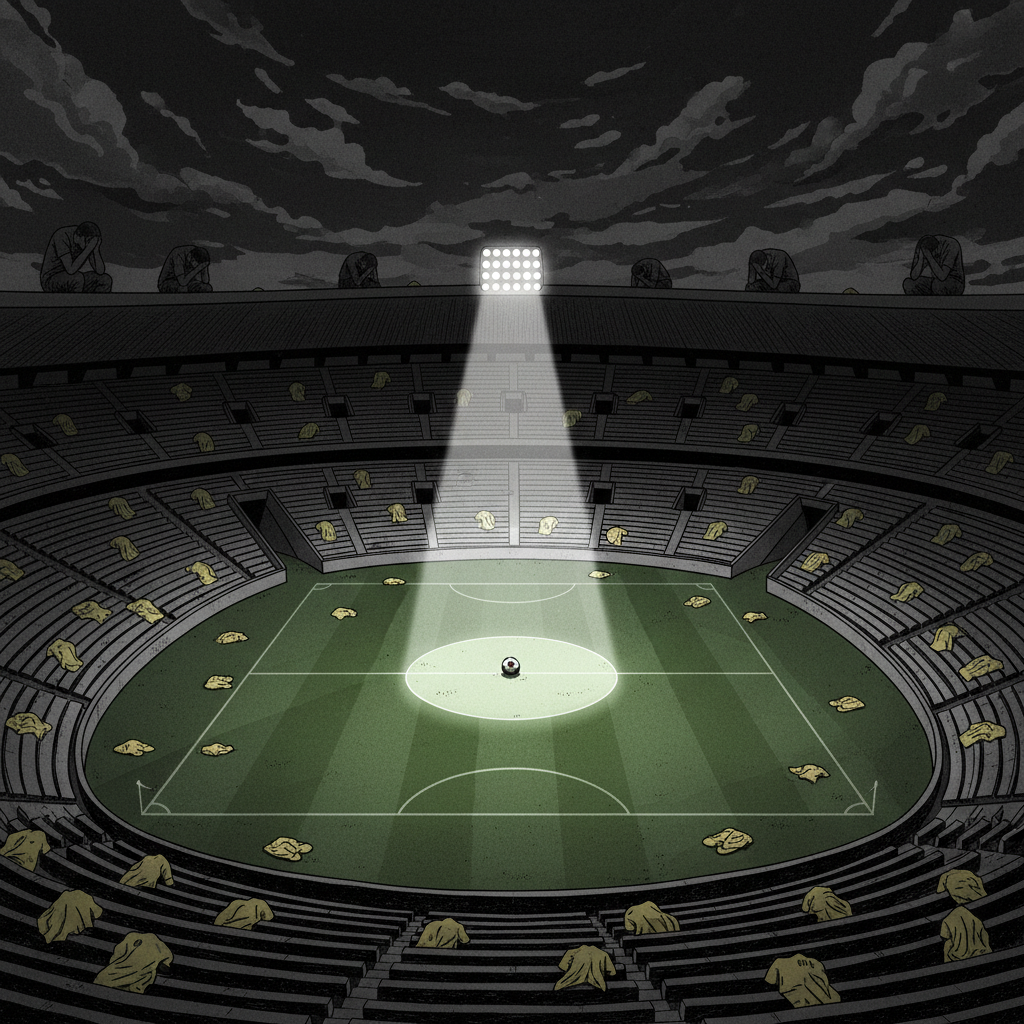
Поражение Бразилии 7:1 на Чемпионате мира 2014
8 июля 2014 года Бразилия потерпела историческое поражение 7:1 от Германии в полуфинале Чемпионата мира по футболу 2014 на стадионе «Минейрао» в Белу-Оризонти. Матч, известный в Бразилии как «Минейрасу», увидел, как Германия забила пять голов за 18 минут в первом тайме, при отсутствии ключевых игроков хозяев — Неймара (перелом позвонка в четвертьфинале) и капитана Тиаго Силвы (дисквалификация).
Краткое резюме
Полуфинал Чемпионата мира 2014 между Бразилией и Германией не был футбольным матчем, ставшим национальным кризисом — это был национальный кризис, выразившийся в форме футбольного матча. Все аналитические перспективы сходятся к одному фундаментальному выводу: 7:1 было сверхдетерминировано. Тактический дефицит, психологическая хрупкость, экзистенциальный груз, культурное значение, медийное усиление и политический контекст — всё указывало на катастрофу.
Ключевые факты
Проверенные факты из многоисточникового исследования, оценённые по уровню достоверности
Germany defeated Brazil 7-1 in the 2014 FIFA World Cup semifinal on July 8, 2014, at Estádio Mineirão in Belo Horizonte.
Достоверность: highGermany's goals were scored by Thomas Müller (11'), Miroslav Klose (23'), Toni Kroos (24', 26'), Sami Khedira (29'), André Schürrle (69', 79'). Oscar scored Brazil's consolation goal in the 90th minute.
Достоверность: highFive goals were scored between the 11th and 29th minutes, with four goals in a six-minute span from the 23rd to 29th minute.
Достоверность: highNeymar suffered a fractured third lumbar vertebra from a knee-to-the-back challenge by Colombia's Juan Camilo Zúñiga in the 88th minute of the quarterfinal on July 4, 2014, ruling him out of the rest of the tournament.
Достоверность: highCaptain Thiago Silva was suspended for the semifinal due to accumulation of two yellow cards. His appeal to FIFA was denied as having 'no legal basis.'
Достоверность: highMiroslav Klose's goal in the 23rd minute made him the all-time leading scorer in World Cup history with 16 goals, surpassing Brazil's Ronaldo who held the record with 15.
Достоверность: highBrazil's official World Cup spending was approximately $11.6 billion, making it the most expensive World Cup in history at that time.
Достоверность: highКлючевые участники
Основные участники этого события с их действиями и заявленными интересами
Luiz Felipe Scolari
individual- ›Selected 4-2-3-1 formation for semifinal despite missing key players
- ›Chose not to fundamentally alter tactical approach for Neymar/Thiago Silva absences
- ›Started Dante and Bernard as replacements
Joachim Löw
individual- ›Developed Germany's tactical system over 8 years since 2006
- ›Prepared specific pressing strategy to exploit Brazil's high defensive line
- ›Instructed team to ease off after 5-0 at halftime
Neymar
individual- ›Carried Brazil's attacking burden through the tournament as the team's talisman
- ›Suffered fractured third lumbar vertebra in quarterfinal vs. Colombia
- ›Watched the 7-1 from a hospital/recovery setting
Dilma Rousseff
individual- ›Defended World Cup spending as beneficial for Brazil's infrastructure and economy
- ›Oversaw security operations during 2013-2014 protests
- ›Won narrow re-election in October 2014
Não vai ter Copa protest movement
group- ›Organized mass protests during 2013 Confederations Cup and 2014 World Cup
- ›Coined and popularized the slogan 'Não vai ter Copa'
- ›Highlighted forced evictions and public spending priorities
Исследования и источники
Хронология событий
2007-10-30 to 2016-08-31
Причинно-следственный анализ
Интерактивный граф, показывающий причинно-следственные связи между политиками, актёрами и событиями — нажмите на узлы для изучения связей
ПРИЧИННО-СЛЕДСТВЕННАЯ СЕТЬ
18 узлов · 17 связей
Выберите узел
Нажмите на любой узел графа для изучения его связей и перспектив призм
Первопричины
1Критический путь
7 шаговАнализы по призмам
Каждая призма предоставляет уникальную аналитическую рамку — нажмите для развёртывания глубокого анализа
Теория игр
Western Moderngame-theoryThe 7-1 was not merely a tactical defeat but a cascading equilibrium collapse. Brazil entered with a fragile strategy that required specific conditions (Neymar's creativity, Thiago Silva's organization, crowd momentum) to function. Germany systematically removed each support pillar, and once the strategic structure collapsed after the second goal, no rational recovery was possible. The game-theoretic lesson is that high-risk, high-reward strategies with single points of failure are catastrophically vulnerable to systematic opponents who identify and exploit those failure points.
Анализ поведенческого обусловливания
Western ModernpavlovThe 7-1 was a mass extinction event for Brazil's conditioned national football identity. Decades of reinforcement — five World Cup titles, generations of legendary players, cultural production around football supremacy — were shattered in 18 minutes. The psychological mechanism was identical to laboratory demonstrations of learned helplessness: after the third rapid goal, Brazilian players and fans alike ceased active coping and entered a state of passive acceptance. The subsequent reconditioning through dark humor was not merely a cultural quirk but a psychologically adaptive response — counter-conditioning the aversive stimulus with a new, less painful response. The 7-1 permanently altered Brazil's conditioned relationship with its own football identity.
Ницшеанский анализ власти
Western ModernnietzscheThe 7-1 was the death of Brazilian football's god — the end of the foundational myth of inherent supremacy that had organized Brazilian national identity for generations. The Übermensch model (dependence on individual genius) was exposed as fatally fragile when tested against Germany's systematic will to power. The ensuing ressentiment was both existentially genuine and politically consequential, contributing to the broader crisis that culminated in Rousseff's impeachment. Brazil's dark humor response represents a remarkable form of amor fati — embracing the catastrophe as part of national identity rather than being destroyed by it.
Статистический анализ Манибол
Entertainment & SportsmoneyballThe statistical story of the 7-1 is a tale of two components. The first is a predictable tactical mismatch: removing Neymar (40% of attacking output) and Thiago Silva (the defensive organizer) from a team facing the most systematically prepared opponent in the tournament made a defeat statistically likely, with an expected margin of 2-3 goals. The second component is the 'trauma premium': the additional 3-4 goals that represent pure psychological collapse, visible in the data as defensive positioning errors, pass completion rate collapse, and pressing intensity dropping to near-zero between the 23rd and 40th minutes. The 7-1 was a 3-0 or 4-1 tactical defeat amplified into a 7-1 catastrophe by the psychological disintegration of a team and a stadium.
Социология спорта
Entertainment & Sportssports-sociologyThe 7-1 was not a football match but a sociological earthquake. Football in Brazil functions as a civil religion — the primary institution of national identity and cross-class solidarity. The Mineiraço shattered this institution's claim to sacredness, exposed the class dynamics of mega-event hosting that had been masked by football's unifying narrative, and produced a collective trauma that is sociologically unprecedented in its combination of magnitude (7-1), context (home soil), and stakes (national identity + $11B investment). The humor response was not trivial but a deeply rooted cultural survival mechanism: Brazil's centuries-old tradition of using laughter to process pain found its ultimate expression in the memes that followed the worst day in the nation's sporting history.
Анализ медийного нарратива
Entertainment & Sportstalking-headThe 7-1 was narrated through four competing but interlocking media frames: Brazilian devastation, German restraint, international disbelief, and protest movement vindication. The Brazilian media's compressed narrative arc — from shock to humor in hours rather than months — reflected a culturally specific processing speed enabled by social media. The event's transformation into a permanent cultural meme ('7 a 1' as shorthand for catastrophic failure) demonstrates how media narrative construction can embed a sporting result into the permanent lexicon of a language and culture. Perhaps most remarkably, Germany's narrative restraint showed that even the victors recognized this was not a normal sporting triumph but a cultural event that required careful narrative handling.
Оценка гражданского воздействия
civilian-impactThe civilian impact of the 7-1 extended far beyond the emotional trauma of a football match. The event crystallized the contradictions of Brazil's mega-event model: $11.6 billion in public spending that produced luxury stadiums while displacing hundreds of thousands from favela communities, white elephant venues with no viable post-tournament use, and a political promise of national glory that was replaced by the worst humiliation in the country's sporting history. The 7-1 became the defining symbol of institutional failure that contributed to Dilma Rousseff's impeachment and discredited the model of mega-event-driven development for a generation. For the communities displaced to build stadiums they could never afford to enter, the 7-1 was not a sporting disaster but the final proof that they had been sacrificed for a spectacle that served everyone but them.
Конвергенции
Где несколько призм приходят к схожим выводам — что указывает на их устойчивость
The 7-1 was overdetermined — multiple independent factors all pointed toward disaster
Every analytical lens identifies independent factors that made Brazil vulnerable to a catastrophic result. The tactical weakness without key players (game-theory, moneyball), the psychological fragility of conditioned expectations (pavlov), the existential weight of the 'country of football' identity (nietzsche, sports-sociology), and the political pressure of $11B in spending (civilian-impact) all created overlapping vulnerabilities. The convergence of all these factors simultaneously is what made the 7-1 historically unique rather than merely a bad result.
Germany's systematic approach defeated Brazil's talent-dependent model
Game-theory identifies Germany's dominant strategy of exploiting structural weaknesses. Moneyball quantifies the tactical asymmetry. Nietzsche frames it as Apollo defeating Dionysus. Sports-sociology contextualizes it as the end of the individual-genius model's supremacy. All four lenses agree that the 7-1 represented the triumph of a collective system over individual talent dependence.
The 18-minute spell was a psychological cascade, not merely a tactical collapse
Game-theory identifies the cascading equilibrium collapse. Pavlov identifies the learned helplessness response. Moneyball quantifies the 'trauma premium' — the gap between expected goals from tactical positioning and actual goals, representing the pure psychological disintegration component. All three agree that the 7-1 was approximately a 3-0 or 4-1 tactical defeat amplified into a 7-1 catastrophe by psychological collapse.
The 7-1 transcended sport to become a political and cultural event
All four lenses independently identify the 7-1 as an event that exceeded its sporting context. Nietzsche identifies the existential dimension. Sports-sociology identifies the civil religion dimension. Talking-head identifies the media narrative construction that elevated the event to national crisis status. Civilian-impact identifies the political consequences. The convergence confirms that the 7-1 cannot be understood as a football match alone.
Продуктивные противоречия
Где призмы расходятся — выявляя сложность, заслуживающую изучения
Возможные варианты будущего
Сценарии, выведенные из призменных анализов — что может произойти в зависимости от различных рамок
Brazilian football renaissance through systematic reform
Medium. Brazil's talent pipeline remains strong, but institutional resistance to systematic approaches is significant. The tension between jogo bonito tradition and tactical modernization has not been resolved.
The 7-1 becomes a fading cultural memory without institutional change
Medium-high. The humor response already began the process of normalizing the trauma. Future successes could complete the reconditioning process without addressing structural issues.
Permanent discrediting of the mega-event development model in Brazil
Medium. The Brazilian public's appetite for mega-events has been significantly reduced, but economic pressures and political opportunism could override this skepticism in the future.
Ключевые вопросы
Вопросы, остающиеся открытыми после анализа — для дальнейшего исследования
- ?What specific tactical adjustments, if any, did Scolari make at halftime when the score was already 5-0?
- ?What were the exact economic downstream effects of World Cup spending — did any infrastructure investments produce measurable long-term benefits?
- ?How many of the 12 World Cup stadiums are currently in regular use versus functioning as white elephants?
Детали проверки фактов
Результаты проверки фактов
verifiedМета-наблюдения
All seven lenses analyze the 7-1 from the perspective of Brazil's failure, with Germany's achievement treated as a backdrop rather than a story in its own right. Germany's 2014 World Cup victory — the culmination of 14 years of systematic development — deserves its own multi-lens analysis as one of the greatest achievements in football history. By centering the 7-1 on Brazilian trauma, we risk reducing Germany's triumph to a supporting role in someone else's tragedy.
The 7-1 resists reduction to any single explanatory framework because it operates simultaneously across tactical, psychological, cultural, political, and sociological dimensions. Any lens that claims to fully explain the event is necessarily incomplete. The genuine understanding of the 7-1 requires holding all seven perspectives simultaneously — not synthesizing them into a single narrative but allowing them to remain in productive tension.
We should be honest about what we cannot know. We cannot know what would have happened with Neymar and Thiago Silva present. We cannot precisely separate the tactical from the psychological component of the scoreline. We cannot definitively determine whether the 7-1 'caused' political change or merely symbolized existing trends. We cannot know whether future generations will remember the 7-1 as a defining national trauma or a fading sporting anecdote. The 7-1 teaches epistemic humility: some events are too complex, too overdetermined, and too deeply embedded in their cultural context to be fully explained by any analytical framework.
Найдите свою перспективу
Разные рамки резонируют с разными читателями — найдите свою точку входа
Readers who approach the 7-1 as a tactical and statistical puzzle — wanting to understand the mechanics of how five goals happened in 18 minutes and what the data reveals about the underlying quality difference between the teams.
The 7-1 was approximately a 3-0 tactical defeat amplified into a 7-1 by psychological collapse. Germany's dominant strategy exploited specific, identifiable weaknesses created by Brazil's missing players. The match was a statistical outlier (4-5 sigma) driven by the interaction between tactical inferiority and psychological cascade.
Readers who feel the 7-1 as a cultural and emotional event — who understand that football in Brazil is not just a sport but a structure of meaning, and that the 7-1 shattered something fundamental about Brazilian self-understanding.
The 7-1 was the death of a foundational national myth. Decades of conditioned belief in Brazilian football supremacy were extinguished in 18 minutes. Football functions as a civil religion in Brazil, and the 7-1 was a desecration of the sacred. The dark humor response was a culturally specific form of amor fati — embracing catastrophe rather than being destroyed by it.
Readers who see the 7-1 as a political and institutional event — the culmination of misplaced spending priorities, government overreach, and institutional failure that was expressed through but not limited to a football match.
The $11.6B World Cup spending displaced hundreds of thousands, created white elephant stadiums, and was justified by a promise of national glory that the 7-1 destroyed. The political downstream contributed to Rousseff's impeachment. The media narrative was constructed differently across four perspectives (devastation, restraint, disbelief, vindication), each serving different institutional interests.
Readers skeptical of the grander narratives who want to strip the 7-1 back to its sporting fundamentals: a team missing two key players lost badly to a better-prepared opponent. The cultural and political overlay, while real, risks obscuring the straightforward sporting explanation.
Much of what happened can be explained by standard tactical analysis: Brazil's defensive disorganization without Thiago Silva, the creative void without Neymar, and Germany's clinical exploitation of predictable weaknesses. The 7-1 was extraordinary in degree but not in kind — football produces heavy defeats when one team is significantly weakened and the other is at peak preparation.
Start with the analytical cluster (game-theory, moneyball) to understand what happened mechanically, then layer the intuitive cluster (pavlov, nietzsche, sports-sociology) to understand why it mattered so deeply, and finally add the institutional cluster (civilian-impact, talking-head) to understand the broader consequences. The 7-1 requires all three perspectives to be fully comprehended — it was a tactical failure, an existential crisis, and a political turning point, all simultaneously.
Связанные анализы
Другие события, проанализированные через схожие призмы или категории
Арабская весна была революционной волной протестов, восстаний и вооружённых мятежей, охватившей арабский мир с декабря 2010 года. Спровоцированная самосожжением тунисского уличного торговца Мухаммеда Буазизи 17 декабря 2010 года, движение распространилось с поразительной скоростью по Северной Африке и Ближнему Востоку. Лозунг «الشعب يريد إسقاط النظام» (Народ хочет падения режима) звучал от Туниса до Каира, от Бенгази до Дамаска. Выбор армии — встать на сторону протестующих или остаться верной режиму — оказался решающей переменной в каждой стране.
С 6 апреля по 18 июля 1994 года в Руанде за 100 дней было систематически убито около 800 000 тутси и умеренных хуту — самое эффективное массовое убийство в современной истории с ежедневным уровнем смертности, превышающим Холокост. Геноцид не был вспышкой «древней племенной вражды», а кульминацией колониального проекта: бельгийские администраторы создали жёсткие расовые категории из подвижных социальных идентичностей посредством переписи 1933 года и обязательных этнических удостоверений личности. Радио RTLM — «Радио Мачете» — систематически обуславливало население годами дегуманизирующей пропаганды, называя тутси «inyenzi» (тараканы). От 250 000 до 500 000 женщин были изнасилованы как орудие геноцида. Провал международного сообщества был активным: Даллэр отправил предупреждение за три месяца, запросил 5000 солдат и получил отказ. Совет Безопасности ООН сократил МООНПР с 2500 до 270 солдат во время геноцида. Военная победа РПФ прекратила геноцид в июле 1994 года, но последствия распространились на Первую конголезскую войну (1996-97) и «Мировую войну Африки», унёсшую более 5 миллионов жизней.
26 апреля 1986 года в 01:23 реактор №4 Чернобыльской атомной электростанции в Украинской ССР взорвался во время испытания на безопасность, выбросив в атмосферу в 400 раз больше радиоактивных материалов, чем бомба, сброшенная на Хиросиму. Взрыв и последовавший за ним пожар отправили облако радиоактивных осадков над западной частью СССР и Европой. Советские власти первоначально скрывали катастрофу, вынуждая 49 000 жителей Припяти продолжать обычную жизнь в течение 36 часов до эвакуации. Около 600 000 ликвидаторов были мобилизованы для ликвидации последствий катастрофы — в том числе «биороботы», добровольцы, заменившие вышедшую из строя технику, чтобы сгребать радиоактивный графит с крыши реактора 90-секундными сменами, получая пожизненную дозу облучения за каждый выход. Официальное советское число погибших — 31 человек — остаётся оспариваемым; оценки варьируются от 4 000 (ВОЗ) до 93 000 (Greenpeace) избыточных смертей от рака. Катастрофа разрушила миф о советском технологическом превосходстве, вынудила Горбачёва перейти к гласности и — по собственной более поздней оценке Горбачёва — стала «возможно, истинной причиной распада Советского Союза», более значимой, чем любая политика или реформа. Зона отчуждения площадью 2 600 квадратных километров остаётся непригодной для проживания — постоянный шрам на украинской земле, где решения Москвы обернулись последствиями для Украины.
Как проводился этот анализ
Полная прозрачность процесса анализа, инструментов и ограничений
Движок Crosslight
v0.4.0 "Global Lens Expansion"- ⚠Non-Western philosophical lenses rely on translated primary texts — nuance may be lost in translation
- ⚠Some traditions (e.g., Maat, Ubuntu) have limited surviving primary texts; analysis draws on scholarly reconstruction
- ⚠Cross-cultural lens application is inherently interpretive — a Confucian reading of a Western event is an analytical exercise, not a claim of cultural authority
Статистика анализа
Методология
Этот анализ был произведён многоагентным конвейером Crosslight: Агент исследования собирал и проверял факты из множества источников, специализированные агенты призм применяли отдельные аналитические рамки, Агент синтеза интегрировал выводы и выявлял паттерны, а Агент проверки фактов верифицировал утверждения. Каждая призменная перспектива является интерпретацией ИИ — а не институциональным одобрением.Узнать больше →