
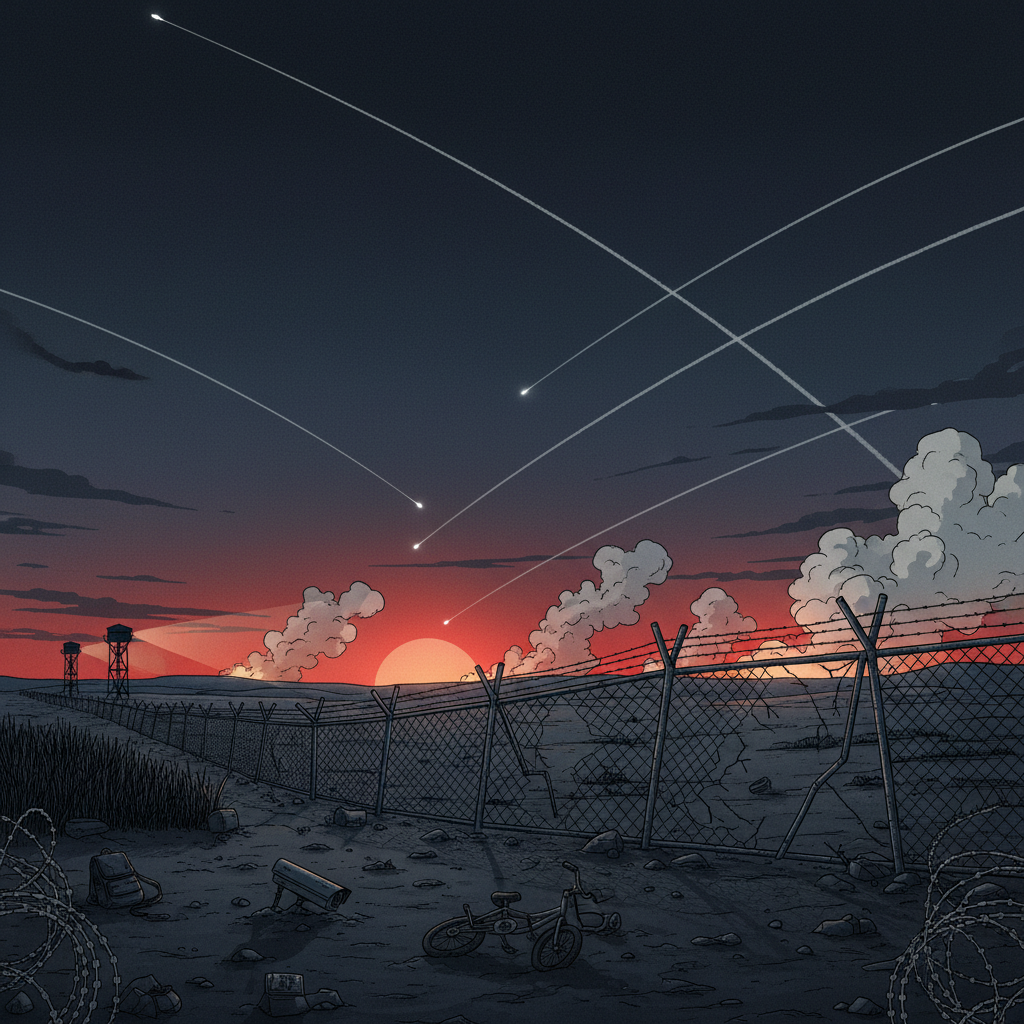
Атака ХАМАС 7 октября
On October 7, 2023, Hamas launched a surprise multi-front assault on southern Israel from the Gaza Strip, killing approximately 1,200 people and taking over 250 hostages. The attack triggered Israel's largest military operation in Gaza since 1948, a broader regional escalation involving Hezbollah and Iran, and ultimately contributed to the US-Israel strikes on Iran in February-March 2026. The event represents a catalyst whose causal chain extends from the immediate attack through the Gaza war, regional proxy conflict, and into the reshaping of the Middle Eastern security architecture.
Краткое резюме
Seven lenses converge on a central finding: October 7 was a catalyst event whose consequences far exceeded the intentions of any single actor, triggering an escalation chain that reshaped the Middle Eastern security architecture. Intelligence lenses (regional-intelligence, CIA) identify a systemic analytical failure rooted in technological hubris. The proxy-warfare lens reveals how Hamas's autonomous action within Iran's proxy framework ultimately destroyed the very proxy doctrine it exemplified. Civilian-impact documents a humanitarian catastrophe of historic proportions on both sides, with radically asymmetric scale. Game-theory exposes the escalation trap where each player's rational response drove the system toward collective catastrophe. Machiavelli strips away stated justifications to reveal the gap between declared and actual objectives for all parties. Nietzsche diagnoses the psychological dynamics of ressentiment (ресентимент) and will to power (воля к власти) that underpin the conflict's intensity. Together, these perspectives reveal October 7 not as an isolated attack but as the moment when decades of unresolved tension, strategic miscalculation, and human suffering converged into a rupture whose consequences -- extending through Gaza's destruction, Hezbollah's degradation, and the US-Iran 2026 strikes -- continue to unfold.
Ключевые факты
Проверенные факты из многоисточникового исследования, оценённые по уровню достоверности
Hamas launched Operation Al-Aqsa Flood on October 7, 2023, breaching the Gaza-Israel barrier at multiple points with approximately 3,000 militants.
Достоверность: highApproximately 1,200 people were killed in Israel on October 7, including 364 at the Nova music festival, approximately 695 Israeli civilians, 373 security forces, and 71 foreign nationals.
Достоверность: highOver 250 hostages were taken to Gaza, including Israeli soldiers, civilians, and foreign nationals.
Достоверность: highIsrael launched Operation Swords of Iron on October 8, 2023, beginning an intensive aerial bombardment campaign followed by a ground invasion of northern Gaza on October 27.
Достоверность: highThe ICC issued arrest warrants for Israeli PM Netanyahu and Hamas leader Yahya Sinwar (and others) for alleged war crimes and crimes against humanity.
Достоверность: highThe ICJ ordered provisional measures in South Africa's genocide case against Israel, ruling that Palestinians in Gaza have plausible rights under the Genocide Convention that needed protection.
Достоверность: highHezbollah began cross-border attacks on Israel on October 8, 2023, opening a second front in solidarity with Hamas, escalating to a full-scale conflict by late 2024.
Достоверность: highКлючевые участники
Основные участники этого события с их действиями и заявленными интересами
Hamas (Izz ad-Din al-Qassam Brigades)
organization- ›Launched coordinated multi-front assault on southern Israel
- ›Breached Gaza-Israel barrier at 30+ points
- ›Attacked military bases, kibbutzim, and Nova music festival
Israel (Government and IDF)
state- ›Declared war and mobilized 360,000 reservists
- ›Launched Operation Swords of Iron air campaign
- ›Imposed total siege on Gaza (fuel, electricity, water, food)
Iran / IRGC
state- ›Provided long-term strategic and financial support to Hamas
- ›Supplied weapons technology and training through IRGC Quds Force
- ›Coordinated Axis of Resistance response across multiple fronts
Hezbollah
organization- ›Opened second front with cross-border attacks on northern Israel
- ›Launched rockets and anti-tank missiles at Israeli positions
- ›Escalated to major conflict by late 2024
United States
state- ›Deployed two carrier strike groups to Eastern Mediterranean
- ›Provided emergency military aid packages to Israel
- ›Vetoed multiple UN Security Council ceasefire resolutions
Исследования и источники
Хронология событий
2023-10-07 to ongoing (2026-03-15)
Причинно-следственный анализ
Интерактивный граф, показывающий причинно-следственные связи между политиками, актёрами и событиями — нажмите на узлы для изучения связей
ПРИЧИННО-СЛЕДСТВЕННАЯ СЕТЬ
17 узлов · 16 связей
Выберите узел
Нажмите на любой узел графа для изучения его связей и перспектив призм
Первопричины
4Критический путь
9 шаговАнализы по призмам
Каждая призма предоставляет уникальную аналитическую рамку — нажмите для развёртывания глубокого анализа
Региональная разведывательная перспектива
regional-intelligenceOctober 7 represents a textbook case of intelligence failure driven by analytical hubris -- the belief that technological superiority and economic leverage had permanently deterred Hamas. The failure was not primarily one of collection (indicators existed) but of analysis and institutional culture, where a dominant framework became unfalsifiable. The most significant intelligence lesson is that a disciplined adversary willing to accept the costs of low-tech communication can defeat the world's most sophisticated SIGINT apparatus.
Опосредованная война и доктрина негосударственных субъектов
proxy-warfareOctober 7 exposed the central paradox of proxy warfare: proxies are valued for their operational autonomy and deniability, but that same autonomy means they can drag their patron into conflicts the proxy strategy was designed to prevent. Iran built the most sophisticated state-sponsored proxy network in modern history, only to see it become the mechanism through which Iran was drawn into direct military confrontation with the US and Israel -- the very outcome four decades of proxy doctrine was designed to avoid.
Анализ воздействия на гражданское население
civilian-impactThe civilian impact of October 7 and the subsequent Gaza operation is characterized by radical asymmetry in scale alongside shared human suffering. While October 7 inflicted devastating, concentrated violence on Israeli communities in a single day, the sustained military operation in Gaza has produced civilian casualties, displacement, and infrastructure destruction at a scale that multiple UN agencies describe as unprecedented in modern conflict. The population-level data -- regardless of which source's figures one accepts -- describes a humanitarian catastrophe whose demographic, psychological, and economic consequences will shape the region for a generation.
Стратегическая разведывательная оценка ЦРУ
Western InstitutionalciaFrom a US strategic intelligence perspective, October 7 triggered the most consequential unplanned escalation chain since 9/11. The CIA's analytical frameworks correctly identified the escalation dynamics -- proxy degradation leading to nuclear hedging leading to preventive strikes -- but the political environment constrained the policy options for interrupting this chain. The key intelligence lesson is that a single dramatic event can collapse carefully constructed strategic frameworks (normalization, containment) faster than they can be rebuilt.
Анализ теории игр
Western Moderngame-theoryGame theory reveals October 7 as a rational (if catastrophic) move within Hamas's strategic calculus: the pre-existing equilibrium was deteriorating for Palestinian interests, Israel's deterrence model had created exploitable overconfidence, and the expected payoff of dramatic disruption exceeded continued marginalization. The resulting escalation trap -- where each player's rational response to the previous move drives the system toward collective catastrophe -- demonstrates why the most dangerous moments in international security arise when multiple players simultaneously face commitment traps that foreclose de-escalation.
Макиавеллистский анализ власти
Greco-Roman & ClassicalmachiavelliThrough a Machiavellian lens, October 7 reveals a conflict where every major actor's stated goals diverge significantly from their inferred real goals, and where the weakest actor's willingness to pay the highest price gave it disproportionate power to reshape the strategic landscape. Hamas traded its physical capacity for strategic disruption; Israel traded international legitimacy for military dominance; Iran traded its proxy network for nuclear leverage; the US traded diplomatic credibility for alliance maintenance. The Prince would observe that all parties achieved something, but none achieved what they claimed to want.
Ницшеанский анализ воли к власти
Western ModernnietzscheThrough Nietzsche's lens, October 7 reveals a conflict driven not by rational strategic calculation but by the collision of competing expressions of will to power (воля к власти) -- Hamas's ressentiment (ресентимент) erupting as destructive nihilism, Israel's master morality reasserting dominance through overwhelming force, and both sides trapped in what Nietzsche would diagnose as reactive rather than creative expressions of will. The tragedy is that no party in this conflict is exercising will to power (воля к власти) in its highest form -- the creation of new values and possibilities. All are destroying, negating, reacting. The abyss has consumed every party that gazed into it.
Конвергенции
Где несколько призм приходят к схожим выводам — что указывает на их устойчивость
Intelligence failure rooted in systemic analytical hubris, not collection gaps
All three lenses agree that October 7's intelligence failure was primarily analytical rather than collection-based. Warning indicators existed but were filtered through institutional frameworks that had concluded Hamas was deterred. The regional-intelligence lens traces this to the 1973 'conceptzia' pattern recurring; the CIA lens identifies a broader failure of the US-Israeli intelligence partnership; game-theory shows how Israel's false model of Hamas's preferences created exploitable strategic overconfidence.
The escalation chain from October 7 to US-Iran strikes was structurally predictable even if not inevitable
Four lenses converge on the assessment that the escalation from proxy attack through proxy network destruction to direct state confrontation follows a recognizable structural pattern. Proxy-warfare identifies the fundamental paradox of proxy doctrine (proxies can drag patrons into unwanted confrontation); CIA traces the strategic logic from deterrence degradation to nuclear hedging to preventive strikes; game-theory models the commitment traps that foreclosed de-escalation; Machiavelli identifies how each actor's pursuit of stated goals (which concealed real goals) drove escalation.
All actors' stated goals diverge significantly from their inferred real goals
Machiavelli and game-theory both identify systematic gaps between declared and actual objectives for all parties. Hamas claimed liberation but sought Abraham Accords disruption and strategic repositioning. Israel claimed hostage rescue but prioritized deterrence restoration and regime survival. Iran claimed Palestinian solidarity but pursued proxy network maintenance and nuclear leverage. The US claimed stability but prioritized alliance credibility and Iran containment.
The weakest actor's willingness to accept maximum costs gave it disproportionate strategic agency
Game-theory identifies Hamas's asymmetric payoff structure (strategic repositioning worth catastrophic military losses); Machiavelli notes that willingness to pay the highest price inverted conventional power dynamics; Nietzsche frames this as the explosive discharge of ressentiment (ресентимент) that temporarily reversed the master-slave dynamic. All three recognize that Hamas's acceptance of devastating consequences for Gaza enabled strategic outcomes that a conventionally rational actor would not have pursued.
Продуктивные противоречия
Где призмы расходятся — выявляя сложность, заслуживающую изучения
Возможные варианты будущего
Сценарии, выведенные из призменных анализов — что может произойти в зависимости от различных рамок
Managed Post-Conflict Equilibrium
Low-medium probability (20-30%). Requires simultaneous progress on multiple intractable issues. Historical precedent (post-1973, post-Oslo) suggests partial progress followed by breakdown.
Frozen Conflict with Periodic Eruption
High probability (40-50%). Most consistent with historical patterns. The Israeli-Palestinian conflict has repeatedly entered periods of reduced violence without resolution, with each cycle producing greater devastation than the last.
Regional Realignment and Arab-Israeli Normalization
Medium probability (25-35%). The degradation of Iran's proxy network and the exhaustion of the conflict may create a window for normalization, but the depth of Palestinian suffering makes any deal that marginalizes Palestinian statehood politically toxic.
Continued Escalation and Regional War
Low probability (10-15%). The 2026 strikes have degraded Iran's conventional capabilities, but asymmetric retaliation (terrorism, cyber, proxy reconstitution) remains possible. Full regional war is unlikely given the military imbalance.
Ключевые вопросы
Вопросы, остающиеся открытыми после анализа — для дальнейшего исследования
- ?What was the full extent of pre-October 7 intelligence warnings, and at what levels were they received and dismissed?
- ?What was the precise degree of Iranian foreknowledge and involvement in October 7 operational planning?
- ?What is the accurate civilian-to-combatant casualty ratio in Gaza, and can it be independently verified?
- ?What was the content of Saudi-Israeli normalization negotiations at the time of October 7?
Детали проверки фактов
Результаты проверки фактов
verifiedМета-наблюдения
No lens adequately captures the experience of the individual human beings at the center of this conflict -- the October 7 survivors, the hostage families, the children of Gaza, the soldiers on both sides. All seven lenses analyze the conflict from above or outside; none can convey what it means to live inside it. Additionally, none adequately addresses the religious dimensions that motivate many actors -- Islamic theology, Jewish historical consciousness, messianic nationalism -- which resist secular analytical frameworks.
This conflict resists reduction to any single explanatory framework because it operates simultaneously as an intelligence failure, a proxy warfare crisis, a humanitarian catastrophe, a strategic escalation chain, a power politics game, and a psychological drama of collective trauma and will to power (воля к власти). Any analysis that privileges one dimension necessarily distorts the whole. The seven lenses together approach but do not achieve a complete picture.
This analysis was produced by an AI system analyzing one of the most emotionally charged, politically contested, and humanly devastating events of the 21st century. The multi-perspective framing is designed to present all major viewpoints with attribution, but no analysis of this event can be truly neutral. The reader is encouraged to notice which perspectives resonate and which provoke resistance, and to treat that response as data about their own analytical framework rather than evidence of the analysis's bias.
Найдите свою перспективу
Разные рамки резонируют с разными читателями — найдите свою точку входа
Readers who approach conflict through strategic logic, institutional analysis, and rational actor frameworks. You likely focus on what actors could and should have done differently, and you evaluate outcomes against strategic objectives.
October 7 was a predictable consequence of Israeli analytical hubris and a rational (if extreme) strategic move by Hamas. The escalation chain follows recognizable patterns from intelligence failure through commitment trap to regional confrontation.
Readers who experience this conflict through its human and psychological dimensions first. You are drawn to the suffering of civilian populations and the deeper psychological forces driving the violence. You may find purely strategic analysis emotionally unsatisfying or morally insufficient.
The conflict is driven by deep psychological forces (ressentiment (ресентимент), will to power (воля к власти), collective trauma) that cannot be resolved through strategic frameworks alone. The civilian cost is the central reality that all other analyses must reckon with.
Readers who understand conflict through institutional structures, alliance dynamics, and great power competition. You focus on how organizations (intelligence agencies, proxy networks, alliances) shape and constrain individual and state behavior.
October 7 was a failure of institutional structures -- intelligence organizations, proxy management doctrines, alliance mechanisms -- that had maintained a fragile status quo for decades. The institutional framework failed because it was designed for a world that the actors had already moved beyond.
Readers skeptical of stated motivations and official narratives. You suspect that all parties are pursuing unstated objectives disguised as moral imperatives, and you evaluate claims against revealed preferences rather than declared intentions.
Every major actor's stated goals diverge from their inferred real goals. The gap between stated and actual objectives -- not the objectives themselves -- is the primary driver of the conflict's intractability.
If you find yourself strongly aligned with one cluster, deliberately engage with the opposite. If you resonate with the analytical cluster's strategic logic, the intuitive cluster's focus on civilian suffering will challenge your framework in productive ways. If the institutional perspective feels natural, the Machiavellian skepticism about stated objectives will deepen your analysis. Every perspective here captures something real and misses something important.
Связанные анализы
Другие события, проанализированные через схожие призмы или категории
Арабская весна была революционной волной протестов, восстаний и вооружённых мятежей, охватившей арабский мир с декабря 2010 года. Спровоцированная самосожжением тунисского уличного торговца Мухаммеда Буазизи 17 декабря 2010 года, движение распространилось с поразительной скоростью по Северной Африке и Ближнему Востоку. Лозунг «الشعب يريد إسقاط النظام» (Народ хочет падения режима) звучал от Туниса до Каира, от Бенгази до Дамаска. Выбор армии — встать на сторону протестующих или остаться верной режиму — оказался решающей переменной в каждой стране.
С 6 апреля по 18 июля 1994 года в Руанде за 100 дней было систематически убито около 800 000 тутси и умеренных хуту — самое эффективное массовое убийство в современной истории с ежедневным уровнем смертности, превышающим Холокост. Геноцид не был вспышкой «древней племенной вражды», а кульминацией колониального проекта: бельгийские администраторы создали жёсткие расовые категории из подвижных социальных идентичностей посредством переписи 1933 года и обязательных этнических удостоверений личности. Радио RTLM — «Радио Мачете» — систематически обуславливало население годами дегуманизирующей пропаганды, называя тутси «inyenzi» (тараканы). От 250 000 до 500 000 женщин были изнасилованы как орудие геноцида. Провал международного сообщества был активным: Даллэр отправил предупреждение за три месяца, запросил 5000 солдат и получил отказ. Совет Безопасности ООН сократил МООНПР с 2500 до 270 солдат во время геноцида. Военная победа РПФ прекратила геноцид в июле 1994 года, но последствия распространились на Первую конголезскую войну (1996-97) и «Мировую войну Африки», унёсшую более 5 миллионов жизней.
26 апреля 1986 года в 01:23 реактор №4 Чернобыльской атомной электростанции в Украинской ССР взорвался во время испытания на безопасность, выбросив в атмосферу в 400 раз больше радиоактивных материалов, чем бомба, сброшенная на Хиросиму. Взрыв и последовавший за ним пожар отправили облако радиоактивных осадков над западной частью СССР и Европой. Советские власти первоначально скрывали катастрофу, вынуждая 49 000 жителей Припяти продолжать обычную жизнь в течение 36 часов до эвакуации. Около 600 000 ликвидаторов были мобилизованы для ликвидации последствий катастрофы — в том числе «биороботы», добровольцы, заменившие вышедшую из строя технику, чтобы сгребать радиоактивный графит с крыши реактора 90-секундными сменами, получая пожизненную дозу облучения за каждый выход. Официальное советское число погибших — 31 человек — остаётся оспариваемым; оценки варьируются от 4 000 (ВОЗ) до 93 000 (Greenpeace) избыточных смертей от рака. Катастрофа разрушила миф о советском технологическом превосходстве, вынудила Горбачёва перейти к гласности и — по собственной более поздней оценке Горбачёва — стала «возможно, истинной причиной распада Советского Союза», более значимой, чем любая политика или реформа. Зона отчуждения площадью 2 600 квадратных километров остаётся непригодной для проживания — постоянный шрам на украинской земле, где решения Москвы обернулись последствиями для Украины.
Как проводился этот анализ
Полная прозрачность процесса анализа, инструментов и ограничений
Движок Crosslight
v0.4.0 "Global Lens Expansion"- ⚠Non-Western philosophical lenses rely on translated primary texts — nuance may be lost in translation
- ⚠Some traditions (e.g., Maat, Ubuntu) have limited surviving primary texts; analysis draws on scholarly reconstruction
- ⚠Cross-cultural lens application is inherently interpretive — a Confucian reading of a Western event is an analytical exercise, not a claim of cultural authority
Статистика анализа
Методология
Этот анализ был произведён многоагентным конвейером Crosslight: Агент исследования собирал и проверял факты из множества источников, специализированные агенты призм применяли отдельные аналитические рамки, Агент синтеза интегрировал выводы и выявлял паттерны, а Агент проверки фактов верифицировал утверждения. Каждая призменная перспектива является интерпретацией ИИ — а не институциональным одобрением.Узнать больше →