
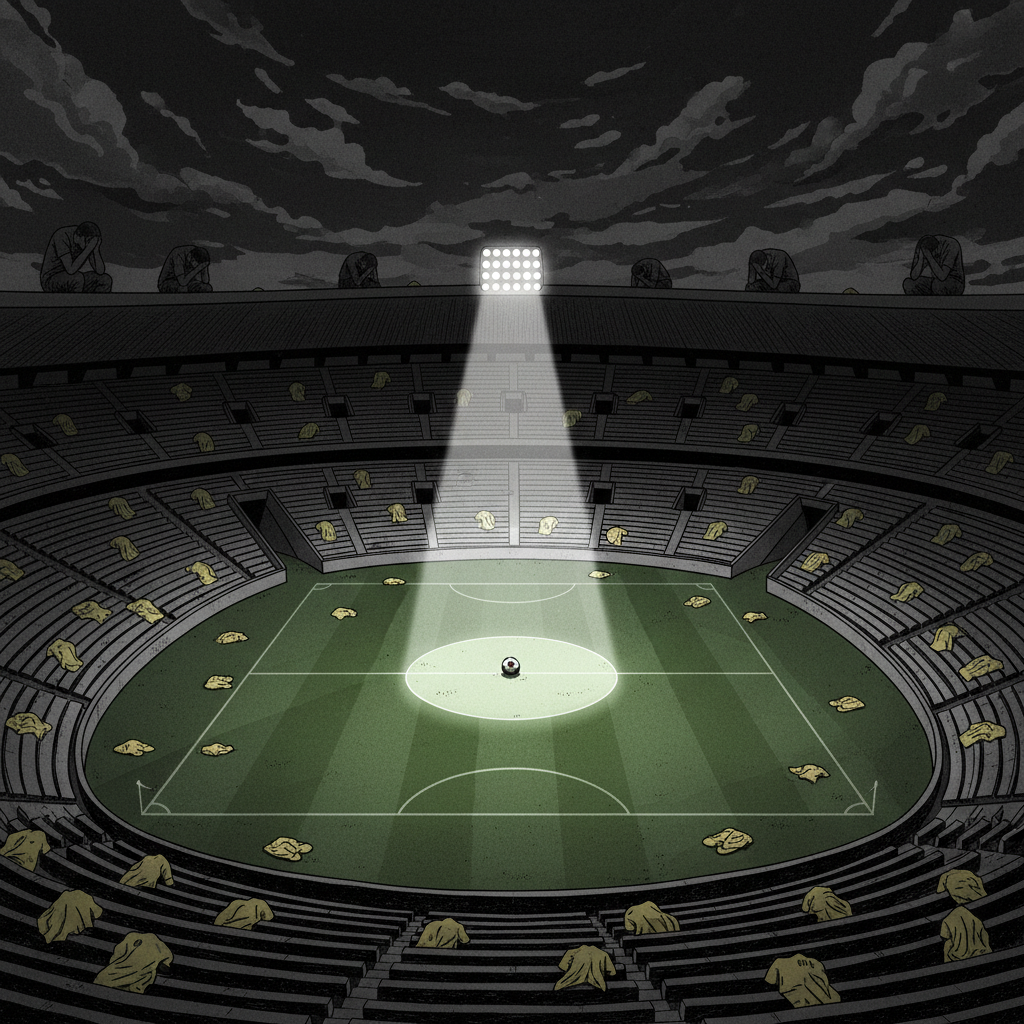
Brasiliens 7-1-förlust i VM 2014
Den 8 juli 2014 led Brasilien en historisk 7-1-förlust mot Tyskland i semifinalen av FIFA:s världsmästerskap 2014 på Estádio Mineirão i Belo Horizonte. Matchen, känd i Brasilien som "Mineiraço", såg Tyskland göra fem mål på 18 minuter under första halvlek, medan värdarna saknade nyckelspelarna Neymar (kotfraktur från kvartsfinalen) och lagkapten Thiago Silva (avstängd).
Sammanfattning
VM-semifinalen 2014 mellan Brasilien och Tyskland var inte en fotbollsmatch som blev en nationell kris — det var en nationell kris som uttryckte sig som en fotbollsmatch. Alla analytiska perspektiv konvergerar mot samma fundamentala slutsats: 7-1 var överdeterminerat.
Nyckelfakta
Verifierade fakta fran flerkallsforskning, bedomda efter konfidensgrad
Germany defeated Brazil 7-1 in the 2014 FIFA World Cup semifinal on July 8, 2014, at Estádio Mineirão in Belo Horizonte.
high konfidensGermany's goals were scored by Thomas Müller (11'), Miroslav Klose (23'), Toni Kroos (24', 26'), Sami Khedira (29'), André Schürrle (69', 79'). Oscar scored Brazil's consolation goal in the 90th minute.
high konfidensFive goals were scored between the 11th and 29th minutes, with four goals in a six-minute span from the 23rd to 29th minute.
high konfidensNeymar suffered a fractured third lumbar vertebra from a knee-to-the-back challenge by Colombia's Juan Camilo Zúñiga in the 88th minute of the quarterfinal on July 4, 2014, ruling him out of the rest of the tournament.
high konfidensCaptain Thiago Silva was suspended for the semifinal due to accumulation of two yellow cards. His appeal to FIFA was denied as having 'no legal basis.'
high konfidensMiroslav Klose's goal in the 23rd minute made him the all-time leading scorer in World Cup history with 16 goals, surpassing Brazil's Ronaldo who held the record with 15.
high konfidensBrazil's official World Cup spending was approximately $11.6 billion, making it the most expensive World Cup in history at that time.
high konfidensNyckelaktorer
Huvudaktorer involverade i denna handelse med deras atgarder och uttalade intressen
Luiz Felipe Scolari
individual- ›Selected 4-2-3-1 formation for semifinal despite missing key players
- ›Chose not to fundamentally alter tactical approach for Neymar/Thiago Silva absences
- ›Started Dante and Bernard as replacements
Joachim Löw
individual- ›Developed Germany's tactical system over 8 years since 2006
- ›Prepared specific pressing strategy to exploit Brazil's high defensive line
- ›Instructed team to ease off after 5-0 at halftime
Neymar
individual- ›Carried Brazil's attacking burden through the tournament as the team's talisman
- ›Suffered fractured third lumbar vertebra in quarterfinal vs. Colombia
- ›Watched the 7-1 from a hospital/recovery setting
Dilma Rousseff
individual- ›Defended World Cup spending as beneficial for Brazil's infrastructure and economy
- ›Oversaw security operations during 2013-2014 protests
- ›Won narrow re-election in October 2014
Não vai ter Copa protest movement
group- ›Organized mass protests during 2013 Confederations Cup and 2014 World Cup
- ›Coined and popularized the slogan 'Não vai ter Copa'
- ›Highlighted forced evictions and public spending priorities
Forskning och källor
Händelsetidslinje
2007-10-30 to 2016-08-31
Kausal analys
Interaktiv graf som visar hur policyer, aktörer och händelser hänger kausalt samman — klicka på noder för att utforska relationer
KAUSALT NÄTVERK
18 noder · 17 kopplingar
Välj en nod
Klicka på valfri nod i grafen för att utforska dess kopplingar och linsperspektiv
Grundorsaker
1Kritisk väg
7 stegLinsanalyser
Varje lins tillhandahåller ett unikt analytiskt ramverk — klicka för att expandera och fördjupa analysen
Spelteori
Western Moderngame-theoryThe 7-1 was not merely a tactical defeat but a cascading equilibrium collapse. Brazil entered with a fragile strategy that required specific conditions (Neymar's creativity, Thiago Silva's organization, crowd momentum) to function. Germany systematically removed each support pillar, and once the strategic structure collapsed after the second goal, no rational recovery was possible. The game-theoretic lesson is that high-risk, high-reward strategies with single points of failure are catastrophically vulnerable to systematic opponents who identify and exploit those failure points.
Beteendekonditioneringsanalys
Western ModernpavlovThe 7-1 was a mass extinction event for Brazil's conditioned national football identity. Decades of reinforcement — five World Cup titles, generations of legendary players, cultural production around football supremacy — were shattered in 18 minutes. The psychological mechanism was identical to laboratory demonstrations of learned helplessness: after the third rapid goal, Brazilian players and fans alike ceased active coping and entered a state of passive acceptance. The subsequent reconditioning through dark humor was not merely a cultural quirk but a psychologically adaptive response — counter-conditioning the aversive stimulus with a new, less painful response. The 7-1 permanently altered Brazil's conditioned relationship with its own football identity.
Nietzscheansk maktanalys
Western ModernnietzscheThe 7-1 was the death of Brazilian football's god — the end of the foundational myth of inherent supremacy that had organized Brazilian national identity for generations. The Übermensch model (dependence on individual genius) was exposed as fatally fragile when tested against Germany's systematic will to power. The ensuing ressentiment was both existentially genuine and politically consequential, contributing to the broader crisis that culminated in Rousseff's impeachment. Brazil's dark humor response represents a remarkable form of amor fati — embracing the catastrophe as part of national identity rather than being destroyed by it.
Moneyball statistisk analys
Entertainment & SportsmoneyballThe statistical story of the 7-1 is a tale of two components. The first is a predictable tactical mismatch: removing Neymar (40% of attacking output) and Thiago Silva (the defensive organizer) from a team facing the most systematically prepared opponent in the tournament made a defeat statistically likely, with an expected margin of 2-3 goals. The second component is the 'trauma premium': the additional 3-4 goals that represent pure psychological collapse, visible in the data as defensive positioning errors, pass completion rate collapse, and pressing intensity dropping to near-zero between the 23rd and 40th minutes. The 7-1 was a 3-0 or 4-1 tactical defeat amplified into a 7-1 catastrophe by the psychological disintegration of a team and a stadium.
Idrottssociologi
Entertainment & Sportssports-sociologyThe 7-1 was not a football match but a sociological earthquake. Football in Brazil functions as a civil religion — the primary institution of national identity and cross-class solidarity. The Mineiraço shattered this institution's claim to sacredness, exposed the class dynamics of mega-event hosting that had been masked by football's unifying narrative, and produced a collective trauma that is sociologically unprecedented in its combination of magnitude (7-1), context (home soil), and stakes (national identity + $11B investment). The humor response was not trivial but a deeply rooted cultural survival mechanism: Brazil's centuries-old tradition of using laughter to process pain found its ultimate expression in the memes that followed the worst day in the nation's sporting history.
Medienarrativanalys
Entertainment & Sportstalking-headThe 7-1 was narrated through four competing but interlocking media frames: Brazilian devastation, German restraint, international disbelief, and protest movement vindication. The Brazilian media's compressed narrative arc — from shock to humor in hours rather than months — reflected a culturally specific processing speed enabled by social media. The event's transformation into a permanent cultural meme ('7 a 1' as shorthand for catastrophic failure) demonstrates how media narrative construction can embed a sporting result into the permanent lexicon of a language and culture. Perhaps most remarkably, Germany's narrative restraint showed that even the victors recognized this was not a normal sporting triumph but a cultural event that required careful narrative handling.
Civil påverkansanalys
civilian-impactThe civilian impact of the 7-1 extended far beyond the emotional trauma of a football match. The event crystallized the contradictions of Brazil's mega-event model: $11.6 billion in public spending that produced luxury stadiums while displacing hundreds of thousands from favela communities, white elephant venues with no viable post-tournament use, and a political promise of national glory that was replaced by the worst humiliation in the country's sporting history. The 7-1 became the defining symbol of institutional failure that contributed to Dilma Rousseff's impeachment and discredited the model of mega-event-driven development for a generation. For the communities displaced to build stadiums they could never afford to enter, the 7-1 was not a sporting disaster but the final proof that they had been sacrificed for a spectacle that served everyone but them.
Konvergenspunkter
Där flera linser når liknande slutsatser — vilket tyder på robusthet
The 7-1 was overdetermined — multiple independent factors all pointed toward disaster
Every analytical lens identifies independent factors that made Brazil vulnerable to a catastrophic result. The tactical weakness without key players (game-theory, moneyball), the psychological fragility of conditioned expectations (pavlov), the existential weight of the 'country of football' identity (nietzsche, sports-sociology), and the political pressure of $11B in spending (civilian-impact) all created overlapping vulnerabilities. The convergence of all these factors simultaneously is what made the 7-1 historically unique rather than merely a bad result.
Germany's systematic approach defeated Brazil's talent-dependent model
Game-theory identifies Germany's dominant strategy of exploiting structural weaknesses. Moneyball quantifies the tactical asymmetry. Nietzsche frames it as Apollo defeating Dionysus. Sports-sociology contextualizes it as the end of the individual-genius model's supremacy. All four lenses agree that the 7-1 represented the triumph of a collective system over individual talent dependence.
The 18-minute spell was a psychological cascade, not merely a tactical collapse
Game-theory identifies the cascading equilibrium collapse. Pavlov identifies the learned helplessness response. Moneyball quantifies the 'trauma premium' — the gap between expected goals from tactical positioning and actual goals, representing the pure psychological disintegration component. All three agree that the 7-1 was approximately a 3-0 or 4-1 tactical defeat amplified into a 7-1 catastrophe by psychological collapse.
The 7-1 transcended sport to become a political and cultural event
All four lenses independently identify the 7-1 as an event that exceeded its sporting context. Nietzsche identifies the existential dimension. Sports-sociology identifies the civil religion dimension. Talking-head identifies the media narrative construction that elevated the event to national crisis status. Civilian-impact identifies the political consequences. The convergence confirms that the 7-1 cannot be understood as a football match alone.
Produktiva spänningar
Där linserna är oense — vilket avslöjar komplexitet värd att undersöka
Möjliga framtider
Scenarier härledda från linsanalyser — vad som kan utspela sig baserat på olika ramverk
Brazilian football renaissance through systematic reform
Medium. Brazil's talent pipeline remains strong, but institutional resistance to systematic approaches is significant. The tension between jogo bonito tradition and tactical modernization has not been resolved.
The 7-1 becomes a fading cultural memory without institutional change
Medium-high. The humor response already began the process of normalizing the trauma. Future successes could complete the reconditioning process without addressing structural issues.
Permanent discrediting of the mega-event development model in Brazil
Medium. The Brazilian public's appetite for mega-events has been significantly reduced, but economic pressures and political opportunism could override this skepticism in the future.
Nyckelfrågor
Frågor som förblir öppna efter analysen — för fortsatt undersökning
- ?What specific tactical adjustments, if any, did Scolari make at halftime when the score was already 5-0?
- ?What were the exact economic downstream effects of World Cup spending — did any infrastructure investments produce measurable long-term benefits?
- ?How many of the 12 World Cup stadiums are currently in regular use versus functioning as white elephants?
Detaljer om faktakontroll
Faktakontrollresultat
verifiedMetaobservationer
All seven lenses analyze the 7-1 from the perspective of Brazil's failure, with Germany's achievement treated as a backdrop rather than a story in its own right. Germany's 2014 World Cup victory — the culmination of 14 years of systematic development — deserves its own multi-lens analysis as one of the greatest achievements in football history. By centering the 7-1 on Brazilian trauma, we risk reducing Germany's triumph to a supporting role in someone else's tragedy.
The 7-1 resists reduction to any single explanatory framework because it operates simultaneously across tactical, psychological, cultural, political, and sociological dimensions. Any lens that claims to fully explain the event is necessarily incomplete. The genuine understanding of the 7-1 requires holding all seven perspectives simultaneously — not synthesizing them into a single narrative but allowing them to remain in productive tension.
We should be honest about what we cannot know. We cannot know what would have happened with Neymar and Thiago Silva present. We cannot precisely separate the tactical from the psychological component of the scoreline. We cannot definitively determine whether the 7-1 'caused' political change or merely symbolized existing trends. We cannot know whether future generations will remember the 7-1 as a defining national trauma or a fading sporting anecdote. The 7-1 teaches epistemic humility: some events are too complex, too overdetermined, and too deeply embedded in their cultural context to be fully explained by any analytical framework.
Hitta ditt perspektiv
Olika ramverk resonerar med olika läsare — hitta din ingångspunkt
Readers who approach the 7-1 as a tactical and statistical puzzle — wanting to understand the mechanics of how five goals happened in 18 minutes and what the data reveals about the underlying quality difference between the teams.
The 7-1 was approximately a 3-0 tactical defeat amplified into a 7-1 by psychological collapse. Germany's dominant strategy exploited specific, identifiable weaknesses created by Brazil's missing players. The match was a statistical outlier (4-5 sigma) driven by the interaction between tactical inferiority and psychological cascade.
Readers who feel the 7-1 as a cultural and emotional event — who understand that football in Brazil is not just a sport but a structure of meaning, and that the 7-1 shattered something fundamental about Brazilian self-understanding.
The 7-1 was the death of a foundational national myth. Decades of conditioned belief in Brazilian football supremacy were extinguished in 18 minutes. Football functions as a civil religion in Brazil, and the 7-1 was a desecration of the sacred. The dark humor response was a culturally specific form of amor fati — embracing catastrophe rather than being destroyed by it.
Readers who see the 7-1 as a political and institutional event — the culmination of misplaced spending priorities, government overreach, and institutional failure that was expressed through but not limited to a football match.
The $11.6B World Cup spending displaced hundreds of thousands, created white elephant stadiums, and was justified by a promise of national glory that the 7-1 destroyed. The political downstream contributed to Rousseff's impeachment. The media narrative was constructed differently across four perspectives (devastation, restraint, disbelief, vindication), each serving different institutional interests.
Readers skeptical of the grander narratives who want to strip the 7-1 back to its sporting fundamentals: a team missing two key players lost badly to a better-prepared opponent. The cultural and political overlay, while real, risks obscuring the straightforward sporting explanation.
Much of what happened can be explained by standard tactical analysis: Brazil's defensive disorganization without Thiago Silva, the creative void without Neymar, and Germany's clinical exploitation of predictable weaknesses. The 7-1 was extraordinary in degree but not in kind — football produces heavy defeats when one team is significantly weakened and the other is at peak preparation.
Start with the analytical cluster (game-theory, moneyball) to understand what happened mechanically, then layer the intuitive cluster (pavlov, nietzsche, sports-sociology) to understand why it mattered so deeply, and finally add the institutional cluster (civilian-impact, talking-head) to understand the broader consequences. The 7-1 requires all three perspectives to be fully comprehended — it was a tactical failure, an existential crisis, and a political turning point, all simultaneously.
Relaterade analyser
Andra händelser analyserade genom liknande linser eller kategorier
Arabiska våren var en revolutionär våg av protester, uppror och väpnade revolter som svepte över arabvärlden från december 2010. Utlöst av den tunisiske gatuhandlaren Mohamed Bouazizis självförbränning den 17 december 2010 spred sig rörelsen med häpnadsväckande hastighet över Nordafrika och Mellanöstern. Slagordet "الشعب يريد إسقاط النظام" (Folket vill ha regimens fall) ekade från Tunis till Kairo. Militärens val — att ställa sig på demonstranternas sida eller förbli lojala mot regimen — visade sig vara den avgörande variabeln i varje land.
Mellan 6 april och 18 juli 1994 mördades systematiskt cirka 800 000 tutsis och moderata hutus i Rwanda under loppet av 100 dagar — det mest effektiva massdödandet i modern historia, med en daglig dödstakt som översteg Förintelsens. Folkmördet var inte ett utbrott av ”urgamla stamfejder” utan kulmen på ett kolonialt projekt: belgiska administratörer hade tillverkat rigida raskategorier från flytande sociala identiteter genom folkräkningen 1933 och obligatoriska etniska identitetskort. Habyarimanas regim och dess inre krets akazu (lilla huset) valde folkmörd som politisk överlevnadsstrategi inför militärt tryck från Rwandas patriotiska front och Arusha-avtalens krav på maktdelning. RTLM-radio — ”Radio Machete” — konditionerade systematiskt befolkningen genom år av avhumaniserande propaganda och kallade tutsis för ”inyenzi” (kackerlackor). Mellan 250 000 och 500 000 kvinnor våldtogs som avsiktligt vapen för folkmörd. Det internationella samfundets misslyckande var aktivt: Dallaire skickade sin ”folkmördsfax” tre månader före, begärde 5 000 soldater och nekades. FN:s säkerhetsråd reducerade UNAMIR från 2 500 till 270 soldater under folkmördet. RPF:s militära seger avslutade folkmördet i juli 1994, men konsekvenserna spred sig till första Kongokriget (1996-97) och ”Afrikas världskrig” som dödade över 5 miljoner människor.
Den 26 april 1986 klockan 01:23 exploderade reaktor nr 4 vid Tjernobyl-kärnkraftverket i Ukrainska SSR under ett säkerhetstest och frigjorde 400 gånger mer radioaktivt material än Hiroshimabomben. De sovjetiska myndigheterna hemlighöll katastrofen och tvingade Pripjats 49 000 invånare att fortsätta sitt normala liv i 36 timmar. Omkring 600 000 'likvidatorer' sattes in. Uppskattningarna av dödstalet sträcker sig från 4 000 (WHO) till 93 000 (Greenpeace). Katastrofen krossade myten om sovjetisk teknologisk överlägsenhet och tvingade Gorbatjov mot glasnost.
Hur detta analyserades
Full transparens om analysprocessen, verktygen och begränsningarna
Crosslight-motorn
v0.4.0 "Global Lens Expansion"- ⚠Non-Western philosophical lenses rely on translated primary texts — nuance may be lost in translation
- ⚠Some traditions (e.g., Maat, Ubuntu) have limited surviving primary texts; analysis draws on scholarly reconstruction
- ⚠Cross-cultural lens application is inherently interpretive — a Confucian reading of a Western event is an analytical exercise, not a claim of cultural authority
Analysstatistik
Metodik
Denna analys producerades av Crosslights multiagent-pipeline: en forskningsagent samlade in och verifierade fakta från flera källor, specialiserade linsagenter tillämpade distinkta analytiska ramverk, en syntesagent integrerade insikter och identifierade mönster, och en faktakontrollagent verifierade påståenden. Varje linsperspektiv är AI:ns tolkning — inte institutionellt godkännande.Läs mer →