
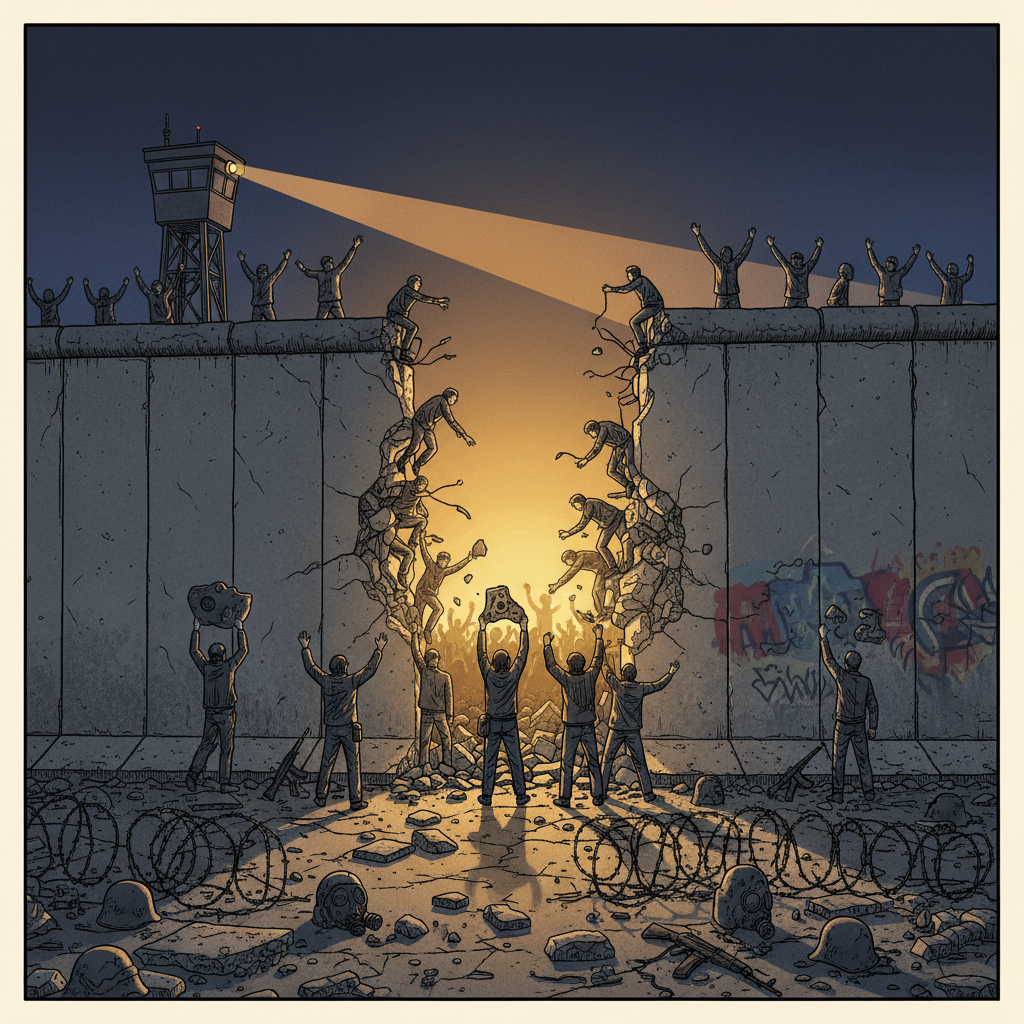
Berlinmurens fall
På kvällen den 9 november 1989 öppnades Berlinmuren — kalla krigets mäktigaste symbol — oväntat efter att DDR:s talesman Günter Schabowski av misstag meddelade omedelbar resefrihet under en presskonferens. Murens fall var kulmen av Gorbatjovs glasnost- och perestrojkareformer, dominoeffekten i Östblocket och månaders grasrotspåtryckningar från Leipzigs måndagsdemonstrationer. Tyskland återförenades formellt den 3 oktober 1990.
Sammanfattning
Five lenses converge on the fundamental insight that the Berlin Wall's fall was overdetermined — the division was unsustainable and some form of collapse was inevitable — but diverge sharply on why and how. Game theory highlights the rational calculus of cooperation replacing confrontation; Machiavelli focuses on elite agency and political opportunism; Jung reveals the psychological dimensions of division and incomplete integration; the CIA lens claims Western strategic pressure as a significant cause; and Taoism sees the Wall's fall as natural correction of artificial forcing. The most productive tension is between the CIA's triumphalism (the West won) and Taoism's inevitabilism (the Wall dissolved under its own contradictions), with the other lenses occupying the spectrum between these poles. All lenses agree on three things: Gorbachev's non-intervention was the single most critical enabling factor; the grassroots movements (Leipzig, Mauerspechte) were as important as elite decisions; and the Schabowski gaffe was the accidental catalyst that collapsed a fragile equilibrium.
Nyckelfakta
Verifierade fakta fran flerkallsforskning, bedomda efter konfidensgrad
Mikhail Gorbachev became General Secretary of the Communist Party of the Soviet Union on March 11, 1985, and initiated glasnost (openness) and perestroika (restructuring) reforms.
high konfidensThe Sinatra Doctrine, articulated by Soviet Foreign Ministry spokesman Gennadi Gerasimov in October 1989, replaced the Brezhnev Doctrine, signaling that the USSR would no longer intervene militarily to prevent political change in Eastern Bloc states.
high konfidensThe Leipzig Monday Demonstrations began on September 4, 1989, at the Nikolaikirche (St. Nicholas Church) and grew from hundreds to over 300,000 participants by late October 1989.
high konfidensThe chant "Wir sind das Volk" (We are the people) became the rallying cry of the Leipzig Monday demonstrators, explicitly claiming popular sovereignty against the SED regime.
high konfidensErich Honecker was forced to resign as General Secretary of the SED on October 18, 1989, replaced by Egon Krenz.
high konfidensOn the evening of November 9, 1989, SED Politburo member Günter Schabowski held a press conference announcing new travel regulations. When asked when the regulations took effect, he replied "sofort, unverzüglich" (immediately, without delay), though the regulations were supposed to take effect the next morning.
high konfidensThe press conference was broadcast live on West German television, widely watched in East Berlin. Thousands gathered at border crossings, particularly Bornholmer Straße.
high konfidensNyckelaktorer
Huvudaktorer involverade i denna handelse med deras atgarder och uttalade intressen
Mikhail Gorbachev
individual- ›Initiated glasnost and perestroika reforms
- ›Articulated Sinatra Doctrine
- ›Refused to authorize military intervention in GDR
Helmut Kohl
individual- ›Seized reunification window within days
- ›Negotiated monetary union
- ›Secured Allied and Soviet consent via Two Plus Four Agreement
Günter Schabowski
individual- ›Delivered the press conference that inadvertently opened the Wall
Leipzig Monday Demonstrators
group- ›Organized weekly Monday demonstrations from September 1989
- ›Grew from hundreds to over 300,000 participants
- ›Maintained nonviolent discipline
George H.W. Bush
individual- ›Exercised deliberate restraint
- ›Supported Kohl's reunification agenda
- ›Worked to reassure Gorbachev
Forskning och källor
Händelsetidslinje
1985-03-11 to 1990-10-03
Kausal analys
Interaktiv graf som visar hur policyer, aktörer och händelser hänger kausalt samman — klicka på noder för att utforska relationer
KAUSALT NÄTVERK
15 noder · 15 kopplingar
Välj en nod
Klicka på valfri nod i grafen för att utforska dess kopplingar och linsperspektiv
Grundorsaker
2Kritisk väg
11 stegLinsanalyser
Varje lins tillhandahåller ett unikt analytiskt ramverk — klicka för att expandera och fördjupa analysen
Spelteori
Western Moderngame-theoryThe Fall of the Berlin Wall was a multi-player game that resolved through a remarkable convergence of cooperative strategies — but the timing was determined by an exogenous shock (Schabowski's gaffe) that no rational actor model could have predicted. The most significant game-theoretic insight is that the Cold War's most dangerous confrontation point was defused not through deterrence or brinksmanship, but through one leader's decision not to play the game at all (Gorbachev's non-intervention) and millions of citizens solving their collective action problem on Monday evenings in Leipzig.
Machiavelli-analys
Greco-Roman & ClassicalmachiavelliThe Fall of the Berlin Wall reveals Machiavelli's deepest insight: that fortuna governs at least half of human affairs, and the virtuous prince is one who can adapt to fortune's changes. Gorbachev had virtù in choosing reform over repression, but lacked the capacity to control its consequences. Kohl had virtù in seizing the moment with extraordinary speed. The SED regime had neither virtù nor fortuna — its power was borrowed from Moscow, and when Moscow withdrew, the regime had nothing of its own. The most Machiavellian lesson: Schabowski's gaffe demonstrates that even the most consequential historical events can turn on a moment of incompetence, and the prince who cannot recover from accidents is no prince at all.
Jungiansk djuppsykologi
Western ModernjungThe Berlin Wall was not just a political structure but a psychic one — the externalization of Germany's collective shadow after the catastrophe of the Nazi period. Its fall on November 9, 1989, was a moment of numinous collective experience, but true individuation requires integrating what the Wall divided, not merely removing the barrier. The Mauer im Kopf persists because political reunification was not accompanied by psychological reunification. Schabowski's gaffe was the collective unconscious speaking through a bureaucrat's error what the political system could not yet say: that the division was unsustainable, and history would find its own way through the Wall.
CIA / Västlig underrättelsebedömning
Western InstitutionalciaThe Fall of the Berlin Wall was the Western alliance's greatest strategic achievement and one of the intelligence community's most instructive analytical failures. Western pressure — military, economic, and ideological — was a significant contributing factor to the Soviet system's crisis, but the specific mechanism and timing of the Wall's fall were driven by forces no intelligence agency predicted: Gorbachev's personal commitment to non-violence, the nonlinear dynamics of collective citizen action, and the bureaucratic accident of Schabowski's press conference. The greatest intelligence success of the entire episode was not an assessment but a policy recommendation: Bush's restraint, which preserved the cooperative dynamic that made peaceful reunification possible.
Taoism
East AsiantaoismThe Fall of the Berlin Wall is the Tao made visible in history. The Wall was the ultimate act of forcing — the attempt to divide by concrete what nature had joined. For 28 years the pressure built like water behind a dam, and on November 9, 1989, a crack appeared through a bureaucrat's fumbled words, and 28 years of accumulated force flowed through it in a single night. The most consequential actions were non-actions: Gorbachev not intervening, Bush not gloating, border guards not shooting. The Mauerspechte, chipping away with hammers, were water wearing away stone. The Tao Te Ching teaches: 'Nothing in the world is as soft and yielding as water. Yet for dissolving the hard and inflexible, nothing can surpass it.' The Berlin Wall dissolved not under military assault but under the soft, persistent, irresistible pressure of human freedom.
Konvergenspunkter
Där flera linser når liknande slutsatser — vilket tyder på robusthet
Gorbachev's non-intervention was the single most critical factor enabling peaceful change
All five lenses identify Gorbachev's decision not to use military force as the necessary precondition for everything else. Without it, the Monday Demonstrations could have been crushed (Budapest 1956, Prague 1968), Schabowski's gaffe would have been irrelevant, and the Wall would have stood.
Grassroots citizen action was as consequential as elite political decisions
Game theory identifies the Leipzig demonstrations as solving the collective action problem; Jung sees 'Wir sind das Volk' as collective individuation; Taoism sees citizens as water finding cracks. The Machiavelli and CIA lenses, while acknowledging citizen agency, give more weight to elite actors.
The Schabowski gaffe was an accidental catalyst that collapsed a fragile equilibrium
Game theory calls it an exogenous shock; Machiavelli sees it as fortuna overriding virtues; Jung interprets it as the collective unconscious speaking through a bureaucratic error; Taoism sees it as the Tao finding its own path through a crack. The CIA lens is less focused on the gaffe itself, treating it as acceleration of an inevitable process.
The Mauer im Kopf (wall in the head) represents incomplete integration after political reunification
Jung sees it as unintegrated shadow material; Taoism sees it as the natural yin-yang cycle after forced reunification; Machiavelli notes the political consequences of Kohl's speed (unification on Western terms without genuine negotiation). Game theory and CIA are less focused on post-reunification psychology.
Produktiva spänningar
Där linserna är oense — vilket avslöjar komplexitet värd att undersöka
Möjliga framtider
Scenarier härledda från linsanalyser — vad som kan utspela sig baserat på olika ramverk
Gradual dissolution of the Mauer im Kopf through generational change
Likely over a 50-100 year horizon. Jung and Taoism both suggest that integration follows its own timeline and cannot be forced.
Korean reunification following the Berlin Wall model
Low in the near term. The Berlin Wall model required a reformist Soviet leader willing to accept Eastern Bloc self-determination. No equivalent Chinese policy shift is visible.
Russian revanchism produces new East-West confrontation
Already materializing. The Russia-Ukraine War is a direct consequence of the unresolved tensions from 1989.
Nyckelfrågor
Frågor som förblir öppna efter analysen — för fortsatt undersökning
- ?What were the full contents of the classified Soviet Politburo deliberations on non-intervention in November 1989?
- ?To what extent did CIA covert operations materially support Eastern Bloc dissident movements, as opposed to merely monitoring them?
- ?What was Gorbachev's internal calculus: did he genuinely believe he could reform communism, or had he accepted the system's end?
Detaljer om faktakontroll
Faktakontrollresultat
verifiedMetaobservationer
All five lenses struggle with the ordinary human dimension of the Wall's fall: the families reunited after decades, the woman who walked from East Berlin to West Berlin for the first time in 28 years to visit her sister, the border guard who decided to open the gate because he could not look into the faces of the crowd and say no. No analytical framework fully captures the emotional reality of that night. The lenses provide understanding; the human experience provides meaning.
The Fall of the Berlin Wall resists single-cause explanation. It was simultaneously a strategic outcome (game-theory), a political opportunity seized (Machiavelli), a collective psychological breakthrough (Jung), a Western strategic achievement (CIA), and a natural correction (Taoism). Any interpretation that privileges one cause over all others is necessarily incomplete. The irreducible complexity is the point: historical events of this magnitude are overdetermined, and their meaning depends on where you stand.
No intelligence agency predicted November 9, 1989. No political leader planned it. No analytical framework can fully explain it. The most honest response to the Fall of the Berlin Wall is epistemic humility: we can analyze it from multiple angles, identify contributing factors, and trace consequences, but we cannot reduce it to a single cause or narrative without distorting it. The five lenses in this analysis are five windows onto a reality too large for any single frame.
Hitta ditt perspektiv
Olika ramverk resonerar med olika läsare — hitta din ingångspunkt
Readers who think in terms of strategic calculation, rational actors, and geopolitical competition. You see the Cold War as a contest that was won through superior strategy and resources.
The Wall fell because the strategic balance shifted: Soviet economic decline, Western pressure, and Gorbachev's rational calculation that intervention was costlier than acceptance. The game-theoretic and CIA lenses provide the most actionable framework for understanding geopolitical change.
Readers who sense deeper currents beneath political events. You see the Wall's fall as expressing something about human nature, collective psychology, or the natural order of things — not just strategic calculation.
The Wall was a psychic structure as much as a physical one, and its fall represented a moment of collective liberation that transcended political calculation. The Mauer im Kopf reveals that true integration requires psychological work, not just political treaties.
Readers who focus on power, institutions, and political skill. You see history as shaped by individuals and organizations making calculated decisions in pursuit of their interests.
Kohl's Machiavellian speed in seizing the reunification window was the defining political performance of the crisis. Leaders shaped the outcome, even if citizens provided the pressure.
Readers who distrust official narratives and look for hidden motives and strategic calculations behind public rhetoric.
Every major actor had stated goals that differed from their real goals. Gorbachev's 'reform' masked a survival strategy. Kohl's 'historical destiny' masked electoral calculation. Bush's 'restraint' masked strategic positioning. The CIA lens reveals that intelligence agencies got the direction right but the timeline wrong, a humbling reminder of analytical limitations.
If you gravitate toward the strategic/analytical cluster (game-theory, CIA), challenge yourself with the Jungian and Taoist perspectives on collective psychology and natural flow. If you gravitate toward the intuitive cluster (Jung, Taoism), engage seriously with the game-theoretic analysis of rational incentives and the CIA's evidence of Western strategic pressure. The most complete understanding requires holding the tension between these frameworks without resolving it prematurely.
Relaterade analyser
Andra händelser analyserade genom liknande linser eller kategorier
Natten den 28 februari 1986, klockan 23:21, sköts Sveriges statsminister Olof Palme till döds på Sveavägen i centrala Stockholm när han gick hem från biografen med sin hustru Lisbeth. Han hade avböjt livvaktsskydd tidigare under dagen — en statsminister som promenerade obevakad genom sin huvudstad en fredagskvä̈ll, själva förkroppsligandet av svensk demokratisk öppenhet. Ett andra skott snuddade Lisbeth Palme. Mördaren flydde upp för trapporna vid Tunnelgatan och försvann i mörkret. Det som följde var inte bara en mordutredning utan ett nationellt trauma som förtärde Sverige i närmare fyra decennier.
Den 22 november 1963 mördades president John F. Kennedy på Dealey Plaza i Dallas, Texas. Lee Harvey Oswald greps men sköts ihjäl av Jack Ruby innan rättegång hann hållas. Warrenkommissionen drog slutsatsen att Oswald handlade ensam, medan HSCA senare fann att det sannolikt rörde sig om en konspiration. Avhemligade dokument fram till 2025 avslöjar institutionellt mörkerläggning av CIA och FBI, vilket gör det till det mest ödesdigra olösta fallet i amerikansk historia.
Den 26 april 1986 klockan 01:23 exploderade reaktor nr 4 vid Tjernobyl-kärnkraftverket i Ukrainska SSR under ett säkerhetstest och frigjorde 400 gånger mer radioaktivt material än Hiroshimabomben. De sovjetiska myndigheterna hemlighöll katastrofen och tvingade Pripjats 49 000 invånare att fortsätta sitt normala liv i 36 timmar. Omkring 600 000 'likvidatorer' sattes in. Uppskattningarna av dödstalet sträcker sig från 4 000 (WHO) till 93 000 (Greenpeace). Katastrofen krossade myten om sovjetisk teknologisk överlägsenhet och tvingade Gorbatjov mot glasnost.
Hur detta analyserades
Full transparens om analysprocessen, verktygen och begränsningarna
Crosslight-motorn
v0.4.0 "Global Lens Expansion"- ⚠Non-Western philosophical lenses rely on translated primary texts — nuance may be lost in translation
- ⚠Some traditions (e.g., Maat, Ubuntu) have limited surviving primary texts; analysis draws on scholarly reconstruction
- ⚠Cross-cultural lens application is inherently interpretive — a Confucian reading of a Western event is an analytical exercise, not a claim of cultural authority
Analysstatistik
Metodik
Denna analys producerades av Crosslights multiagent-pipeline: en forskningsagent samlade in och verifierade fakta från flera källor, specialiserade linsagenter tillämpade distinkta analytiska ramverk, en syntesagent integrerade insikter och identifierade mönster, och en faktakontrollagent verifierade påståenden. Varje linsperspektiv är AI:ns tolkning — inte institutionellt godkännande.Läs mer →