Mgawanyiko wa India 1947
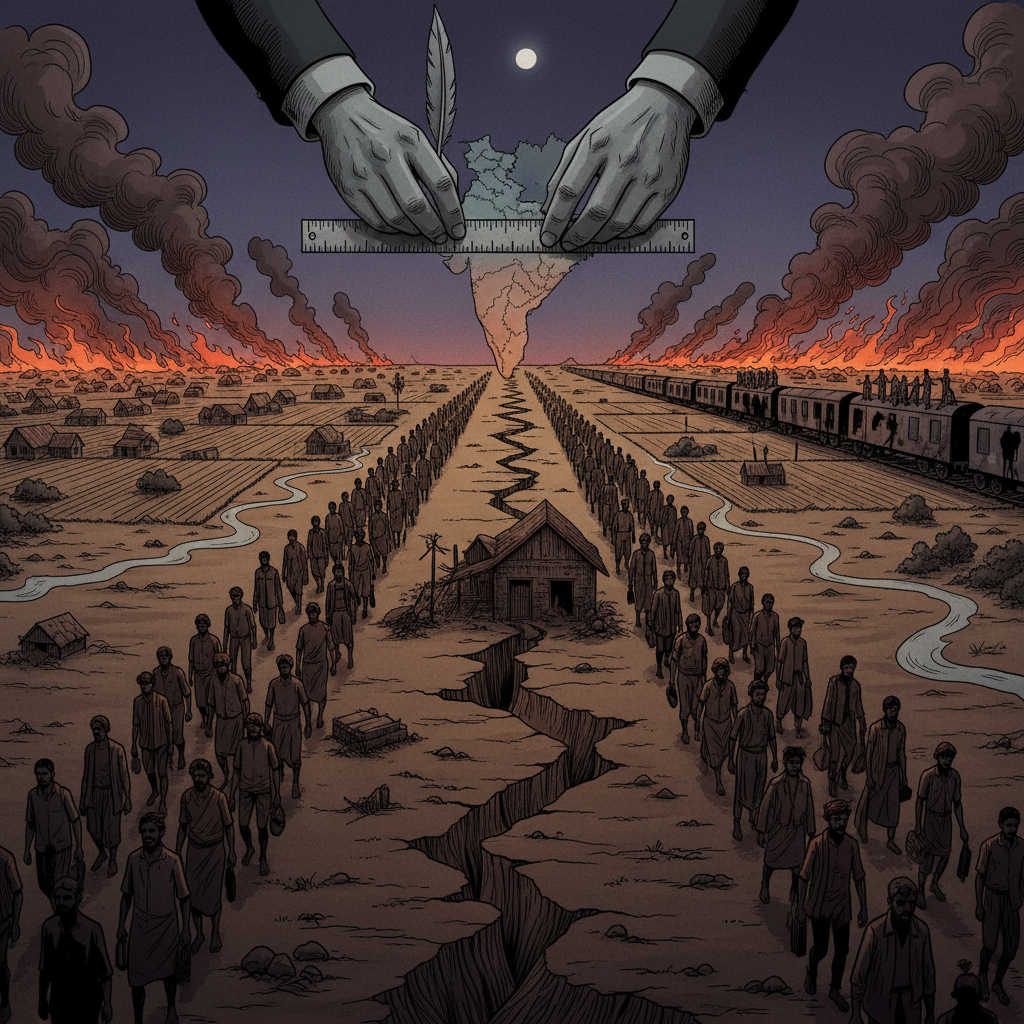
The Partition of British India in August 1947 divided the subcontinent into the independent dominions of India and Pakistan (later splitting into Pakistan and Bangladesh in 1971). Accompanied by one of the largest mass migrations in human history — an estimated 14 to 20 million people displaced — and catastrophic communal violence that killed between 200,000 and 2 million people, the Partition reshaped the political, demographic, and cultural landscape of South Asia. Driven by the interplay of British colonial withdrawal strategy, Hindu-Muslim communal tensions inflamed over decades, and the political maneuvering of leaders including Mountbatten, Nehru, Jinnah, Gandhi, and Patel, the Partition remains one of the most consequential and contested events of the twentieth century. Its reverberations continue in the India-Pakistan rivalry, the Kashmir conflict, communal politics across the subcontinent, and the lived trauma of millions of partition survivors and their descendants.
Muhtasari Mkuu
The Partition of India in 1947 stands as one of the most consequential and catastrophic acts of political surgery in modern history. Seven analytical lenses converge on a central finding: the division of British India into India and Pakistan was shaped by the intersection of imperial expedience, elite bargaining, and communal mobilization, producing human suffering on a scale that none of the principal actors fully anticipated or prevented. The colonial-legacy lens traces a direct line from divide-and-rule policies through separate electorates to the communalization of politics that made partition thinkable. The religious-nationalism lens reveals how identity was weaponized by elites on both sides, transforming fluid communal boundaries into hardened national ones. Game theory identifies partition as a tragic Nash equilibrium: no player could unilaterally deviate without facing worse outcomes, yet the collective result was catastrophic. Machiavelli's lens exposes how Mountbatten, Nehru, and Jinnah each pursued partition for reasons that diverged sharply from their stated goals of communal harmony and self-determination. The CIA lens frames partition as a strategic realignment that created a permanently unstable subcontinent, ripe for Cold War exploitation. Nietzsche's lens reads the event as a violent assertion of will to power (nia ya nguvu) by nationalist movements breaking free from imperial subjugation, with the suffering of millions as the unacknowledged cost of this Promethean act. The civilian-impact lens insists that no strategic, ideological, or philosophical framing can justify or adequately account for the 10-20 million displaced, the 200,000-2,000,000 killed, and the generational trauma inflicted on ordinary people. The deepest tension across all lenses is between those that treat partition as historically inevitable and those that insist on human agency and moral responsibility for its execution.
Ukweli Muhimu
Ukweli uliothibitishwa kutoka utafiti wa vyanzo vingi, uliokadiriwa kwa kiwango cha imani
The British East India Company established effective control over Bengal following the Battle of Plassey in 1757, initiating nearly two centuries of British colonial rule over the Indian subcontinent.
Imani ya highThe Indian National Congress was founded in 1885 and the All-India Muslim League in 1906. The Congress initially pursued broad-based anti-colonial nationalism, while the Muslim League increasingly articulated demands for separate Muslim political representation, culminating in the Lahore Resolution of 1940 calling for independent Muslim-majority states.
Imani ya highDirect Action Day, called by the Muslim League on August 16, 1946, triggered the Great Calcutta Killings, in which approximately 4,000 people were killed and 100,000 left homeless in four days of Hindu-Muslim communal rioting in Calcutta (now Kolkata). Indian historians generally attribute the violence to the League's inflammatory mobilization; Pakistani historians point to Congress's refusal to share power in Bengal as the proximate cause.
Imani ya highBritish Prime Minister Clement Attlee announced on February 20, 1947 that Britain would transfer power in India no later than June 1948, and appointed Lord Louis Mountbatten as the last Viceroy to oversee the transition. Mountbatten subsequently accelerated the timeline, announcing the Mountbatten Plan on June 3, 1947, which moved the date of independence to August 1947 — less than ten weeks away.
Imani ya highSir Cyril Radcliffe, a British barrister who had never visited India, arrived on July 8, 1947 and was given approximately five weeks to draw the boundary lines dividing Punjab and Bengal between India and Pakistan. The Radcliffe Award was completed by August 12 but not published until August 17, 1947 — two days after Indian independence — reportedly to avoid either dominion refusing to celebrate independence.
Imani ya highPakistan gained independence on August 14, 1947 and India on August 15, 1947. Power was transferred through the Indian Independence Act 1947, passed by the British Parliament on July 18, 1947.
Imani ya highAn estimated 14 to 20 million people were displaced during and immediately after Partition, making it one of the largest mass migrations in human history. The migration was bidirectional: Muslims moved to Pakistan (West and East), while Hindus and Sikhs moved to India. Refugee flows continued for years, with significant movement from East Pakistan to India persisting into the 1950s and 1960s.
Imani ya highWaigizaji Wakuu
Waigizaji wakuu wanaohusika katika tukio hili pamoja na vitendo vyao na maslahi yaliyoelezwa
Lord Louis Mountbatten
individual- ›Accepted appointment as last Viceroy of India (March 1947)
- ›Accelerated the independence timeline from June 1948 to August 1947
- ›Announced the Mountbatten Plan (June 3, 1947) providing for partition
Jawaharlal Nehru
individual- ›Led Congress negotiations with the British and the Muslim League
- ›Rejected the Cabinet Mission Plan of 1946, which proposed a federal structure preserving a united India (Indian historians dispute this characterization; Pakistani historians emphasize it as the critical turning point)
- ›Accepted the partition plan as the lesser evil compared to continued civil conflict
Muhammad Ali Jinnah
individual- ›Transformed the Muslim League from a minority-interest lobby into a mass movement demanding a separate Muslim state
- ›Articulated and championed the Two-Nation Theory — that Hindus and Muslims constituted separate nations
- ›Called Direct Action Day (August 16, 1946), leading to the Great Calcutta Killings
Mahatma Gandhi
individual- ›Opposed Partition consistently and to the end, calling it a 'vivisection' of India
- ›Undertook personal peace missions during communal violence in Noakhali (Bengal) and Bihar (1946-47)
- ›Fasted in Calcutta in September 1947 to halt Hindu-Muslim violence, succeeding in restoring calm
Sir Cyril Radcliffe
individual- ›Arrived in India on July 8, 1947 — five weeks before the independence deadline
- ›Chaired the Punjab and Bengal Boundary Commissions
- ›Drew the boundary lines dividing Punjab and Bengal with limited demographic data and no firsthand knowledge of the terrain
Vallabhbhai Patel
individual- ›Accepted Partition pragmatically, reportedly earlier than Nehru, as the only way to prevent civil war and obtain a strong centralized state
- ›Led the integration of over 500 princely states into the Indian Union as Home Minister
- ›Orchestrated the military intervention in Junagadh and the 'police action' in Hyderabad
Utafiti na Vyanzo
Ratiba ya Tukio
1757-1971
Uchambuzi wa Kisababu
Grafu inayoweza kuingiliana inayoonyesha jinsi sera, waigizaji, na matukio yanavyounganika kisababu — bonyeza nodi ili kuchunguza mahusiano
MTANDAO WA KISABABU
nodi 18 · muunganiko 19
Chagua nodi
Bonyeza nodi yoyote kwenye grafu ili kuchunguza muunganiko wake na mitazamo ya lenses
Sababu Kuu
1Njia Muhimu
hatua 12Uchambuzi wa Lenses
Kila lens hutoa mfumo wa kipekee wa uchambuzi — bonyeza ili kupanua kwa uchambuzi wa kina
Urithi wa Kikoloni
colonial-legacyThe Partition of India was not a failure of decolonization but rather the logical culmination of colonial governance: a system built on categorizing, dividing, and ruling subject populations produced, in its death throes, the most comprehensive enactment of those categories the subcontinent had ever experienced. The Radcliffe Line did not divide India — British administrative practice had already divided it; Radcliffe merely made the division physical, permanent, and lethal.
Utaifa wa Kidini
religious-nationalismThe Partition of India demonstrates that religious nationalism, once it achieves the institutional infrastructure of separate electorates, separate political parties, and separate media ecosystems, develops a self-fulfilling logic: the demand for a separate state on religious grounds produces the very communal violence that is then cited as proof that coexistence is impossible, creating a feedback loop from which there is no exit short of actual separation — and the separation itself generates new grievances that perpetuate the cycle.
Athari kwa Raia
civilian-impactThe civilian experience of Partition reveals that the human cost of nation-state formation based on religious identity is not merely the violence of separation but the permanent destruction of the social fabric of coexistence — the neighbor-to-neighbor relationships, shared economic systems, and cultural syncretism that sustained subcontinental life for centuries were severed not by a line on a map but by the organized, systematic violence that ordinary people inflicted on other ordinary people in the name of communities that, until recently, they had shared.
CIA (Mtazamo wa Ujasusi wa Vita Baridi)
Western InstitutionalciaFrom a Cold War intelligence perspective, the Partition of India was less a humanitarian catastrophe than a strategic restructuring that created the conditions for seven decades of American engagement in South Asia — an engagement built on a fundamental asymmetry: the US allied with Pakistan for geographic reasons while the more natural partnership (democratic India) was alienated by that very alliance, producing a strategic architecture whose contradictions have never been resolved and whose consequences — nuclear proliferation, jihadist blowback, great-power competition in the Indo-Pacific — continue to compound.
Uchambuzi wa Nadharia ya Mchezo
Western Moderngame-theoryThe Partition of India represents a textbook case of a multi-party bargaining failure in which the unique Nash equilibrium—partition—was stable but catastrophically inefficient. Mountbatten's timeline acceleration was the critical strategic move: by transforming a repeated game into a one-shot interaction, he eliminated delay as a viable strategy for all parties but also eliminated the possibility of building cooperative mechanisms that might have managed the transition humanely. The tragedy was not that partition occurred—game-theoretically, it was likely inevitable given the commitment problems inherent in Congress-League power-sharing—but that it occurred under conditions designed to minimize British costs rather than minimize human suffering. The compressed timeline was rational for Britain but devastating for the subcontinent.
Uchambuzi wa Nguvu wa Machiavelli
Greco-Roman & ClassicalmachiavelliThe Partition of India is Machiavelli's nightmare and masterclass simultaneously. Every major actor pursued goals that diverged significantly from their stated positions, and the actor who controlled timing (Mountbatten) controlled the outcome. The most Machiavellian insight is that Gandhi—the most morally consistent actor—was also the most politically impotent, confirming Machiavelli's darkest observation that virtue without power is merely martyrdom. Patel, who most closely approximated Machiavelli's ideal prince—pragmatic, decisive, willing to accept terrible trade-offs for strategic objectives—achieved the most for his constituency. The partition's catastrophic human cost, however, demonstrates the limits of Machiavellian analysis: a framework focused on power acquisition struggles to account for the suffering of those who are neither princes nor subjects but simply in the way.
Uchambuzi wa Nietzsche wa Nia ya Nguvu
Western ModernnietzscheThe Partition of India reveals the will to power (nia ya nguvu) operating at its most creative and most destructive simultaneously. The creation of two nation-states from one civilization was an extraordinary act of collective will—and an extraordinary act of collective self-mutilation. Nietzsche's framework illuminates what conventional political analysis misses: that the partition was not merely a strategic failure or a humanitarian catastrophe but a civilizational crisis of values, in which the subcontinent's inability to create new values adequate to its complexity condemned it to organize itself according to borrowed European categories that distorted and diminished its own traditions. Gandhi alone glimpsed an alternative—a politics grounded in truth rather than power—but his vision was overwhelmed by the competing wills to power of empire, nation, and community.
Mwelekeo wa Pamoja
Pale lenses nyingi zinapofika hitimisho sawa — kuonyesha nguvu
The rushed timeline amplified violence and displacement beyond any actor's expectations or control
Mountbatten's acceleration of the independence date from June 1948 to August 1947 compressed complex population transfers and boundary decisions into weeks rather than months. Every lens agrees this single decision multiplied casualties. Colonial-legacy sees it as imperial abandonment, game-theory as information asymmetry, machiavelli as strategic haste to lock in outcomes before opposition could organize.
The Radcliffe Line was drawn with inadequate knowledge and produced catastrophic boundary effects
Cyril Radcliffe, who had never visited India, was given five weeks to draw borders affecting 88 million people. Colonial-legacy reads this as the final act of imperial contempt. Civilian-impact documents the villages bisected, families separated, and communities stranded on the wrong side. Game theory notes the impossibility of drawing rational boundaries through intermixed populations. The CIA lens observes that the resulting territorial disputes, especially Kashmir, created permanent instability.
Partition was the only viable equilibrium given the political constraints of 1946-47
After Direct Action Day (August 1946) and the failure of the Cabinet Mission, the three strategic lenses converge on the assessment that unified independence had become impossible. Game theory identifies a coordination failure where no credible commitment mechanism existed to guarantee minority rights. Machiavelli notes that none of the three principal leaders could accept a deal that left them weaker than partition. The CIA lens sees the British as rationally choosing the fastest exit that preserved some influence.
Colonial divide-and-rule policies deliberately communalized Indian politics over decades
From separate electorates in 1909 through communal awards and census categories, the British systematically hardened religious identity into political identity. Religious-nationalism traces how fluid pre-colonial communal relations were rigidified into Hindu-Muslim binary opposition. Machiavelli identifies this as a classic strategy of maintaining power through division. Nietzsche reads it as the master imposing categories of identity on the colonized.
Mvutano Wenye Tija
Pale lenses zinapotofautiana — kufunua ugumu unaostahili kuchunguzwa
Mustakabali Unaowezekana
Hali zilizopatikana kutoka uchambuzi wa lenses — kinachoweza kutokea kulingana na mifumo tofauti
Indo-Pakistani wars and nuclear standoff (what actually happened)
This is the realized outcome. India and Pakistan fought wars in 1947, 1965, 1971, and 1999 (Kargil). Nuclear acquisition created mutual deterrence but not resolution. The conflict became a defining feature of South Asian geopolitics.
Bangladesh independence and the failure of the Two-Nation Theory (1971)
This outcome materialized in 1971. The separation of East Pakistan as Bangladesh demonstrated that religious identity alone was insufficient to hold a nation together across vast geographic, linguistic, and cultural distances. The Two-Nation Theory's premise that Muslims constituted one nation was definitively refuted.
Generational trauma and ongoing communal tensions in South Asia
This is the ongoing reality. Partition trauma continues to shape political identity, family narratives, and communal relations across South Asia nearly eight decades later. The 2002 Gujarat riots, periodic cross-border terrorism, and rising Hindu nationalism all draw on partition-era communal frameworks.
Maswali Muhimu
Maswali yanayobaki wazi baada ya uchambuzi — kwa uchunguzi unaoendelea
- ?What was the actual death toll of partition violence, and why do estimates range so widely from 200,000 to 2,000,000?
- ?To what extent did the British government have intelligence warning of the scale of violence that partition would produce, and did they suppress or ignore it?
- ?What role did local administrative structures, police forces, and princely state armies play in either facilitating or attempting to prevent communal violence during the transfer of power?
Maelezo ya Ukaguzi wa Ukweli
Matokeo ya Ukaguzi wa Ukweli
verifiedUchunguzi wa Meta
All seven lenses struggle to account for the experience of women during partition. Sexual violence was not incidental to partition but central to its logic: women's bodies became territories to be claimed, violated, and 'recovered' by communal and state actors. The gendered dimension of partition violence cuts across every lens but is adequately captured by none of them. Additionally, all lenses underrepresent the experience of Dalits, Sikhs, and other communities who do not fit neatly into the Hindu-Muslim binary that dominates partition historiography.
Partition was simultaneously a rational strategic outcome, a colonial crime, a nationalist achievement, a communal catastrophe, a geopolitical realignment, and a human tragedy. These framings are not reconcilable into a single coherent narrative. The event's meaning shifts depending on whether you stand in Delhi, Lahore, Dhaka, or London, and whether you are Hindu, Muslim, Sikh, or British. This irreducible multiplicity of meaning is itself the most important thing to understand about partition.
Any single-lens analysis of partition is necessarily a distortion. The event was too vast, too complex, and too deeply embedded in multiple cultural and political contexts to be captured by any framework. The value of multi-lens analysis is not to produce a definitive account but to make visible the assumptions and blind spots that every framework brings. Readers should hold their preferred interpretation lightly and remain open to the insights offered by frameworks they find uncomfortable.
Pata Mtazamo Wako
Mifumo tofauti inawavutia wasomaji tofauti — pata mahali pako pa kuingia
Readers who seek structural explanations, think in terms of incentives and constraints, and believe that understanding the strategic logic of events is the first step toward preventing their recurrence. You likely find moral outrage insufficient without causal analysis.
Partition was a predictable equilibrium outcome given the strategic constraints facing all three major actors. The rushed timeline was rational from Britain's perspective but catastrophic for the populations affected. Kashmir represents an unresolved node in the strategic game that nuclear weapons have frozen but not settled.
Readers who believe that identity, meaning, and the human drive for self-determination are the deepest forces in history. You see partition not as a strategic calculation but as an eruption of communal will that had been suppressed and distorted by colonial power. You may find reductionist explanations unsatisfying.
The demand for Pakistan was a genuine expression of Muslim political identity forged under conditions of colonial subjugation and Hindu-majority democratic threat. Nietzsche reads partition as the violent birth of new values from the death of the colonial order, with all the creative destruction that entails.
Readers who focus on how institutions, policies, and power structures shape outcomes over long periods. You see partition as the culmination of specific colonial decisions, from separate electorates to the Radcliffe Commission, and you believe that different institutional choices could have produced different outcomes.
Two centuries of colonial institution-building systematically communalized Indian politics. The specific decisions made by Mountbatten, Nehru, and Jinnah in 1946-47 were constrained by these institutional legacies but not determined by them. Individual ambition and miscalculation within institutional constraints produced the specific catastrophe of August 1947.
Readers who distrust grand narratives, whether strategic, ideological, or philosophical, and insist that the primary measure of any political event is its impact on ordinary human lives. You find that most analytical frameworks serve to rationalize or aestheticize suffering.
No lens adequately captures what partition meant for the 10-20 million people who lost their homes, the women subjected to abduction and sexual violence, or the families separated across a border drawn by a man who had never visited India. The civilian-impact lens insists that all other analyses must be held accountable to this ground-level reality.
The most complete understanding of partition requires holding multiple lenses simultaneously. Start with the civilian-impact lens to ground yourself in the human reality, then add colonial-legacy for structural causation, game-theory for strategic logic, and religious-nationalism for the identity dimensions. Use Machiavelli to understand how individual leaders navigated these forces, and Nietzsche to grapple with the philosophical meaning of the event.
Uchambuzi Unaohusiana
Matukio mengine yaliyochambuliwa kupitia lenses au kategoria zinazofanana
Kati ya tarehe 6 Aprili na 18 Julai 1994, takriban Watutsi 800,000 na Wahutu wa wastani waliuawa kwa utaratibu nchini Rwanda kwa muda wa siku 100 — mauaji ya watu wengi kwa ufanisi zaidi katika historia ya kisasa, yenye kiwango cha vifo kwa siku kinachozidi kile cha Holocaust. Mauaji ya kimbari hayakuwa mlipuko wa 'chuki za kikabila za kale' bali kilele cha mradi wa kikoloni: watawala wa Kibelgiji walikuwa wametengeneza makundi magumu ya kikabila kutoka kwa utambulisho wa kijamii unaobadilika kupitia sensa ya 1933 na kadi za kitambulisho cha lazima cha kikabila, wakiunda mgawanyiko wa Hutu-Tutsi ambao wasomi wa kisiasa baadaye waliutumia kama silaha. Serikali ya Habyarimana na mzunguko wake wa ndani wa akazu (nyumba ndogo), wakikabiliwa na shinikizo la kijeshi kutoka kwa Rwandan Patriotic Front na madai ya kugawana madaraka ya Makubaliano ya Arusha, walichagua mauaji ya kimbari kama mkakati wa kuishi kisiasa. Radio ya RTLM — 'Radio Machete' — iliandaa watu kwa utaratibu kupitia miaka ya propaganda ya kudhalilisha, wakiwaita Watutsi 'inyenzi' (mende) kabla ya kutangaza maagizo ya wazi ya kuua na maeneo ya waathiriwa wakati wa mauaji ya kimbari yenyewe. Kati ya wanawake 250,000 na 500,000 walibakwa kama silaha ya makusudi ya mauaji ya kimbari, hukumu ya kihistoria ya ICTR ya Akayesu ikitambua ubakaji kama kitendo cha mauaji ya kimbari kwa mara ya kwanza katika sheria ya kimataifa. Kushindwa kwa jumuiya ya kimataifa hakukuwa kupita bali kwa makusudi: kamanda wa UNAMIR Romeo Dallaire alituma 'faksi ya mauaji ya kimbari' akionya miezi mitatu kabla ya mauaji kuanza, akaomba askari 5,000, na alikataliwa. Baraza la Usalama la Umoja wa Mataifa lilipunguza UNAMIR kutoka askari 2,500 hadi 270 wakati wa mauaji ya kimbari. Marekani ilikwepa kwa makusudi kutumia neno 'mauaji ya kimbari' ili kuepuka wajibu wa kisheria wa kuingilia kati. Ushindi wa kijeshi wa RPF ulikomeshia mauaji ya kimbari Julai 1994, lakini matokeo yake yalienea hadi Vita ya Kwanza ya Kongo (1996-97) na 'Vita ya Dunia ya Afrika' iliyoua watu zaidi ya milioni 5.
Mapinduzi ya Kiarabu yalikuwa wimbi la mapinduzi ya maandamano, maasi na uasi wenye silaha uliosambaa katika ulimwengu wa Kiarabu kuanzia Desemba 2010. Yalitokana na kujichoma moto kwa muuzaji wa mitaani wa Tunisia Mohamed Bouazizi mnamo Desemba 17, 2010. Kauli mbiu ya "الشعب يريد إسقاط النظام" (Watu wanataka kuanguka kwa utawala) ilisikika kutoka Tunis hadi Cairo, Benghazi hadi Damascus. Uchaguzi wa jeshi — kusimama upande wa waandamanaji au kubaki waaminifu kwa utawala — ulidhihirika kuwa kigezo muhimu katika kila nchi.
Tarehe 26 Aprili 1986, saa 01:23 asubuhi, kinu cha nne cha kiwanda cha nguvu za nyuklia cha Chernobyl katika Jamhuri ya Kisovieti ya Ukraine kilipasuka wakati wa jaribio la usalama, kikitoa nyenzo za mionzi mara 400 zaidi ya bomu la Hiroshima. Mamlaka za Kisovieti ziliweka siri janga hilo, na kuwalazimisha wakazi 49,000 wa Pripyat kuendelea na maisha ya kawaida kwa masaa 36. Takriban 'waondoaji' 600,000 walipelekwa. Makadirio ya vifo yanakadiriwa kuwa kati ya 4,000 (WHO) na 93,000 (Greenpeace). Janga hilo liliharibu hadithi ya ubora wa kiteknolojia wa Usovieti na kumlazimisha Gorbachev kuelekea glasnost.
Jinsi Hii Ilivyochambuliwa
Uwazi kamili kuhusu mchakato wa uchambuzi, zana, na mipaka
Injini ya Crosslight
v0.4.0 "Global Lens Expansion"- ⚠Non-Western philosophical lenses rely on translated primary texts — nuance may be lost in translation
- ⚠Some traditions (e.g., Maat, Ubuntu) have limited surviving primary texts; analysis draws on scholarly reconstruction
- ⚠Cross-cultural lens application is inherently interpretive — a Confucian reading of a Western event is an analytical exercise, not a claim of cultural authority
Takwimu za Uchambuzi
Mbinu
Uchambuzi huu ulitengenezwa na mfumo wa mawakala wengi wa Crosslight: Wakala wa Utafiti alikusanya na kuthibitisha ukweli kutoka vyanzo vingi, Mawakala Maalum wa Lenses walitumia mifumo tofauti ya uchambuzi, Wakala wa Muhtasari alichanganya maarifa na kutambua mifumo, na Wakala wa Ukaguzi wa Ukweli alithibitisha madai. Kila mtazamo wa lens ni tafsiri ya AI — si idhini ya kitaasisi.Jifunze zaidi →