世越号沉船事故
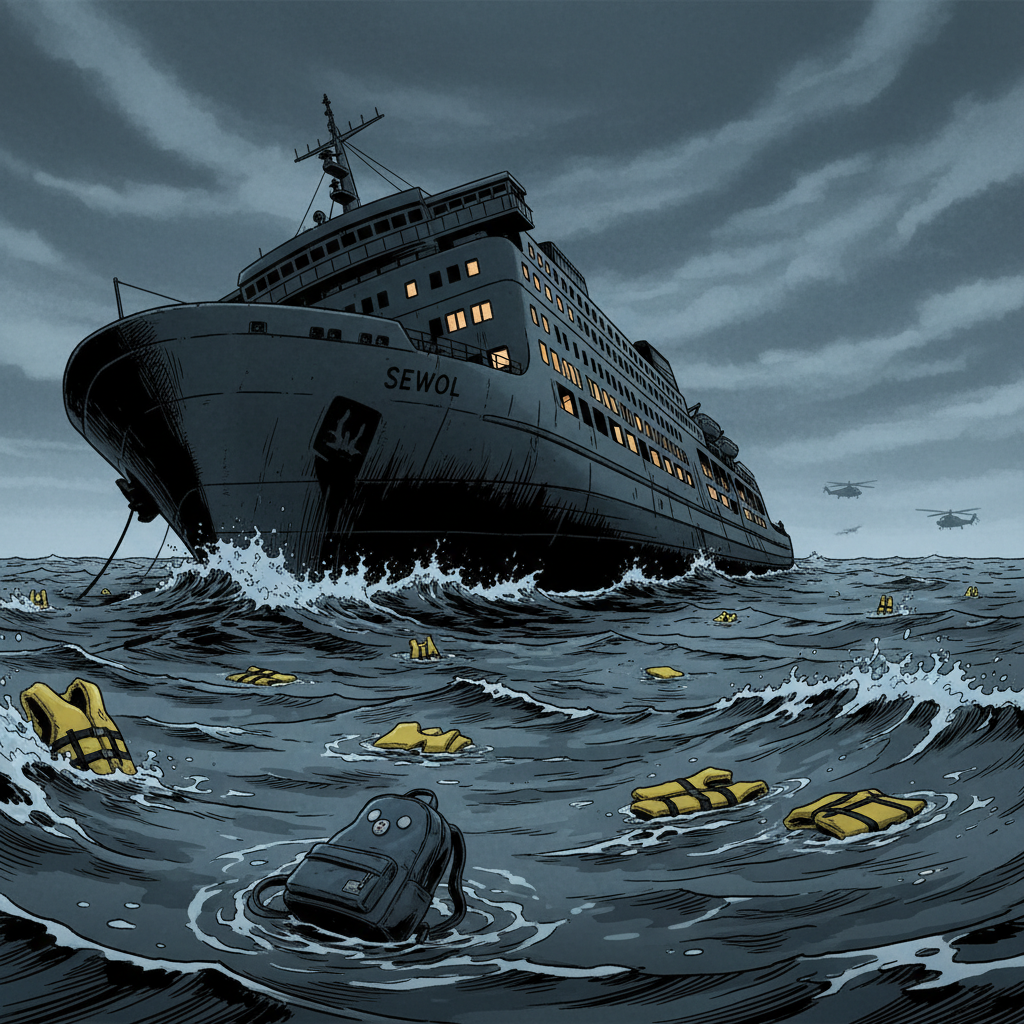
On April 16, 2014, the South Korean ferry MV Sewol capsized and sank while en route from Incheon to Jeju Island, killing 304 of the 476 people on board. Among the dead were 250 students from Danwon High School in Ansan, aged 16-17, on a school field trip. The disaster exposed systemic failures in South Korea's maritime safety regime: the vessel had been illegally modified to carry more passengers and cargo, was loaded to more than twice its legal cargo limit, and its crew abandoned ship while repeatedly instructing passengers to stay in their cabins. President Park Geun-hye's unexplained seven-hour absence during the critical early hours became a major political scandal contributing to her impeachment in 2017. The Sewol disaster became a symbol of institutional failure in South Korea.
执行摘要
Seven analytical lenses converge on a single devastating conclusion: the Sewol disaster was not an accident but the inevitable product of a social system that systematically prioritized speed, profit, and hierarchical obedience over human safety. Every lens identifies systemic rather than individual failure as the root cause, though they differ on which systemic dimension is most significant — Confucian hierarchy, neoliberal deregulation, regulatory capture, or behavioral conditioning. The most profound insight emerges from the intersection of the Confucian and Pavlovian analyses: the very virtue Korean society most cultivates in its children — obedience to authority — became the mechanism of their deaths when authority proved unworthy of trust. The disaster catalyzed a counter-hegemonic movement that toppled a president, but whether it produced lasting structural change or merely a temporary disruption of the hegemonic order remains the central open question.
关键事实
来自多来源研究的已验证事实,按置信度评级
MV Sewol departed Incheon at approximately 9:00 PM on April 15, 2014, with 476 people: 443 passengers (325 Danwon High School students, 14 teachers) and 33 crew.
high置信度Distress signal sent at 08:58 KST on April 16, 2014. The ship took approximately two and a half hours to sink.
high置信度MV Sewol was originally the Japanese ferry Naminoue (built 1994). Chonghaejin Marine purchased it in 2012 and illegally modified it to add passenger cabins on upper decks, raising center of gravity.
high置信度Sewol carried 2,142.7 tons of cargo against a legal maximum of 987 tons, with only 761.2 tons of ballast water. Included 180 vehicles (recorded as 150) and 1,157+ tons of freight.
high置信度Captain Lee Joon-seok (age 69) and 14 crew evacuated while PA system told passengers to remain in cabins.
high置信度Of 172 survivors, more than half were rescued by civilian fishing boats that arrived ~40 minutes before the Korea Coast Guard.
high置信度304 people died, including ~250 Danwon High School students aged 16-17. About 82% of casualties were children.
high置信度关键参与者
参与此事件的主要参与者及其行动和公开利益
Captain Lee Joon-seok
individual- ›Failed to issue evacuation order
- ›Abandoned ship while passengers remained below
- ›Was among first crew rescued
Chonghaejin Marine Company
corporation- ›Purchased and illegally modified MV Sewol
- ›Routinely overloaded beyond legal limits
- ›Falsified cargo manifests
President Park Geun-hye
individual- ›Absent from crisis management for seven hours
- ›Blamed captain and crew publicly
- ›Ordered Coast Guard dissolution
Korea Coast Guard
organization- ›Arrived 40 min after civilian boats
- ›Failed to enter sinking vessel
- ›Rescued captain/crew first
Danwon High School families
group- ›Established Paengmok Harbor vigil
- ›Launched yellow ribbon movement
- ›Demanded independent investigation
研究与来源
事件时间线
2009-2017
因果分析
展示政策、参与者和事件之间因果关系的交互图谱——点击节点探索关系
因果网络
14 个节点 · 16 个连接
选择节点
点击图谱中的任意节点以探索其连接和视角分析
根本原因
1关键路径
8 个步骤视角分析
每个视角提供独特的分析框架——点击展开查看深度分析
平民影响分析
civilian-impactThe Sewol disaster inverts the expected moral calculus of obedience: children who followed instructions died while those who defied authority survived. This produced not merely grief but a fundamental crisis of institutional trust in South Korean society, transforming a maritime accident into a civilization-level reckoning with the relationship between authority, obedience, and the duty of care.
儒家伦理
East AsianconfucianThe Sewol disaster reveals the lethal paradox at the heart of Confucian obedience culture: the very virtue of respectful compliance that Korean society cultivates in its children became the mechanism of their deaths when the authority figures they trusted violated every Confucian duty of care. The disaster demands a reckoning not with Confucianism itself but with its distortion — obedience without the reciprocal obligation of benevolent authority that makes Confucian hierarchy ethically coherent.
博弈论
Western Moderngame-theoryThe Sewol disaster is a textbook case of catastrophic equilibrium: every actor behaved rationally given the incentive structure they faced, and 304 people died. The regulatory capture equilibrium was individually rational for both regulators and industry, the captain's abandonment was individually rational given the payoff structure, and the students' obedience was rational given their information state. The tragedy is that the system produced collectively catastrophic outcomes from individually rational choices at every level.
行为条件反射分析
Western ModernpavlovThe Sewol disaster demonstrates that behavioral conditioning is not merely a laboratory phenomenon but a lethal social force. The Korean education system's systematic conditioning of obedience produced students who followed fatal instructions as automatically as Pavlov's dogs responded to bells. The tragedy is not that the conditioning 'failed' — it worked perfectly. The students did exactly what they had been trained to do. The failure was in the system that conditioned obedience without ensuring the authorities being obeyed were worthy of that conditioned trust.
马基雅维利现实政治
Greco-Roman & ClassicalmachiavelliThe Sewol disaster is a Machiavellian masterclass in how appearance devours substance. Park Geun-hye may or may not have been monitoring the crisis during the seven missing hours — but it does not matter. Machiavelli teaches that for a prince, appearing to act is as important as acting. By disappearing during the crisis, Park violated the cardinal Machiavellian principle: never let your people see you as either incompetent or indifferent, for they will forgive cruelty before they forgive contempt.
企业利益分析
Western ModerncorporateThe Sewol disaster demonstrates that regulatory capture is not a market 'imperfection' but a predictable equilibrium outcome when the regulated industry has concentrated interests and the public has diffuse ones. Chonghaejin Marine did not 'break' the system — it operated exactly as the system was designed to allow. The 304 deaths are the externalized cost of a regulatory regime that systematically valued corporate profitability over public safety.
葛兰西分析(文化霸权)
Western ModerngramsciThe Sewol disaster reveals that ppalli-ppalli is not a neutral cultural trait but a hegemonic formation — a way of organizing society that serves particular class interests while appearing as universal common sense. When 250 children died because speed and profit were prioritized over safety and care, the hegemonic spell was broken. The yellow ribbon movement and the candlelight protests represent one of the most successful counter-hegemonic mobilizations in recent East Asian history: a war of position that toppled a president and, for a time, made a new common sense — that the state's first duty is to protect life, not to facilitate profit.
趋同点
多个视角得出相似结论的地方——表明结论的稳健性
Systemic institutional failure, not individual incompetence
All four lenses independently identify the disaster as the product of systemic failures — regulatory capture, corporate impunity, deregulation ideology — rather than merely individual bad actors. Captain Lee's abandonment and Park's absence are symptoms, not causes.
Obedience to authority as lethal mechanism
The Confucian, Pavlovian, and civilian impact lenses all identify the students' conditioned obedience as the proximate cause of the extreme casualty concentration. The cultural conditioning that produced compliance (Confucian/Pavlov) directly produced the casualties (civilian impact).
Appearance vs. reality in governance
Machiavelli identifies the failure of political appearance management; Gramsci identifies the hegemonic construction of 'common sense' that masked danger; corporate analysis identifies the regulatory capture that created the appearance of oversight without substance.
Post-1997 deregulation as causal root
Corporate, Gramscian, and game theory analyses all trace the causal chain back to the post-Asian Financial Crisis deregulation regime that created the institutional conditions for the disaster.
建设性分歧
视角之间存在分歧的地方——揭示值得审视的复杂性
可能的未来
从视角分析中得出的情景——基于不同框架可能展开的走向
Durable reform: Sewol becomes Korea's 'never again' moment
Medium — possible if reforms are institutionalized before political attention fades
Gradual erosion: Reforms decay as memories fade
Medium-high — historical pattern suggests regulatory reforms erode within 15-20 years without sustained political pressure
Cultural transformation: Korean society fundamentally rebalances obedience norms
Low — deep cultural conditioning is resistant to event-driven change
关键问题
分析后仍然开放的问题——供持续探究
- ?What was Park Geun-hye doing during the seven missing hours?
- ?How many previous overloading incidents occurred on Sewol routes before the disaster?
- ?What was the exact relationship between maritime regulators and Chonghaejin Marine personnel?
事实核查详情
事实核查结果
verified元观察
All seven lenses focus on what went wrong and why, but none adequately accounts for the acts of extraordinary courage that also occurred: the crew member Park Ji-young (age 22) who helped students put on life vests and pushed them toward exits before she herself drowned, or the students who defied instructions to help classmates. The disaster produced both the worst and the best of human behavior, and an exclusive focus on failure risks dishonoring those who chose courage.
The Sewol disaster sits at the intersection of culture (Confucian hierarchy), economics (neoliberal deregulation), politics (regulatory capture and presidential accountability), psychology (conditioned obedience), and technology (maritime engineering). No single lens can capture this intersection; the seven together approach but do not exhaust the event's meaning.
This analysis was conducted from outside Korean culture, primarily using English-language sources. Korean-language scholarship, survivor testimony, and the Sewol families' own articulation of what the disaster means should be weighted more heavily than any external analytical framework. The most important voices in this analysis are those of the 304 who cannot speak and the families who speak for them.
找到你的视角
不同的框架与不同的读者产生共鸣——找到你的切入点
Readers who think in terms of incentives, systems, and institutional design. You see the disaster as a predictable outcome of misaligned incentives and regulatory failure.
The disaster was rational at every level — the system produced catastrophic outcomes from individually rational choices. Reform requires changing incentive structures, not just punishing individuals.
Readers who focus on cultural context, human behavior, and the relationship between individuals and the social systems that shape them. You see the disaster as a failure of the social contract between authority and trust.
The obedience that killed the students was a product of the very social system that Korean society values most. Reform requires rethinking the relationship between authority and compliance, not just fixing regulations.
Readers who focus on leadership, governance, and the responsibilities of those in power. You see the disaster as a failure of leadership at every level.
Leaders' failure to fulfill their duty of care — captain, company, president — produced both the disaster and the political consequences. The appearance of caring is inseparable from the substance of governance.
Readers who question dominant narratives and look for whose interests are served by 'common sense.' You see the disaster as the product of a hegemonic system that normalized danger.
Ppalli-ppalli culture and deregulation ideology were not neutral — they served particular class interests while appearing as universal Korean values. The reforms may be transformismo: surface changes that preserve underlying power structures.
Start with the convergences — all seven lenses agree on systemic failure. Then explore the tensions: the debate between individual agency (Machiavelli) and structural determinism (Gramsci) reveals the most productive analytical ground. The Confucian-Pavlovian intersection on obedience is the most distinctive insight this analysis produces.
相关分析
通过类似视角或类别分析的其他事件
1986年4月26日凌晨1时23分,乌克兰苏维埃社会主义共和国切尔诺贝利核电站4号反应堆在安全测试期间发生爆炸,释放出相当于广岛原子弹400倍的放射性物质。苏联当局最初掩盖了这场灾难,迫使普里皮亚季4.9万居民在36小时内继续正常生活。约60万名"清理人"被调遣参与善后。死亡人数估计从世界卫生组织的4000人到绿色和平组织的93000人不等。这场灾难打破了苏联技术优势的神话,迫使戈尔巴乔夫走向公开性改革。
阿拉伯之春是一场从2010年12月开始席卷阿拉伯世界的革命浪潮,包括抗议、起义和武装叛乱。2010年12月17日,突尼斯街头小贩穆罕默德·布瓦吉吉的自焚引发了这场运动。“الشعب يريد إسقاط النظام”(人民要求推翻政权)的口号从突尼斯响彻到开罗、班加西和大马士革。军队的选择——站在抗议者一边还是忠于政权——被证明是每个国家的决定性变量。
1994年4月6日至7月18日期间,卢旺达在100天内系统性屠杀了约80万图西族和温和派胡图族——这是现代史上最高效的大规模屠杀,每日死亡率超过了大屠杀。这场种族灭绝并非“古老部族仇恨”的爆发,而是殖民工程的灾难性结果:比利时管理者通过1933年人口普查和强制性民族身份证,从流动的社会身份中制造出了僵化的种族类别。RTLM电台——“砂刀电台”——通过多年的去人性化宣传系统性地对民众进行调教。25万至50万妇女被强奸作为种族灭绝的蓄意武器。国际社会的失败是主动的:达莱尔提前三个月发出警告,请求5000名士兵,被拒绝。联合国安理会在种族灭绝期间将UNAMIR从2500人削减至270人。RPF的军事胜利在1994年7月结束了种族灭绝,但后果蔓延至第一次刚果战争(1996-97)和造成500多万人死亡的“非洲世界大战”。
分析方法
关于分析过程、工具和局限性的完全透明
Crosslight Engine
v0.4.0 "Global Lens Expansion"- ⚠Non-Western philosophical lenses rely on translated primary texts — nuance may be lost in translation
- ⚠Some traditions (e.g., Maat, Ubuntu) have limited surviving primary texts; analysis draws on scholarly reconstruction
- ⚠Cross-cultural lens application is inherently interpretive — a Confucian reading of a Western event is an analytical exercise, not a claim of cultural authority
分析统计
方法论
本分析由 Crosslight 多代理管线生成:研究代理从多来源收集并验证事实,专业视角代理应用各自独特的分析框架,综合代理整合洞察并识别模式,事实核查代理验证声明。每个视角是AI的解读——而非机构背书。了解更多 →