The Cuban Missile Crisis
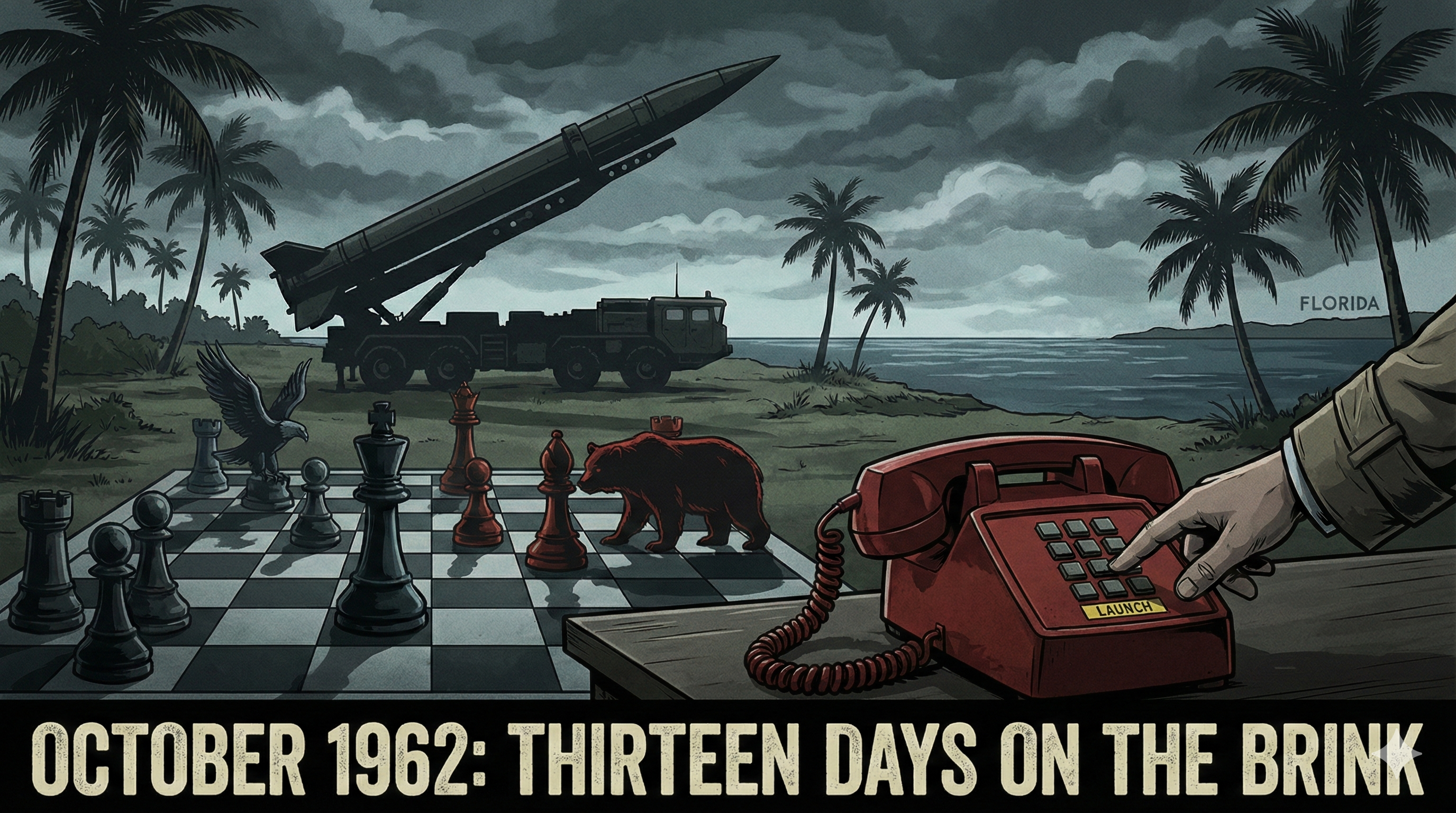
The 13-day confrontation between the United States and Soviet Union in October 1962 over nuclear missiles in Cuba—the closest the Cold War came to nuclear war.
Executive Summary
The Cuban Missile Crisis stands as humanity's closest approach to nuclear annihilation and its most instructive case study in crisis management. All lenses converge on recognizing that the resolution required both firmness and flexibility - the secret Turkey deal allowed both superpowers to claim victory while actually compromising. The crisis revealed the paradox of nuclear deterrence: weapons too terrible to use still shape behavior, but brinksmanship creates real danger of accidental catastrophe. Castro's exclusion from negotiations shows how small powers become pawns in great power rivalry regardless of stated alliances.
Key Facts
Verified facts from multi-source research, scored by confidence level
On October 14, 1962, a U-2 spy plane piloted by Major Richard Heyser photographed Soviet missile installations under construction in Cuba.
high confidencePresident Kennedy was briefed on October 16, 1962 and convened EXCOMM (Executive Committee of the National Security Council) to discuss response options.
high confidenceOn October 22, 1962, Kennedy announced the discovery of missiles and imposed a naval 'quarantine' around Cuba in a televised address.
high confidenceOn October 24, Soviet ships approaching Cuba appeared to slow down or reverse course. Secretary of State Dean Rusk said, 'We're eyeball to eyeball, and I think the other fellow just blinked.'
high confidenceOn October 27, 1962 ('Black Saturday'), a U-2 plane was shot down over Cuba, killing Major Rudolf Anderson.
high confidenceAttorney General Robert Kennedy secretly met with Soviet Ambassador Anatoly Dobrynin and proposed the US would remove Jupiter missiles from Turkey, but this could not be part of any public resolution.
high confidenceOn October 28, 1962, Khrushchev announced publicly that Soviet missiles would be dismantled and removed from Cuba.
high confidenceKey Actors
Major actors involved in this event with their actions and stated interests
United States (Kennedy Administration)
state- ›Imposed naval quarantine around Cuba
- ›Raised military alert to DEFCON 2
- ›Engaged in secret back-channel negotiations via RFK-Dobrynin
Soviet Union (Khrushchev)
state- ›Secretly deployed nuclear missiles to Cuba
- ›Initially denied missile presence
- ›Ordered some ships to turn back from quarantine line
Cuba (Castro)
state- ›Accepted Soviet missile deployment
- ›Mobilized Cuban military forces
- ›Cuban forces shot down U-2 on October 27
US Joint Chiefs of Staff
organization- ›Unanimously recommended full invasion of Cuba
- ›Raised forces to DEFCON 2
- ›Prepared invasion plans
Listen to This Analysis
AI-generated audio documentary featuring custom character voices bringing the analysis to life
The Cuban Missile Crisis: Situation Room Briefing
A professional intelligence briefing exploring the 13-day confrontation that brought humanity to the brink of nuclear war. Features authoritative analysis through multiple strategic lenses.
Research & Sources
Event Timeline
1962-10-14 to 1962-10-28
Causal Analysis
Interactive graph showing how policies, actors, and events connect causally — click nodes to explore relationships
CAUSAL NETWORK
15 nodes · 14 connections
Select a node
Click any node in the graph to explore its connections and lens perspectives
Root Causes
2Critical Path
9 stepsLens Analyses
Each lens provides a unique analytical framework — click to expand for deep analysis
Game Theory & Strategic Interaction
Western Moderngame-theoryThe Cuban Missile Crisis represents a textbook case of Chicken where both rational players found a way to 'swerve' while appearing not to - the secret Turkey deal allowed face-saving compromise. The crisis demonstrated that even in intense nuclear brinksmanship, rational actors with good communication channels can find cooperative equilibria, but the margin for error was terrifyingly small.
Machiavellian Realpolitik
Greco-Roman & ClassicalmachiavelliThe Cuban Missile Crisis demonstrates classic Machiavellian principles: Khrushchev's gambit showed bold virtù but miscalculated American resolve and his own logistics. Kennedy combined the lion's threat of force with the fox's cunning in back-channel dealing. Castro learned the brutal lesson that small powers are pawns in great power politics, regardless of stated alliances. The resolution showed both leaders understood the supreme Machiavellian principle: survive to play another day.
Taoist Wisdom
East AsiantaoismFrom a Taoist perspective, the Cuban Missile Crisis illustrates the wisdom of yielding when at the extreme. Both leaders reached the point where 'the bow that is stretched too far will snap.' Their willingness to privately yield while publicly posturing allowed the natural flow to restore balance. Castro, who urged maximum confrontation, represented the stiffness that Lao Tzu warns leads to death. The superpowers' flexibility - the 'softness that overcomes hardness' - preserved life.
Intelligence & Covert Operations Analysis
Western InstitutionalciaThe Cuban Missile Crisis represents an intelligence community paradox: CIA covert action helped create the crisis (Bay of Pigs), CIA technical collection helped detect it (U-2), but CIA institutional preferences (supporting hawks) could have made it worse. The resolution came through diplomatic channels that bypassed intelligence. The lesson for covert operations is humility: clever schemes can spiral into existential crises that only statesmanship, not tradecraft, can resolve.
Council on Foreign Relations Perspective
Western InstitutionalcfrThe Cuban Missile Crisis vindicated the core tenets of postwar American foreign policy: containment works when backed by credible force, alliances matter but require careful management, and negotiation with adversaries is not appeasement when conducted from strength. The crisis showed that the international system, even in its most dangerous moments, can be managed by skilled statesmanship. The institutional legacy - hotline, test ban, crisis prevention protocols - represents the establishment approach of converting dangerous competition into regulated rivalry.
Convergences
Where multiple lenses reach similar conclusions — suggesting robustness
The secret Turkey missile deal was essential to resolution
All analytical lenses recognize that the public-private split in the deal was diplomatically essential. Game theory sees it as enabling cooperative equilibrium, Machiavelli as foxlike cunning, Taoism as wise yielding, and CFR as mature statecraft.
Both leaders were ultimately rational actors who preferred compromise to war
Despite domestic pressures and ideological commitments, Kennedy and Khrushchev both demonstrated willingness to accept less than total victory to avoid catastrophe. This rationality was not guaranteed but proved decisive.
Castro and Cuba were marginalized in great power negotiations
All lenses note that Cuba, despite being the geographical center of the crisis, was excluded from resolution. This reflects the harsh reality of great power politics where small states' interests are subordinated to superpower calculations.
The crisis resulted from overreach followed by necessary retreat
Khrushchev's bold gambit extended Soviet power beyond sustainable limits. His retreat, while politically costly, was strategically necessary. This pattern of overreach-correction appears in multiple frameworks.
Productive Tensions
Where lenses disagree — revealing complexity worth examining
Possible Futures
Scenarios derived from lens analyses — what might unfold based on different frameworks
Nuclear War
Did not occur but was terrifyingly possible; later revelations show it was closer than known at the time
Prolonged Stalemate (what actually risked happening)
Was avoided by the secret deal but was the trajectory before October 27
Key Questions
Questions that remain open after analysis — for continued inquiry
- ?What were the full Soviet Presidium deliberations during the crisis?
- ?How close did the tactical nuclear weapons in Cuba come to being used?
- ?What were the detailed US invasion plans and projected casualties?
Fact Check Details
Fact Check Results
verifiedMeta Observations
All lenses focus on the leaders and states while underrepresenting the millions of people on all sides who lived in terror during those thirteen days and had no voice in their potential annihilation. The crisis is analyzed as strategic problem rather than existential trauma.
No single lens captures how close to catastrophe the crisis came through accident and miscalculation. The U-2 shootdown, the Soviet submarine nearly launching nuclear torpedo, the U-2 that strayed into Soviet airspace - these contingencies exceed any framework's predictive power.
The Cuban Missile Crisis is one of history's most studied events, yet fundamental questions remain. We still do not fully know what Khrushchev was thinking, whether Kennedy would have ordered invasion, or how close we came to catastrophe. Our confidence in 'lessons learned' should be tempered by how much we still don't know.
Find Your Perspective
Different frameworks resonate with different readers — find your entry point
Those who prefer strategic, rational analysis of power dynamics and actor incentives
The crisis demonstrates rational bargaining under extreme conditions. Despite nuclear stakes, actors found equilibrium through credible threats and secret concessions. Power calculations dominated throughout.
Those who seek deeper patterns beyond immediate strategic calculation
The crisis reached maximum yang and reversed. Both leaders' willingness to yield while appearing firm embodied Taoist wisdom. The stiff and unbending approach urged by hawks would have led to destruction.
Those who value alliances, institutions, and managed international order
The crisis validated containment and led to institutional innovations (hotline, test ban). American leadership of the Western alliance was essential. Negotiation from strength works.
Those questioning mainstream narratives (note: no explicitly skeptical lens selected for this analysis)
A counter-narrative perspective might emphasize that US aggression (Bay of Pigs, Jupiter missiles) provoked the crisis, that the resolution was a US concession hidden from public view, and that the 'victory' narrative serves establishment interests.
If you resonate with the analytical cluster, try reading the Taoist analysis for a counterbalance that questions whether 'winning' through firmness is the right frame. If you resonate with the institutional view, consider how the marginalization of Cuba and Turkey complicates the success narrative.
Related Analyses
Other events analyzed through similar lenses or categories
On November 22, 1963, President John F. Kennedy was assassinated in Dealey Plaza, Dallas, Texas. Lee Harvey Oswald was arrested but killed by Jack Ruby before trial. The Warren Commission concluded Oswald acted alone, while the HSCA later found probable conspiracy. Declassified documents through 2025 reveal institutional cover-ups by the CIA and FBI, making it the most consequential unsolved case in American history.
Analyzing Obama's 2015 COP21 address as a metaphorical acknowledgment of declining US global legitimacy in the social media age.
The emergence of SARS-CoV-2 in late 2019, its global spread, varying governmental responses, vaccine development and distribution, economic impacts, and resulting societal changes.
How This Was Analyzed
Full transparency about the analysis process, tools, and limitations
Crosslight Engine
v0.3.0 "Causality"- ⚠Causal attribution is inherently interpretive — graphs represent analysis, not ground truth
- ⚠Actor discovery limited by available public information and source accessibility
- ⚠Lobbying data availability varies significantly by jurisdiction
Analysis Statistics
Methodology
This analysis was produced by the Crosslight multi-agent pipeline: a Research Agent gathered and verified facts from multiple sources, specialized Lens Agents applied distinct analytical frameworks, a Synthesis Agent integrated insights and identified patterns, and a Fact-Check Agent verified claims. Each lens perspective is the AI's interpretation — not institutional endorsement.Learn more →