
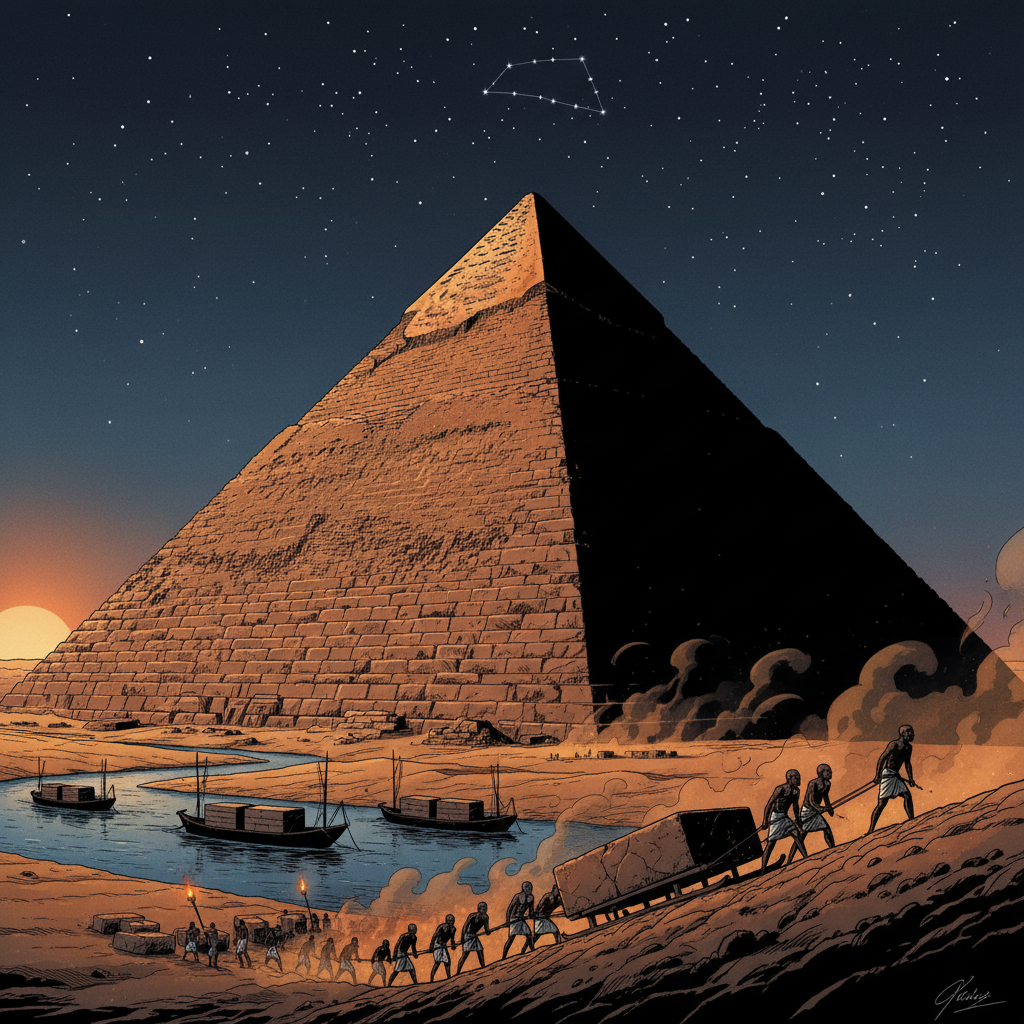
Building the Pyramids at Giza
The construction of the three Great Pyramids at Giza (c. 2589–2504 BCE) during Egypt's Fourth Dynasty represents humanity's first megaproject—a multi-generational, state-directed engineering endeavor that mobilized 20,000–25,000 workers, 2.3 million limestone blocks, and the full administrative apparatus of the world's first nation-state to build monuments that remain standing 4,500 years later.
Executive Summary
Six analytical lenses converge on a single, remarkable conclusion: the Building of the Pyramids at Giza was not merely an engineering achievement but a civilizational technology—a system that simultaneously solved economic, political, psychological, and spiritual problems through a single integrated program. Game theory reveals a stable cooperative equilibrium sustained for 85 years without coercion. Machiavelli identifies the most sophisticated exercise of power in the ancient world, where extraction was experienced as participation. Taoism shows a civilization working with natural forces rather than against them. Jung uncovers the collective unconscious materializing itself in stone. Nietzsche finds the supreme expression of the will to power—and the slave-morality distortion that misread it for 2,400 years. Brookings recognizes history's first successful infrastructure megaproject, complete with counter-cyclical employment, supply chain management, and the inevitable signs of programmatic decline. Together, these lenses reveal that the pyramids endure not because they are big but because they emerged from a rare civilizational alignment where power, belief, economics, psychology, and nature all pointed in the same direction.
Key Facts
Verified facts from multi-source research, scored by confidence level
The Great Pyramid of Khufu was built c. 2580–2560 BCE, containing approximately 2.3 million limestone blocks averaging 2.5 tons each, with a total estimated weight of 6.1 million tons.
high confidenceWorkers were organized in rotating crews of approximately 2,000 each, with names like 'Friends of Khufu' and 'Drunkards of Menkaure,' subdivided into phyles of ~200 and divisions of ~20.
high confidenceThe workforce numbered 20,000–25,000 at peak, recruited through corvée labor during the annual Nile flood season (Akhet, June–September) when agricultural land was inundated.
high confidenceHemiunu served as vizier and 'Overseer of All Construction Projects of the King' under Khufu. He was Khufu's nephew, son of Prince Nefermaat, and grandson of Sneferu.
high confidenceThe Great Pyramid was aligned to true north within 3 arc-minutes (1/20th of a degree) and its base was level to within 15 millimeters across the entire 230-meter span.
high confidenceThe Diary of Merer, discovered in 2013 at Wadi al-Jarf by French archaeologist Pierre Tallet, documents the transport of Tura limestone casing blocks to Giza during Khufu's 26th–27th regnal year.
high confidenceThe workers' village at Heit el-Ghurab, excavated by Mark Lehner and AERA from 1988 onward, revealed well-fed workers consuming cattle, sheep, and goat meat daily, with evidence of medical care including healed fractures and bone-setting.
high confidenceKey Actors
Major actors involved in this event with their actions and stated interests
Pharaoh Khufu (Cheops)
individual- ›Commissioned the Great Pyramid at Giza
- ›Appointed Hemiunu as vizier and chief architect
- ›Organized national corvée labor system
Pharaoh Khafre (Chephren)
individual- ›Built the second Giza pyramid on higher ground
- ›Commissioned the Great Sphinx
- ›Constructed the valley temple with diorite statues
Vizier Hemiunu
individual- ›Designed and managed construction of the Great Pyramid
- ›Coordinated quarrying, transport, and workforce logistics
- ›Oversaw the national supply chain
Inspector Merer
individual- ›Led team of ~40 boatmen transporting casing blocks
- ›Completed 2–3 round trips every 10 days from Tura to Giza
- ›Documented daily logistics in papyrus diary
The Egyptian State (Fourth Dynasty)
state- ›Centralized all administrative functions under the vizier
- ›Established corvée labor system mobilizing nationwide workforce
- ›Built canal and harbor infrastructure to Giza plateau
The Workforce
group- ›Quarried, transported, and placed millions of limestone blocks
- ›Operated in rotating 3-month shifts
- ›Maintained phyle organizational structure
Research & Sources
Event Timeline
c. 2589 BCE to c. 2504 BCE
Causal Analysis
Interactive graph showing how policies, actors, and events connect causally — click nodes to explore relationships
CAUSAL NETWORK
18 nodes · 23 connections
Select a node
Click any node in the graph to explore its connections and lens perspectives
Root Causes
3Critical Path
7 stepsLens Analyses
Each lens provides a unique analytical framework — click to expand for deep analysis
Game Theory
Western Moderngame-theoryThe Building of the Pyramids at Giza represents perhaps the most successful sustained cooperative equilibrium in human history. For 85 years across three generations, a repeated game between state, workforce, priesthood, and provincial authorities produced monuments of staggering scale—without any evidence of coercion. The game-theoretic genius was structural: the Nile flood cycle created natural timing, the corvée system channeled seasonal surplus labor, religious ideology multiplied perceived payoffs, and generous material compensation made cooperation the dominant strategy for every player. The equilibrium's eventual collapse confirms the theory: it required all three pillars (surplus, legitimacy, compensation) to hold simultaneously.
Machiavelli's Power Analysis
Greco-Roman & ClassicalmachiavelliMachiavelli would have recognized the pyramid project as the most sophisticated exercise of power in the ancient world—and perhaps in all of human history. It achieved every objective a prince could desire: it demonstrated state capacity so overwhelming that resistance became psychologically impossible; it employed potential discontents in productive labor; it redistributed wealth in ways that generated gratitude rather than resentment; it bound every province to the royal enterprise; and it created a physical monument that legitimized authority across generations. The deepest insight is that the pyramid's religious justification was not a deception imposed on an unwilling population but a shared framework that made coercive extraction feel like sacred participation. This is the Machiavellian ideal: power so skillfully exercised that it is experienced as virtue.
Taoist Flow Analysis
East AsiantaoismThe Pyramids at Giza are the supreme illustration of the Taoist paradox of power: the mightiest expression of human will (extreme yang) succeeded precisely because it worked WITH natural forces rather than against them. The Nile's flood cycle provided the labor rhythm; the limestone plateau provided the building material; the desert provided preservation. Khufu and his architects did not conquer nature—they channeled it. Yet the Tao's warning is also fulfilled: extreme yang cannot sustain itself. The generational decline from Khufu's towering ambition to Menkaure's modest pyramid traces the inevitable yin reversal. The pyramids endure not because they resisted change but because stone, unlike kingdoms, does not participate in the cycle. They are yang frozen in time—monuments to the moment a civilization reached its zenith and began, imperceptibly, to turn.
Jungian Depth Psychology
Western ModernjungThe Pyramids at Giza are the largest objects ever created by the collective unconscious. They emerged not from one mind but from the psychic depths of an entire civilization—a civilization that achieved the rare condition of near-total archetypal alignment, where ruler, priesthood, laborers, and state all participated in a single numinous project. The pyramid's form—earth reaching toward heaven, multiplicity converging to unity—is the mandala made permanent. Its Shadow is the 4,500-year anonymity of its builders, now being slowly recovered by archaeology. The Jungian lesson: no archetype manifests without casting a corresponding shadow, and no monument to collective transcendence exists without a buried cost to individual identity.
Nietzschean Will to Power
Western ModernnietzscheThe Pyramids at Giza are the will to power made permanent—the single most concentrated expression of human creative ambition in the archaeological record. Nietzsche would see in them the answer to nihilism: if meaning is not given but created, then the pyramid builders created more meaning per stone than any civilization before or since. The slave labor myth's 2,400-year persistence—and its recent demolition by archaeology—is itself a Nietzschean parable: master-morality achievements are always vulnerable to slave-morality reinterpretation, but the truth of the creation endures in the stone itself. The pyramid does not argue for its own greatness; it simply stands.
Brookings Institution Policy Analysis
Western InstitutionalbrookingsThe pyramid-building program was the most successful public works project in human history, measured by durability of outcomes (4,500 years and counting), scale of labor mobilization (20,000–25,000 workers for 85 years), and sophistication of administration (a supply chain spanning 900+ kilometers managed by papyrus record-keeping). The Brookings analyst recognizes in it the template for every subsequent infrastructure megaproject: align with economic cycles, invest in worker welfare, build durable ancillary infrastructure, and recognize that every program contains the seeds of its own obsolescence. The pyramids' greatest policy lesson may be their decline: Menkaure's diminished monument is a reminder that even the most successful programs must eventually adapt or end.
Convergences
Where multiple lenses reach similar conclusions — suggesting robustness
The pyramid project succeeded because it aligned incentives across all participants rather than relying on coercion
All four lenses independently conclude that the absence of coercion was not a weakness but the project's core strength. Game theory shows cooperation was the dominant strategy for every player. Machiavelli recognizes that making extraction feel like participation is the highest form of political art. Nietzsche's master-morality reading is confirmed by archaeological evidence of worker pride. Brookings identifies generous compensation as an investment in productivity and compliance.
The religious-ideological framework was functionally essential, not merely decorative
Game theory identifies the religious framing as a payoff multiplier that made cooperation psychologically irresistible. Machiavelli sees it as the mechanism that transformed extraction into sacred obligation. Jung identifies it as the archetypal container that channeled collective psychic energy. Taoism recognizes it as alignment with the perceived natural order. All four agree: without the theological framework, the material incentives alone would not have sustained an 85-year megaproject.
The project's decline was inevitable and structurally predictable
Game theory predicts equilibrium collapse when surplus, legitimacy, or compensation fails. Taoism identifies the declining pyramid sizes as yin reversal following yang peak. Brookings identifies declining returns and institutional capture (priesthood, nomarchs) as policy failure indicators. All three frameworks correctly predicted the Old Kingdom's eventual dissolution.
The pyramids created a self-reinforcing cycle of power and legitimacy
Machiavelli identifies circular reinforcement: the ability to build demonstrated power, and the monument legitimized further exercises of power. Jung sees the archetype generating its own psychic energy: the rising pyramid intensified collective participation in the numinous experience. Nietzsche recognizes the will to power creating its own validation: the monument's permanence proved the worthiness of the ambition that created it.
Productive Tensions
Where lenses disagree — revealing complexity worth examining
Possible Futures
Scenarios derived from lens analyses — what might unfold based on different frameworks
ScanPyramids reveals construction ramps and resolves the method debate
Medium-high. The technology is advancing rapidly, and the 2025 discovery of six voids suggests the internal structure is more complex than previously assumed. Resolution may come within 10-20 years.
Discovery of additional construction-era papyri at other Red Sea or Nile sites
Medium. Wadi al-Jarf was discovered partly by chance. The Red Sea coast and Upper Egypt contain numerous unexplored sites from the Old Kingdom period. Additional finds are plausible but cannot be predicted.
Pseudoarchaeological narratives continue to challenge scholarly consensus via social media and streaming platforms
High. Graham Hancock's Ancient Apocalypse on Netflix demonstrated the reach of pseudoarchaeological narratives. Despite unanimous scholarly rejection, these claims resonate with deep archetypal patterns (hidden knowledge, lost civilizations) that Jung would recognize as Shadow projections.
Key Questions
Questions that remain open after analysis — for continued inquiry
- ?What is the function of the 'Big Void' and the six additional chambers detected by ScanPyramids within the Great Pyramid?
- ?What exact construction method was used for the upper courses of the Great Pyramid?
- ?Was Khufu's mummy ever actually placed in the King's Chamber, and if so, when and how was it removed?
Fact Check Details
Fact Check Results
verifiedMeta Observations
All six lenses analyze the pyramids as a product of human agency—whether political, economic, psychological, or spiritual. What they collectively miss is the role of geography and geology: the Giza plateau's bedrock stability, the limestone's workability, the Nile's annual flood, the desert's preservative aridity. The builders were brilliant, but they also got lucky. A different geography would have produced a different civilization, regardless of the quality of its leaders or the sophistication of its institutions.
The pyramids resist reduction to any single explanatory framework because they were genuinely multi-dimensional achievements. They were simultaneously religious monuments, political instruments, economic redistribution mechanisms, engineering marvels, psychological archetypes, and policy experiments. Any lens that claims to have 'the' explanation is necessarily incomplete. The pyramids' enduring fascination may stem precisely from this irreducible complexity—they always exceed whatever framework we apply to them.
We are analyzing events that occurred 4,500 years ago through fragmentary archaeological evidence, with no surviving written testimony from the builders themselves (Merer's diary is the closest we have, and it records logistics, not motivations). Every interpretation offered by these lenses—however well-supported—is ultimately a story we tell about stone. The pyramids themselves are silent. The humility to acknowledge what we cannot know is the beginning of genuine understanding.
Find Your Perspective
Different frameworks resonate with different readers — find your entry point
Readers who value empirical evidence, systematic analysis, and institutional design. You are drawn to understanding HOW the pyramids were built—the logistics, economics, and organizational structures that made the project possible. You tend to trust archaeological evidence over interpretive frameworks.
The pyramids were a rationally designed system: the corvée solved seasonal unemployment, the phyle system optimized workforce management, and the supply chain was centuries ahead of its time. The project's success was structural, not mystical.
Readers who sense that the pyramids represent something deeper than engineering—a civilization in harmony with natural forces and collective psychological energies. You are drawn to the symbolic and spiritual dimensions of the project.
The pyramids emerged from a rare alignment of natural cycles, collective psychology, and cosmic symbolism. They are mandalas in stone—expressions of psychic wholeness that transcend their material function. Their decline was not failure but the natural turning of the cycle.
Readers who see the pyramids primarily as a political and institutional achievement—evidence of extraordinary state capacity. You are interested in how power was exercised, legitimized, and eventually eroded.
The pyramids were power made physical. They simultaneously demonstrated and created pharaonic authority through a system so sophisticated that exploitation was experienced as participation. The eventual decline reveals the limits of even the most successful institutional design.
Readers who question conventional narratives and look for hidden power dynamics. You are suspicious of both the ancient 'slave labor' myth and modern romanticizations of the corvée system. You want to know who really benefited and at whose expense.
The 2,400-year slave labor myth is a textbook case of narrative distortion by later cultures with their own agendas. But the modern correction—that workers were proud, well-treated participants—may also be incomplete. The truth about power is always more complex than either the official narrative or its debunking.
If you find yourself in one cluster, deliberately engage with the insights from the opposite cluster. Analytical readers should sit with the Jungian insight that some human achievements transcend rational explanation. Intuitive readers should grapple with the Brookings insight that practical logistics were essential to the project's success. The pyramids are simultaneously engineering and archetype, policy and power, nature and will. No single perspective captures the whole.
Related Analyses
Other events analyzed through similar lenses or categories
On November 22, 1963, President John F. Kennedy was assassinated in Dealey Plaza, Dallas, Texas. Lee Harvey Oswald was arrested but killed by Jack Ruby before trial. The Warren Commission concluded Oswald acted alone, while the HSCA later found probable conspiracy. Declassified documents through 2025 reveal institutional cover-ups by the CIA and FBI, making it the most consequential unsolved case in American history.
On the night of February 28, 1986, at 23:21, Swedish Prime Minister Olof Palme was shot and killed on the central Stockholm street Sveavägen while walking home from a cinema with his wife Lisbeth. He had dismissed his security detail earlier that day — a prime minister walking unguarded through his capital on a Friday night, the very embodiment of Swedish democratic openness. A second shot grazed Lisbeth Palme. The killer fled up the steps of Tunnelgatan and vanished into the night. What followed was not merely a murder investigation but a national trauma that consumed Sweden for nearly four decades: a catastrophically botched crime scene, an investigation fixated on the wrong suspects, 134 people who confessed to the murder, over 10,000 tips that created information paralysis, the wrongful conviction and acquittal of Christer Pettersson, and dozens of competing conspiracy theories implicating South African intelligence, the CIA, NATO's Stay Behind/Gladio networks, the Kurdish PKK, and elements within the Swedish police themselves. In 2020, Chief Prosecutor Krister Petersson named graphic designer Stig Engström — the 'Skandia Man' — as the probable killer and closed the case. Engström had died by suicide in 2000, so could never be tried. The announcement was met with widespread criticism as circumstantial and unprovable. In December 2025, Sweden's director of public prosecutions formally reversed the conclusion, stating there was insufficient evidence to consider Engström the main suspect — but the investigation would not be reopened. The case remains, in effect, unsolved: Sweden's defining political wound, still open after nearly forty years.
On July 8, 2022, former Japanese Prime Minister Shinzo Abe was assassinated while delivering a campaign speech in Nara, Japan. The attacker, Tetsuya Yamagami, used a homemade firearm motivated by a personal grudge against the Unification Church, which he blamed for bankrupting his family through coercive donations totaling approximately 100 million yen. Yamagami targeted Abe as the most prominent political ally of the Church, whose ties to Japan's ruling Liberal Democratic Party (LDP) traced back to Abe's grandfather, Prime Minister Kishi Nobusuke, in the 1960s. The assassination triggered Japan's largest political scandal in decades, revealing that nearly half of LDP Diet members had connections to the Unification Church, leading to a government dissolution order against the Church in October 2023.
How This Was Analyzed
Full transparency about the analysis process, tools, and limitations
Crosslight Engine
v0.3.1 "Arena & Stage"- ⚠Entertainment/sports lenses reflect domain stereotypes for analytical color, not endorsement
- ⚠Celebrity and sports events have limited 'ground truth' - analysis is inherently interpretive
- ⚠Hot take and tabloid personas are satirical framing devices for accessible analysis
Analysis Statistics
Methodology
This analysis was produced by the Crosslight multi-agent pipeline: a Research Agent gathered and verified facts from multiple sources, specialized Lens Agents applied distinct analytical frameworks, a Synthesis Agent integrated insights and identified patterns, and a Fact-Check Agent verified claims. Each lens perspective is the AI's interpretation — not institutional endorsement.Learn more →