
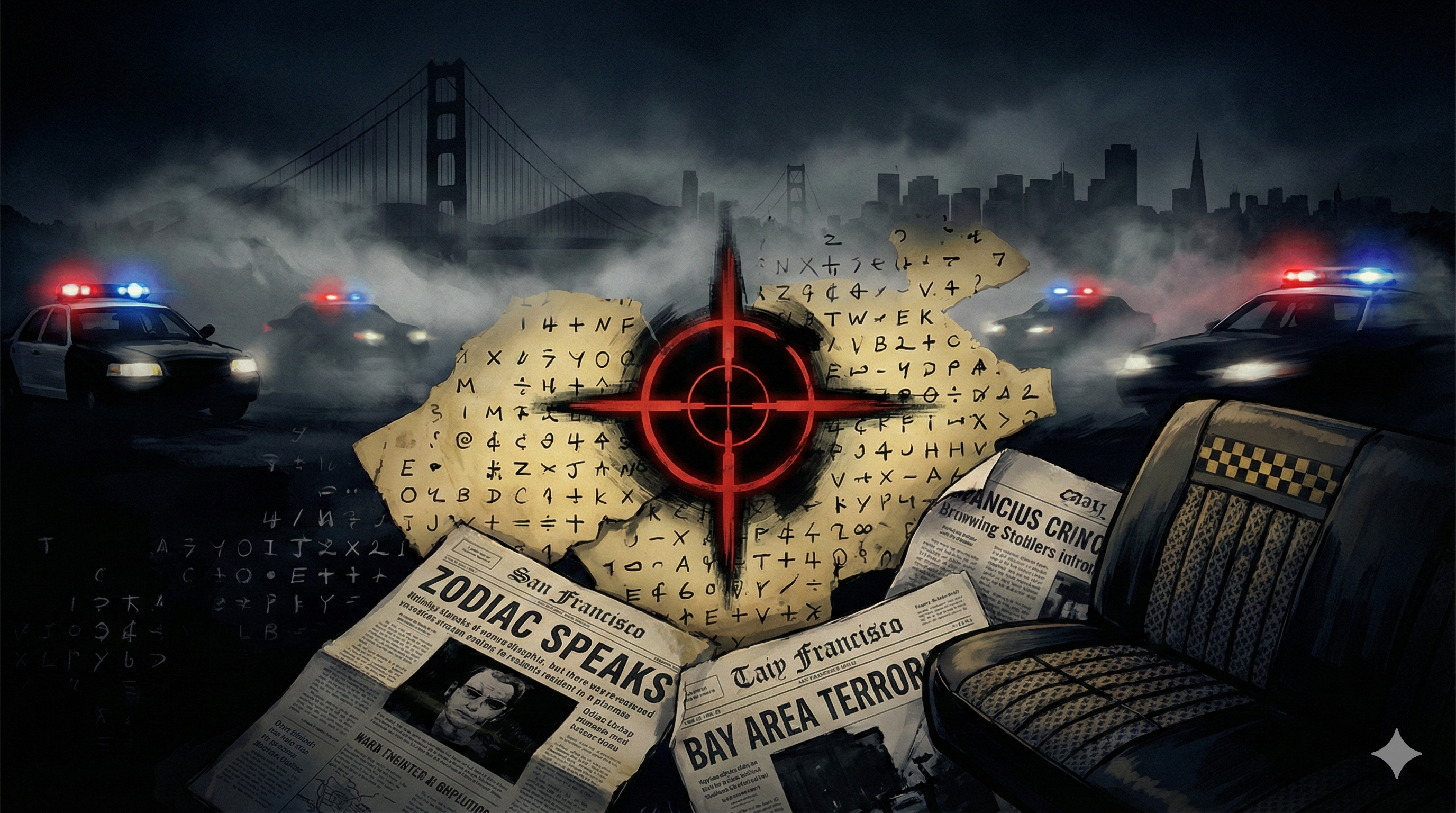
The Zodiac Killer
Between December 1968 and October 1969, a serial killer terrorized the San Francisco Bay Area, murdering at least five people and taunting police and media with cryptic letters and ciphers. The self-named 'Zodiac' exploited jurisdictional fragmentation between multiple police departments, manipulated media into amplifying his terror, and created complex cryptographic puzzles that took over 50 years to solve. Despite being America's most famous unsolved serial killer case, extensive investigation of over 2,500 suspects has never resulted in identification or arrest. The case fundamentally shaped criminal profiling, true crime media, and public fascination with unsolved mysteries.
Executive Summary
The Zodiac Killer case represents a perfect storm of factors that enabled a relatively small-scale serial killer to achieve disproportionate cultural impact: jurisdictional fragmentation that game theory shows created stable non-cooperation equilibrium; Machiavellian manipulation of media as force multiplier; Taoist paradox of seeking fame through anonymity; FBI-perspective investigative failures that modern techniques might overcome; and structural ambiguities that legitimate conspiracy theorizing without confirming it. All lenses converge on the observation that the Zodiac's power derived from symbolism rather than body count, making the case more about American institutions' vulnerabilities than about the killer himself.
Key Facts
Verified facts from multi-source research, scored by confidence level
David Faraday (17) and Betty Lou Jensen (16) were shot and killed on Lake Herman Road in Benicia on December 20, 1968.
high confidenceDarlene Ferrin (22) was killed and Michael Mageau (19) survived a shooting at Blue Rock Springs Park on July 4-5, 1969.
high confidenceCecelia Shepard (22) died and Bryan Hartnell (20) survived a stabbing attack at Lake Berryessa on September 27, 1969, where the killer wore a black executioner's hood with the Zodiac cross-circle symbol.
high confidencePaul Stine (29), a taxi driver and doctoral candidate at SFSU, was shot and killed in San Francisco on October 11, 1969.
high confidenceThe 408-symbol cipher (Z408) was solved on August 8, 1969 by schoolteachers Donald and Bettye Harden within days of publication.
high confidenceThe 340-character cipher (Z340) was solved on December 5, 2020 by David Oranchak, Sam Blake, and Jarl Van Eycke after 51 years.
high confidenceOver 2,500 suspects have been investigated by San Francisco Police Department as of 2009.
high confidenceKey Actors
Major actors involved in this event with their actions and stated interests
The Zodiac Killer
individual- ›Murdered five confirmed victims
- ›Sent 22+ letters to newspapers
- ›Created four ciphers
Listen to This Analysis
AI-generated audio documentary featuring custom character voices bringing the analysis to life
Dear Editor: A Memoir
A darkly comedic first-person narrative from America's most theatrical serial killer. Part confession, part roast of 1960s law enforcement, told with Hitchcockian suspense and zero graphic details.
Research & Sources
Event Timeline
1968-12-20 to 1974-01-29
Causal Analysis
Interactive graph showing how policies, actors, and events connect causally — click nodes to explore relationships
CAUSAL NETWORK
16 nodes · 11 connections
Select a node
Click any node in the graph to explore its connections and lens perspectives
Root Causes
3Critical Path
7 stepsLens Analyses
Each lens provides a unique analytical framework — click to expand for deep analysis
Game Theory Analysis
Western Moderngame-theoryThe Zodiac case represents a near-perfect exploitation of game-theoretic vulnerabilities in fragmented law enforcement. The killer's strategy of operating across jurisdictions, manipulating media as a force multiplier, and using ciphers to demonstrate intellectual superiority created an asymmetric game that favored evasion. The stable equilibrium of non-cooperation between agencies proved more durable than any coordination attempts.
Machiavellian Power Analysis
Greco-Roman & ClassicalmachiavelliThe Zodiac case exemplifies Machiavellian principles: the appearance of power matters more than its reality. With five confirmed kills, the Zodiac achieved disproportionate terror through strategic communication and mystique-building. His power derived from what he represented - the anonymous predator society cannot stop - rather than actual capability. In Machiavellian terms, he was more feared than loved, and his anonymity made that fear permanent.
Taoist Perspective
East AsiantaoismThe Zodiac case teaches that some things resist resolution because resolution would destroy their essential nature. The killer sought immortality through mystery; solving the case would paradoxically diminish him to ordinary dimensions. The investigation's failure may be its deepest success: it preserved the question that gave the case meaning. From a Taoist view, the Zodiac achieved a kind of terrible enlightenment - becoming one with the unknown.
FBI Law Enforcement Perspective
Western InstitutionalfbiThe Zodiac case exposed critical weaknesses in American law enforcement coordination that took decades to address. VICAP, the national database for violent crimes, was created in 1985 partly in response to cases like this. The case remains a training example for multi-jurisdictional investigation failures. From an FBI perspective, resolution depends on whether usable DNA was preserved and whether the killer has genetic relatives in searchable databases - factors entirely outside investigative control.
Conspiracy Theory Analysis
Western ModernconspiracyThe Zodiac case is a perfect environment for conspiracy theorizing because it combines genuine investigative failures, institutional defensiveness, degraded evidence, and a cultural appetite for mystery. The conspiracy lens doesn't claim any specific theory is correct, but observes that the case's structure - fragmented investigation, excluded prime suspects, convenient cessation, ongoing institutional reticence - creates legitimate space for questioning official narratives. The truth may be mundane (a lone killer who died or stopped), but the case architecture prevents confident rejection of more complex possibilities.
Convergences
Where multiple lenses reach similar conclusions — suggesting robustness
The Zodiac's power came from media manipulation and mystique rather than actual violence capability
Game theory sees media as coerced force multiplier; Machiavelli sees appearance mattering more than reality; Taoism sees mystery as essential; FBI profiling shows persona-building exceeded killing compulsion
Jurisdictional fragmentation was the critical enabler of the killer's evasion
All three lenses identify the multi-agency structure as creating conditions for failure - whether through non-cooperative equilibrium, pre-VICAP coordination gaps, or suspicious institutional behavior
The case may never be solved regardless of technological advances
Taoism suggests the mystery is the case's essential nature; conspiracy notes structural reasons for permanent ambiguity
Productive Tensions
Where lenses disagree — revealing complexity worth examining
Possible Futures
Scenarios derived from lens analyses — what might unfold based on different frameworks
Genetic genealogy identification within 5-10 years
Moderate - depends entirely on evidence quality and database coverage
Permanent unsolved status
Moderate to high - many cold cases never achieve resolution despite new technology
Disputed identification that doesn't achieve closure
Low to moderate - consistent with Case Breakers' Poste claim and DNA exclusion of Allen
Key Questions
Questions that remain open after analysis — for continued inquiry
- ?Is preserved biological evidence sufficient quality for genetic genealogy?
- ?Did the Zodiac have children or other close relatives who might be in DNA databases?
- ?Is the killer still alive or did he die before modern investigation techniques?
- ?Were there additional victims beyond the five confirmed?
Fact Check Details
Fact Check Results
verifiedMeta Observations
All lenses tend to center the killer rather than the victims. The five confirmed dead (Faraday, Jensen, Ferrin, Shepard, Stine) and two survivors (Mageau, Hartnell) are overshadowed by fascination with their murderer. This is perhaps the Zodiac's ultimate victory and our collective failure.
The case exists at the intersection of individual pathology, institutional structure, media dynamics, and cultural appetite for mystery. No single lens captures this complexity; even the synthesis cannot resolve the fundamental underdetermination of the facts.
After 55+ years and millions of investigation hours, we still don't know who the Zodiac was. This should humble claims about understanding complex human events. Sometimes the honest answer is that we don't know and may never know.
Find Your Perspective
Different frameworks resonate with different readers — find your entry point
Those who prefer logical analysis, believe in progress through technology, and trust institutional expertise when properly applied
The case has structural explanations for failure and potential technological solutions; the killer was more strategic than mystical
Those who see meaning in mystery, value philosophical reflection, and question whether resolution is always desirable
The case may be significant precisely because it remains unsolved; some truths emerge through acceptance rather than pursuit
Those who trust law enforcement expertise, believe in criminal justice system, and prioritize practical resolution
Professional investigation techniques have improved dramatically; genetic genealogy offers genuine hope
Those skeptical of official narratives, who notice institutional self-protection, and question whether all information has been shared
Legitimate questions remain about evidence handling, suspect exclusions, and agency transparency
Start with the perspective that feels natural, then deliberately explore the opposite. If you're analytically inclined, the Taoist lens offers unexpected insights about why the case matters beyond its facts. If you're skeptical of institutions, the FBI lens provides valuable context about what's actually possible with current technology.
Related Analyses
Other events analyzed through similar lenses or categories
On November 22, 1963, President John F. Kennedy was assassinated in Dealey Plaza, Dallas, Texas. Lee Harvey Oswald was arrested but killed by Jack Ruby before trial. The Warren Commission concluded Oswald acted alone, while the HSCA later found probable conspiracy. Declassified documents through 2025 reveal institutional cover-ups by the CIA and FBI, making it the most consequential unsolved case in American history.
The decade-plus celebrity feud between Taylor Swift and Kanye West (with Kim Kardashian), spanning from the infamous 2009 VMA interruption through the 2016 'Famous' phone call controversy, the Reputation era, and the 2020 vindication when the full phone call leaked proving Swift had been telling the truth.
Analyzing Obama's 2015 COP21 address as a metaphorical acknowledgment of declining US global legitimacy in the social media age.
How This Was Analyzed
Full transparency about the analysis process, tools, and limitations
Crosslight Engine
v0.3.0 "Causality"- ⚠Causal attribution is inherently interpretive — graphs represent analysis, not ground truth
- ⚠Actor discovery limited by available public information and source accessibility
- ⚠Lobbying data availability varies significantly by jurisdiction
Analysis Statistics
Methodology
This analysis was produced by the Crosslight multi-agent pipeline: a Research Agent gathered and verified facts from multiple sources, specialized Lens Agents applied distinct analytical frameworks, a Synthesis Agent integrated insights and identified patterns, and a Fact-Check Agent verified claims. Each lens perspective is the AI's interpretation — not institutional endorsement.Learn more →