
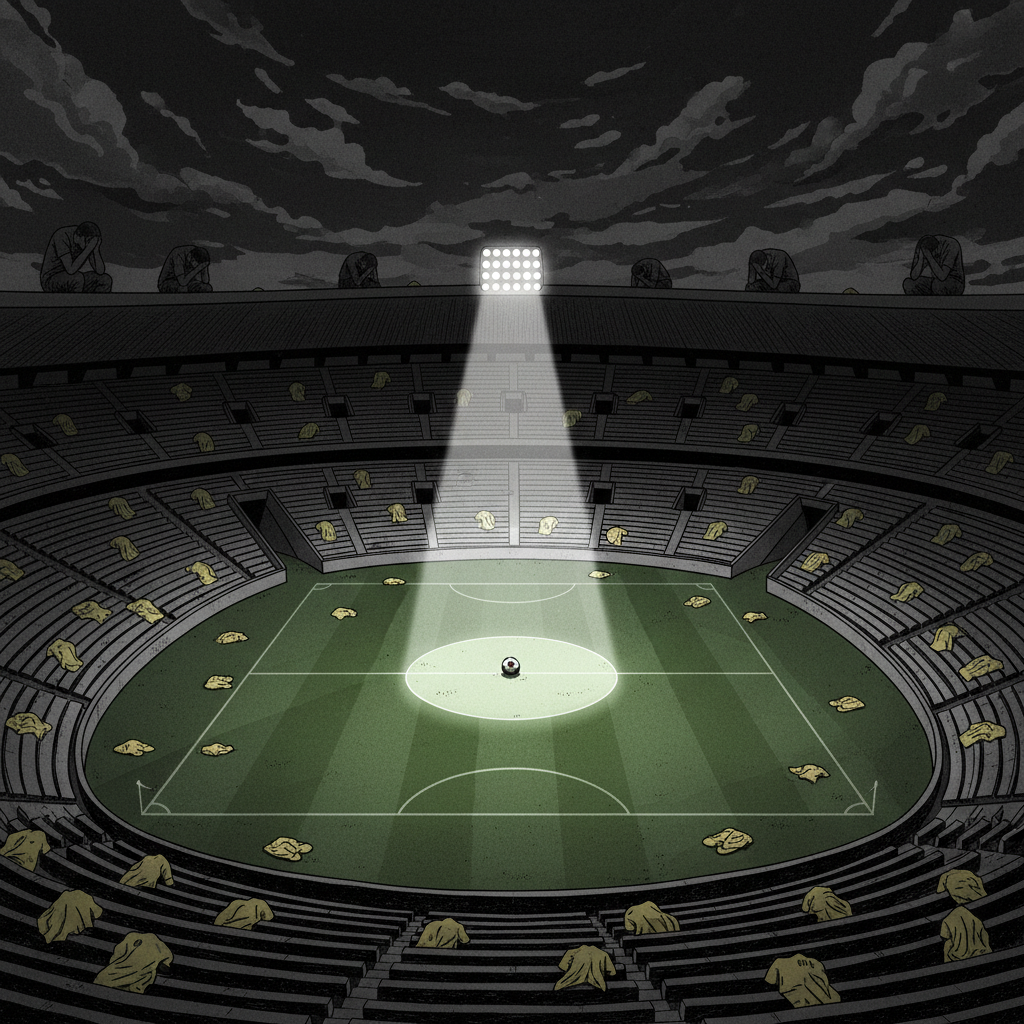
תבוסת ברזיל 7-1 במונדיאל 2014
ב-8 ביולי 2014, ספגה ברזיל תבוסה היסטורית 7-1 מגרמניה בחצי הגמר של מונדיאל 2014 באצטדיון מינייראו בבלו הוריזונטה. המשחק, הידוע בברזיל בשם "מינייראסו", ראה את גרמניה מבקיעה חמישה שערים ב-18 דקות במחצית הראשונה, כאשר המארחים חסרו את שחקני המפתח ניימאר (חוליה שבורה מרבע הגמר) והקפטן תיאגו סילבה (מושעה). התוצאה הייתה התבוסה הגרועה ביותר בהיסטוריה של ברזיל במונדיאל והפכה לרגע של טראומה לאומית.
סיכום מנהלים
חצי הגמר של מונדיאל 2014 בין ברזיל לגרמניה לא היה משחק כדורגל שהפך למשבר לאומי — הוא היה משבר לאומי שהתבטא כמשחק כדורגל. כל הפרספקטיבות האנליטיות מתכנסות לאותה מסקנה יסודית: ה-7-1 היה על-מוגדר. הגירעון הטקטי, השבריריות הפסיכולוגית, המשקל הקיומי, המשמעות התרבותית, ההגברה התקשורתית וההקשר הפוליטי — כולם הצביעו לעבר קטסטרופה.
עובדות מרכזיות
עובדות מאומתות ממחקר רב-מקורי, מדורגות לפי רמת ביטחון
Germany defeated Brazil 7-1 in the 2014 FIFA World Cup semifinal on July 8, 2014, at Estádio Mineirão in Belo Horizonte.
ביטחון highGermany's goals were scored by Thomas Müller (11'), Miroslav Klose (23'), Toni Kroos (24', 26'), Sami Khedira (29'), André Schürrle (69', 79'). Oscar scored Brazil's consolation goal in the 90th minute.
ביטחון highFive goals were scored between the 11th and 29th minutes, with four goals in a six-minute span from the 23rd to 29th minute.
ביטחון highNeymar suffered a fractured third lumbar vertebra from a knee-to-the-back challenge by Colombia's Juan Camilo Zúñiga in the 88th minute of the quarterfinal on July 4, 2014, ruling him out of the rest of the tournament.
ביטחון highCaptain Thiago Silva was suspended for the semifinal due to accumulation of two yellow cards. His appeal to FIFA was denied as having 'no legal basis.'
ביטחון highMiroslav Klose's goal in the 23rd minute made him the all-time leading scorer in World Cup history with 16 goals, surpassing Brazil's Ronaldo who held the record with 15.
ביטחון highBrazil's official World Cup spending was approximately $11.6 billion, making it the most expensive World Cup in history at that time.
ביטחון highגורמים מרכזיים
גורמים מרכזיים המעורבים באירוע זה עם פעולותיהם ואינטרסים מוצהרים
Luiz Felipe Scolari
individual- ›Selected 4-2-3-1 formation for semifinal despite missing key players
- ›Chose not to fundamentally alter tactical approach for Neymar/Thiago Silva absences
- ›Started Dante and Bernard as replacements
Joachim Löw
individual- ›Developed Germany's tactical system over 8 years since 2006
- ›Prepared specific pressing strategy to exploit Brazil's high defensive line
- ›Instructed team to ease off after 5-0 at halftime
Neymar
individual- ›Carried Brazil's attacking burden through the tournament as the team's talisman
- ›Suffered fractured third lumbar vertebra in quarterfinal vs. Colombia
- ›Watched the 7-1 from a hospital/recovery setting
Dilma Rousseff
individual- ›Defended World Cup spending as beneficial for Brazil's infrastructure and economy
- ›Oversaw security operations during 2013-2014 protests
- ›Won narrow re-election in October 2014
Não vai ter Copa protest movement
group- ›Organized mass protests during 2013 Confederations Cup and 2014 World Cup
- ›Coined and popularized the slogan 'Não vai ter Copa'
- ›Highlighted forced evictions and public spending priorities
מחקר ומקורות
ציר זמן של האירוע
2007-10-30 to 2016-08-31
ניתוח סיבתי
גרף אינטראקטיבי המציג כיצד מדיניות, גורמים ואירועים מתחברים סיבתית — לחץ על צמתים לחקור קשרים
רשת סיבתית
18 צמתים · 17 חיבורים
בחר צומת
לחץ על כל צומת בגרף לחקור את חיבוריו ופרספקטיבות העדשות
סיבות שורש
1נתיב קריטי
7 שלביםניתוחי עדשות
כל עדשה מספקת מסגרת אנליטית ייחודית — לחץ להרחבה לניתוח מעמיק
תורת המשחקים
Western Moderngame-theoryThe 7-1 was not merely a tactical defeat but a cascading equilibrium collapse. Brazil entered with a fragile strategy that required specific conditions (Neymar's creativity, Thiago Silva's organization, crowd momentum) to function. Germany systematically removed each support pillar, and once the strategic structure collapsed after the second goal, no rational recovery was possible. The game-theoretic lesson is that high-risk, high-reward strategies with single points of failure are catastrophically vulnerable to systematic opponents who identify and exploit those failure points.
ניתוח התניה התנהגותית
Western ModernpavlovThe 7-1 was a mass extinction event for Brazil's conditioned national football identity. Decades of reinforcement — five World Cup titles, generations of legendary players, cultural production around football supremacy — were shattered in 18 minutes. The psychological mechanism was identical to laboratory demonstrations of learned helplessness: after the third rapid goal, Brazilian players and fans alike ceased active coping and entered a state of passive acceptance. The subsequent reconditioning through dark humor was not merely a cultural quirk but a psychologically adaptive response — counter-conditioning the aversive stimulus with a new, less painful response. The 7-1 permanently altered Brazil's conditioned relationship with its own football identity.
ניתוח כוח ניטשיאני
Western ModernnietzscheThe 7-1 was the death of Brazilian football's god — the end of the foundational myth of inherent supremacy that had organized Brazilian national identity for generations. The Übermensch model (dependence on individual genius) was exposed as fatally fragile when tested against Germany's systematic will to power. The ensuing ressentiment was both existentially genuine and politically consequential, contributing to the broader crisis that culminated in Rousseff's impeachment. Brazil's dark humor response represents a remarkable form of amor fati — embracing the catastrophe as part of national identity rather than being destroyed by it.
ניתוח סטטיסטי מאניבול
Entertainment & SportsmoneyballThe statistical story of the 7-1 is a tale of two components. The first is a predictable tactical mismatch: removing Neymar (40% of attacking output) and Thiago Silva (the defensive organizer) from a team facing the most systematically prepared opponent in the tournament made a defeat statistically likely, with an expected margin of 2-3 goals. The second component is the 'trauma premium': the additional 3-4 goals that represent pure psychological collapse, visible in the data as defensive positioning errors, pass completion rate collapse, and pressing intensity dropping to near-zero between the 23rd and 40th minutes. The 7-1 was a 3-0 or 4-1 tactical defeat amplified into a 7-1 catastrophe by the psychological disintegration of a team and a stadium.
סוציולוגיה של הספורט
Entertainment & Sportssports-sociologyThe 7-1 was not a football match but a sociological earthquake. Football in Brazil functions as a civil religion — the primary institution of national identity and cross-class solidarity. The Mineiraço shattered this institution's claim to sacredness, exposed the class dynamics of mega-event hosting that had been masked by football's unifying narrative, and produced a collective trauma that is sociologically unprecedented in its combination of magnitude (7-1), context (home soil), and stakes (national identity + $11B investment). The humor response was not trivial but a deeply rooted cultural survival mechanism: Brazil's centuries-old tradition of using laughter to process pain found its ultimate expression in the memes that followed the worst day in the nation's sporting history.
ניתוח נרטיב תקשורתי
Entertainment & Sportstalking-headThe 7-1 was narrated through four competing but interlocking media frames: Brazilian devastation, German restraint, international disbelief, and protest movement vindication. The Brazilian media's compressed narrative arc — from shock to humor in hours rather than months — reflected a culturally specific processing speed enabled by social media. The event's transformation into a permanent cultural meme ('7 a 1' as shorthand for catastrophic failure) demonstrates how media narrative construction can embed a sporting result into the permanent lexicon of a language and culture. Perhaps most remarkably, Germany's narrative restraint showed that even the victors recognized this was not a normal sporting triumph but a cultural event that required careful narrative handling.
הערכת השפעה אזרחית
civilian-impactThe civilian impact of the 7-1 extended far beyond the emotional trauma of a football match. The event crystallized the contradictions of Brazil's mega-event model: $11.6 billion in public spending that produced luxury stadiums while displacing hundreds of thousands from favela communities, white elephant venues with no viable post-tournament use, and a political promise of national glory that was replaced by the worst humiliation in the country's sporting history. The 7-1 became the defining symbol of institutional failure that contributed to Dilma Rousseff's impeachment and discredited the model of mega-event-driven development for a generation. For the communities displaced to build stadiums they could never afford to enter, the 7-1 was not a sporting disaster but the final proof that they had been sacrificed for a spectacle that served everyone but them.
התכנסויות
היכן שעדשות מרובות מגיעות למסקנות דומות — מה שמצביע על עמידות
The 7-1 was overdetermined — multiple independent factors all pointed toward disaster
Every analytical lens identifies independent factors that made Brazil vulnerable to a catastrophic result. The tactical weakness without key players (game-theory, moneyball), the psychological fragility of conditioned expectations (pavlov), the existential weight of the 'country of football' identity (nietzsche, sports-sociology), and the political pressure of $11B in spending (civilian-impact) all created overlapping vulnerabilities. The convergence of all these factors simultaneously is what made the 7-1 historically unique rather than merely a bad result.
Germany's systematic approach defeated Brazil's talent-dependent model
Game-theory identifies Germany's dominant strategy of exploiting structural weaknesses. Moneyball quantifies the tactical asymmetry. Nietzsche frames it as Apollo defeating Dionysus. Sports-sociology contextualizes it as the end of the individual-genius model's supremacy. All four lenses agree that the 7-1 represented the triumph of a collective system over individual talent dependence.
The 18-minute spell was a psychological cascade, not merely a tactical collapse
Game-theory identifies the cascading equilibrium collapse. Pavlov identifies the learned helplessness response. Moneyball quantifies the 'trauma premium' — the gap between expected goals from tactical positioning and actual goals, representing the pure psychological disintegration component. All three agree that the 7-1 was approximately a 3-0 or 4-1 tactical defeat amplified into a 7-1 catastrophe by psychological collapse.
The 7-1 transcended sport to become a political and cultural event
All four lenses independently identify the 7-1 as an event that exceeded its sporting context. Nietzsche identifies the existential dimension. Sports-sociology identifies the civil religion dimension. Talking-head identifies the media narrative construction that elevated the event to national crisis status. Civilian-impact identifies the political consequences. The convergence confirms that the 7-1 cannot be understood as a football match alone.
מתחים פוריים
היכן שעדשות חולקות — מגלה מורכבות הראויה לבחינה
עתידות אפשריים
תרחישים הנגזרים מניתוחי עדשות — מה עשוי להתפתח על פי מסגרות שונות
Brazilian football renaissance through systematic reform
Medium. Brazil's talent pipeline remains strong, but institutional resistance to systematic approaches is significant. The tension between jogo bonito tradition and tactical modernization has not been resolved.
The 7-1 becomes a fading cultural memory without institutional change
Medium-high. The humor response already began the process of normalizing the trauma. Future successes could complete the reconditioning process without addressing structural issues.
Permanent discrediting of the mega-event development model in Brazil
Medium. The Brazilian public's appetite for mega-events has been significantly reduced, but economic pressures and political opportunism could override this skepticism in the future.
שאלות מרכזיות
שאלות שנותרות פתוחות לאחר הניתוח — לחקירה מתמשכת
- ?What specific tactical adjustments, if any, did Scolari make at halftime when the score was already 5-0?
- ?What were the exact economic downstream effects of World Cup spending — did any infrastructure investments produce measurable long-term benefits?
- ?How many of the 12 World Cup stadiums are currently in regular use versus functioning as white elephants?
פרטי בדיקת עובדות
תוצאות בדיקת עובדות
verifiedתצפיות מטא
All seven lenses analyze the 7-1 from the perspective of Brazil's failure, with Germany's achievement treated as a backdrop rather than a story in its own right. Germany's 2014 World Cup victory — the culmination of 14 years of systematic development — deserves its own multi-lens analysis as one of the greatest achievements in football history. By centering the 7-1 on Brazilian trauma, we risk reducing Germany's triumph to a supporting role in someone else's tragedy.
The 7-1 resists reduction to any single explanatory framework because it operates simultaneously across tactical, psychological, cultural, political, and sociological dimensions. Any lens that claims to fully explain the event is necessarily incomplete. The genuine understanding of the 7-1 requires holding all seven perspectives simultaneously — not synthesizing them into a single narrative but allowing them to remain in productive tension.
We should be honest about what we cannot know. We cannot know what would have happened with Neymar and Thiago Silva present. We cannot precisely separate the tactical from the psychological component of the scoreline. We cannot definitively determine whether the 7-1 'caused' political change or merely symbolized existing trends. We cannot know whether future generations will remember the 7-1 as a defining national trauma or a fading sporting anecdote. The 7-1 teaches epistemic humility: some events are too complex, too overdetermined, and too deeply embedded in their cultural context to be fully explained by any analytical framework.
מצא את הפרספקטיבה שלך
מסגרות שונות מהדהדות עם קוראים שונים — מצא את נקודת הכניסה שלך
Readers who approach the 7-1 as a tactical and statistical puzzle — wanting to understand the mechanics of how five goals happened in 18 minutes and what the data reveals about the underlying quality difference between the teams.
The 7-1 was approximately a 3-0 tactical defeat amplified into a 7-1 by psychological collapse. Germany's dominant strategy exploited specific, identifiable weaknesses created by Brazil's missing players. The match was a statistical outlier (4-5 sigma) driven by the interaction between tactical inferiority and psychological cascade.
Readers who feel the 7-1 as a cultural and emotional event — who understand that football in Brazil is not just a sport but a structure of meaning, and that the 7-1 shattered something fundamental about Brazilian self-understanding.
The 7-1 was the death of a foundational national myth. Decades of conditioned belief in Brazilian football supremacy were extinguished in 18 minutes. Football functions as a civil religion in Brazil, and the 7-1 was a desecration of the sacred. The dark humor response was a culturally specific form of amor fati — embracing catastrophe rather than being destroyed by it.
Readers who see the 7-1 as a political and institutional event — the culmination of misplaced spending priorities, government overreach, and institutional failure that was expressed through but not limited to a football match.
The $11.6B World Cup spending displaced hundreds of thousands, created white elephant stadiums, and was justified by a promise of national glory that the 7-1 destroyed. The political downstream contributed to Rousseff's impeachment. The media narrative was constructed differently across four perspectives (devastation, restraint, disbelief, vindication), each serving different institutional interests.
Readers skeptical of the grander narratives who want to strip the 7-1 back to its sporting fundamentals: a team missing two key players lost badly to a better-prepared opponent. The cultural and political overlay, while real, risks obscuring the straightforward sporting explanation.
Much of what happened can be explained by standard tactical analysis: Brazil's defensive disorganization without Thiago Silva, the creative void without Neymar, and Germany's clinical exploitation of predictable weaknesses. The 7-1 was extraordinary in degree but not in kind — football produces heavy defeats when one team is significantly weakened and the other is at peak preparation.
Start with the analytical cluster (game-theory, moneyball) to understand what happened mechanically, then layer the intuitive cluster (pavlov, nietzsche, sports-sociology) to understand why it mattered so deeply, and finally add the institutional cluster (civilian-impact, talking-head) to understand the broader consequences. The 7-1 requires all three perspectives to be fully comprehended — it was a tactical failure, an existential crisis, and a political turning point, all simultaneously.
ניתוחים קשורים
אירועים אחרים שנותחו דרך עדשות או קטגוריות דומות
האביב הערבי היה גל מחאה מהפכני של מחאות, התקוממויות ומרדים מזוינים שפקדו את העולם הערבי החל מדצמבר 2010. הוצת על ידי הצתת האש של הרוכל הטוניסאי מוחמד בועזיזי ב-17 בדצמבר 2010 — מעשה ייאוש נגד עשרות שנים של שחיתות סמכותנית, השפלה ואבטלה בקרב צעירים. קריאת הלחימה המזהה "الشعب يريد إسقاط النظام" (העם רוצה בנפילת המשטר) הדהדה מתוניס עד קהיר, מבנגזי עד דמשק. בחירת הצבא — לעמוד לצד המפגינים או להישאר נאמן למשטר — התבררה כמשתנה המכריע בכל מדינה.
בין 6 באפריל ל-18 ביולי 1994, כ-800,000 טוטסים והוטו מתונים נרצחו בשיטתית ברואנדה במהלך 100 ימים — רצח ההמונים היעיל ביותר בהיסטוריה המודרנית. רצח העם לא היה פריצת של «שנאות שבטיות עתיקות» אלא שיאו של מפעל קולוניאלי: המנהלים הבלגיים יצרו קטגוריות גזעיות נוקשות מזהויות חברתיות גמישות במפקד 1933 ותעודות זהות אתנית חובה. משטר האביארימנה והמעגל הפנימי akazu בחרו ברצח עם כאסטרטגיה להישרדות פוליטית. רדיו RTLM — «רדיו מאצ'טה» — התנה את האוכלוסיה בשיטתית בשנים של תעמולה משפילה. כישלון הקהילה הבינלאומי היה פעיל: דלייר שלח את האזהרה שלו שלושה חודשים לפני תחילת הרצח, ביקש 5,000 חיילים וסורב. מועצת הביטחון של האו"ם צמצמה את UNAMIR מ-2,500 ל-270 חיילים במהלך רצח העם. ניצחון RPF הצבאי סיים את רצח העם ביולי 1994, אך התוצאות התפשטו למלחמת קונגו הראשונה (1996-97) ו«מלחמת העולם של אפריקה» שהרגה למעלה מ-5 מיליון אנשים.
ב-26 באפריל 1986, בשעה 01:23 בלילה, התפוצץ כור מספר 4 בתחנת הכוח הגרעינית של צ'רנוביל בסוכנות האוקראינית הסובייטית במהלך ניסוי בטיחות, ושחרר חומר רדיואקטיבי פי 400 מפצצת הירושימה. הרשויות הסובייטיות הסתירו תחילה את האסון, והכריחו את 49,000 תושבי פריפיאט להמשיך בחיים רגילים במשך 36 שעות. כ-600,000 'מחסלים' גויסו. הערכות מספר ההרוגים נעות בין 4,000 (WHO) ל-93,000 (גרינפיס). האסון שבר את המיתוס של העליונות הטכנולוגית הסובייטית.
כיצד נותח זה
שקיפות מלאה לגבי תהליך הניתוח, הכלים והמגבלות
מנוע Crosslight
v0.4.0 "Global Lens Expansion"- ⚠Non-Western philosophical lenses rely on translated primary texts — nuance may be lost in translation
- ⚠Some traditions (e.g., Maat, Ubuntu) have limited surviving primary texts; analysis draws on scholarly reconstruction
- ⚠Cross-cultural lens application is inherently interpretive — a Confucian reading of a Western event is an analytical exercise, not a claim of cultural authority
סטטיסטיקות ניתוח
מתודולוגיה
ניתוח זה הופק על ידי צינור הסוכנים המרובים של Crosslight: סוכן מחקר אסף ואימת עובדות ממקורות מרובים, סוכני עדשות מתמחים החילו מסגרות אנליטיות ייחודיות, סוכן סינתזה שילב תובנות וזיהה דפוסים, וסוכן בדיקת עובדות אימת טענות. כל פרספקטיבת עדשה היא פרשנות הבינה המלאכותית — לא אישור מוסדי.למד עוד →