אסון מעבורת סוול
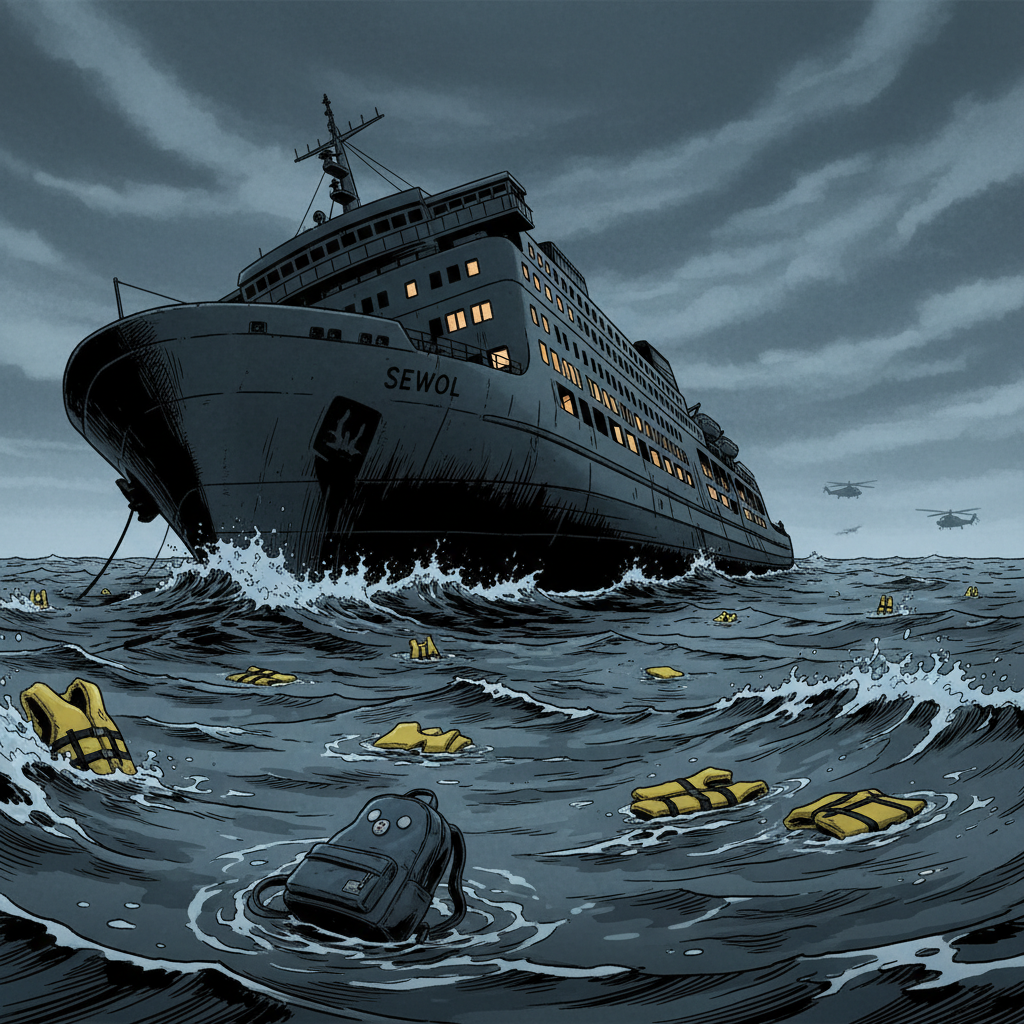
On April 16, 2014, the South Korean ferry MV Sewol capsized and sank while en route from Incheon to Jeju Island, killing 304 of the 476 people on board. Among the dead were 250 students from Danwon High School in Ansan, aged 16-17, on a school field trip. The disaster exposed systemic failures in South Korea's maritime safety regime: the vessel had been illegally modified to carry more passengers and cargo, was loaded to more than twice its legal cargo limit, and its crew abandoned ship while repeatedly instructing passengers to stay in their cabins. President Park Geun-hye's unexplained seven-hour absence during the critical early hours became a major political scandal contributing to her impeachment in 2017. The Sewol disaster became a symbol of institutional failure in South Korea.
סיכום מנהלים
Seven analytical lenses converge on a single devastating conclusion: the Sewol disaster was not an accident but the inevitable product of a social system that systematically prioritized speed, profit, and hierarchical obedience over human safety. Every lens identifies systemic rather than individual failure as the root cause, though they differ on which systemic dimension is most significant — Confucian hierarchy, neoliberal deregulation, regulatory capture, or behavioral conditioning. The most profound insight emerges from the intersection of the Confucian and Pavlovian analyses: the very virtue Korean society most cultivates in its children — obedience to authority — became the mechanism of their deaths when authority proved unworthy of trust. The disaster catalyzed a counter-hegemonic movement that toppled a president, but whether it produced lasting structural change or merely a temporary disruption of the hegemonic order remains the central open question.
עובדות מרכזיות
עובדות מאומתות ממחקר רב-מקורי, מדורגות לפי רמת ביטחון
MV Sewol departed Incheon at approximately 9:00 PM on April 15, 2014, with 476 people: 443 passengers (325 Danwon High School students, 14 teachers) and 33 crew.
ביטחון highDistress signal sent at 08:58 KST on April 16, 2014. The ship took approximately two and a half hours to sink.
ביטחון highMV Sewol was originally the Japanese ferry Naminoue (built 1994). Chonghaejin Marine purchased it in 2012 and illegally modified it to add passenger cabins on upper decks, raising center of gravity.
ביטחון highSewol carried 2,142.7 tons of cargo against a legal maximum of 987 tons, with only 761.2 tons of ballast water. Included 180 vehicles (recorded as 150) and 1,157+ tons of freight.
ביטחון highCaptain Lee Joon-seok (age 69) and 14 crew evacuated while PA system told passengers to remain in cabins.
ביטחון highOf 172 survivors, more than half were rescued by civilian fishing boats that arrived ~40 minutes before the Korea Coast Guard.
ביטחון high304 people died, including ~250 Danwon High School students aged 16-17. About 82% of casualties were children.
ביטחון highגורמים מרכזיים
גורמים מרכזיים המעורבים באירוע זה עם פעולותיהם ואינטרסים מוצהרים
Captain Lee Joon-seok
individual- ›Failed to issue evacuation order
- ›Abandoned ship while passengers remained below
- ›Was among first crew rescued
Chonghaejin Marine Company
corporation- ›Purchased and illegally modified MV Sewol
- ›Routinely overloaded beyond legal limits
- ›Falsified cargo manifests
President Park Geun-hye
individual- ›Absent from crisis management for seven hours
- ›Blamed captain and crew publicly
- ›Ordered Coast Guard dissolution
Korea Coast Guard
organization- ›Arrived 40 min after civilian boats
- ›Failed to enter sinking vessel
- ›Rescued captain/crew first
Danwon High School families
group- ›Established Paengmok Harbor vigil
- ›Launched yellow ribbon movement
- ›Demanded independent investigation
מחקר ומקורות
ציר זמן של האירוע
2009-2017
ניתוח סיבתי
גרף אינטראקטיבי המציג כיצד מדיניות, גורמים ואירועים מתחברים סיבתית — לחץ על צמתים לחקור קשרים
רשת סיבתית
14 צמתים · 16 חיבורים
בחר צומת
לחץ על כל צומת בגרף לחקור את חיבוריו ופרספקטיבות העדשות
סיבות שורש
1נתיב קריטי
8 שלביםניתוחי עדשות
כל עדשה מספקת מסגרת אנליטית ייחודית — לחץ להרחבה לניתוח מעמיק
ניתוח ההשפעה על האוכלוסייה האזרחית
civilian-impactThe Sewol disaster inverts the expected moral calculus of obedience: children who followed instructions died while those who defied authority survived. This produced not merely grief but a fundamental crisis of institutional trust in South Korean society, transforming a maritime accident into a civilization-level reckoning with the relationship between authority, obedience, and the duty of care.
אתיקה קונפוציאנית
East AsianconfucianThe Sewol disaster reveals the lethal paradox at the heart of Confucian obedience culture: the very virtue of respectful compliance that Korean society cultivates in its children became the mechanism of their deaths when the authority figures they trusted violated every Confucian duty of care. The disaster demands a reckoning not with Confucianism itself but with its distortion — obedience without the reciprocal obligation of benevolent authority that makes Confucian hierarchy ethically coherent.
תורת המשחקים
Western Moderngame-theoryThe Sewol disaster is a textbook case of catastrophic equilibrium: every actor behaved rationally given the incentive structure they faced, and 304 people died. The regulatory capture equilibrium was individually rational for both regulators and industry, the captain's abandonment was individually rational given the payoff structure, and the students' obedience was rational given their information state. The tragedy is that the system produced collectively catastrophic outcomes from individually rational choices at every level.
ניתוח התנייה התנהגותית
Western ModernpavlovThe Sewol disaster demonstrates that behavioral conditioning is not merely a laboratory phenomenon but a lethal social force. The Korean education system's systematic conditioning of obedience produced students who followed fatal instructions as automatically as Pavlov's dogs responded to bells. The tragedy is not that the conditioning 'failed' — it worked perfectly. The students did exactly what they had been trained to do. The failure was in the system that conditioned obedience without ensuring the authorities being obeyed were worthy of that conditioned trust.
ריאלפוליטיק מקיאוולית
Greco-Roman & ClassicalmachiavelliThe Sewol disaster is a Machiavellian masterclass in how appearance devours substance. Park Geun-hye may or may not have been monitoring the crisis during the seven missing hours — but it does not matter. Machiavelli teaches that for a prince, appearing to act is as important as acting. By disappearing during the crisis, Park violated the cardinal Machiavellian principle: never let your people see you as either incompetent or indifferent, for they will forgive cruelty before they forgive contempt.
ניתוח אינטרסים תאגידיים
Western ModerncorporateThe Sewol disaster demonstrates that regulatory capture is not a market 'imperfection' but a predictable equilibrium outcome when the regulated industry has concentrated interests and the public has diffuse ones. Chonghaejin Marine did not 'break' the system — it operated exactly as the system was designed to allow. The 304 deaths are the externalized cost of a regulatory regime that systematically valued corporate profitability over public safety.
ניתוח גרמשיאני (הגמוניה תרבותית)
Western ModerngramsciThe Sewol disaster reveals that ppalli-ppalli is not a neutral cultural trait but a hegemonic formation — a way of organizing society that serves particular class interests while appearing as universal common sense. When 250 children died because speed and profit were prioritized over safety and care, the hegemonic spell was broken. The yellow ribbon movement and the candlelight protests represent one of the most successful counter-hegemonic mobilizations in recent East Asian history: a war of position that toppled a president and, for a time, made a new common sense — that the state's first duty is to protect life, not to facilitate profit.
התכנסויות
היכן שעדשות מרובות מגיעות למסקנות דומות — מה שמצביע על עמידות
Systemic institutional failure, not individual incompetence
All four lenses independently identify the disaster as the product of systemic failures — regulatory capture, corporate impunity, deregulation ideology — rather than merely individual bad actors. Captain Lee's abandonment and Park's absence are symptoms, not causes.
Obedience to authority as lethal mechanism
The Confucian, Pavlovian, and civilian impact lenses all identify the students' conditioned obedience as the proximate cause of the extreme casualty concentration. The cultural conditioning that produced compliance (Confucian/Pavlov) directly produced the casualties (civilian impact).
Appearance vs. reality in governance
Machiavelli identifies the failure of political appearance management; Gramsci identifies the hegemonic construction of 'common sense' that masked danger; corporate analysis identifies the regulatory capture that created the appearance of oversight without substance.
Post-1997 deregulation as causal root
Corporate, Gramscian, and game theory analyses all trace the causal chain back to the post-Asian Financial Crisis deregulation regime that created the institutional conditions for the disaster.
מתחים פוריים
היכן שעדשות חולקות — מגלה מורכבות הראויה לבחינה
עתידות אפשריים
תרחישים הנגזרים מניתוחי עדשות — מה עשוי להתפתח על פי מסגרות שונות
Durable reform: Sewol becomes Korea's 'never again' moment
Medium — possible if reforms are institutionalized before political attention fades
Gradual erosion: Reforms decay as memories fade
Medium-high — historical pattern suggests regulatory reforms erode within 15-20 years without sustained political pressure
Cultural transformation: Korean society fundamentally rebalances obedience norms
Low — deep cultural conditioning is resistant to event-driven change
שאלות מרכזיות
שאלות שנותרות פתוחות לאחר הניתוח — לחקירה מתמשכת
- ?What was Park Geun-hye doing during the seven missing hours?
- ?How many previous overloading incidents occurred on Sewol routes before the disaster?
- ?What was the exact relationship between maritime regulators and Chonghaejin Marine personnel?
פרטי בדיקת עובדות
תוצאות בדיקת עובדות
verifiedתצפיות מטא
All seven lenses focus on what went wrong and why, but none adequately accounts for the acts of extraordinary courage that also occurred: the crew member Park Ji-young (age 22) who helped students put on life vests and pushed them toward exits before she herself drowned, or the students who defied instructions to help classmates. The disaster produced both the worst and the best of human behavior, and an exclusive focus on failure risks dishonoring those who chose courage.
The Sewol disaster sits at the intersection of culture (Confucian hierarchy), economics (neoliberal deregulation), politics (regulatory capture and presidential accountability), psychology (conditioned obedience), and technology (maritime engineering). No single lens can capture this intersection; the seven together approach but do not exhaust the event's meaning.
This analysis was conducted from outside Korean culture, primarily using English-language sources. Korean-language scholarship, survivor testimony, and the Sewol families' own articulation of what the disaster means should be weighted more heavily than any external analytical framework. The most important voices in this analysis are those of the 304 who cannot speak and the families who speak for them.
מצא את הפרספקטיבה שלך
מסגרות שונות מהדהדות עם קוראים שונים — מצא את נקודת הכניסה שלך
Readers who think in terms of incentives, systems, and institutional design. You see the disaster as a predictable outcome of misaligned incentives and regulatory failure.
The disaster was rational at every level — the system produced catastrophic outcomes from individually rational choices. Reform requires changing incentive structures, not just punishing individuals.
Readers who focus on cultural context, human behavior, and the relationship between individuals and the social systems that shape them. You see the disaster as a failure of the social contract between authority and trust.
The obedience that killed the students was a product of the very social system that Korean society values most. Reform requires rethinking the relationship between authority and compliance, not just fixing regulations.
Readers who focus on leadership, governance, and the responsibilities of those in power. You see the disaster as a failure of leadership at every level.
Leaders' failure to fulfill their duty of care — captain, company, president — produced both the disaster and the political consequences. The appearance of caring is inseparable from the substance of governance.
Readers who question dominant narratives and look for whose interests are served by 'common sense.' You see the disaster as the product of a hegemonic system that normalized danger.
Ppalli-ppalli culture and deregulation ideology were not neutral — they served particular class interests while appearing as universal Korean values. The reforms may be transformismo: surface changes that preserve underlying power structures.
Start with the convergences — all seven lenses agree on systemic failure. Then explore the tensions: the debate between individual agency (Machiavelli) and structural determinism (Gramsci) reveals the most productive analytical ground. The Confucian-Pavlovian intersection on obedience is the most distinctive insight this analysis produces.
ניתוחים קשורים
אירועים אחרים שנותחו דרך עדשות או קטגוריות דומות
ב-26 באפריל 1986, בשעה 01:23 בלילה, התפוצץ כור מספר 4 בתחנת הכוח הגרעינית של צ'רנוביל בסוכנות האוקראינית הסובייטית במהלך ניסוי בטיחות, ושחרר חומר רדיואקטיבי פי 400 מפצצת הירושימה. הרשויות הסובייטיות הסתירו תחילה את האסון, והכריחו את 49,000 תושבי פריפיאט להמשיך בחיים רגילים במשך 36 שעות. כ-600,000 'מחסלים' גויסו. הערכות מספר ההרוגים נעות בין 4,000 (WHO) ל-93,000 (גרינפיס). האסון שבר את המיתוס של העליונות הטכנולוגית הסובייטית.
האביב הערבי היה גל מחאה מהפכני של מחאות, התקוממויות ומרדים מזוינים שפקדו את העולם הערבי החל מדצמבר 2010. הוצת על ידי הצתת האש של הרוכל הטוניסאי מוחמד בועזיזי ב-17 בדצמבר 2010 — מעשה ייאוש נגד עשרות שנים של שחיתות סמכותנית, השפלה ואבטלה בקרב צעירים. קריאת הלחימה המזהה "الشعب يريد إسقاط النظام" (העם רוצה בנפילת המשטר) הדהדה מתוניס עד קהיר, מבנגזי עד דמשק. בחירת הצבא — לעמוד לצד המפגינים או להישאר נאמן למשטר — התבררה כמשתנה המכריע בכל מדינה.
בין 6 באפריל ל-18 ביולי 1994, כ-800,000 טוטסים והוטו מתונים נרצחו בשיטתית ברואנדה במהלך 100 ימים — רצח ההמונים היעיל ביותר בהיסטוריה המודרנית. רצח העם לא היה פריצת של «שנאות שבטיות עתיקות» אלא שיאו של מפעל קולוניאלי: המנהלים הבלגיים יצרו קטגוריות גזעיות נוקשות מזהויות חברתיות גמישות במפקד 1933 ותעודות זהות אתנית חובה. משטר האביארימנה והמעגל הפנימי akazu בחרו ברצח עם כאסטרטגיה להישרדות פוליטית. רדיו RTLM — «רדיו מאצ'טה» — התנה את האוכלוסיה בשיטתית בשנים של תעמולה משפילה. כישלון הקהילה הבינלאומי היה פעיל: דלייר שלח את האזהרה שלו שלושה חודשים לפני תחילת הרצח, ביקש 5,000 חיילים וסורב. מועצת הביטחון של האו"ם צמצמה את UNAMIR מ-2,500 ל-270 חיילים במהלך רצח העם. ניצחון RPF הצבאי סיים את רצח העם ביולי 1994, אך התוצאות התפשטו למלחמת קונגו הראשונה (1996-97) ו«מלחמת העולם של אפריקה» שהרגה למעלה מ-5 מיליון אנשים.
כיצד נותח זה
שקיפות מלאה לגבי תהליך הניתוח, הכלים והמגבלות
מנוע Crosslight
v0.4.0 "Global Lens Expansion"- ⚠Non-Western philosophical lenses rely on translated primary texts — nuance may be lost in translation
- ⚠Some traditions (e.g., Maat, Ubuntu) have limited surviving primary texts; analysis draws on scholarly reconstruction
- ⚠Cross-cultural lens application is inherently interpretive — a Confucian reading of a Western event is an analytical exercise, not a claim of cultural authority
סטטיסטיקות ניתוח
מתודולוגיה
ניתוח זה הופק על ידי צינור הסוכנים המרובים של Crosslight: סוכן מחקר אסף ואימת עובדות ממקורות מרובים, סוכני עדשות מתמחים החילו מסגרות אנליטיות ייחודיות, סוכן סינתזה שילב תובנות וזיהה דפוסים, וסוכן בדיקת עובדות אימת טענות. כל פרספקטיבת עדשה היא פרשנות הבינה המלאכותית — לא אישור מוסדי.למד עוד →