
The 2008 Financial Crisis
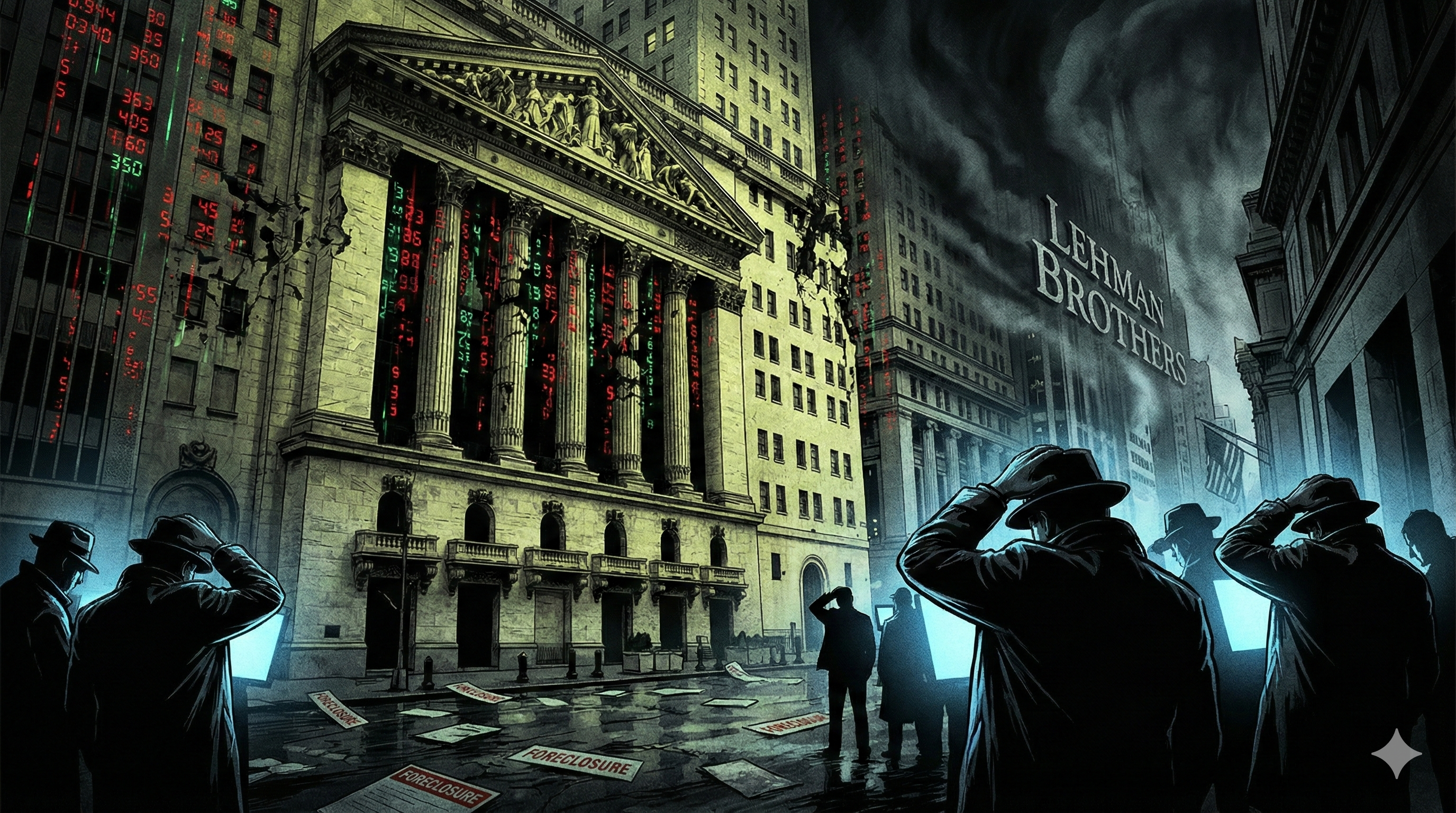
The collapse of Lehman Brothers in September 2008 triggered a worldwide economic recession. Originating from the US subprime mortgage market, the crisis spread through interconnected global financial systems, destroying trillions in wealth and reshaping economic policy for a generation.
Executive Summary
The 2008 financial crisis emerges across all lenses as a systemic failure driven by misaligned incentives, concentrated power, and resistance to natural market corrections. Game theory reveals the rational individual choices that produced collective catastrophe. Machiavellian analysis exposes how the politically connected were protected while others bore costs. Taoist wisdom frames it as inevitable reversal after unsustainable expansion. Corporate analysis maps the winners (big banks, short sellers) and losers (homeowners, taxpayers). Brookings identifies the policy failures and inequitable recovery.
Key Facts
Verified facts from multi-source research, scored by confidence level
Lehman Brothers filed for bankruptcy on September 15, 2008, with $639 billion in assets, making it the largest bankruptcy in US history.
high confidenceThe Troubled Asset Relief Program (TARP) was signed into law on October 3, 2008, authorizing up to $700 billion in financial system bailouts.
high confidenceBetween 2007 and 2010, approximately 3.8 million foreclosure filings were completed in the United States.
high confidenceThe Federal Reserve reduced the federal funds rate from 5.25% in September 2007 to effectively 0% by December 2008.
high confidenceAIG received $182 billion in government bailout funds, the largest single-company rescue in US history.
high confidenceGoldman Sachs executives, including former CEO Henry Paulson as Treasury Secretary, played key roles in crisis response decisions.
high confidenceThe Glass-Steagall Act, which separated commercial and investment banking, was repealed in 1999 by the Gramm-Leach-Bliley Act.
high confidenceKey Actors
Major actors involved in this event with their actions and stated interests
Henry Paulson
individual- ›Orchestrated Bear Stearns sale to JPMorgan
- ›Allowed Lehman Brothers to fail
- ›Designed TARP program
Goldman Sachs
corporation- ›Received $10 billion in TARP funds
- ›Received $12.9 billion via AIG bailout
- ›Converted to bank holding company for Fed access
Federal Reserve
organization- ›Cut interest rates to zero
- ›Launched quantitative easing programs
- ›Provided emergency lending to banks
American Homeowners
group- ›Defaulted on mortgages en masse
- ›Lost homes to foreclosure
- ›Organized protests against banks
Research & Sources
Event Timeline
2007-08-09 to 2009-06-30
Causal Analysis
Interactive graph showing how policies, actors, and events connect causally — click nodes to explore relationships
CAUSAL NETWORK
18 nodes · 19 connections
Select a node
Click any node in the graph to explore its connections and lens perspectives
Root Causes
4Critical Path
7 stepsLens Analyses
Each lens provides a unique analytical framework — click to expand for deep analysis
Game Theory & Strategic Interaction
Western Moderngame-theoryThe 2008 crisis exemplifies a massive coordination failure and multi-party prisoner's dilemma. Individual banks had rational incentives to maximize leverage and take on risk (defect), while collective stability required restraint (cooperate). The 'too big to fail' dynamic created moral hazard - banks knew they would be bailed out, shifting the equilibrium toward excessive risk-taking. The Nash equilibrium was systemically unstable.
Machiavellian Realpolitik
Greco-Roman & ClassicalmachiavelliThe crisis revealed a stark power dynamic: Wall Street's influence over regulators and politicians was decisive. Goldman Sachs alumni populated key government positions. Lehman was sacrificed (weakness punished) while connected institutions were saved. The crisis was used as a 'shock doctrine' moment to rapidly pass TARP with minimal oversight. Those with power preserved it; those without bore the costs.
Taoist Wisdom
East AsiantaoismThe crisis represents a classic case of forcing against natural flow. The housing bubble was sustained through artificial intervention - low rates, lax lending, securitization alchemy. Like water dammed too long, the eventual release was catastrophic. The bailouts were further forcing - preventing natural correction. Lao Tzu would note: 'Fill your bowl to the brim and it will spill.' The yang of expansion inevitably becomes the yin of contraction.
Corporate & Business Interests
Western ModerncorporateClear winners and losers emerged: JP Morgan acquired Bear Stearns cheaply; Goldman and Morgan Stanley gained bank holding company status and Fed access. Losers included Lehman bondholders, homeowners, and smaller banks. The crisis accelerated consolidation - the big got bigger. Short sellers like Paulson & Co. made billions. Mortgage servicers profited from foreclosure fees. The crisis was a massive wealth transfer upward.
Brookings Institution Perspective
Western InstitutionalbrookingsEvidence shows regulatory failure was central: Glass-Steagall repeal (1999), SEC leverage rule relaxation (2004), and rating agency conflicts created systemic risk. The policy response (TARP, Fed intervention, fiscal stimulus) prevented worse outcomes but was inequitably distributed. Dodd-Frank addressed some issues but left 'too big to fail' largely intact. The crisis exposed how financial deregulation, pursued by both parties, created fragility that harmed ordinary Americans most.
Convergences
Where multiple lenses reach similar conclusions — suggesting robustness
Misaligned incentives drove the crisis
All three analytical frameworks identify incentive structures - executive compensation, rating agency business models, 'too big to fail' implicit guarantees - as central causes. The disagreement is only about which incentives mattered most.
The powerful were protected, the powerless bore costs
Whether framed as power politics (Machiavelli), market dynamics (Corporate), or policy failure (Brookings), all agree that benefits and costs were distributed inequitably. Large institutions were saved; homeowners were foreclosed.
The bubble was unsustainable and correction was inevitable
Game theory sees unsustainable equilibrium; Taoism sees extreme yang requiring yin reversal; Corporate sees asset bubble. The framing differs but all identify fundamental instability requiring correction.
Regulatory failure enabled excessive risk-taking
Deregulation (Glass-Steagall, leverage rules, derivatives) created conditions for crisis. Even corporate lens, which might favor deregulation, acknowledges the role of regulatory failure in enabling the bubble.
Productive Tensions
Where lenses disagree — revealing complexity worth examining
Possible Futures
Scenarios derived from lens analyses — what might unfold based on different frameworks
Gradual Reform Success
Low - regulatory capture and political cycles work against sustained reform
Another Major Crisis
Moderate to high - fundamental dynamics unchanged
Structural Break-Up
Low but not negligible - requires political shock
Key Questions
Questions that remain open after analysis — for continued inquiry
- ?What was discussed in internal deliberations about Lehman?
- ?How much did foreign governments influence US crisis response?
- ?What is the true current exposure of major banks to derivatives?
Fact Check Details
Fact Check Results
verifiedMeta Observations
None of our lenses adequately capture the lived experience of those who lost homes, jobs, and savings. The human cost tends to become abstracted into statistics and frameworks.
The crisis involved millions of decisions by millions of actors in an interconnected global system. No single framework captures this complexity. The lenses illuminate aspects but the whole exceeds any combination of them.
Every analysis here involves interpretation and judgment. Reasonable, informed people disagree about the crisis even now. Your synthesis of these lenses is itself a perspective, not the final truth.
Find Your Perspective
Different frameworks resonate with different readers — find your entry point
Those who prefer logical, strategic analysis; economists; business strategists
Incentives drove behavior; the game was set up to produce this outcome; winners and losers can be mapped
Those who see patterns and cycles; those skeptical of human ability to control complex systems
The crisis was natural correction after unsustainable expansion; forcing prolongs imbalance
Those who trust evidence-based policy; reformers; those who believe institutions can be improved
Regulatory failure was central; better policy can prevent future crises
Those who see power dynamics beneath surface; those skeptical of official narratives
The powerful protected themselves; stated goals differed from real goals
If you naturally gravitate to analytical lenses, try reading the Taoist perspective for a different epistemology. If you trust institutions, read the Machiavellian analysis to understand power dynamics. Discomfort often indicates learning.
Related Analyses
Other events analyzed through similar lenses or categories
The emergence of SARS-CoV-2 in late 2019, its global spread, varying governmental responses, vaccine development and distribution, economic impacts, and resulting societal changes.
The construction of the three Great Pyramids at Giza (c. 2589–2504 BCE) during Egypt's Fourth Dynasty represents humanity's first megaproject—a multi-generational, state-directed engineering endeavor that mobilized 20,000–25,000 workers, 2.3 million limestone blocks, and the full administrative apparatus of the world's first nation-state to build monuments that remain standing 4,500 years later.
The decade-long radical transformation of France (1789-1799) that established principles of popular sovereignty and human rights that continue to shape modern political systems.
How This Was Analyzed
Full transparency about the analysis process, tools, and limitations
Crosslight Engine
v0.2.0 "Deep Dive"- ⚠AI analysis can miss nuance, misinterpret context, or reflect training biases
- ⚠Multi-lingual research depends on available sources — some perspectives may be underrepresented
- ⚠Think tank lenses reflect general institutional positions, not official statements
Analysis Statistics
Methodology
This analysis was produced by the Crosslight multi-agent pipeline: a Research Agent gathered and verified facts from multiple sources, specialized Lens Agents applied distinct analytical frameworks, a Synthesis Agent integrated insights and identified patterns, and a Fact-Check Agent verified claims. Each lens perspective is the AI's interpretation — not institutional endorsement.Learn more →