
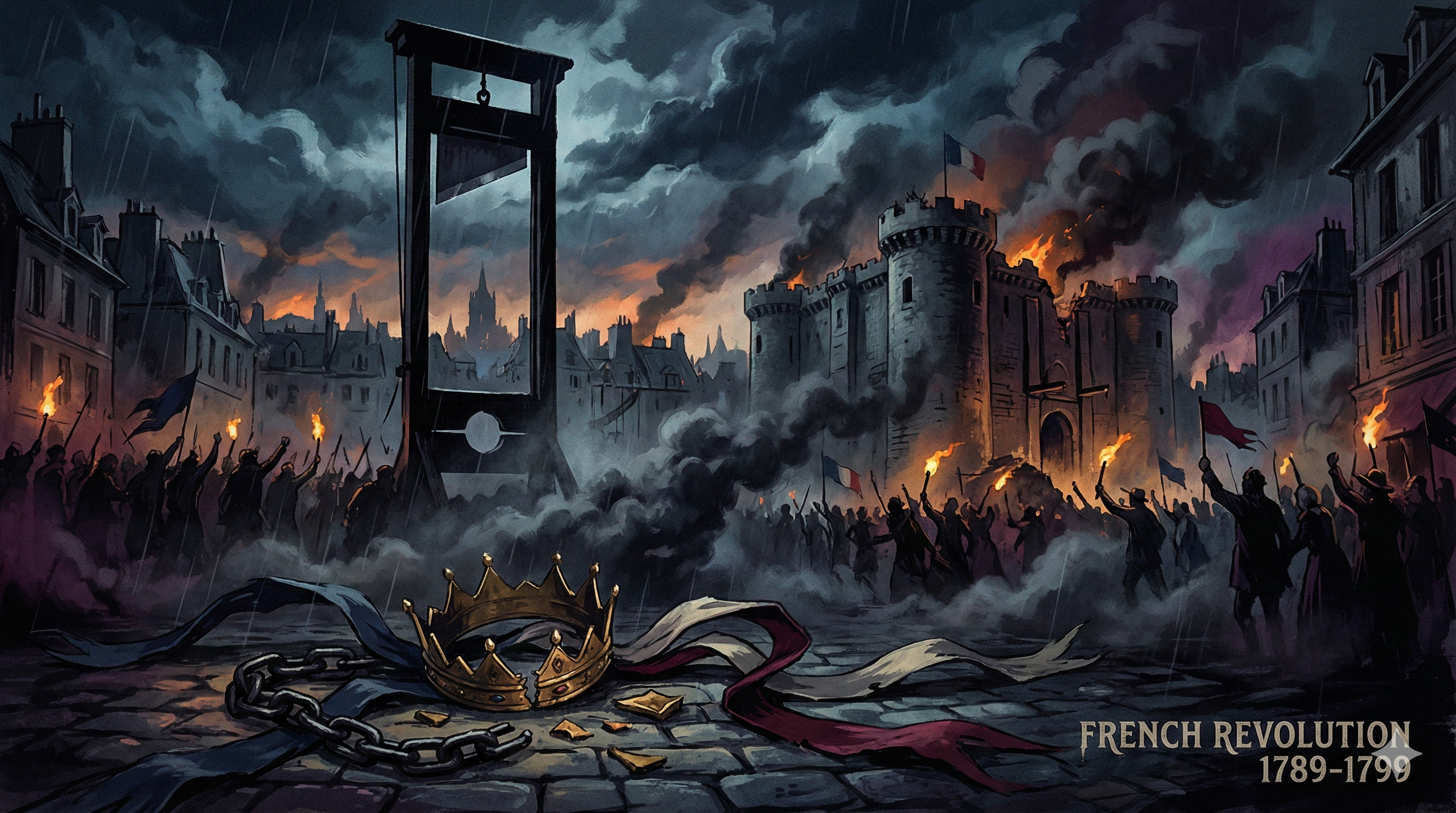
The French Revolution
The decade-long radical transformation of France (1789-1799) that established principles of popular sovereignty and human rights that continue to shape modern political systems.
Executive Summary
The French Revolution emerges from multi-lens analysis as a pivotal event whose significance lies not in simple triumph or failure but in its profound contradictions. All lenses agree on its transformative impact while highlighting different aspects: Game Theory reveals why moderate outcomes were difficult to sustain; Machiavelli illuminates the power dynamics that consumed revolutionary leaders; Taoism explains the inevitable reversals of extreme action; and Counter-Narrative complicates the triumphalist story with attention to violence and exclusion.
Key Facts
Verified facts from multi-source research, scored by confidence level
The Estates-General convened on May 5, 1789, for the first time since 1614, called by Louis XVI to address France's severe financial crisis
high confidenceFrance's national debt had ballooned to between 8-12 billion livres by 1789, with half of state revenue going to service the debt
high confidenceThe Third Estate comprised 98% of France's population but bore the primary tax burden, while the First and Second Estates (clergy and nobility) enjoyed extensive tax exemptions
high confidenceThe Storming of the Bastille occurred on July 14, 1789, when Parisian revolutionaries attacked the royal fortress and prison, killing the governor and releasing seven prisoners
high confidenceThe Declaration of the Rights of Man and of the Citizen was adopted by the National Constituent Assembly on August 26, 1789
high confidenceThe Flight to Varennes on June 20-21, 1791, was an attempted escape by the royal family that was foiled near the border, dramatically increasing public hostility toward the monarchy
high confidenceKing Louis XVI was executed by guillotine on January 21, 1793, after being convicted of conspiracy with foreign powers
high confidenceKey Actors
Major actors involved in this event with their actions and stated interests
King Louis XVI
individual- ›Called the Estates-General in May 1789
- ›Attempted to dismiss the National Assembly
- ›Accepted the constitutional monarchy in 1791
Marie Antoinette
individual- ›Advocated for Austrian intervention
- ›Maintained secret correspondence with foreign powers
- ›Rejected compromise with revolutionaries
Maximilien Robespierre
individual- ›Advocated for universal male suffrage
- ›Opposed war with Austria in 1792
- ›Dominated the Committee of Public Safety from July 1793
Georges Danton
individual- ›Led the Cordeliers Club
- ›Helped organize the storming of the Tuileries
- ›First president of the Committee of Public Safety
Napoleon Bonaparte
individual- ›Defended the Convention during the 13 Vendémiaire uprising (1795)
- ›Led Italian Campaign (1796-1797)
- ›Invaded Egypt (1798-1799)
The Third Estate / National Assembly
group- ›Declared itself the National Assembly
- ›Took the Tennis Court Oath
- ›Abolished feudalism (August 4, 1789)
Research & Sources
Event Timeline
May 5, 1789 - November 9, 1799
Causal Analysis
Interactive graph showing how policies, actors, and events connect causally — click nodes to explore relationships
CAUSAL NETWORK
23 nodes · 20 connections
Select a node
Click any node in the graph to explore its connections and lens perspectives
Root Causes
4Critical Path
10 stepsLens Analyses
Each lens provides a unique analytical framework — click to expand for deep analysis
Game Theory & Strategic Interaction
Western Moderngame-theoryThe French Revolution demonstrates how revolutionary situations create Prisoner's Dilemma dynamics that favor radicals: when moderates cannot credibly commit to protecting each other, they are vulnerable to elimination by more ruthless factions. The Revolution's self-consuming terror was not an aberration but a predictable outcome of the game structure.
Machiavellian Realpolitik
Greco-Roman & ClassicalmachiavelliThe French Revolution illustrates Machiavelli's central insight: a new order cannot be established without the destruction of the old, but the destroyers rarely survive to enjoy their creation. Louis XVI failed by being neither feared nor loved - merely pitied. Robespierre was feared but not loved, and fear alone cannot sustain power once people have nothing left to lose. Only Napoleon mastered Machiavelli's advice to be both lion and fox.
Taoist Wisdom
East AsiantaoismThe French Revolution exemplifies the Taoist principle of reversal: extreme yang produces extreme yin. The monarchy's rigidity produced revolutionary fluidity; revolutionary chaos produced authoritarian order. The Terror's attempt to force virtue through violence was the ultimate negation of wu wei and inevitably collapsed. True and lasting change comes not from forcing but from aligning with the natural tendency of things.
Counter-Narrative Analysis
Western Moderncounter-narrativeThe French Revolution's legacy is genuinely ambiguous: it articulated universal principles while violating them systematically. The Declaration of the Rights of Man is both a foundational document of human rights and a monument to hypocrisy. Taking the Revolution's counter-narratives seriously does not negate its genuine achievements but provides a more complete picture of revolutionary change as a process of violence, exclusion, and partial progress rather than simple triumph.
Convergences
Where multiple lenses reach similar conclusions — suggesting robustness
Revolutionary instability was structurally determined, not accidental
All three analytical lenses agree that the Revolution's violent trajectory was not simply the result of bad actors but emerged from structural conditions. Game theory points to Prisoner's Dilemma dynamics; Machiavelli to the logic of power in revolutionary situations; Taoism to the inevitability of extreme yang producing extreme yin.
The Terror was a predictable phase, not an aberration
All four lenses see the Terror not as a betrayal of revolutionary ideals but as a predictable outcome of revolutionary dynamics. Whether framed as equilibrium under threat (game theory), the logic of power without restraint (Machiavelli), forcing against nature (Taoism), or the violence inherent in revolutionary change (counter-narrative), the Terror emerges as intrinsic rather than accidental.
Napoleon's rise was overdetermined by preceding chaos
The analytical lenses converge on Napoleon as the predictable resolution to revolutionary instability: the Nash equilibrium (game theory), the successful Machiavellian prince, and the yang response to yin chaos (Taoism).
Productive Tensions
Where lenses disagree — revealing complexity worth examining
Possible Futures
Scenarios derived from lens analyses — what might unfold based on different frameworks
Revolutionary principles continue gradual global expansion
Likely over long term; pattern since 1789 has been gradual (if uneven) expansion of rights
Revolutionary/counter-revolutionary cycles continue
Highly likely; nothing in the analysis suggests the patterns have been transcended
Key Questions
Questions that remain open after analysis — for continued inquiry
- ?What was the actual death toll of the Revolution and subsequent wars?
- ?To what extent did revolutionary property redistribution actually benefit peasants versus bourgeoisie?
- ?How did ordinary people in different regions experience the Revolution?
Fact Check Details
Fact Check Results
verifiedMeta Observations
All lenses struggle with the sheer contingency of historical events. Individual choices (Louis XVI's character, Robespierre's paranoia, Napoleon's ambition) mattered enormously but are difficult to incorporate into structural analysis. The role of pure chance - bad harvests, a carriage recognized at Varennes - is underweighted.
The French Revolution was simultaneously a political revolution, social revolution, cultural revolution, religious revolution, and international war. No single lens can capture all dimensions. The interaction between economic crisis, ideological ferment, social conflict, and international pressure created a complexity that exceeds any single framework.
The French Revolution has generated over 200 years of historiographical debate without consensus. The event is close enough to feel familiar but distant enough to be genuinely foreign. Any analysis, including this one, is necessarily partial and perspectival. Readers should hold conclusions lightly and remain open to alternative interpretations.
Find Your Perspective
Different frameworks resonate with different readers — find your entry point
Those who prefer structural analysis, strategic reasoning, and understanding how power actually operates
The Revolution's trajectory was structurally determined; individual actors were constrained by game dynamics and power logic; Napoleon's rise was overdetermined by preceding chaos.
Those who seek deeper patterns, distrust forced change, and value organic development
The Revolution's extremism guaranteed its reversal; forcing produces backlash; the pattern has repeated and will repeat.
Not represented in this analysis; would emphasize institutional continuities and the Revolution's contribution to modern state-building
N/A - lens not applied
Those who question dominant narratives, attend to marginalized perspectives, and suspect ideology masks interest
The Revolution's proclaimed universalism was false universalism; violence and exclusion were integral, not accidental; official memory obscures uncomfortable truths.
Analytical readers should engage with counter-narrative's critique of strategic 'necessity' arguments. Intuitive readers should engage with game theory's structural explanations. Skeptical readers should engage with Taoist patterns that explain why revolutionary dynamics recur.
Related Analyses
Other events analyzed through similar lenses or categories
On November 22, 1963, President John F. Kennedy was assassinated in Dealey Plaza, Dallas, Texas. Lee Harvey Oswald was arrested but killed by Jack Ruby before trial. The Warren Commission concluded Oswald acted alone, while the HSCA later found probable conspiracy. Declassified documents through 2025 reveal institutional cover-ups by the CIA and FBI, making it the most consequential unsolved case in American history.
The pivotal 1836 military engagement where Texan defenders held the Alamo Mission against Mexican forces for 13 days, becoming a rallying cry that galvanized the Texas Revolution.
The emergence of SARS-CoV-2 in late 2019, its global spread, varying governmental responses, vaccine development and distribution, economic impacts, and resulting societal changes.
How This Was Analyzed
Full transparency about the analysis process, tools, and limitations
Crosslight Engine
v0.3.0 "Causality"- ⚠Causal attribution is inherently interpretive — graphs represent analysis, not ground truth
- ⚠Actor discovery limited by available public information and source accessibility
- ⚠Lobbying data availability varies significantly by jurisdiction
Analysis Statistics
Methodology
This analysis was produced by the Crosslight multi-agent pipeline: a Research Agent gathered and verified facts from multiple sources, specialized Lens Agents applied distinct analytical frameworks, a Synthesis Agent integrated insights and identified patterns, and a Fact-Check Agent verified claims. Each lens perspective is the AI's interpretation — not institutional endorsement.Learn more →