
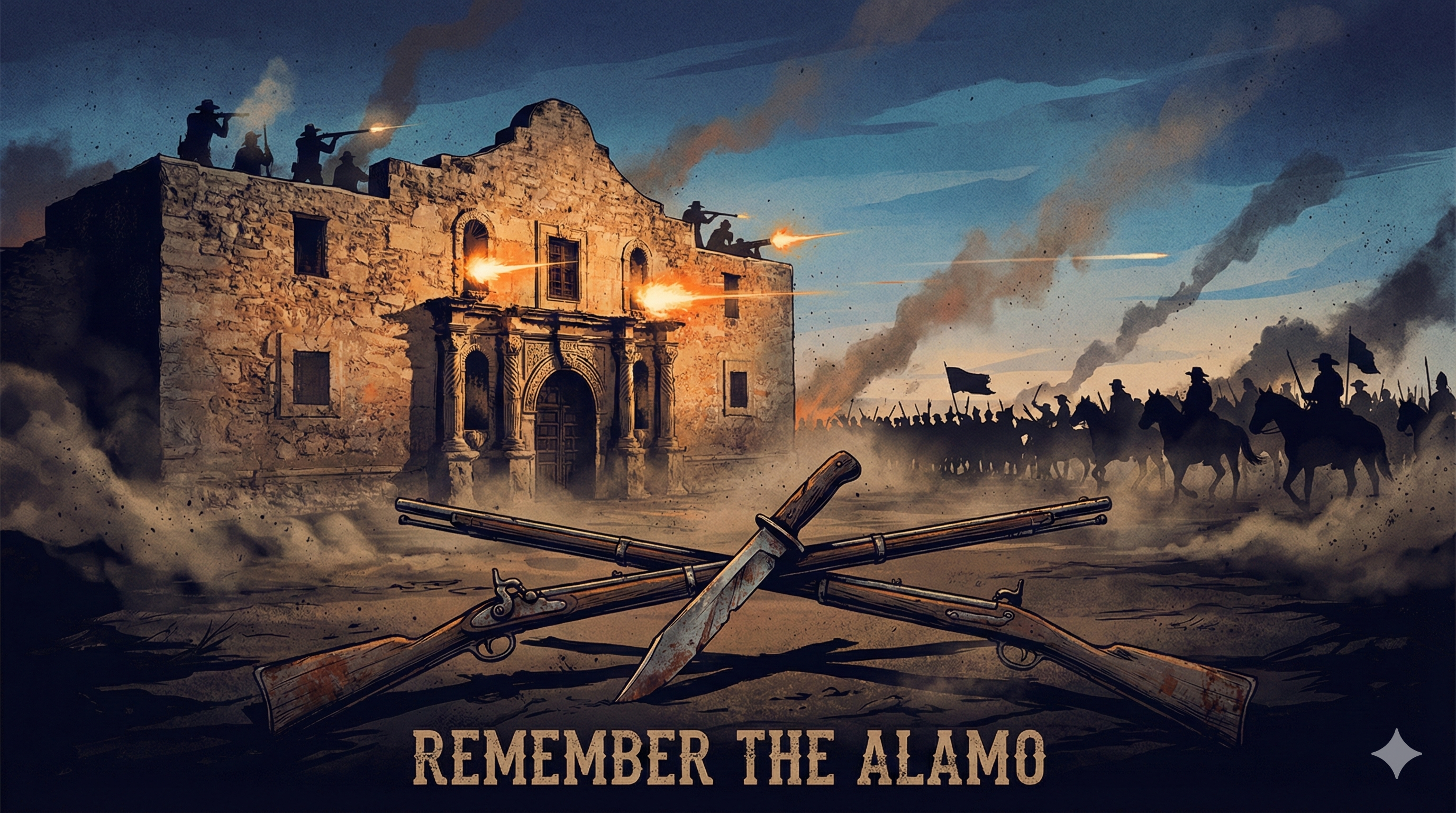
The Battle of the Alamo
The pivotal 1836 military engagement where Texan defenders held the Alamo Mission against Mexican forces for 13 days, becoming a rallying cry that galvanized the Texas Revolution.
Executive Summary
The Battle of the Alamo represents a fascinating case where tactical victory produced strategic catastrophe. All four lenses converge on this central insight while offering different explanations: Game Theory sees commitment devices that eliminated cooperative equilibria; Machiavelli sees 'cruelty poorly-used' that created martyrs rather than submission; Taoism sees yang excess that guaranteed yin reversal; Counter-Narrative sees a complex event simplified into founding myth. The synthesis reveals that the Alamo's power lies not in what happened but in how it was transformed—from military defeat into symbolic victory, from 189 deaths into immortal cause. Santa Anna won the battle and lost everything; the defenders lost their lives and won immortality.
Key Facts
Verified facts from multi-source research, scored by confidence level
The siege of the Alamo lasted 13 days, from February 23 to March 6, 1836
high confidenceMexican General Santa Anna arrived at San Antonio a month earlier than the Texans expected, crossing the Rio Grande on February 12, 1836
high confidenceSanta Anna ordered the raising of a red flag atop San Fernando Church, signifying 'no quarter' - all defenders would be killed
high confidenceWilliam Travis wrote his famous 'Victory or Death' letter on February 24, 1836, calling for reinforcements with the words 'I shall never surrender or retreat'
high confidenceThe final assault occurred at dawn on March 6, 1836, and lasted approximately 90 minutes
high confidenceApproximately 189 Texan defenders died, though historians debate the exact number. All combatants were killed.
high confidenceMexican casualties were estimated at 400-600 killed or wounded, approximately one-third of the assault force
medium confidenceKey Actors
Major actors involved in this event with their actions and stated interests
Antonio López de Santa Anna
individual- ›Repealed the 1824 Constitution and centralized power
- ›Led personal expedition to crush Texas rebellion
- ›Divided army and arrived earlier than expected
William Barret Travis
individual- ›Assumed command of regular forces at the Alamo
- ›Sent multiple messengers requesting reinforcements
- ›Refused to surrender despite overwhelming odds
James Bowie
individual- ›Defied Houston's order to destroy the Alamo
- ›Chose to fortify and defend rather than retreat
- ›Shared command with Travis after election by volunteers
David 'Davy' Crockett
individual- ›Arrived in Texas seeking new political career after losing Congressional seat
- ›Brought group of Tennessee volunteers
- ›Fought as rifleman defending the palisade
Sam Houston
individual- ›Ordered Bowie to destroy Alamo and retreat (ignored)
- ›Attended Convention of 1836 during the siege
- ›Recruited and trained army while Alamo was besieged
Mexican Army
organization- ›Conducted 13-day siege
- ›Suffered significant casualties in failed assault attempts
- ›Launched final dawn assault on March 6
Research & Sources
Event Timeline
February 23, 1836 - March 6, 1836
Causal Analysis
Interactive graph showing how policies, actors, and events connect causally — click nodes to explore relationships
CAUSAL NETWORK
18 nodes · 11 connections
Select a node
Click any node in the graph to explore its connections and lens perspectives
Root Causes
3Critical Path
8 stepsLens Analyses
Each lens provides a unique analytical framework — click to expand for deep analysis
Game Theory & Strategic Interaction
Western Moderngame-theoryThe Alamo represents a game-theoretic tragedy where commitment devices (no-quarter policy, 'Victory or Death' rhetoric) eliminated all cooperative equilibria. Both sides rationally followed their dominant strategies to mutual destruction. However, Santa Anna failed to account for the meta-game: his tactical victory was a strategic catastrophe that created the focal point ('Remember the Alamo!') that coordinated his defeat six weeks later.
Machiavellian Realpolitik
Greco-Roman & ClassicalmachiavelliMachiavelli would recognize Santa Anna's fundamental error: 'Men ought either to be well treated or crushed, because they can avenge themselves of lighter injuries.' Santa Anna chose a middle path—he crushed the Alamo defenders but not the Texan cause, creating martyrs who animated revenge. His 'cruelty' was not 'well-used' because it was incomplete. He should have either offered generous terms (winning Texan loyalty) or annihilated the entire movement quickly. Instead, he created a wound that would not heal.
Taoist Wisdom
East AsiantaoismThe Tao Te Ching teaches: 'The stiff and unbending is the disciple of death. The soft and yielding is the disciple of life.' Santa Anna was stiff—his no-quarter policy admitted no flexibility. Travis was stiff—his honor admitted no retreat. Both died to their positions. But Houston was water—flowing around obstacles, pooling strength, and when the time came, carving canyons through stone in minutes. The Alamo was necessary loss; San Jacinto was natural victory. The defeated became victors; the victors became the defeated. This is the way of all things.
Counter-Narrative Analysis
Western Moderncounter-narrativeThe Alamo we 'remember' is largely a 20th-century construction that serves present political needs rather than historical accuracy. The actual event involved Anglo-American settlers—many seeking to preserve slavery—rebelling against a Mexican government that had abolished the institution. Tejanos fought on both sides. Indigenous peoples lost regardless of outcome. The 'liberty vs. tyranny' framing erases these complexities, transforming a morally ambiguous event into a foundational myth. As Chomsky might note, who controls the story controls the meaning—and the Alamo's meaning has been controlled by those whose interests it serves.
Convergences
Where multiple lenses reach similar conclusions — suggesting robustness
Santa Anna's tactical victory was a strategic disaster
Game Theory shows that Santa Anna failed to account for the meta-game; Machiavelli shows his 'cruelty' created martyrs rather than terror; Taoism shows yang excess guaranteeing reversal. All three lenses predict that his 'victory' would produce defeat.
Commitment and inflexibility drove the tragedy
Game Theory emphasizes how commitment devices (no-quarter policy, 'Victory or Death') eliminated cooperative options. Machiavelli notes the rigidity that prevented adaptive response. Taoism sees 'stiffness' as death. All three lenses identify inflexibility as the root cause of mutual destruction.
Houston exemplified strategic wisdom
Game Theory credits his understanding of the larger game; Machiavelli credits his patience and timing; Taoism credits his wu wei—flowing with rather than against circumstances. All three see Houston as the strategic victor of the Texas Revolution.
Productive Tensions
Where lenses disagree — revealing complexity worth examining
Possible Futures
Scenarios derived from lens analyses — what might unfold based on different frameworks
Traditional narrative persists
Moderate - dominant for decades but facing increasing challenge
Complex narrative becomes mainstream
Low-to-moderate - possible over 20-30 years
Alamo becomes contested battleground
High - already occurring
Key Questions
Questions that remain open after analysis — for continued inquiry
- ?How exactly did Davy Crockett die?
- ?What percentage of defenders were motivated primarily by slavery preservation?
- ?How many Tejanos fought on each side?
- ?What did Mexican sources say at the time?
Fact Check Details
Fact Check Results
verifiedMeta Observations
All four lenses treat the Alamo as a discrete event rather than an ongoing process. But the Alamo is still happening—in school curricula, museum exhibits, political speeches, and this very analysis. The 'event' is less important than its continuous reconstruction. What we analyze shapes what it means.
No single lens captures the full truth. The defenders were both courageous and fighting for unjust causes. Santa Anna was both tyrannical and defending legitimate sovereignty. The battle was both preventable and (in some sense) necessary. These contradictions don't resolve—they constitute the event's meaning.
Anyone who tells you they know exactly what the Alamo means is selling something. The event has been recruited for too many causes—Texan identity, American exceptionalism, Confederate nostalgia, anti-Mexican sentiment, anti-revisionist reaction—to have a single stable meaning. Humility demands we hold our interpretations lightly.
Find Your Perspective
Different frameworks resonate with different readers — find your entry point
Those who prefer systematic, mathematical analysis of strategic interaction. If you find comfort in payoff matrices and equilibrium concepts, this lens speaks your language.
The Alamo was a game-theoretic tragedy where commitment devices eliminated cooperation. Both sides rationally followed dominant strategies to mutual destruction.
Those who sense patterns beyond calculation, who appreciate paradox and cyclical flow. If 'the soft overcomes the hard' rings true to you, this lens offers meaning.
Santa Anna's yang aggression guaranteed yin reversal. Houston's patient yielding embodied wu wei. What appears as victory contains defeat; what appears as defeat contains victory.
Those who see power as the currency of politics, who appreciate strategic thinking stripped of moral illusion. If you've read Kissinger and nodded, this lens fits.
Santa Anna's cruelty was poorly-used—it created martyrs rather than submission. Travis managed appearances brilliantly despite military failure. Houston exemplified patient strategic calculation.
Those who question dominant narratives, who ask 'who benefits?' and 'whose voice is missing?' If you sense that official histories serve power, this lens validates your instinct.
The Alamo we 'remember' is a 20th-century construction that erases slavery, simplifies Tejano complexity, and serves ongoing political purposes. The 'heroes' fought to preserve human bondage.
Start with the cluster that resonates, then deliberately read the one that challenges you most. If you're analytical, the Taoist view may seem mystical but offers genuine insight. If you're skeptical, the game-theoretic view may seem amoral but reveals structural dynamics. Growth comes from synthesis, not from staying in comfortable frameworks.
Related Analyses
Other events analyzed through similar lenses or categories
On November 22, 1963, President John F. Kennedy was assassinated in Dealey Plaza, Dallas, Texas. Lee Harvey Oswald was arrested but killed by Jack Ruby before trial. The Warren Commission concluded Oswald acted alone, while the HSCA later found probable conspiracy. Declassified documents through 2025 reveal institutional cover-ups by the CIA and FBI, making it the most consequential unsolved case in American history.
The decade-long radical transformation of France (1789-1799) that established principles of popular sovereignty and human rights that continue to shape modern political systems.
The emergence of SARS-CoV-2 in late 2019, its global spread, varying governmental responses, vaccine development and distribution, economic impacts, and resulting societal changes.
How This Was Analyzed
Full transparency about the analysis process, tools, and limitations
Crosslight Engine
v0.3.0 "Causality"- ⚠Causal attribution is inherently interpretive — graphs represent analysis, not ground truth
- ⚠Actor discovery limited by available public information and source accessibility
- ⚠Lobbying data availability varies significantly by jurisdiction
Analysis Statistics
Methodology
This analysis was produced by the Crosslight multi-agent pipeline: a Research Agent gathered and verified facts from multiple sources, specialized Lens Agents applied distinct analytical frameworks, a Synthesis Agent integrated insights and identified patterns, and a Fact-Check Agent verified claims. Each lens perspective is the AI's interpretation — not institutional endorsement.Learn more →