The Russia-Ukraine War
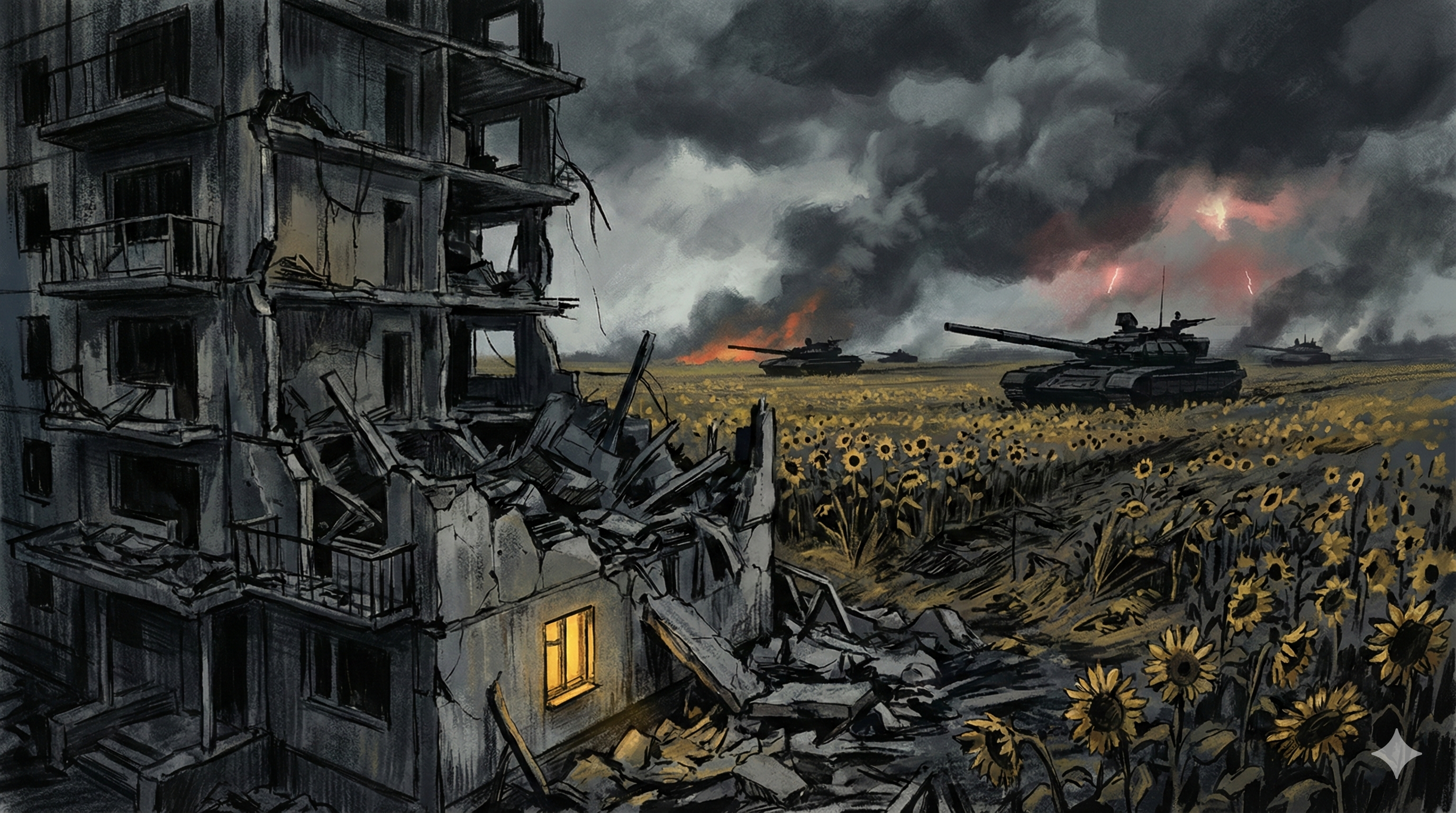
Beginning with Russia's annexation of Crimea in 2014 and escalating to full-scale invasion on February 24, 2022, this conflict has reshaped European security, exposed Western vulnerabilities, and triggered the largest land war in Europe since 1945.
Executive Summary
The Russia-Ukraine War represents a pivotal moment in 21st century history - the largest European conflict since WWII, a test of whether military conquest can succeed in the modern era, and potentially the beginning of Russia's final imperial transformation. All seven analytical lenses converge on key findings: Russia's invasion was a strategic catastrophe that united rather than divided the West; the war has created clear winners (defense industry, China, India) and losers (Ukrainian and Russian civilians, European energy consumers); and Russia faces structural decline regardless of territorial outcomes. The lenses diverge on whether this decline will be gradual or catastrophic, and on the war's likely resolution. The humanitarian lens emphasizes the unprecedented suffering, with 11 million displaced and systematic infrastructure destruction. The economic lens reveals how war serves certain interests, creating incentives that may prolong conflict. The historical lens suggests Russia is following a pattern of imperial overreach leading to collapse. The Taoist lens notes that force against natural tendency always fails eventually. A view from 50 years hence will likely see this war as the moment Russia's imperial era definitively ended.
Key Facts
Verified facts from multi-source research, scored by confidence level
Russia launched a full-scale invasion of Ukraine on February 24, 2022, with attacks on multiple fronts including from Belarus toward Kyiv.
high confidenceAs of October 2025, Russia controls 19% of Ukrainian territory, approximately 115,132 square kilometers.
high confidenceBritish intelligence estimates approximately 1.118 million Russian soldiers killed and wounded as of October 2025, with approximately 240,000 killed.
medium confidencePresident Zelensky reported 46,000 Ukrainian soldiers killed and 380,000 wounded as of February 2025.
medium confidenceNearly 11 million Ukrainians have been displaced, with 5.75 million refugees abroad and 3.75 million internally displaced as of September 2025.
high confidenceIn 2021, Russia supplied 45% of EU coal imports, 36% of natural gas imports, and 25% of petroleum imports.
high confidenceGermany received 65% of its gas imports from Russia in 2021, making it the largest EU importer of Russian gas at 55 billion cubic meters.
high confidenceKey Actors
Major actors involved in this event with their actions and stated interests
Vladimir Putin / Russian Government
state- ›Annexed Crimea in February-March 2014
- ›Supported separatist forces in Donbas 2014-2022
- ›Launched full-scale invasion February 24, 2022
Volodymyr Zelensky / Ukrainian Government
state- ›Remained in Kyiv during initial invasion
- ›Mobilized Ukrainian defense forces
- ›Conducted international diplomatic campaign
NATO / United States
organization- ›Provided $175+ billion in military and economic aid to Ukraine
- ›Imposed comprehensive sanctions on Russia
- ›Expanded NATO to include Finland and Sweden
European Union / Germany
organization- ›Halted Nord Stream 2 approval (February 22, 2022)
- ›Implemented REPowerEU to reduce Russian energy dependence
- ›Provided military equipment to Ukraine (reversed longstanding policy)
China
state- ›Purchased 47% of Russian oil exports since late 2022
- ›Increased trade with Russia despite sanctions
- ›Avoided providing lethal military aid
Defense Industry
corporation- ›Increased production of artillery shells, missiles, and drones
- ›Signed multi-year contracts with NATO governments
- ›Expanded manufacturing capacity
Research & Sources
Event Timeline
2014-02-20 to ongoing
Causal Analysis
Interactive graph showing how policies, actors, and events connect causally — click nodes to explore relationships
CAUSAL NETWORK
13 nodes · 12 connections
Select a node
Click any node in the graph to explore its connections and lens perspectives
Root Causes
1Critical Path
6 stepsLens Analyses
Each lens provides a unique analytical framework — click to expand for deep analysis
Game Theory Analysis
Western Moderngame-theoryThe Russia-Ukraine war exemplifies how asymmetric information and miscalculated resolve can lead to catastrophically inefficient outcomes. Russia's fundamental error was treating the war as a one-shot game when it is actually an infinitely repeated game between permanent neighbors. Ukraine's strategy of making conquest costly is game-theoretically sound given the impossibility of credible Russian commitments. The West faces a commitment problem: providing enough support to prevent Russian victory but not enough to enable Ukrainian victory, potentially prolonging the war.
Machiavellian Power Analysis
Greco-Roman & ClassicalmachiavelliPutin committed the classic Machiavellian error of being 'feared' rather than building genuine alliances. His invasion united NATO, ended European strategic ambiguity, and turned Ukraine into an implacable enemy. He mistook Western caution for weakness and Ukrainian corruption for lack of national identity. The war reveals that raw military power is insufficient without accurate intelligence about enemy resolve. Putin's personalist system prevented honest feedback about military readiness. He may achieve tactical territorial gains while suffering strategic defeat in every other dimension: economic isolation, technological regression, demographic drain, and transformation of Russia into a Chinese vassal state.
Taoist Flow Analysis
East AsiantaoismThe Tao that can be named is not the eternal Tao, but this conflict teaches that force against natural tendency always extracts terrible costs. Russia seeks to force Ukraine into a submission that contradicts Ukraine's natural development. This forcing will ultimately fail because it requires constant energy expenditure against the flow. The water always finds its way around the rock. Ukraine has discovered its national identity through resistance - a transformation that cannot be undone by military force. Russia, in seeking to prevent Ukraine from becoming European, has made that outcome inevitable. In trying to demonstrate strength, Russia has revealed profound weakness. The Taoist wisdom here: what you resist, persists; what you force, escapes.
Geopolitical Strategic Analysis
geopoliticalThe Russia-Ukraine war marks the end of the post-Cold War era and the beginning of a new period of great power competition. Europe's 'holiday from history' is over. The war demonstrates that economic interdependence does not prevent conflict when one party values geopolitical objectives over economic welfare. However, it also shows that military power alone cannot subjugate a determined nation with external support. The emerging order will feature renewed military competition, accelerated bloc formation, and increased risk of cascading conflicts - but also potentially stronger defensive alliances and clearer red lines.
Humanitarian Impact Analysis
humanitarianThe deliberate targeting of civilian infrastructure transforms warfare into collective punishment. This strategy assumes that civilian suffering will break Ukrainian will - an assumption that has proven false but at enormous human cost. The humanitarian crisis will outlast the military conflict by decades. A generation of Ukrainian children is being traumatized. The long-term costs - in mental health, lost education, family separation, and destroyed communities - far exceed any territorial objective Russia might achieve. The world is watching a humanitarian catastrophe unfold in real time, with limited ability to prevent it short of ending the war.
Economic Impact and War Profiteering Analysis
economicWar is a wealth transfer mechanism - from taxpayers and civilians to defense corporations, from combatant nations to neutral trading partners. The Russia-Ukraine war has created winners (defense industry, energy exporters, China, India) and losers (Ukrainian and Russian civilians, European consumers) in predictable patterns. The economic incentives for prolonged conflict are significant: defense companies profit from ongoing war, China benefits from a weakened Russia, and reconstruction contractors benefit from maximum destruction. This creates a disturbing alignment of interests that may extend the conflict beyond what military logic alone would dictate.
Russian Imperial Decline Analysis
historical-cyclesRussia's invasion of Ukraine fits a centuries-long pattern of Russian imperial overreach followed by collapse. The Tsarist empire fell after WWI exhaustion. The Soviet empire fell after Cold War exhaustion and Afghanistan. Putin's Russia may be entering its own collapse cycle, triggered by Ukrainian resistance and Western sanctions. The demographic and economic fundamentals suggest that regardless of territorial gains, Russia faces structural decline. The question is not whether Russia declines, but how - and whether that decline is gradual and managed or sudden and catastrophic. Historians in 2076 may view the 2022 invasion as the beginning of Russia's transformation from would-be empire to middle power.
Convergences
Where multiple lenses reach similar conclusions — suggesting robustness
Russia's invasion was a strategic miscalculation that backfired in nearly every dimension
All strategic lenses agree that Russia expected quick victory, underestimated Ukrainian resistance, and failed to anticipate Western unity. The invasion achieved the opposite of stated goals: strengthening NATO, unifying Europe, and cementing Ukrainian national identity.
The war creates significant economic winners whose interests may prolong conflict
Defense industry profits, Chinese energy discounts, and reconstruction opportunities create stakeholders who benefit from continued or extended conflict. This alignment of interests should be considered in understanding why the war persists.
Russia faces structural decline regardless of war outcome
Demographic decline (1.5 fertility, shrinking population), brain drain (650,000+ emigrants), economic dependence on commodity exports, and technological regression all point to Russian decline. The war accelerates rather than reverses this trajectory.
European energy dependence on Russia represented a massive policy failure
Decades of warnings about energy dependence were ignored. The belief that trade creates peace was falsified. The €700+ billion cost of the energy crisis exceeded any economic benefits from cheap Russian gas.
Productive Tensions
Where lenses disagree — revealing complexity worth examining
Possible Futures
Scenarios derived from lens analyses — what might unfold based on different frameworks
Frozen Conflict Korea Model
Most likely (40-50%)
Russian Strategic Defeat
Possible (20-30%)
Ukrainian Exhaustion / Western Abandonment
Significant risk (15-25%)
Escalation to Broader Conflict
Low but catastrophic (5-10%)
Key Questions
Questions that remain open after analysis — for continued inquiry
- ?What are the true casualty figures on both sides?
- ?What is the actual state of Russian military production capacity?
- ?How much Chinese dual-use technology has reached Russia?
- ?What percentage of Russian elite genuinely supports the war versus fears speaking out?
Fact Check Details
Fact Check Results
verifiedMeta Observations
All analytical frameworks struggle to capture the experience of individuals within the conflict - the Ukrainian grandmother defending her home, the Russian conscript dying for unclear reasons, the child growing up in a bomb shelter. Analysis abstracts suffering into statistics and patterns. The human reality exceeds any framework.
The war emerged from decades of accumulated decisions, misperceptions, and structural factors that no single explanation captures. NATO expansion, Russian imperial ideology, Ukrainian national awakening, European energy greed, American political cycles, and countless individual choices all contributed. Monocausal explanations are always incomplete.
We are analyzing an ongoing conflict with incomplete information, contested facts, and uncertain outcomes. Casualty figures are estimates. Russian decision-making is opaque. Future developments are unknowable. Confidence should be calibrated accordingly. These analyses may look very different with the clarity of historical hindsight.
Find Your Perspective
Different frameworks resonate with different readers — find your entry point
Those who see international politics as strategic competition between rational actors pursuing interests. Values: logic, evidence, strategic thinking.
The war represents a tragic equilibrium where both sides rationally continue fighting. Resolution requires changing the payoff structure, not moral appeals.
Those who prioritize human suffering and natural cycles over strategic calculations. Values: compassion, wisdom, long-term perspective.
The war violates natural tendencies and creates suffering that outlasts any strategic objective. Force against nature eventually fails.
Those focused on state interests, international institutions, and economic systems. Values: order, stability, institutional integrity.
The war is destroying the post-Cold War order. New institutions and relationships are forming that will shape the next era.
Those suspicious of stated motives, attentive to who benefits, and skeptical of official narratives. Values: truth, accountability, pattern recognition.
Follow the money and power. Defense industries and certain states benefit from continued conflict. Imperial patterns repeat. Stated justifications rarely reflect true motivations.
The war requires both strategic understanding (why it continues) and moral clarity (that it should stop). The analytical cluster provides the former; the intuitive cluster the latter. Economic analysis reveals hidden stakeholders. Historical patterns provide context. A complete understanding requires all perspectives.
Related Analyses
Other events analyzed through similar lenses or categories
Analyzing Obama's 2015 COP21 address as a metaphorical acknowledgment of declining US global legitimacy in the social media age.
On November 22, 1963, President John F. Kennedy was assassinated in Dealey Plaza, Dallas, Texas. Lee Harvey Oswald was arrested but killed by Jack Ruby before trial. The Warren Commission concluded Oswald acted alone, while the HSCA later found probable conspiracy. Declassified documents through 2025 reveal institutional cover-ups by the CIA and FBI, making it the most consequential unsolved case in American history.
The decade-long radical transformation of France (1789-1799) that established principles of popular sovereignty and human rights that continue to shape modern political systems.
How This Was Analyzed
Full transparency about the analysis process, tools, and limitations
Crosslight Engine
v0.3.0 "Causal Depth"- ⚠Causal attribution is inherently interpretive — graphs represent analysis, not ground truth
- ⚠Actor discovery limited by available public information and source accessibility
- ⚠Lobbying data availability varies significantly by jurisdiction
Analysis Statistics
Methodology
This analysis was produced by the Crosslight multi-agent pipeline: a Research Agent gathered and verified facts from multiple sources, specialized Lens Agents applied distinct analytical frameworks, a Synthesis Agent integrated insights and identified patterns, and a Fact-Check Agent verified claims. Each lens perspective is the AI's interpretation — not institutional endorsement.Learn more →