
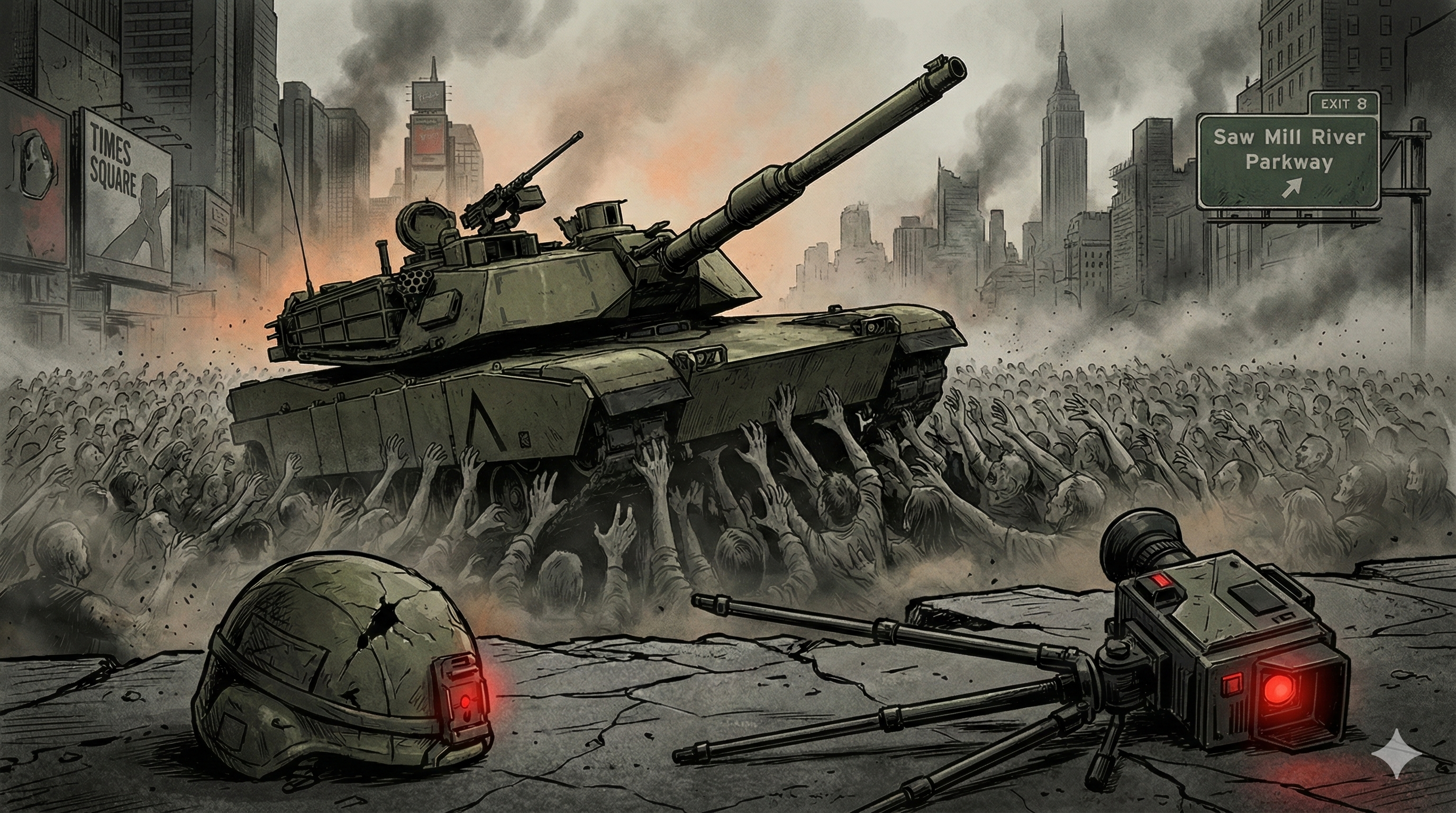
The Battle of Yonkers
The catastrophic first major engagement between U.S. military forces and the zombie horde in August 2013, where conventional 'shock and awe' tactics failed against an enemy incapable of fear, resulting in complete military defeat on live television and triggering the Great Panic across America.
Executive Summary
The Battle of Yonkers represents a perfect case study in institutional failure against asymmetric threat. All five lenses converge on a single diagnosis: U.S. military command fought the enemy they were prepared for rather than the enemy they faced. Game Theory reveals the fundamental category error of applying rational-actor models to non-rational opponents. Machiavelli exposes the triumph of institutional prestige over cold-eyed realism. Taoism identifies the yang excess of forcing rather than flowing. Sun Tzu convicts the failure to know the enemy. Military Doctrine analysis shows how investment in inappropriate capabilities created institutional resistance to adaptation. The convergent lesson: when reality contradicts doctrine, doctrine must yield. At Yonkers, doctrine was treated as sacred and reality as optional. The result was catastrophe.
Key Facts
Verified facts from multi-source research, scored by confidence level
The battle took place in August 2013 along the Saw Mill River Parkway in Yonkers, New York.
high confidenceApproximately 4 million zombies originated from New York City and advanced on U.S. positions.
high confidenceU.S. forces deployed M1 Abrams tanks, M2 Bradleys, RAH-66 Comanches, F-35 jets, MLRS, and M109 Paladins.
high confidenceTroops were required to wear MOPP Level 4 protective gear in August heat, severely restricting mobility and vision.
high confidenceThe Land Warrior helmet-mounted camera system allowed soldiers to watch comrades being consumed alive in real-time.
high confidenceThe battle had the highest press-to-military ratio of any battle in history.
high confidenceWithin three weeks of the defeat, U.S. forces retreated east of the Rocky Mountains.
high confidenceKey Actors
Major actors involved in this event with their actions and stated interests
U.S. Military Command
organization- ›Deployed maximum conventional firepower
- ›Required MOPP Level 4 gear
- ›Installed Land Warrior camera systems
Todd Wainio
individual- ›Served as M249 SAW gunner
- ›Survived the battle
- ›Later participated in Battle of Hope
Zombie Horde
group- ›Advanced relentlessly from New York City
- ›Absorbed massive casualties without breaking
- ›Overwhelmed defensive positions
Research & Sources
Event Timeline
August 2013
Causal Analysis
Interactive graph showing how policies, actors, and events connect causally — click nodes to explore relationships
CAUSAL NETWORK
15 nodes · 18 connections
Select a node
Click any node in the graph to explore its connections and lens perspectives
Root Causes
2Critical Path
7 stepsLens Analyses
Each lens provides a unique analytical framework — click to expand for deep analysis
Game Theory
Western Moderngame-theoryThe Battle of Yonkers represents the catastrophic failure of applying rational-actor models to non-rational opponents. Every assumption underlying modern military doctrine—that enemies can be deterred, demoralized, or shocked into submission—presupposes an opponent capable of fear and calculation. Against biological automata pursuing consumption without thought, the entire edifice of strategic theory collapses. Game theory's greatest insight here is recognizing when game theory does not apply.
Machiavelli
Greco-Roman & ClassicalmachiavelliMachiavelli's central teaching—that the Prince must be a 'great pretender and dissembler' who adapts to circumstances—was inverted at Yonkers. Command pretended reality matched their doctrine rather than adapting doctrine to reality. The deepest Machiavellian failure was not deception but the absence of the cold-eyed realism Machiavelli demanded. A true Machiavellian prince, facing zombies, would have instantly recognized: 'This enemy cannot be intimidated, therefore I must adopt methods that do not require intimidation.' Instead, institutional pride demanded a demonstration that demonstration could not provide. Machiavelli warned that 'there is no avoiding war; it can only be postponed to the advantage of others.' At Yonkers, war was not postponed—it was misunderstood. And misunderstanding is worse than delay.
Taoism
East AsiantaoismThe Tao Te Ching teaches: 'The stiff and unbending is the disciple of death. The soft and yielding is the disciple of life.' At Yonkers, the U.S. military was stiff and unbending—committed to doctrine, unwilling to yield to the nature of the enemy. The zombies, paradoxically, embodied yielding: they had no ego to defend, no face to save, no doctrine to uphold. They simply continued. In Taoist terms, the military tried to be the mighty oak tree that resists the wind; the zombies were the reed that bends but does not break. The oak shattered. The deepest Taoist insight: the zombies won not through strength but through the absence of weakness. They had no morale to break, no supply lines to cut, no leaders to kill. Their victory came from having nothing that could be attacked except their physical forms—and even those required precise targeting to destroy. Against emptiness, fullness fails. Against nothing-to-lose, everything-to-prove loses everything.
Sun Tzu
East Asiansun-tzuSun Tzu's deepest teaching is not any specific tactic but the meta-principle: doctrine must derive from reality, not reality from doctrine. 'Water shapes its course according to the nature of the ground over which it flows; the soldier works out his victory in relation to the foe whom he is facing.' At Yonkers, military command tried to shape the ground to their doctrine rather than shaping doctrine to the ground. They fought the enemy they were prepared for rather than the enemy they faced. Sun Tzu would recognize this as the cardinal sin of generalship: fighting your last war.
Military Doctrine
military-doctrineThe Battle of Yonkers teaches that doctrine is a tool, not a truth. When the tool doesn't fit the task, the correct response is to find a new tool—not to insist the task must fit the tool. American military doctrine had become religious rather than pragmatic. The catechism of 'shock and awe,' 'network-centric warfare,' and 'force multiplication' was recited without examining whether it applied to the enemy at hand. The most expensive military in human history was defeated by opponents who could not read, think, or fear—because that military had forgotten how to fight enemies without those qualities. The resurrection of military effectiveness at the Battle of Hope came not from new technology but from old virtues: discipline, accuracy, patience, and the willingness to do simple things well for a very long time.
Convergences
Where multiple lenses reach similar conclusions — suggesting robustness
Enemy nature was misunderstood or ignored across all decision-making levels
All three lenses identify the same root cause: command understood facts about zombies (slow, headshot-killable, fear-immune) but failed to derive appropriate doctrine from these facts. The knowledge existed; the wisdom to apply it did not.
Institutional investment in existing doctrine created resistance to adaptation
Machiavelli sees this as failure of princely flexibility. Military Doctrine sees it as sunk-cost fallacy in equipment and training. Taoism sees it as yang rigidity opposing natural flow. Same phenomenon, different frameworks.
Media spectacle served institutional ego rather than tactical objectives
Machiavelli identifies the gap between stated goals (victory) and real goals (institutional prestige). Game Theory notes the reputational incentives driving the spectacle. Both agree the media presence was counterproductive.
Technology amplified failure rather than enabling success
Land Warrior transmitted horror, destroying morale. MOPP gear restricted effectiveness. High-tech weapons were less useful than rifles. Technology optimized for one enemy became liability against another.
Productive Tensions
Where lenses disagree — revealing complexity worth examining
Possible Futures
Scenarios derived from lens analyses — what might unfold based on different frameworks
Successful doctrinal adaptation leads to eventual victory (Battle of Hope)
This future actually occurred—the U.S. eventually developed effective doctrine
Continued institutional resistance leads to eventual human extinction
Narrowly averted—this was the trajectory until forced adaptation
Key Questions
Questions that remain open after analysis — for continued inquiry
- ?What was the exact composition and strength of U.S. forces at Yonkers?
- ?Were there any dissenting voices in military command before the battle?
- ?How did surviving units eventually reach safety?
Fact Check Details
Fact Check Results
verifiedMeta Observations
All lenses analyze the battle as if better decision-making could have prevented it. But military institutions may be structurally incapable of adapting before catastrophe—in which case, the question is not 'how to prevent Yonkers' but 'how to minimize the scale of the inevitable Yonkers.'
The interaction between political pressure, institutional dynamics, individual decision-making, and technological capabilities resists single-factor explanation. Yonkers was overdetermined—multiple causes each sufficient for failure.
We analyze Yonkers with hindsight. In the moment, with incomplete information and political pressure demanding action, the decisions may have appeared more reasonable than they do now. The challenge is building institutions that can avoid Yonkers-type failures despite operating with incomplete information and facing political pressure for visible action.
Find Your Perspective
Different frameworks resonate with different readers — find your entry point
Those who approach problems through systematic analysis of incentives, structures, and institutional dynamics
The failure was predictable from first principles—rational-actor models don't apply to non-rational opponents
Those who trust pattern recognition and wisdom over formal analysis
The military was fighting the wrong war entirely—flexibility and adaptation matter more than firepower
Those who focus on organizational dynamics, leadership, and institutional incentives
Institutions optimize for survival within their environment, not for effectiveness against novel threats
Those who question official narratives and look for hidden motivations
The spectacle served institutional ego, not military effectiveness; stated goals masked real goals
The analytical reader should consider whether formal models capture the full picture. The intuitive reader should examine whether wisdom can be systematized. The institutional reader should consider individual agency. The skeptical reader should acknowledge that incompetence is often more likely than conspiracy.
Related Analyses
Other events analyzed through similar lenses or categories
On November 22, 1963, President John F. Kennedy was assassinated in Dealey Plaza, Dallas, Texas. Lee Harvey Oswald was arrested but killed by Jack Ruby before trial. The Warren Commission concluded Oswald acted alone, while the HSCA later found probable conspiracy. Declassified documents through 2025 reveal institutional cover-ups by the CIA and FBI, making it the most consequential unsolved case in American history.
The decade-long radical transformation of France (1789-1799) that established principles of popular sovereignty and human rights that continue to shape modern political systems.
The pivotal 1836 military engagement where Texan defenders held the Alamo Mission against Mexican forces for 13 days, becoming a rallying cry that galvanized the Texas Revolution.
How This Was Analyzed
Full transparency about the analysis process, tools, and limitations
Crosslight Engine
v0.3.0 "Causality"- ⚠Causal attribution is inherently interpretive — graphs represent analysis, not ground truth
- ⚠Actor discovery limited by available public information and source accessibility
- ⚠Lobbying data availability varies significantly by jurisdiction
Analysis Statistics
Methodology
This analysis was produced by the Crosslight multi-agent pipeline: a Research Agent gathered and verified facts from multiple sources, specialized Lens Agents applied distinct analytical frameworks, a Synthesis Agent integrated insights and identified patterns, and a Fact-Check Agent verified claims. Each lens perspective is the AI's interpretation — not institutional endorsement.Learn more →